Hawaii: Sharing the road — Part 4 Practice Test
Questions in this part include: “How does the manual define a divided highway?” · “On what kind of road may bicyclists legally ride on the left-hand edge?”
Independent educational site · not affiliated with any government agency or DMV
Ready? Test yourself
- Instant feedback with an explanation
- Every answer cites its source in the manual
- Your best score is saved on this device
Questions are original and based on the official manual "Hawaii Driver's Manual" (2023), Hawaii Department of Transportation.
All 17 questions in this practice test
Take the test above first, then use this list to study. Tap “Show answer” to see the correct answer and explanation.
Show the questions and answersHide the questions
-
How does the manual define a divided highway?
- A highway with a painted double yellow line in the center of it
- A highway that has a turn lane in the middle for left turns
- Any highway that has four or more traffic lanes in total
- Two roadways separated by land or other space not meant for vehicles
Show answer
Correct answer: Two roadways separated by land or other space not meant for vehicles
The manual defines a divided highway as two roadways separated by a strip of land or other space not intended for vehicular travel.
Source: Hawaii Driver's Manual (2023), page 96 · Open this page in the manual (Manual page 96)
-
In the morning, what does the presence of school children waiting along the roadway indicate?
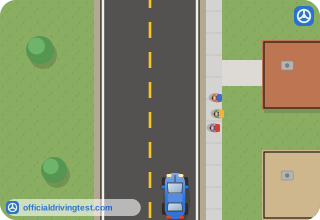
- A school bus is in the area
- A school crossing guard is on duty
- The road is a school zone with a lower speed limit
- The schools in the area are closed
Show answer
Correct answer: A school bus is in the area
The manual says school children waiting along the roadway in the morning indicate a school bus is in the area.
Source: Hawaii Driver's Manual (2023), page 96 · Open this page in the manual (Manual page 96)
-
How does the manual say bicycles are legally considered?
- As pedestrians, with all of the rights of persons walking on the road
- As vehicles, but with no responsibilities under the traffic laws
- As vehicles, with the same rights and responsibilities as other vehicles
- As a separate class that may ignore traffic signals and signs
Show answer
Correct answer: As vehicles, with the same rights and responsibilities as other vehicles
Bicycles are legally considered vehicles and have all of the rights and responsibilities that other vehicles have.
Source: Hawaii Driver's Manual (2023), page 97 · Open this page in the manual (Manual page 97)
-
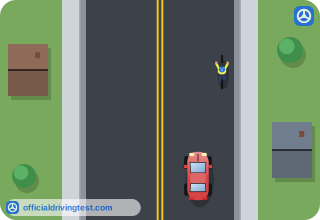
Why does the manual say motorists should be extra alert for bicyclists?
- Bicyclists are not permitted to use the roadway at all
- Bicyclists always ride faster than the traffic around them
- Bicyclists are exempt from obeying traffic signs and signals
- Bicyclists are often not as easy to see as other vehicles
Show answer
Correct answer: Bicyclists are often not as easy to see as other vehicles
Motorists should be extra alert because bicyclists are often not as easy to see as other vehicles.
Source: Hawaii Driver's Manual (2023), page 97 · Open this page in the manual (Manual page 97)
-
Which of these is a time when a bicyclist may legally move into the travel lane, according to the motorists' section?
- When riding in a group of bicyclists
- When preparing to make a left turn
- When riding downhill on a steep road
- When riding in the early evening hours
Show answer
Correct answer: When preparing to make a left turn
Bicyclists may move into the lane when preparing to make a left turn, passing another bicycle or avoiding an obstacle in the edge of the road.
Source: Hawaii Driver's Manual (2023), page 97 · Open this page in the manual (Manual page 97)
-
On what kind of road may bicyclists legally ride on the left-hand edge?
- A road with no bike lane
- A road with a speed limit under 25 MPH
- A one-way road
- A two-way road with a wide shoulder
Show answer
Correct answer: A one-way road
Bicyclists may legally ride on the left-hand edge of a one-way road.
Source: Hawaii Driver's Manual (2023), page 97 · Open this page in the manual (Manual page 97)
-
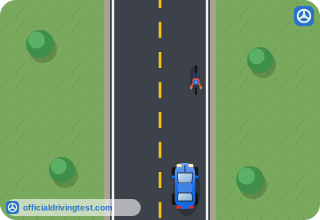
What does the manual say about bicyclists riding against traffic?
- It is illegal
- It is legal on short trips
- It is legal on roads with no sidewalk
- It is legal in a bike lane
Show answer
Correct answer: It is illegal
The manual states that it is illegal to ride against traffic, which is why drivers should look out for it, especially when turning.
Source: Hawaii Driver's Manual (2023), page 97 · Open this page in the manual (Manual page 97)
-
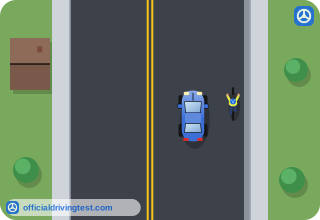
How much space should motorists maintain between the bicyclist and their vehicle until they have safely passed?
- At least 3 feet
- At least 1 foot
- At least 2 feet
- At least 4 feet
Show answer
Correct answer: At least 3 feet
Motorists should maintain at least 3 feet of space between the bicyclist and their vehicle until they have safely passed.
Source: Hawaii Driver's Manual (2023), page 97 · Open this page in the manual (Manual page 97)
-
According to the manual, what causes a significant number of crashes when a motorist passes a bicyclist?
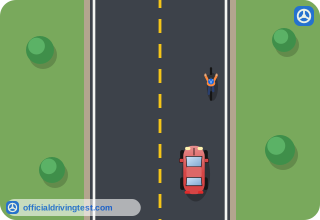
- Passing the bicyclist on the left side at a very high speed
- Sounding the horn while passing and startling the bicyclist into swerving
- Slowing and turning right immediately after passing, leaving too little space
- Staying behind the bicyclist for too long before passing them
Show answer
Correct answer: Slowing and turning right immediately after passing, leaving too little space
A significant number of crashes occur when a motorist passes a bicyclist and immediately slows down and turns right without leaving enough space.
Source: Hawaii Driver's Manual (2023), page 97 · Open this page in the manual (Manual page 97)
-
If you plan to make an immediate right turn and a bicyclist is ahead of you, what does the manual say is better?
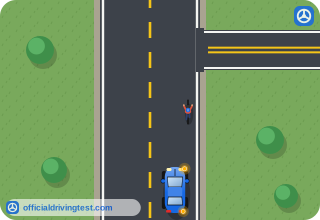
- To pass the bicyclist quickly before turning
- Not to pass the bicyclist
- To sound your horn and turn ahead of the bicyclist
- To drive in the bike lane until you turn
Show answer
Correct answer: Not to pass the bicyclist
The manual says that if you plan to make an immediate right turn, it is better not to pass the bicyclist.
Source: Hawaii Driver's Manual (2023), page 97 · Open this page in the manual (Manual page 97)
-
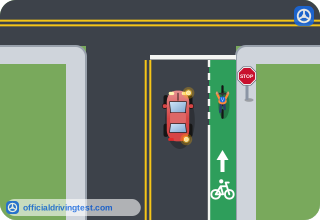
What should a driver do when crossing a bike lane while making a right turn at an intersection?
- Speed up to turn ahead of the bicyclists
- Sound the horn and then turn
- Move into the bike lane well before the intersection
- Look for and yield to bicyclists
Show answer
Correct answer: Look for and yield to bicyclists
The manual says to remain clear of bike lanes and to look for and yield to bicyclists when crossing them.
Source: Hawaii Driver's Manual (2023), page 97 · Open this page in the manual (Manual page 97)
-
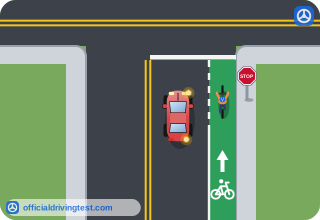
When should a driver look for overtaking bicyclists when making a right turn?
- Only when a bike lane is marked on the road ahead
- Only when a bicyclist is visible near your vehicle
- Every time, even when no bicyclist seems to be around
- Only when it is dark or when visibility is poor
Show answer
Correct answer: Every time, even when no bicyclist seems to be around
The manual says to train yourself to look for overtaking bicyclists every time you make a right turn, even when you think there is no bicyclist around.
Source: Hawaii Driver's Manual (2023), page 97 · Open this page in the manual (Manual page 97)
-
What does the manual say about opening a car door into moving traffic, including bicyclists?
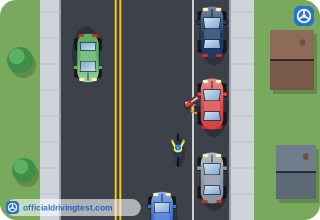
- It is a violation to open it unexpectedly and create a hazard
- It is allowed if the driver signals before opening it
- It is allowed if no vehicle is within 3 feet of the door
- It is a violation only when a bicyclist is actually hit
Show answer
Correct answer: It is a violation to open it unexpectedly and create a hazard
Opening a car door unexpectedly so as to create a hazard for moving traffic, including bicyclists, is a traffic violation.
Source: Hawaii Driver's Manual (2023), page 97 · Open this page in the manual (Manual page 97)
-
What does the manual say about bicyclists and traffic signs, signals and other traffic regulations?
- They are required to obey only the signals
- They are exempt when no vehicles are nearby
- They must obey them only on roads with bike lanes
- Like motorists, they are required to obey all of them
Show answer
Correct answer: Like motorists, they are required to obey all of them
Like motorists, bicyclists are required to obey all traffic signs, signals and other traffic regulations.
Source: Hawaii Driver's Manual (2023), page 97 · Open this page in the manual (Manual page 97)
-
When making a right turn, what do both motorists and bicyclists often forget to check, because they are searching for traffic coming from the left?
- Vehicles stopped directly behind them
- Pedestrians coming from their right
- Signs posted along the left side
- Bicyclists riding on the sidewalk
Show answer
Correct answer: Pedestrians coming from their right
Both are often so preoccupied with traffic from the left that they forget to check for pedestrians coming from their right.
Source: Hawaii Driver's Manual (2023), page 97 · Open this page in the manual (Manual page 97)
-
Under which condition may a bicyclist move into the travelway, according to the bicyclists' rules?
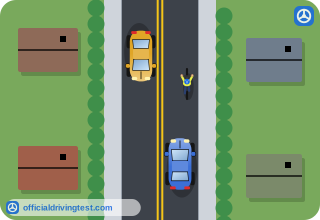
- When the bicyclist is carrying a passenger on the bicycle
- When the lane is too narrow for a bicycle and a car to safely share
- When there are no vehicles following behind the bicyclist
- When the bicyclist is riding downhill on a long steep road
Show answer
Correct answer: When the lane is too narrow for a bicycle and a car to safely share
Bicyclists may move into the travelway when making a left turn, avoiding hazards, moving the same speed as traffic or if the lane is too narrow to share safely.
Source: Hawaii Driver's Manual (2023), page 98 · Open this page in the manual (Manual page 98)
-
How must bicyclists ride on the roadway?
- Two abreast at all times
- Two abreast when no vehicle is behind them
- Three abreast if the road is wide
- Single file
Show answer
Correct answer: Single file
On the roadway, bicyclists must ride single file.
Source: Hawaii Driver's Manual (2023), page 98 · Open this page in the manual (Manual page 98)