Hawaii: Sharing the road — Part 5 Practice Test
Questions in this part include: “Where may bicyclists ride two abreast, if it is wide enough not to impede traffic?” · “What does the manual advise about wearing a bicycle helmet?”
Independent educational site · not affiliated with any government agency or DMV
Ready? Test yourself
- Instant feedback with an explanation
- Every answer cites its source in the manual
- Your best score is saved on this device
Questions are original and based on the official manual "Hawaii Driver's Manual" (2023), Hawaii Department of Transportation.
All 17 questions in this practice test
Take the test above first, then use this list to study. Tap “Show answer” to see the correct answer and explanation.
Show the questions and answersHide the questions
-
Where may bicyclists ride two abreast, if it is wide enough not to impede traffic?
- On a bicycle lane or path
- On any roadway with a shoulder
- On a sidewalk in a business district
- On a one-way road
Show answer
Correct answer: On a bicycle lane or path
Bicyclists may ride two abreast on a bicycle lane or path if it is wide enough not to impede traffic.
Source: Hawaii Driver's Manual (2023), page 98 · Open this page in the manual (Manual page 98)
-
What penalties apply to bicyclists caught violating traffic laws?
- Lighter penalties than drivers
- No penalties, only warnings
- The same penalties as drivers
- Penalties only if a crash occurs
Show answer
Correct answer: The same penalties as drivers
Bicyclists caught violating traffic laws are subject to the same penalties as drivers.
Source: Hawaii Driver's Manual (2023), page 98 · Open this page in the manual (Manual page 98)
-
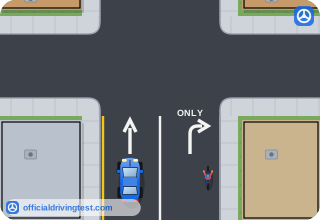
A bicyclist who is going straight through should do what with a right-turn-only lane?
- Stay in it and signal
- Use it to pass vehicles on the right
- Ride in it only at night
- Move out of it
Show answer
Correct answer: Move out of it
The manual says to follow lane markings and to move out of a right-turn-only lane if you are going straight through.
Source: Hawaii Driver's Manual (2023), page 98 · Open this page in the manual (Manual page 98)
-
What must a bicycle have if it is ridden at night?
- A rear light and pedal reflectors
- A headlight and a rear reflector
- A headlight and a horn
- A rear reflector and a bell
Show answer
Correct answer: A headlight and a rear reflector
A bicyclist riding at night must have a headlight and rear reflector; a rear light and pedal reflectors are only recommended.
Source: Hawaii Driver's Manual (2023), page 98 · Open this page in the manual (Manual page 98)
-
When may a bicyclist carry passengers?
- Whenever the passenger sits behind the rider
- Whenever the passenger wears a helmet
- Only when the bicycle is equipped to do so
- Only on roads with a bike lane
Show answer
Correct answer: Only when the bicycle is equipped to do so
The manual says not to carry passengers unless the bicycle is equipped to do so.
Source: Hawaii Driver's Manual (2023), page 98 · Open this page in the manual (Manual page 98)
-
Where are bicycles not allowed to ride on the sidewalk?
- In business districts
- In residential areas
- Near schools
- Along parks
Show answer
Correct answer: In business districts
Bicycles are not allowed to ride on the sidewalk in business districts; in other areas they may if they stay at 10 MPH or less and yield to pedestrians.
Source: Hawaii Driver's Manual (2023), page 98 · Open this page in the manual (Manual page 98)
-
Where sidewalk riding is permitted, what is the maximum speed for a bicyclist?
- 10 MPH
- 5 MPH
- 15 MPH
- 20 MPH
Show answer
Correct answer: 10 MPH
In areas where sidewalk riding is allowed, bicyclists must stay at 10 MPH or less.
Source: Hawaii Driver's Manual (2023), page 98 · Open this page in the manual (Manual page 98)
-
What does the manual advise about wearing a bicycle helmet?
- Wear one only when you are riding fast or a long way from home
- Wear one every time you ride, even if the law does not require it
- Wear one only when you are riding at night or in the rain
- Wear one only in places where the law requires it of you
Show answer
Correct answer: Wear one every time you ride, even if the law does not require it
The manual says to wear a bicycle helmet every time you ride; although it may not be required by law, it is a good idea.
Source: Hawaii Driver's Manual (2023), page 98 · Open this page in the manual (Manual page 98)
-
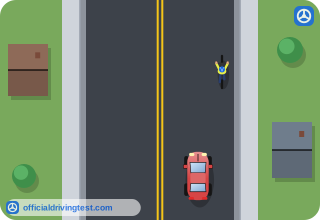
What does the manual mean when it tells bicyclists to be predictable?
- Ride only at the same time and place every day so drivers expect you
- Ride in the center of the travel lane at all times, on every road
- Always ride closely behind another bicyclist to be more visible
- Do nothing that would surprise drivers, such as swerving in and out of traffic
Show answer
Correct answer: Do nothing that would surprise drivers, such as swerving in and out of traffic
Bicyclists should not do anything that would surprise drivers, such as swerving in and out of parked cars or traffic.
Source: Hawaii Driver's Manual (2023), page 98 · Open this page in the manual (Manual page 98)
-
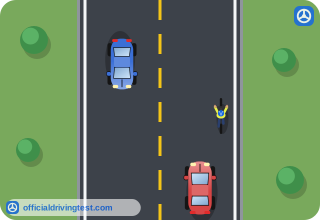
Before making a left turn or moving into the travelway, what should a bicyclist do?
- Speed up to cross ahead of traffic
- Ride onto the sidewalk first
- Look behind to make sure it is clear
- Watch only the vehicles ahead
Show answer
Correct answer: Look behind to make sure it is clear
Bicyclists should look behind them and make sure it is clear before making a left turn or moving into the travelway.
Source: Hawaii Driver's Manual (2023), page 98 · Open this page in the manual (Manual page 98)
-
How close to parked cars should a bicyclist ride, according to the manual?
- Leave at least 3 feet, in case a driver suddenly opens a door
- Leave at least 1 foot so that cars can still pass you
- Ride close enough to touch the parked cars on your right
- Leave at least 6 feet from parked cars at all times
Show answer
Correct answer: Leave at least 3 feet, in case a driver suddenly opens a door
Bicyclists should leave at least 3 feet from parked cars so they won't be hit if a driver suddenly opens the door.
Source: Hawaii Driver's Manual (2023), page 98 · Open this page in the manual (Manual page 98)
-
Why does the manual tell bicyclists not to wear headphones?
- Headphones are illegal for all bicyclists on public roads
- Headphones can slip off and tangle in the wheels or chain
- Headphones make bicycle helmets fit poorly on the head
- They need to hear the traffic around them and stay alert
Show answer
Correct answer: They need to hear the traffic around them and stay alert
Bicyclists need to hear the traffic around them and be alert to what is going on.
Source: Hawaii Driver's Manual (2023), page 98 · Open this page in the manual (Manual page 98)
-
Before riding, what should a bicyclist make sure about the seat and handlebars?
- That they are loose enough to adjust while riding
- That they are tight
- That they are set as high as possible
- That they are covered with padding
Show answer
Correct answer: That they are tight
The manual says to make sure the brakes work, the seat and handlebars are tight and the tires are properly inflated.
Source: Hawaii Driver's Manual (2023), page 98 · Open this page in the manual (Manual page 98)
-
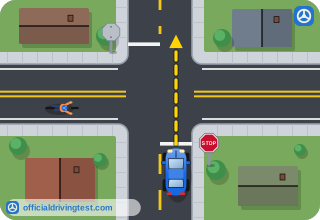
What should a bicyclist not assume about drivers, even after making eye contact?
- That the drivers will use turn signals
- That the drivers see the bicyclist
- That the drivers are driving slowly
- That the drivers know the traffic laws
Show answer
Correct answer: That the drivers see the bicyclist
The manual says not to assume that drivers see you, even if you make eye contact, and to elicit a response from the driver.
Source: Hawaii Driver's Manual (2023), page 98 · Open this page in the manual (Manual page 98)
-
What color of clothes does the manual say a bicyclist should wear to be visible?
- Dark-colored clothes
- Gray clothes
- Clothes of any color
- Bright-colored clothes
Show answer
Correct answer: Bright-colored clothes
To be visible, bicyclists should wear bright-colored clothes when they ride.
Source: Hawaii Driver's Manual (2023), page 98 · Open this page in the manual (Manual page 98)
-
Besides turning like a motor vehicle, how else may a bicyclist choose to turn left, according to the manual?
- Ride to the crosswalk, walk the bicycle across and continue riding
- Ride across the intersection on the sidewalk without slowing down
- Turn from the right edge of the road without signaling
- Wait in the right lane until traffic clears and turn from there
Show answer
Correct answer: Ride to the crosswalk, walk the bicycle across and continue riding
Others may cross like a pedestrian: ride to the crosswalk, walk their bicycle across the intersection, then continue riding.
Source: Hawaii Driver's Manual (2023), page 98 · Open this page in the manual (Manual page 98)
-
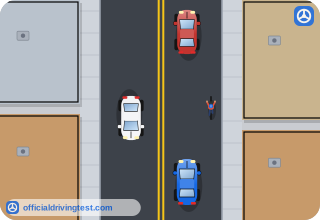
What does the manual say about passing vehicles on the right when riding a bicycle?
- Do it only when the vehicles are stopped at a red light
- Do it only on one-way roads
- Don't do it, because drivers may not expect or see you
- Do it when the lane is wide enough
Show answer
Correct answer: Don't do it, because drivers may not expect or see you
Bicyclists should not pass vehicles on the right because drivers may not expect or see them; when stopped in traffic it is safer to take your place in line.
Source: Hawaii Driver's Manual (2023), page 98 · Open this page in the manual (Manual page 98)