Hawaii: Sharing the road — Part 1 Practice Test
Questions in this part include: “In the definitions, a bicycle is a human-powered device with two or three wheels of what minimum diameter?” · “How does the manual say you should respond to competition from an arrogant driver?”
Independent educational site · not affiliated with any government agency or DMV
Ready? Test yourself
- Instant feedback with an explanation
- Every answer cites its source in the manual
- Your best score is saved on this device
Questions are original and based on the official manual "Hawaii Driver's Manual" (2023), Hawaii Department of Transportation.
All 18 questions in this practice test
Take the test above first, then use this list to study. Tap “Show answer” to see the correct answer and explanation.
Show the questions and answersHide the questions
-
In the definitions, a bicycle is a human-powered device with two or three wheels of what minimum diameter?
- 16 inches
- 12 inches
- 20 inches
- 24 inches
Show answer
Correct answer: 16 inches
A bicycle is defined as a device with two or three wheels having a diameter of 16 inches or greater propelled by human power.
Source: Hawaii Driver's Manual (2023), page 8 · Open this page in the manual (Manual page 8)
-
According to the definitions, a bus is a motor vehicle designed for carrying more than how many passengers and used for the transportation of persons?
- 6 passengers
- 12 passengers
- 20 passengers
- 10 passengers
Show answer
Correct answer: 10 passengers
A bus is defined as every motor vehicle designed for carrying more than ten passengers and used for the transportation of persons.
Source: Hawaii Driver's Manual (2023), page 8 · Open this page in the manual (Manual page 8)
-
A highly reflective triangular emblem on the rear of a vehicle is required to be how many inches (cm) in size?
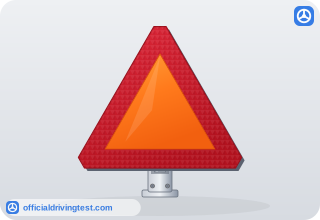
- 12 inches (30cm)
- 18 inches (46cm)
- 24 inches (61cm)
- 36 inches (91cm)
Show answer
Correct answer: 18 inches (46cm)
The slow moving vehicle emblem is a highly reflective 18 inch (46cm) triangular emblem.
Source: Hawaii Driver's Manual (2023), page 30 · Open this page in the manual (Manual page 30)
-
The slow moving vehicle emblem must be displayed on the rear of vehicles designed to operate at what speed?
- 15 mph (24 km/h) or less
- 35 mph (56 km/h) or less
- 45 mph (72 km/h) or less
- 25 mph (40 km/h) or less
Show answer
Correct answer: 25 mph (40 km/h) or less
The emblem is required on the rear of vehicles designed to operate at speeds of 25 mph (40 km/h) or less.
Source: Hawaii Driver's Manual (2023), page 30 · Open this page in the manual (Manual page 30)
-
What should you do when you see a highly reflective triangular emblem on the rear of the vehicle ahead?
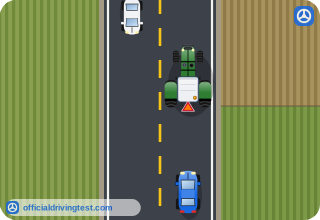
- Reduce speed and approach cautiously
- Pass as quickly as possible
- Follow closely and flash your headlights
- Move to the left lane at once
Show answer
Correct answer: Reduce speed and approach cautiously
When you see the slow moving vehicle emblem, reduce speed and approach cautiously.
Source: Hawaii Driver's Manual (2023), page 30 · Open this page in the manual (Manual page 30)
-
How does the manual say you should respond to competition from an arrogant driver?
- Never get involved in competition with him
- Race him briefly to show you are not afraid
- Speed up so that he cannot pass you
- Follow him closely until he leaves the road
Show answer
Correct answer: Never get involved in competition with him
The manual says never allow yourself to become involved in competition with an arrogant driver, or become one, because there is nothing to gain and too much to lose.
Source: Hawaii Driver's Manual (2023), page 58 · Open this page in the manual (Manual page 58)
-
Compared with the impatient driver, who is simply in a hurry, how is the arrogant driver described?
- He drives too slowly because he is unsure
- He is careless but not in a hurry
- He is easily distracted by passengers
- He is purposely in a hurry
Show answer
Correct answer: He is purposely in a hurry
The manual describes the arrogant driver as purposely in a hurry, competing with his vehicle.
Source: Hawaii Driver's Manual (2023), page 58 · Open this page in the manual (Manual page 58)
-
Why must you use care when passing cars parked by the roadside?
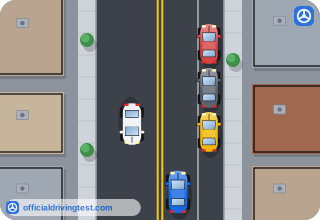
- They are always about to move into your traffic lane
- They hide other traffic, and a door may open into your path
- They cannot be seen clearly by drivers at night
- They make the traffic lane wider than it normally is
Show answer
Correct answer: They hide other traffic, and a door may open into your path
Parked cars obstruct your view of possible conflicts, and a parked car may suddenly move into your lane or a door may be opened into your path.
Source: Hawaii Driver's Manual (2023), page 69 · Open this page in the manual (Manual page 69)
-
Which is a clue that a parked car may move into your lane?
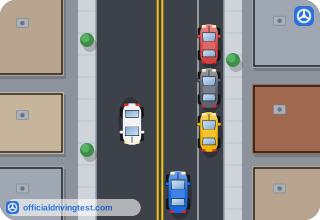
- Its back-up lamps are illuminated
- Its windows are fully closed
- Its hazard sign is missing
- Its engine is cool to the touch
Show answer
Correct answer: Its back-up lamps are illuminated
Illuminated stop lamps, back-up lamps or signal lamps are one of the clues that a parked car may move.
Source: Hawaii Driver's Manual (2023), page 69 · Open this page in the manual (Manual page 69)
-
What should you assume when you approach a vehicle that has just stopped in a parked position?
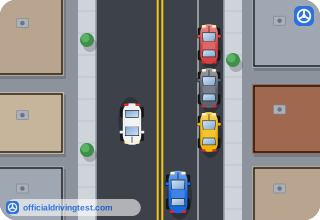
- That the driver will stay inside
- That the vehicle will not move again
- That the driver will open the door as you approach
- That the driver will signal before exiting
Show answer
Correct answer: That the driver will open the door as you approach
When you approach a vehicle that has just stopped in a parked position, you should assume that the driver will open the door as you approach.
Source: Hawaii Driver's Manual (2023), page 69 · Open this page in the manual (Manual page 69)
-
Compared with small vehicles, what are larger vehicles?
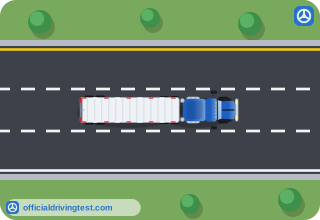
- Harder to see but easier for the driver to operate
- Easier to see but more difficult for the driver to operate
- Less protective of occupants and more agile
- More agile and easier to operate
Show answer
Correct answer: Easier to see but more difficult for the driver to operate
Larger vehicles afford more protection and are easier to see but are more difficult for the driver to operate.
Source: Hawaii Driver's Manual (2023), page 74 · Open this page in the manual (Manual page 74)
-
How much of its traffic lane is a motorcyclist entitled to?
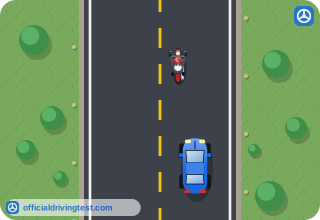
- The left half
- The right half
- The entire width
- Only the center of the lane
Show answer
Correct answer: The entire width
The manual says a motorcyclist is entitled to the entire width of his traffic lane.
Source: Hawaii Driver's Manual (2023), page 75 · Open this page in the manual (Manual page 75)
-
When should you use extra caution to look for motorcyclists, bicyclists and pedestrians?
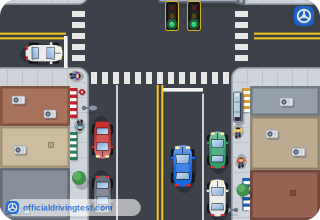
- When making turns or changing lanes
- Only when driving on a freeway
- Only when driving at night
- Only when parking
Show answer
Correct answer: When making turns or changing lanes
The manual says to give them plenty of room and use extra caution to look for them when making turns or changing lanes.
Source: Hawaii Driver's Manual (2023), page 75 · Open this page in the manual (Manual page 75)
-
Why do larger vehicles generally give their drivers better forward visibility than other vehicles?
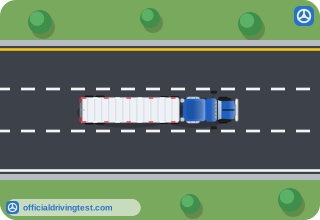
- Their windshields are always larger than car windshields
- Their hoods are shorter than the hoods of cars
- The driver’s position is above most other vehicles
- They are fitted with extra headlights on the roof
Show answer
Correct answer: The driver’s position is above most other vehicles
The manual says the driver’s position is above most other vehicles, which gives better forward visibility.
Source: Hawaii Driver's Manual (2023), page 85 · Open this page in the manual (Manual page 85)
-
How can the driver of a large vehicle see other traffic to the sides and rear?
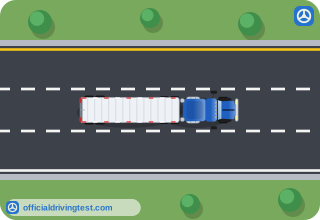
- By looking through large side and rear windows
- Only by the use of mirrors
- By turning around in the seat to look behind
- Through a camera mounted on the rear bumper
Show answer
Correct answer: Only by the use of mirrors
Visibility to the sides and rear is severely limited, so other traffic can only be seen by the use of mirrors.
Source: Hawaii Driver's Manual (2023), page 85 · Open this page in the manual (Manual page 85)
-
What is true of the area to the immediate rear of a large vehicle?
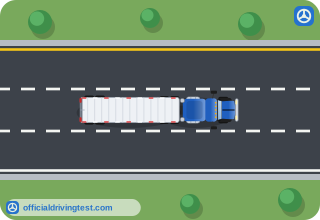
- It is fully visible in the driver’s mirrors
- It is visible only when the vehicle is backing
- It is visible only when headlights are on
- It is not visible to the driver
Show answer
Correct answer: It is not visible to the driver
The manual states that the area to the immediate rear of the vehicle is not visible to the driver.
Source: Hawaii Driver's Manual (2023), page 85 · Open this page in the manual (Manual page 85)
-
When must drivers of large vehicles allow for the greater width and length of their vehicles?
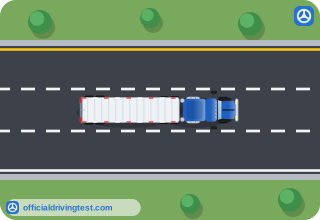
- When turning, changing lanes or backing
- Only when carrying hazardous materials
- Only when travelling above the speed limit
- Only when towing a trailer
Show answer
Correct answer: When turning, changing lanes or backing
Drivers of large vehicles must make allowances for their greater width and length when turning, changing lanes or backing.
Source: Hawaii Driver's Manual (2023), page 85 · Open this page in the manual (Manual page 85)
-
Because they spend much more time driving, what should professional drivers of large vehicles be?
- The fastest and most aggressive drivers on the highways
- The only drivers allowed to use the left lane
- The most skilled, knowledgeable and experienced drivers
- Drivers who are exempt from some traffic laws
Show answer
Correct answer: The most skilled, knowledgeable and experienced drivers
The manual says they should be the most skilled, knowledgeable and experienced drivers on the highways.
Source: Hawaii Driver's Manual (2023), page 85 · Open this page in the manual (Manual page 85)