Hawaii: Pavement markings
Yellow and white lines, lane markings, two-way left turn lanes, crosswalks and the other markings in the Hawaii Driver's Manual. Split into 2 shorter tests so you're not stuck in one long quiz.
Independent educational site · not affiliated with any government agency or DMV
All 35 Pavement markings questions with answers
Choose a part above to take a practice test, or study every question and answer here.
Show the questions and answersHide the questions
-
What tells you the proper lane to drive in on a roadway marked with traffic lanes?
- Signs or pavement markings
- The lane position of the car ahead
- The speed of the surrounding traffic
- Your destination alone
Show answer
Correct answer: Signs or pavement markings
The manual says to drive in the proper lane as indicated by signs or pavement markings.
Source: Hawaii Driver's Manual (2023), page 26 · Open this page in the manual (Manual page 26)
-
You must not pass when there is what kind of line in your lane?
- A solid yellow line
- A broken yellow line
- A broken white line
- A white stop line
Show answer
Correct answer: A solid yellow line
Do not pass when there is a solid yellow line in your lane.
Source: Hawaii Driver's Manual (2023), page 31 · Open this page in the manual (Manual page 31)
-
What are pavement markings?
- Lines, words or figures marked with paint, reflectors or other markers
- Only painted lines that are applied along the road shoulder and curb
- Signs that are mounted on poles beside the road or over it
- Only reflectors that are placed in the center of the traffic lane
Show answer
Correct answer: Lines, words or figures marked with paint, reflectors or other markers
Pavement markings are lines, words or figures marked on the pavement with paint, reflectors or other markers.
Source: Hawaii Driver's Manual (2023), page 33 · Open this page in the manual (Manual page 33)
-
What is the purpose of yellow centerlines?
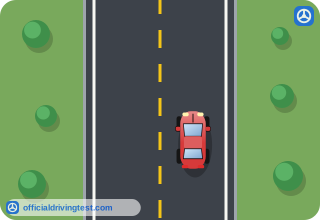
- To separate lanes of traffic moving in the same direction
- To mark the right edge of the roadway
- To show the exact place at which to stop
- To separate traffic moving in opposite directions
Show answer
Correct answer: To separate traffic moving in opposite directions
Yellow centerlines are used to separate traffic moving in opposite directions.
Source: Hawaii Driver's Manual (2023), page 33 · Open this page in the manual (Manual page 33)
-
A single broken yellow line marks the centerline of a road with only two lanes of traffic. When may you cross it?
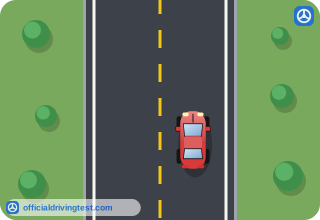
- Never, under any circumstances
- When it is safe, to pass another vehicle
- Only to make a left turn into a driveway
- Only when the road ahead is a divided highway
Show answer
Correct answer: When it is safe, to pass another vehicle
You may cross a single broken yellow line to pass another vehicle when it is safe.
Source: Hawaii Driver's Manual (2023), page 33 · Open this page in the manual (Manual page 33)
-
On which side of a single broken yellow centerline must you drive?
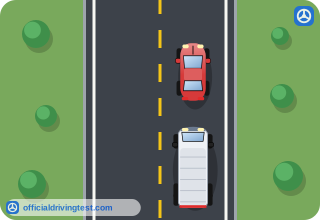
- To the right of it
- To the left of it
- On either side, as you choose
- Directly on top of it
Show answer
Correct answer: To the right of it
The manual says you must drive to the right of this centerline.
Source: Hawaii Driver's Manual (2023), page 33 · Open this page in the manual (Manual page 33)
-
What do double solid yellow lines in the center of the roadway mean?
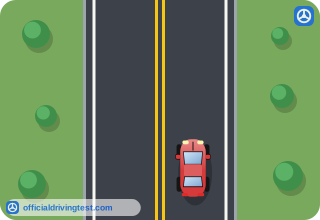
- Passing is allowed in one direction only
- Passing is allowed when it is safe
- Passing is prohibited in both directions
- The center lane is for left turns only
Show answer
Correct answer: Passing is prohibited in both directions
Double solid yellow lines mark the center of the roadway where passing is prohibited in both directions.
Source: Hawaii Driver's Manual (2023), page 33 · Open this page in the manual (Manual page 33)
-
You may cross double solid yellow lines only for which purpose?
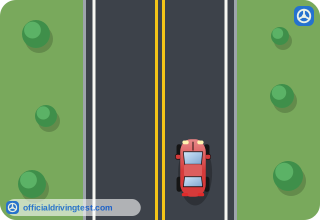
- To pass a slow vehicle when the road ahead is completely clear
- To make a left turn into or from an alley, private road or driveway
- To go around a vehicle that is stopped ahead in your own lane
- To make a U-turn on a street that has very little traffic
Show answer
Correct answer: To make a left turn into or from an alley, private road or driveway
You may cross double solid yellow lines ONLY to make a left turn into or from an alley, private road or driveway.
Source: Hawaii Driver's Manual (2023), page 33 · Open this page in the manual (Manual page 33)
-
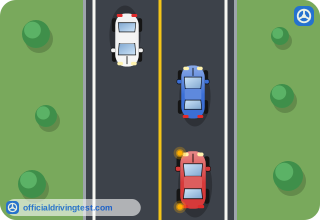
What does a single solid yellow line on a two-lane road indicate?
- A zone where passing is allowed when it is safe
- A lane that is reserved for buses only
- A lane that is used only for left turns
- A zone where passing is prohibited
Show answer
Correct answer: A zone where passing is prohibited
No passing lines are single solid yellow lines used on two-lane roads to indicate zones where passing is prohibited.
Source: Hawaii Driver's Manual (2023), page 33 · Open this page in the manual (Manual page 33)
-
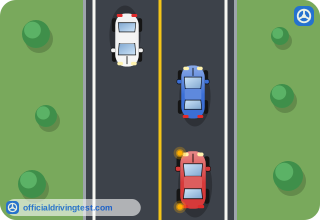
When may you cross a no passing line (a single solid yellow line)?
- Whenever the oncoming lane is clear of traffic for a long way ahead
- When you are driving slower than the posted speed limit of the road
- Only to make a left turn into or from an alley, private road or a driveway
- Whenever you need to pass a bicycle or another slow moving vehicle
Show answer
Correct answer: Only to make a left turn into or from an alley, private road or a driveway
You may cross a no passing line ONLY to make a left turn into or from an alley, private road or a driveway.
Source: Hawaii Driver's Manual (2023), page 33 · Open this page in the manual (Manual page 33)
-
What do white lines on the roadway separate?
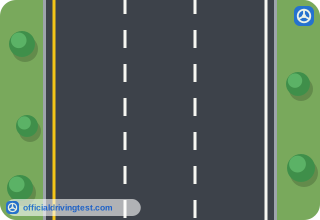
- Lanes of traffic moving in the same direction
- Lanes of traffic that move in opposite directions
- The edge of the roadway from the shoulder area
- Lanes in which passing is always prohibited
Show answer
Correct answer: Lanes of traffic moving in the same direction
White lines separate lanes of traffic moving in the same direction.
Source: Hawaii Driver's Manual (2023), page 34 · Open this page in the manual (Manual page 34)
-
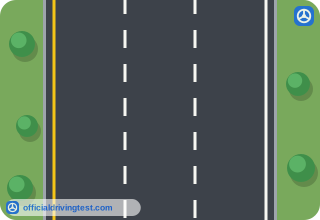
What are you required to do with respect to white lane lines?
- Drive on the lane lines to keep to the center
- Keep your left wheels on the lane line
- Straddle the lane line when passing
- Drive between the lane lines
Show answer
Correct answer: Drive between the lane lines
You are required to drive between white lane lines.
Source: Hawaii Driver's Manual (2023), page 34 · Open this page in the manual (Manual page 34)
-
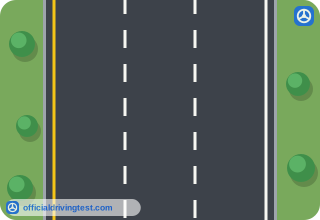
When may you cross a single dashed white lane line?
- Only in unusual circumstances
- When you can do so safely
- Never, because it is prohibited
- Only to make a left turn into a driveway
Show answer
Correct answer: When you can do so safely
Single dashed white lane lines may be crossed when you can do so safely.
Source: Hawaii Driver's Manual (2023), page 34 · Open this page in the manual (Manual page 34)
-
What does a single solid white line indicate?
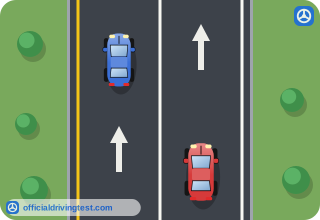
- Movement from lane to lane is hazardous
- Movement from lane to lane is prohibited at all times
- You may change lanes whenever you wish
- The lane is reserved for turning vehicles only
Show answer
Correct answer: Movement from lane to lane is hazardous
Single solid white lines indicate that movement from lane to lane is hazardous.
Source: Hawaii Driver's Manual (2023), page 34 · Open this page in the manual (Manual page 34)
-
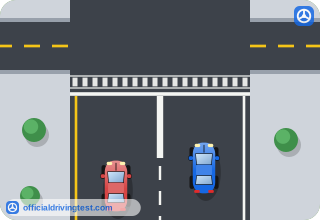
What does the width of a solid white line tell you?
- The wider the line, the higher the speed limit
- The wider the line, the more lanes are ahead
- The wider the line, the greater the hazard
- The wider the line, the less the hazard
Show answer
Correct answer: The wider the line, the greater the hazard
Single solid white lines indicate that lane changes are hazardous, and the wider the line, the greater the hazard.
Source: Hawaii Driver's Manual (2023), page 34 · Open this page in the manual (Manual page 34)
-
When may you cross a single solid white line?
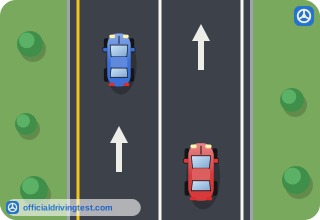
- Whenever there is no traffic in the next lane
- Only in unusual circumstances and then only with great care
- Whenever you signal at least 100 feet before the line
- Only to make a left turn into an alley
Show answer
Correct answer: Only in unusual circumstances and then only with great care
You may cross a solid white line ONLY IN UNUSUAL CIRCUMSTANCES AND THEN ONLY WITH GREAT CARE.
Source: Hawaii Driver's Manual (2023), page 34 · Open this page in the manual (Manual page 34)
-
What do double solid white lines indicate?
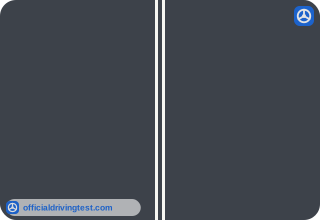
- Movement from lane to lane is hazardous but allowed
- Lane changes are allowed when it is safe
- The roadway ahead must not be entered
- Movement from lane to lane is prohibited
Show answer
Correct answer: Movement from lane to lane is prohibited
Double solid white lines indicate that movement from lane to lane is prohibited, and you must not cross them.
Source: Hawaii Driver's Manual (2023), page 35 · Open this page in the manual (Manual page 35)
-
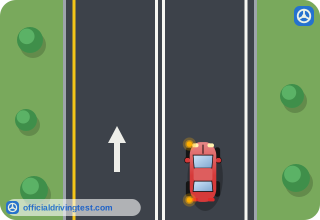
What is the rule for crossing a double solid white line?
- You may cross it only with great care
- You may cross it when you can do so safely
- You must not cross it
- You may cross it only to make a left turn
Show answer
Correct answer: You must not cross it
You MUST NOT cross a double solid white line.
Source: Hawaii Driver's Manual (2023), page 35 · Open this page in the manual (Manual page 35)
-
What do red pavement markings or reflectors indicate?
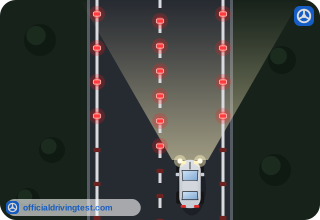
- A roadway that must not be entered or used
- A lane reserved for left turns only
- The exact place at which to stop
- A zone where passing is prohibited
Show answer
Correct answer: A roadway that must not be entered or used
Red pavement markings or reflectors indicate a roadway that must not be entered or used.
Source: Hawaii Driver's Manual (2023), page 35 · Open this page in the manual (Manual page 35)
-
What are edgelines?
- Broken white lines that separate lanes moving in the same direction
- Solid white lines painted across the lanes at intersections or crosswalks
- Double yellow lines that mark the center where passing is prohibited
- Solid white or yellow lines along the edge of the roadway as a safety guide
Show answer
Correct answer: Solid white or yellow lines along the edge of the roadway as a safety guide
Edgelines are solid white or yellow lines along the edge of the roadway to be used as a safety guide.
Source: Hawaii Driver's Manual (2023), page 35 · Open this page in the manual (Manual page 35)
-
On a divided street or highway, which color of edge line may be along the left edge of the roadway?
- White
- Yellow
- Red
- Blue
Show answer
Correct answer: Yellow
White edge lines are used along the right edge of the roadway, and yellow edge lines may be along the left edge on divided streets and highways.
Source: Hawaii Driver's Manual (2023), page 35 · Open this page in the manual (Manual page 35)
-
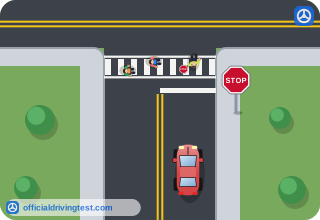
What do stop lines show?
- The exact place at which to stop
- The place where pedestrians must wait
- The start of a no passing zone
- The edge of the roadway
Show answer
Correct answer: The exact place at which to stop
Stop lines are solid white lines painted across the traffic lanes at intersections and pedestrian crosswalks to show the exact place at which to stop.
Source: Hawaii Driver's Manual (2023), page 36 · Open this page in the manual (Manual page 36)
-
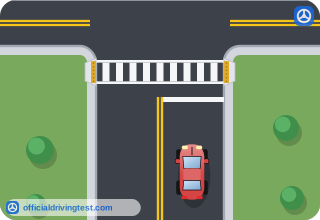
What do crosswalk lines show?
- Where vehicles must stop at a railroad crossing
- Where a lane is reserved for left turns
- Where pedestrians can safely cross the road or street
- Where vehicles may park next to the curb
Show answer
Correct answer: Where pedestrians can safely cross the road or street
Crosswalk lines show pedestrians where to safely cross the road or street.
Source: Hawaii Driver's Manual (2023), page 36 · Open this page in the manual (Manual page 36)
-
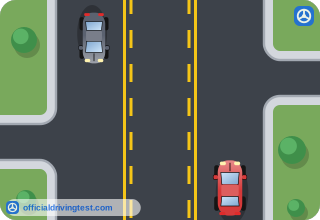
For what may a lane in the center of the roadway, marked by a combination of yellow solid and dashed lines, be used by vehicles traveling in either direction?
- Passing slower vehicles
- Stopping or parking
- Driving in one direction only
- Left turn maneuvers only
Show answer
Correct answer: Left turn maneuvers only
Two-way left turn channelization markings mark a center lane that may be used by vehicles traveling in either direction for left turn maneuvers only.
Source: Hawaii Driver's Manual (2023), page 36 · Open this page in the manual (Manual page 36)
-
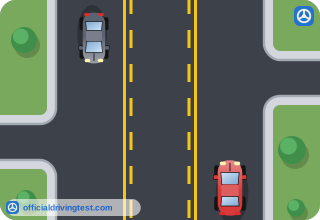
Which statement about a two-way left turn lane in the center of the roadway is correct?
- It may be used for passing when the road ahead is clear
- It may be used only by vehicles traveling in one direction
- It must never be used for passing
- It may be used for passing on the left only
Show answer
Correct answer: It must never be used for passing
The center lane marked by two-way left turn channelization markings must NEVER be used for passing.
Source: Hawaii Driver's Manual (2023), page 36 · Open this page in the manual (Manual page 36)
-
What are obstruction markings?
- Solid lines painted in the traffic lanes to guide you around obstructions
- Dashed white lines painted to show where a traffic lane ends ahead
- White arrows and words painted to show the direction you must go
- Red reflectors or markings that show a roadway must not be used
Show answer
Correct answer: Solid lines painted in the traffic lanes to guide you around obstructions
Obstruction markings are solid lines painted in the traffic lanes to guide you around obstructions, such as bridge supports.
Source: Hawaii Driver's Manual (2023), page 37 · Open this page in the manual (Manual page 37)
-
How must you pass yellow obstruction markings?
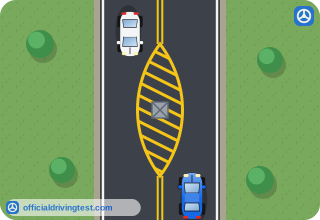
- Only to the left of them
- On either side of them
- You must not pass them
- Only to the right of them
Show answer
Correct answer: Only to the right of them
You must pass only to the right of yellow obstruction markings.
Source: Hawaii Driver's Manual (2023), page 37 · Open this page in the manual (Manual page 37)
-
How may you pass white obstruction markings?
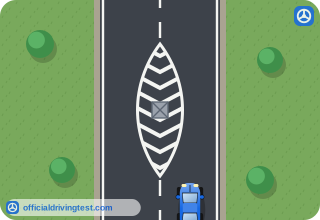
- Only to the right of them
- To either side of them
- Only to the left of them
- You must stop before passing them
Show answer
Correct answer: To either side of them
You may pass to either side of white obstruction markings.
Source: Hawaii Driver's Manual (2023), page 37 · Open this page in the manual (Manual page 37)
-
What do white arrows or words painted in a traffic lane indicate?
- The direction in which you must go
- A lane that is reserved for slow vehicles
- A lane in which passing is allowed
- The place where you must stop
Show answer
Correct answer: The direction in which you must go
Directional markings are white arrows or words painted in the traffic lane to indicate the direction in which you must go.
Source: Hawaii Driver's Manual (2023), page 37 · Open this page in the manual (Manual page 37)
-
What may you do when the arrows painted in your lane indicate more than one direction?
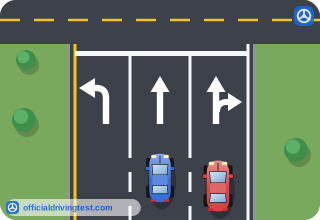
- Move only in the direction of the first arrow
- Move straight ahead only
- Choose any direction indicated
- Change lanes before the intersection
Show answer
Correct answer: Choose any direction indicated
Where arrows indicate more than one direction, you may choose any direction indicated.
Source: Hawaii Driver's Manual (2023), page 37 · Open this page in the manual (Manual page 37)
-
What marks the pavement in the traffic lane before a railroad crossing?
- A large “X” and a red stop line only
- A large “X” and two “R’s”
- Two “RR” letters and a green arrow
- A large circle and a yellow arrow
Show answer
Correct answer: A large “X” and two “R’s”
Railroad crossing markings are white markings painted in the traffic lane, and the pavement is marked with a large “X” and two “R’s”.
Source: Hawaii Driver's Manual (2023), page 38 · Open this page in the manual (Manual page 38)
-
What are traffic islands used for?
- To give you a place to park temporarily
- To let you pass slower traffic
- To direct you into separate traffic lanes
- To mark where a roadway ends
Show answer
Correct answer: To direct you into separate traffic lanes
Traffic islands are used to direct you into separate traffic lanes.
Source: Hawaii Driver's Manual (2023), page 38 · Open this page in the manual (Manual page 38)
-
When are traffic islands called “Safety Islands”?
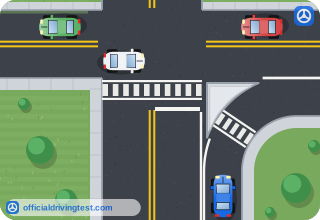
- When they are used to protect pedestrians who may have to stand in the roadway
- When they are made only of curbing and no paint is used on them at all
- When they are only painted markings on the roadway of a busy freeway
- When they are used only to separate traffic moving in opposite directions
Show answer
Correct answer: When they are used to protect pedestrians who may have to stand in the roadway
Traffic islands are called “Safety Islands” when they are used to protect pedestrians who may have to stand in the roadway.
Source: Hawaii Driver's Manual (2023), page 38 · Open this page in the manual (Manual page 38)
-
What should you never do with a traffic island?
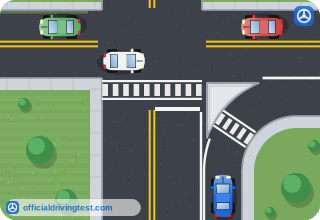
- Drive around it on the right
- Slow down when you approach it
- Look for pedestrians near it
- Drive into or across it
Show answer
Correct answer: Drive into or across it
You should never drive into or across a traffic island.
Source: Hawaii Driver's Manual (2023), page 38 · Open this page in the manual (Manual page 38)
-
What do red lane marking reflectors mean?
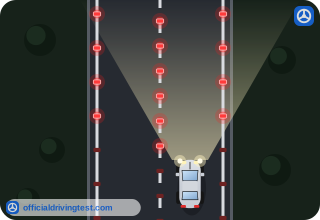
- You are going the wrong direction in the traffic lane
- The lane is reserved for passing slower vehicles
- An exit is ahead
- Road work is ahead
Show answer
Correct answer: You are going the wrong direction in the traffic lane
The manual says red lane marking reflectors mean you are going the wrong direction in the traffic lane.
Source: Hawaii Driver's Manual (2023), page 77 · Open this page in the manual (Manual page 77)