Colorado: Right-of-way and turning
Who goes first at intersections and four-way stops, mountain roads, roundabouts, left and right turns and U-turns. Split into 5 shorter tests so you're not stuck in one long quiz.
Independent educational site · not affiliated with any government agency or DMV
Choose a part
Right-of-way and turning — Part 1
Questions in this part include: “On the drive test, from which part of your lane should you make a right turn?”
StartRight-of-way and turning — Part 2
Questions in this part include: “What does the Colorado Driver Handbook say the law does about the right-of-way?”
StartRight-of-way and turning — Part 3
Questions in this part include: “What does the handbook say about accelerating out of a turn?”
StartRight-of-way and turning — Part 4
Questions in this part include: “In a reverse two-point turnabout, how do you steer while backing slowly into the driveway?”
StartRight-of-way and turning — Part 5
Questions in this part include: “To be safe, how many vehicles should you pass at one time?”
StartAll 84 Right-of-way and turning questions with answers
Choose a part above to take a practice test, or study every question and answer here.
Show the questions and answersHide the questions
-
On the drive test, from which part of your lane should you make a right turn?
- From the center of your lane
- From the leftmost portion of your lane
- From the rightmost portion of your lane
- From the middle lane of the road
Show answer
Correct answer: From the rightmost portion of your lane
When turning right, always turn from the rightmost portion of your lane.
Source: Colorado Driver Handbook (DR 2337, January 2025), page 1 · Open this page in the manual (Manual page 1)
-
On the drive test, from which part of your lane should you make a left turn?
- From the center of your lane
- From the left-most portion of your lane
- From the rightmost portion of your lane
- From the lane nearest the curb
Show answer
Correct answer: From the left-most portion of your lane
When turning left, always turn from the left-most portion of your lane.
Source: Colorado Driver Handbook (DR 2337, January 2025), page 2 · Open this page in the manual (Manual page 2)
-
After completing a turn on the drive test, where should your vehicle be?
- In the leftmost part of the lane
- In the rightmost part of the lane
- Straddling the lane line until traffic clears
- Centered in the appropriate lane
Show answer
Correct answer: Centered in the appropriate lane
After completing the turn you must make sure the vehicle is centered in the appropriate lane.
Source: Colorado Driver Handbook (DR 2337, January 2025), page 2 · Open this page in the manual (Manual page 2)
-
What should you avoid driving over when you start or finish a turn on the drive test?
- Lane markings and curbs
- Crosswalk lines only
- Painted arrows only
- Manhole covers
Show answer
Correct answer: Lane markings and curbs
Start and finish the turn in the proper lane without driving over lane markings or curbs.
Source: Colorado Driver Handbook (DR 2337, January 2025), page 2 · Open this page in the manual (Manual page 2)
-
What do the stopping requirements say about the vehicle's wheels while you are stopped?
- Turn them toward the direction of your upcoming turn
- Keep them pointed straight ahead until you begin the turn
- Turn them toward the curb while you wait for the light
- Turn them away from the traffic in the opposite lane
Show answer
Correct answer: Keep them pointed straight ahead until you begin the turn
While stopped, keep the wheels pointed straight ahead and do not turn them until you begin to make the turn.
Source: Colorado Driver Handbook (DR 2337, January 2025), page 2 · Open this page in the manual (Manual page 2)
-
On the drive test, when should you look behind you after a turn?
- After each turn
- Only after left turns
- Only after right turns
- Only after turns at signals
Show answer
Correct answer: After each turn
Searching includes looking behind after each turn.
Source: Colorado Driver Handbook (DR 2337, January 2025), page 2 · Open this page in the manual (Manual page 2)
-
As a general rule, which part of the road must you drive on?
- The left half of the road
- The right half of the road
- The center of the road
- Whichever half has less traffic
Show answer
Correct answer: The right half of the road
As a general rule, you must drive your vehicle on the right half of the road.
Source: Colorado Driver Handbook (DR 2337, January 2025), page 9 · Open this page in the manual (Manual page 9)
-
How many lanes should you use when driving on a road with marked lanes?
- Two, if the lane next to you is empty
- Any number needed to pass slower vehicles
- Two, when driving on a multi-lane road
- Only one; do not straddle lanes
Show answer
Correct answer: Only one; do not straddle lanes
You should use only one lane and not straddle lanes.
Source: Colorado Driver Handbook (DR 2337, January 2025), page 9 · Open this page in the manual (Manual page 9)
-
On roads without marked lanes, where should you drive?
- Just to the right of the center of the road
- Just to the left of the center of the road
- In the exact center of the road
- On the shoulder of the road
Show answer
Correct answer: Just to the right of the center of the road
On roads without marked lanes you drive just to the right of the center of the road.
Source: Colorado Driver Handbook (DR 2337, January 2025), page 10 · Open this page in the manual (Manual page 10)
-
When there are no signs or pavement markings to control the use of lanes, what must you not do?
- Drive just to the right of the center
- Use your turn signal when turning
- Drive on the shoulder of the road
- Follow the passing rules for marked roads
Show answer
Correct answer: Drive on the shoulder of the road
On an unmarked road you drive just to the right of the center and do not drive on the shoulder.
Source: Colorado Driver Handbook (DR 2337, January 2025), page 10 · Open this page in the manual (Manual page 10)
-
Which rules for passing and turning apply on unmarked roads?
- Special rules that allow passing anywhere
- The same rules as on marked roads
- No rules, since nothing is marked
- Only the rules for parking lots
Show answer
Correct answer: The same rules as on marked roads
The same rules for passing and turning on marked roads apply with unmarked roads.
Source: Colorado Driver Handbook (DR 2337, January 2025), page 10 · Open this page in the manual (Manual page 10)
-
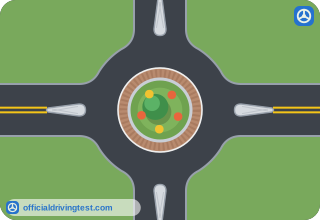
At a roundabout, which traffic yields the right-of-way?
- Traffic inside the roundabout yields to entering traffic
- The faster vehicle yields to the slower one
- Drivers entering from the left side yield
- Entering traffic yields to circulating traffic
Show answer
Correct answer: Entering traffic yields to circulating traffic
Entering traffic yields the right-of-way to circulating traffic.
Source: Colorado Driver Handbook (DR 2337, January 2025), page 10 · Open this page in the manual (Manual page 10)
-
Vehicles in a roundabout travel which way around the center island?
- To the right
- To the left
- Either direction, whichever is shorter
- Straight across the center island
Show answer
Correct answer: To the right
Vehicles travel to the right around a center island.
Source: Colorado Driver Handbook (DR 2337, January 2025), page 10 · Open this page in the manual (Manual page 10)
-
In a roundabout, Colorado law requires drivers to yield the right-of-way to the driver of which vehicles?
- Only emergency vehicles with lights and sirens on
- A passenger car with more than two occupants
- A truck, bus, emergency vehicle or recreational vehicle
- Only trucks carrying hazardous materials
Show answer
Correct answer: A truck, bus, emergency vehicle or recreational vehicle
Colorado law requires yielding to the driver of a truck, bus, emergency vehicle or recreational vehicle (large vehicle).
Source: Colorado Driver Handbook (DR 2337, January 2025), page 10 · Open this page in the manual (Manual page 10)
-
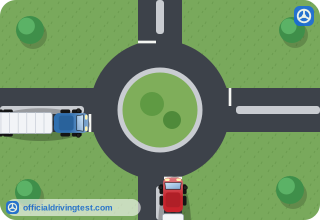
Two drivers of large vehicles enter a roundabout at the same time. Who must yield?
- The driver on the left yields to the driver on the right
- The driver on the right yields to the driver on the left
- The driver of the truck yields to the driver of the bus
- Both drivers must stop completely until one proceeds
Show answer
Correct answer: The driver on the right yields to the driver on the left
When two large vehicles enter at the same time, the driver on the right must yield the right-of-way to the driver on the left.
Source: Colorado Driver Handbook (DR 2337, January 2025), page 10 · Open this page in the manual (Manual page 10)
-
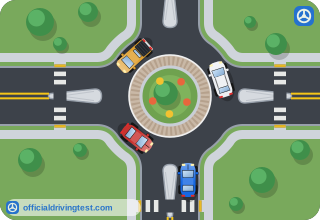
As you approach a roundabout and no large trucks are present, to whom must you yield?
- Approaching traffic on the right
- Traffic waiting behind you
- No one, if you arrived first
- Approaching traffic on the left
Show answer
Correct answer: Approaching traffic on the left
If no large trucks are present, you must yield to approaching traffic on the left.
Source: Colorado Driver Handbook (DR 2337, January 2025), page 10 · Open this page in the manual (Manual page 10)
-
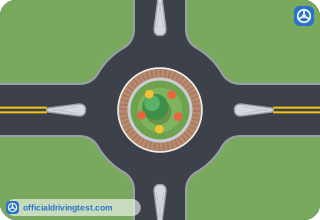
When entering a roundabout, you should not stop completely unless:
- Existing traffic prevents you from merging
- You are in the left lane of the roundabout
- Your turn signal is not working
- You plan to exit at the first exit
Show answer
Correct answer: Existing traffic prevents you from merging
Do not stop completely unless existing traffic prevents you from merging.
Source: Colorado Driver Handbook (DR 2337, January 2025), page 10 · Open this page in the manual (Manual page 10)
-
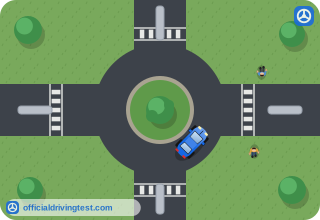
As you enter or leave a roundabout, you must yield to:
- Only vehicles already in the roundabout, not people in crosswalks
- Pedestrians and bicyclists in any crosswalk, and traffic already inside
- Only pedestrians in marked crosswalks, but not bicyclists
- Only emergency vehicles, since other traffic yields to you
Show answer
Correct answer: Pedestrians and bicyclists in any crosswalk, and traffic already inside
You must yield to pedestrians or bicyclists in any crosswalk and to any traffic already inside the roundabout.
Source: Colorado Driver Handbook (DR 2337, January 2025), page 10 · Open this page in the manual (Manual page 10)
-
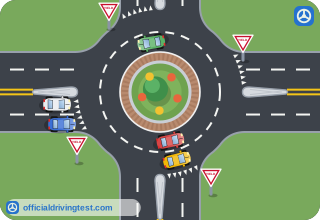
In a roundabout, when should you use your turn signals?
- Only when entering the roundabout
- Only when stopped before entering
- Never, because all traffic flows in the same direction
- When changing lanes and exiting the roundabout
Show answer
Correct answer: When changing lanes and exiting the roundabout
Use your turn signals when changing lanes and exiting the roundabout to alert traffic of your intentions.
Source: Colorado Driver Handbook (DR 2337, January 2025), page 10 · Open this page in the manual (Manual page 10)
-
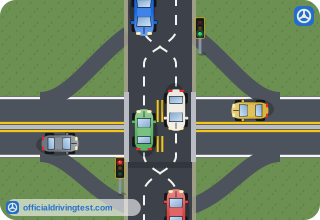
What does a diverging diamond interchange (DDI) give vehicles?
- A stop sign at the end of every ramp
- Roundabouts at the end of each freeway ramp
- Separate lanes that keep trucks off the ramps
- Uninterrupted movements onto the freeway ramps
Show answer
Correct answer: Uninterrupted movements onto the freeway ramps
A DDI crosses traffic to the opposite side of the road across the interchange so vehicles have uninterrupted movements onto the freeway ramps.
Source: Colorado Driver Handbook (DR 2337, January 2025), page 10 · Open this page in the manual (Manual page 10)
-
What does the Colorado Driver Handbook say the law does about the right-of-way?
- It states who must yield, but does not give anyone the right-of-way
- It gives the right-of-way to any driver who has a green traffic signal
- It gives the right-of-way to the vehicle that is traveling fastest
- It gives the right-of-way to the largest vehicle at an intersection
Show answer
Correct answer: It states who must yield, but does not give anyone the right-of-way
The law says who must yield; it never gives anyone the right-of-way, even with a green signal.
Source: Colorado Driver Handbook (DR 2337, January 2025), page 11 · Open this page in the manual (Manual page 11)
-
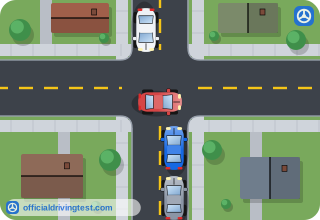
You are approaching an intersection. Whom must you yield the right-of-way to?
- Only drivers of larger vehicles already in the intersection
- Only pedestrians who are in a marked crosswalk
- Pedestrians, bicyclists and drivers already in the intersection
- Only vehicles that are traveling faster than you
Show answer
Correct answer: Pedestrians, bicyclists and drivers already in the intersection
The handbook says you must yield to pedestrians, bicyclists and other drivers already in an intersection you are approaching.
Source: Colorado Driver Handbook (DR 2337, January 2025), page 11 · Open this page in the manual (Manual page 11)
-
At a four-way stop, who must you yield the right-of-way to?
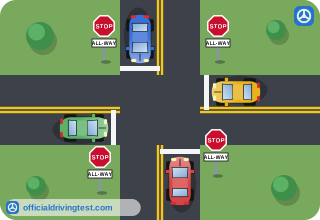
- The vehicle that is going straight ahead
- The vehicle that is turning right
- The vehicle that reached the intersection first
- The largest vehicle at the intersection
Show answer
Correct answer: The vehicle that reached the intersection first
At a four-way stop you yield to the vehicle that reached the intersection first.
Source: Colorado Driver Handbook (DR 2337, January 2025), page 11 · Open this page in the manual (Manual page 11)
-
At a four-way stop, two vehicles reach the intersection at the same time. Which one must yield?
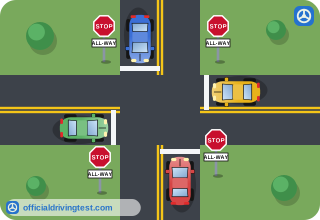
- The vehicle on the right must yield to the vehicle on the left
- The vehicle on the left must yield to the vehicle on the right
- The vehicle that is turning must yield to the vehicle going straight
- The vehicle that is slower must yield to the faster one
Show answer
Correct answer: The vehicle on the left must yield to the vehicle on the right
When more than one vehicle arrives at the same time, the vehicle on the left yields and lets the vehicle on the right go first.
Source: Colorado Driver Handbook (DR 2337, January 2025), page 11 · Open this page in the manual (Manual page 11)
-
Who is always responsible for avoiding a crash at a four-way stop, regardless of who has the right-of-way?
- Only the driver who arrived last
- Only the driver who must yield
- The driver on the right
- You are
Show answer
Correct answer: You are
The handbook says that regardless of who has the right-of-way, you are always responsible for avoiding a crash.
Source: Colorado Driver Handbook (DR 2337, January 2025), page 11 · Open this page in the manual (Manual page 11)
-
What is an uncontrolled intersection?
- An intersection without control devices such as stop signs or lights
- An intersection where the traffic lights are flashing yellow at night
- An intersection that has a stop sign on only one of the roads
- An intersection where more than four roads meet at one point
Show answer
Correct answer: An intersection without control devices such as stop signs or lights
The handbook defines it as an intersection without control devices such as stop signs or traffic lights.
Source: Colorado Driver Handbook (DR 2337, January 2025), page 11 · Open this page in the manual (Manual page 11)
-
Two vehicles reach an uncontrolled intersection at the same time. Which one goes first?
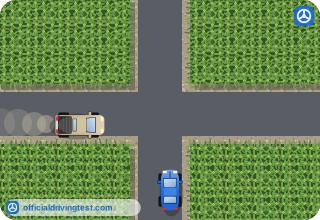
- The vehicle on the left
- The vehicle that is turning left
- The vehicle on the right
- The vehicle that is slower
Show answer
Correct answer: The vehicle on the right
The vehicle on the left must yield and allow the vehicle on the right to go first.
Source: Colorado Driver Handbook (DR 2337, January 2025), page 11 · Open this page in the manual (Manual page 11)
-
Before proceeding through a left turn, what should you always look for and yield to?
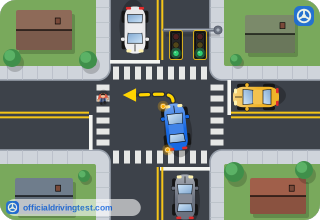
- Only pedestrians who are waiting on the curb
- Pedestrians in the crosswalk and smaller oncoming vehicles
- Only oncoming vehicles that are larger than yours
- Only vehicles that are behind you
Show answer
Correct answer: Pedestrians in the crosswalk and smaller oncoming vehicles
The handbook says to look for and yield to pedestrians in the crosswalk and smaller oncoming vehicles, and to judge their speed and distance.
Source: Colorado Driver Handbook (DR 2337, January 2025), page 11 · Open this page in the manual (Manual page 11)
-
When turning left, you must yield to all oncoming traffic unless you have which of these?
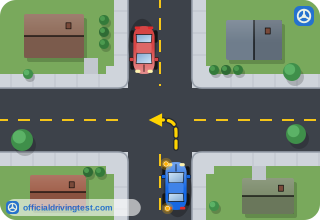
- A green light or a flashing yellow light
- A green arrow or your signal turned on for 3 seconds
- A turn signal on or a bike lane next to you
- A green arrow or you arrived first at a four-way stop
Show answer
Correct answer: A green arrow or you arrived first at a four-way stop
You must yield to all oncoming traffic, unless you have a green arrow or arrived first at a four-way stop.
Source: Colorado Driver Handbook (DR 2337, January 2025), page 11 · Open this page in the manual (Manual page 11)
-
When changing lanes or passing, whom must you yield the right-of-way to?
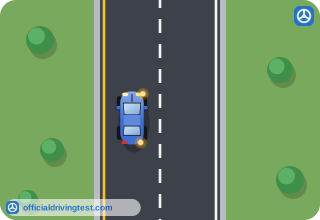
- Vehicles already in the lane you wish to enter or use
- Only vehicles that are traveling faster than you
- Only vehicles that are in the lane you are leaving
- Only vehicles that are signaling a lane change
Show answer
Correct answer: Vehicles already in the lane you wish to enter or use
You must yield to vehicles already in the lane you want to enter or use for passing.
Source: Colorado Driver Handbook (DR 2337, January 2025), page 11 · Open this page in the manual (Manual page 11)
-
When may you NOT change lanes?
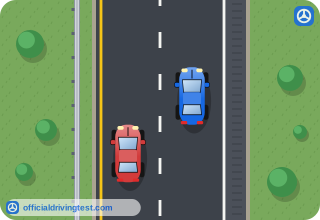
- When your turn signal is on
- When the other vehicle is more than one car length away
- When another vehicle must slow down for you
- When you are traveling faster than the other vehicle
Show answer
Correct answer: When another vehicle must slow down for you
The handbook says not to change lanes if another vehicle must slow down for you.
Source: Colorado Driver Handbook (DR 2337, January 2025), page 11 · Open this page in the manual (Manual page 11)
-
What must you do when merging onto a roadway?
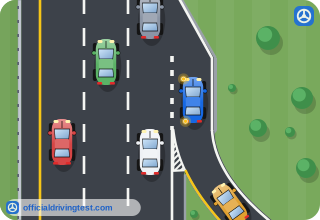
- Merge at once, because vehicles on the roadway must make room
- Yield to all vehicles on the roadway you are merging with
- Yield only to vehicles in the lane next to the merge lane
- Yield only to vehicles that are larger than yours
Show answer
Correct answer: Yield to all vehicles on the roadway you are merging with
The handbook says you must yield to all vehicles on the roadway you are merging with.
Source: Colorado Driver Handbook (DR 2337, January 2025), page 11 · Open this page in the manual (Manual page 11)
-
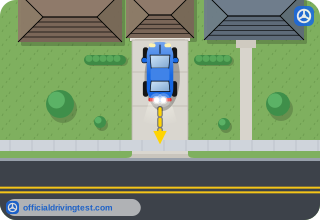
When reversing, to which vehicles must you yield the right-of-way?
- Only vehicles traveling in the same direction
- Only vehicles in the lane directly behind you
- Only vehicles that are larger than yours
- All vehicles close enough to be a hazard
Show answer
Correct answer: All vehicles close enough to be a hazard
When reversing you must yield to all vehicles close enough to be a hazard.
Source: Colorado Driver Handbook (DR 2337, January 2025), page 11 · Open this page in the manual (Manual page 11)
-
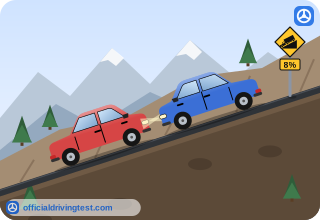
Two vehicles meet on a steep, narrow mountain road that is not wide enough for both. As a general rule, which vehicle must yield?
- The vehicle going downhill
- The vehicle going uphill
- The larger of the two vehicles
- The vehicle that arrived second
Show answer
Correct answer: The vehicle going downhill
The vehicle going downhill must yield by backing up to a wider place or stopping, leaving enough space for the vehicle going uphill, except where it is more practicable for the vehicle going uphill to return to a wider space or turnout.
Source: Colorado Driver Handbook (DR 2337, January 2025), page 11 · Open this page in the manual (Manual page 11)
-
What does the handbook say about accelerating out of a turn?
- Stay at a low speed until the end of the next block
- Accelerate until you reach the speed limit or traffic flow
- Accelerate only after you have signaled once again
- Stop briefly before you enter the new roadway lane
Show answer
Correct answer: Accelerate until you reach the speed limit or traffic flow
The handbook says to accelerate out of turns until you reach the speed limit or flow of traffic.
Source: Colorado Driver Handbook (DR 2337, January 2025), page 12 · Open this page in the manual (Manual page 12)
-
When turning right, where in your lane should you be?
- In the center of your lane
- In the right most part of your lane, near the curb
- In the left side of your lane
- In the left lane, then turn across traffic
Show answer
Correct answer: In the right most part of your lane, near the curb
When turning right you turn from the right most part of your lane and as close to the curb as possible.
Source: Colorado Driver Handbook (DR 2337, January 2025), page 12 · Open this page in the manual (Manual page 12)
-
When turning left, where in your lane should you be?
- In the right most part of your lane
- In the center of your lane
- In the right lane
- In the left side of your lane
Show answer
Correct answer: In the left side of your lane
When turning left you should be in the left side of your lane.
Source: Colorado Driver Handbook (DR 2337, January 2025), page 12 · Open this page in the manual (Manual page 12)
-
From which lane must you begin a right turn?
- The right most lane
- The center lane
- The left lane
- Any lane
Show answer
Correct answer: The right most lane
To make a right turn, you must begin in the right most lane.
Source: Colorado Driver Handbook (DR 2337, January 2025), page 12 · Open this page in the manual (Manual page 12)
-
Where turning from more than one lane is permitted, how are the correct turning lanes indicated?
- By the vehicle driving in front of you
- By police officers who direct each turn
- By traffic signs, signals and/or lane markings
- By the turn signals of other nearby drivers
Show answer
Correct answer: By traffic signs, signals and/or lane markings
Signs, signals and/or lane markings clearly indicate the correct turning lanes where multi-lane turns are permitted.
Source: Colorado Driver Handbook (DR 2337, January 2025), page 12 · Open this page in the manual (Manual page 12)
-
Where should you complete your turn on the new roadway?
- In the lane that is farthest away from you
- In the center of the correct lane, usually the closest one
- In the left lane of the new roadway you enter
- In whichever lane is open at the time you make the turn
Show answer
Correct answer: In the center of the correct lane, usually the closest one
You complete the turn in the center of the correct lane, usually the one closest to you on your side of the street.
Source: Colorado Driver Handbook (DR 2337, January 2025), page 12 · Open this page in the manual (Manual page 12)
-
In intersections with multiple turn lanes, what do you use to identify the correct path?
- The yellow lines in the intersection
- The turn signals of other vehicles
- The position of the curb
- The white lines in the intersection
Show answer
Correct answer: The white lines in the intersection
In intersections with multiple turn lanes, use the white lines in the intersection to identify the correct path.
Source: Colorado Driver Handbook (DR 2337, January 2025), page 12 · Open this page in the manual (Manual page 12)
-
Which of these should you avoid when turning?
- Short turns, wide turns, late turns and straddling lanes
- Turning in the center of the correct lane on the new road
- Using the white lines to identify the correct path
- Accelerating out of the turn to the flow of traffic
Show answer
Correct answer: Short turns, wide turns, late turns and straddling lanes
The handbook says to avoid short turns, wide turns, late turns and straddling lanes.
Source: Colorado Driver Handbook (DR 2337, January 2025), page 13 · Open this page in the manual (Manual page 13)
-
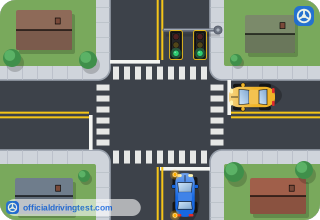
Why does the handbook say crashes are very common during left turns?
- Drivers often make left turns from the wrong lane of the road
- Left turns are made faster than right turns by most drivers
- Drivers must see, judge and navigate oncoming traffic and pedestrians
- Drivers often forget to signal before they turn left
Show answer
Correct answer: Drivers must see, judge and navigate oncoming traffic and pedestrians
Left turns require drivers to see, judge and navigate oncoming traffic and pedestrians in the intersection.
Source: Colorado Driver Handbook (DR 2337, January 2025), page 13 · Open this page in the manual (Manual page 13)
-
Where should you wait when turning left, until there is a large enough gap in oncoming traffic?
- In the middle of the intersection
- At the stop line or crosswalk
- Past the crosswalk, beside the oncoming lane
- On the left shoulder
Show answer
Correct answer: At the stop line or crosswalk
You wait at the stop line or crosswalk until there is a safe gap in oncoming traffic.
Source: Colorado Driver Handbook (DR 2337, January 2025), page 13 · Open this page in the manual (Manual page 13)
-
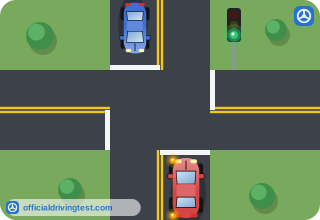
Why should you not pull into the intersection while waiting to turn left?
- It lets oncoming drivers see your turn signal much too early
- It prevents you from using your turn signal at the same time
- It makes you stop twice at the same intersection each time
- It blocks the intersection for emergency vehicles and limits visibility
Show answer
Correct answer: It blocks the intersection for emergency vehicles and limits visibility
The handbook lists blocking emergency vehicles, limiting visibility and risking a collision if oncoming traffic runs the red light.
Source: Colorado Driver Handbook (DR 2337, January 2025), page 13 · Open this page in the manual (Manual page 13)
-
While waiting to turn left, what should you never do with your front wheels?
- Turn them toward the left
- Keep them straight
- Turn them toward the right
- Turn them while you press the brake
Show answer
Correct answer: Turn them toward the left
If you are rear ended with your wheels turned left, you would be pushed into oncoming traffic.
Source: Colorado Driver Handbook (DR 2337, January 2025), page 13 · Open this page in the manual (Manual page 13)
-
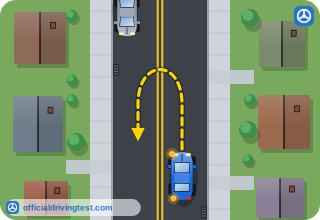
U-turns are forbidden unless which condition is met?
- Whenever you signal and the road has two lanes
- Whenever you are in the left lane of the roadway
- When they can be made without endangering other motorists
- Whenever no police officers are in sight nearby
Show answer
Correct answer: When they can be made without endangering other motorists
U-turns are forbidden unless they can be made without endangering other motorists, and are not allowed where No U-turn signs are posted.
Source: Colorado Driver Handbook (DR 2337, January 2025), page 13 · Open this page in the manual (Manual page 13)
-
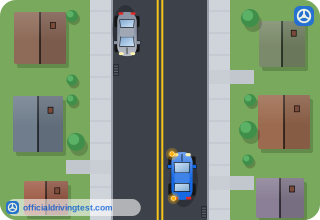
What should you do if you cannot safely make a U-turn?
- Stop in the lane and make the turn when traffic is nearest
- Continue to the next street or turn around area
- Make the turn from the shoulder
- Back up into the nearest driveway
Show answer
Correct answer: Continue to the next street or turn around area
If you cannot safely make a U-turn, continue to the next street or turn around area.
Source: Colorado Driver Handbook (DR 2337, January 2025), page 13 · Open this page in the manual (Manual page 13)
-
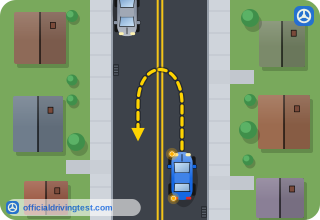
What must you never try to do when making a U-turn?
- A U-turn at a street that has a stop sign nearby
- A U-turn that begins from the curb on the right
- A U-turn made after you have signaled your intent
- A sudden U-turn in front of traffic in either direction
Show answer
Correct answer: A sudden U-turn in front of traffic in either direction
Never try to make a sudden U-turn in front of traffic traveling in either direction.
Source: Colorado Driver Handbook (DR 2337, January 2025), page 13 · Open this page in the manual (Manual page 13)
-
What is a two-point turnabout?
- A turn that uses a street, alley or driveway to reverse direction
- A turn made in a U shape on the same roadway
- A turn made on a two-lane roadway that is too narrow for a U-turn
- A turn made from two lanes at once
Show answer
Correct answer: A turn that uses a street, alley or driveway to reverse direction
A two-point turnabout uses a street, alley or driveway to reverse direction when you cannot drive around a block.
Source: Colorado Driver Handbook (DR 2337, January 2025), page 13 · Open this page in the manual (Manual page 13)
-
In a reverse two-point turnabout, how far do you move back before steering?
- Until the front bumper clears the driveway
- Until the rear wheels are in the middle of the driveway
- Until the rear bumper reaches the near edge of the driveway
- Until you reach the far edge of the driveway
Show answer
Correct answer: Until the rear bumper reaches the near edge of the driveway
You move back until the rear bumper reaches the near edge of the driveway.
Source: Colorado Driver Handbook (DR 2337, January 2025), page 13 · Open this page in the manual (Manual page 13)
-
In a reverse two-point turnabout, how do you steer while backing slowly into the driveway?
- Steer rapidly all the way to the left
- Steer rapidly all the way to the right
- Keep the wheels straight
- Steer gently a quarter turn to the right
Show answer
Correct answer: Steer rapidly all the way to the right
While backing slowly, you steer rapidly all the way to the right.
Source: Colorado Driver Handbook (DR 2337, January 2025), page 13 · Open this page in the manual (Manual page 13)
-
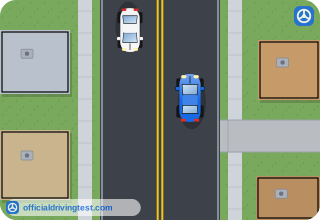
In a reverse two-point turnabout, what do you do as your vehicle centers in the driveway?
- Turn the wheels all the way to the left and continue backing
- Shift to drive and pull out at once
- Continue backing until you reach the end of the driveway
- Straighten the wheels and stop
Show answer
Correct answer: Straighten the wheels and stop
As the vehicle centers in the driveway, you straighten the wheels and stop.
Source: Colorado Driver Handbook (DR 2337, January 2025), page 13 · Open this page in the manual (Manual page 13)
-
At the start of a forward two-point turnabout, what do you do?
- Check your mirrors and signal your intention to turn left
- Check your mirrors and signal your intention to turn right
- Stop and shift to reverse before you signal
- Signal right and move to the right edge of the road
Show answer
Correct answer: Check your mirrors and signal your intention to turn left
A forward two-point turnabout begins with a mirror check and a left turn signal.
Source: Colorado Driver Handbook (DR 2337, January 2025), page 13 · Open this page in the manual (Manual page 13)
-
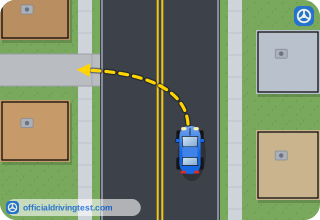
In a forward two-point turnabout, where do you turn into the driveway or alley, after moving close to the center of the road?
- As wide as possible, to the left side of the driveway
- At the far end of the driveway, after pulling off to the right
- As near as possible to the right side
- As near as possible to the left side
Show answer
Correct answer: As near as possible to the right side
You move close to the center of the road and turn into the driveway or alley as near as possible to the right side.
Source: Colorado Driver Handbook (DR 2337, January 2025), page 13 · Open this page in the manual (Manual page 13)
-
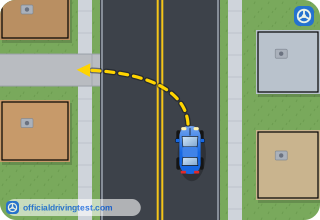
In a forward two-point turnabout, when do you stop after turning into the driveway or alley?
- When the front bumper reaches the far end of the driveway
- As the rear of your vehicle clears the curb or the driveway's edge
- When the rear wheels are well inside the driveway
- When the vehicle is centered in the road ahead
Show answer
Correct answer: As the rear of your vehicle clears the curb or the driveway's edge
You stop as the rear of your vehicle clears the curb or the driveway's edge.
Source: Colorado Driver Handbook (DR 2337, January 2025), page 13 · Open this page in the manual (Manual page 13)
-
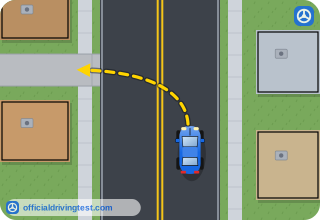
After backing out in a forward two-point turnabout, what do you do once the vehicle is centered in the nearest lane?
- Keep backing until you reach the far lane
- Leave the right signal on and drive forward
- Shift to park and wait for all traffic to clear
- Straighten the wheels and stop, then shift to drive
Show answer
Correct answer: Straighten the wheels and stop, then shift to drive
You straighten the wheels and stop, then shift to drive, cancel the right signal and move forward.
Source: Colorado Driver Handbook (DR 2337, January 2025), page 13 · Open this page in the manual (Manual page 13)
-
When is a three-point turnabout used?
- To reverse direction on a roadway too narrow for a U-turn
- To reverse direction on any road that has several lanes
- To enter a parking space on a busy city street
- To turn around on a freeway ramp or an interchange
Show answer
Correct answer: To reverse direction on a roadway too narrow for a U-turn
A three-point turnabout is for a roadway too narrow for a U-turn with no way to go around the block or use a two-point turn.
Source: Colorado Driver Handbook (DR 2337, January 2025), page 13 · Open this page in the manual (Manual page 13)
-
On what kind of roadway should a three-point turnabout only be used?
- A four-lane roadway
- A one-way street
- A two-lane roadway
- A roadway with a center turn lane
Show answer
Correct answer: A two-lane roadway
The handbook says to only use a three-point turnabout on a two-lane roadway.
Source: Colorado Driver Handbook (DR 2337, January 2025), page 13 · Open this page in the manual (Manual page 13)
-
What is the first step of a three-point turnabout?
- Signal left and turn hard left toward the other side
- Check mirrors, signal right, and stop on the right side
- Back up to the middle of the road
- Stop in the center of the road
Show answer
Correct answer: Check mirrors, signal right, and stop on the right side
You check mirrors, activate the right turn signal and stop on the right side of the road.
Source: Colorado Driver Handbook (DR 2337, January 2025), page 13 · Open this page in the manual (Manual page 13)
-
During a three-point turnabout, when should you activate your left turn signal before the turn?
- At least 100 feet before the turn, or one second
- Only after you have stopped on the other side
- At least 500 feet before the turn, or five seconds
- At least 200 feet before the turn, or three seconds
Show answer
Correct answer: At least 200 feet before the turn, or three seconds
The left turn signal goes on at least 200 feet before the turn, or a minimum of three seconds.
Source: Colorado Driver Handbook (DR 2337, January 2025), page 13 · Open this page in the manual (Manual page 13)
-
At the end of a three-point turnabout, what must you make sure of before continuing straight in the new direction?
- That your turn signal has canceled
- That your hazard lights are on
- That your headlights are on high beam
- That your emergency brake is set
Show answer
Correct answer: That your turn signal has canceled
The handbook says to make sure your turn signal has canceled, then continue driving straight.
Source: Colorado Driver Handbook (DR 2337, January 2025), page 13 · Open this page in the manual (Manual page 13)
-
Where are U-turns not allowed?
- On every street with a posted speed limit above 30 mph
- In locations marked by No U-turn signs
- On every street that has parked vehicles along it
- On every street within a residence district
Show answer
Correct answer: In locations marked by No U-turn signs
U-turns are not allowed in locations marked by No U-turn signs.
Source: Colorado Driver Handbook (DR 2337, January 2025), page 13 · Open this page in the manual (Manual page 13)
-
Which side should you typically pass another vehicle on?
- On the right
- On the shoulder
- On whichever side has more room
- On the left
Show answer
Correct answer: On the left
The handbook says that typically you should pass on the left.
Source: Colorado Driver Handbook (DR 2337, January 2025), page 15 · Open this page in the manual (Manual page 15)
-
When are you allowed to pass on the right?
- On one way streets and on roadways with two or more lanes of travel in each direction
- On any road with a paved shoulder or a turn lane available to use
- On two-lane roads when the driver ahead is going slowly enough
- On any road at all when no vehicle is coming from the opposite direction
Show answer
Correct answer: On one way streets and on roadways with two or more lanes of travel in each direction
Passing on the right is allowed only on one way streets and on roadways with two or more lanes of travel in each direction.
Source: Colorado Driver Handbook (DR 2337, January 2025), page 15 · Open this page in the manual (Manual page 15)
-
Are you allowed to pass another vehicle by driving off of the pavement or on the shoulder?
- Yes, when the vehicle ahead is slow
- Yes, when no oncoming traffic is in sight
- No, it is not allowed
- Yes, on rural roads
Show answer
Correct answer: No, it is not allowed
The handbook says you are not allowed to pass by driving off of the pavement or on the shoulder.
Source: Colorado Driver Handbook (DR 2337, January 2025), page 15 · Open this page in the manual (Manual page 15)
-
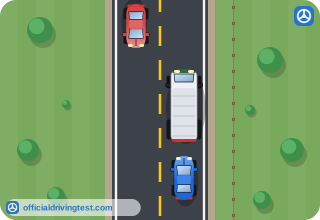
What does the handbook say to judge before deciding to pass another vehicle?
- Whether the driver ahead will move over to let you by
- Whether you will have enough time and room to pass safely
- Whether the road ahead has a paved shoulder to use
- Whether the vehicle ahead is traveling below the limit
Show answer
Correct answer: Whether you will have enough time and room to pass safely
The handbook says to judge whether you will have enough time and room to pass safely by observing the traffic ahead, beside and behind you.
Source: Colorado Driver Handbook (DR 2337, January 2025), page 15 · Open this page in the manual (Manual page 15)
-
After passing a vehicle, when may you return to your previous lane?
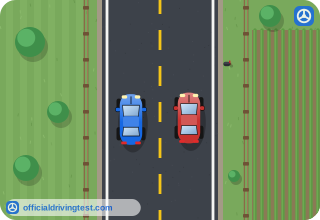
- As soon as your front bumper is past the other vehicle on the road
- When you are about one car length ahead of the other vehicle on the road
- When the driver of the other vehicle signals that you may return
- When you can see both headlights of the vehicle you passed in the rearview mirror
Show answer
Correct answer: When you can see both headlights of the vehicle you passed in the rearview mirror
The handbook says to change one lane back when you can see both headlights of the passed vehicle in the rearview mirror.
Source: Colorado Driver Handbook (DR 2337, January 2025), page 15 · Open this page in the manual (Manual page 15)
-
To be safe, how many vehicles should you pass at one time?
- Two vehicles
- Three vehicles
- As many as the lane is clear for
- Only one vehicle
Show answer
Correct answer: Only one vehicle
The handbook says not to count on passing several vehicles at once and to pass only one vehicle at a time.
Source: Colorado Driver Handbook (DR 2337, January 2025), page 15 · Open this page in the manual (Manual page 15)
-
You may not pass if you cannot safely return to the right-hand side before coming within what distance of an oncoming vehicle?
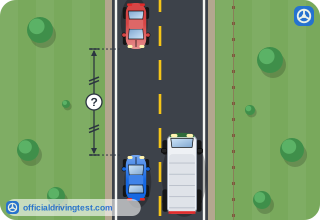
- 200 feet
- 50 feet
- 100 feet
- 500 feet
Show answer
Correct answer: 200 feet
Do not pass if you cannot safely return to the right-hand side before coming within 200 feet of an oncoming vehicle, including a bicyclist in the oncoming lane or shoulder.
Source: Colorado Driver Handbook (DR 2337, January 2025), page 15 · Open this page in the manual (Manual page 15)
-
You may not pass if you cannot safely return to the right-hand side before which of these happens?
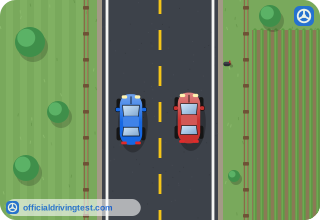
- You reach the next road sign
- You reach the next exit ramp
- A solid yellow line begins
- A broken yellow line begins
Show answer
Correct answer: A solid yellow line begins
Do not pass if you cannot safely return to the right-hand side before a solid yellow line begins.
Source: Colorado Driver Handbook (DR 2337, January 2025), page 15 · Open this page in the manual (Manual page 15)
-
While passing another vehicle, how fast may you drive?
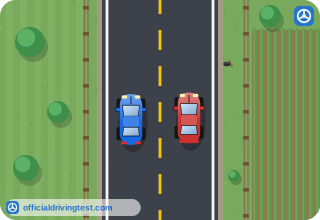
- Up to 5 mph over the posted limit if the pass is done quickly
- No faster than the posted speed limit
- At any speed, as long as you return to your lane promptly
- Up to 10 mph over the limit when the road is a two-lane road
Show answer
Correct answer: No faster than the posted speed limit
Exceeding the posted speed limit when passing is illegal.
Source: Colorado Driver Handbook (DR 2337, January 2025), page 16 · Open this page in the manual (Manual page 16)
-
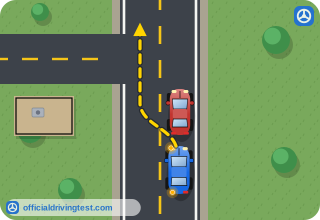
Within what distance of any intersection is it illegal to pass?
- 50 feet
- 150 feet
- 300 feet
- 100 feet
Show answer
Correct answer: 100 feet
The handbook lists passing within 100 feet of any intersection as illegal.
Source: Colorado Driver Handbook (DR 2337, January 2025), page 16 · Open this page in the manual (Manual page 16)
-
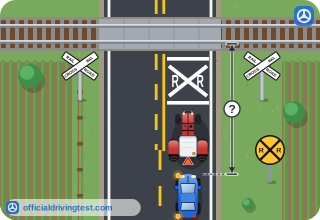
Within what distance of any railroad crossing is it illegal to pass?
- 100 feet
- 25 feet
- 200 feet
- 500 feet
Show answer
Correct answer: 100 feet
The handbook lists passing within 100 feet of any railroad crossing as illegal.
Source: Colorado Driver Handbook (DR 2337, January 2025), page 16 · Open this page in the manual (Manual page 16)
-
Passing within 100 feet of which of these is prohibited when your view is obstructed?
- A traffic island, median or curb
- A parked vehicle, mailbox or hydrant
- A bridge, viaduct or tunnel
- A crosswalk, bike lane or sidewalk
Show answer
Correct answer: A bridge, viaduct or tunnel
Do not pass within 100 feet of any bridge, viaduct or tunnel when your view is obstructed.
Source: Colorado Driver Handbook (DR 2337, January 2025), page 16 · Open this page in the manual (Manual page 16)
-
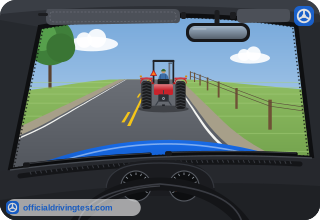
Passing on a hill, curve or bridge is illegal under what condition?
- Only when the posted speed limit is below 35 mph
- When your vision of the road ahead is obstructed
- Only when it is raining or snowing
- Only when another vehicle is following you
Show answer
Correct answer: When your vision of the road ahead is obstructed
Passing on any hill, curve or bridge where vision is obstructed is illegal.
Source: Colorado Driver Handbook (DR 2337, January 2025), page 16 · Open this page in the manual (Manual page 16)
-
Which of these is illegal when passing another vehicle?
- Signaling before you change lanes to pass
- Checking traffic ahead, beside and behind you
- Passing only one vehicle at a time
- Passing in a marked no-passing zone
Show answer
Correct answer: Passing in a marked no-passing zone
Passing in any marked no-passing zone is listed among the illegal behaviors when passing.
Source: Colorado Driver Handbook (DR 2337, January 2025), page 16 · Open this page in the manual (Manual page 16)
-
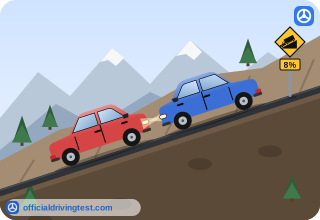
On a mountain road, which vehicles generally have the right-of-way?
- Vehicles going downhill
- The vehicle that arrived first
- Vehicles going uphill
- The larger vehicle
Show answer
Correct answer: Vehicles going uphill
The handbook says vehicles going uphill have the right-of-way over vehicles going downhill; on a steep, narrow road the downhill vehicle yields unless it is more practicable for the uphill vehicle to return to a wider space or turnout.
Source: Colorado Driver Handbook (DR 2337, January 2025), page 17 · Open this page in the manual (Manual page 17)
-
When there is a lane closure ahead, what does the handbook say drivers should do as they approach the merge point?
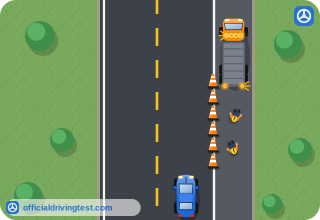
- Continue to drive in both lanes equally
- Move into the open lane as early as possible
- Stop and wait for the other lane to clear
- Use only the lane that will stay open
Show answer
Correct answer: Continue to drive in both lanes equally
The handbook says drivers should keep driving in both lanes equally and take turns filling the open lane just before the lane ends.
Source: Colorado Driver Handbook (DR 2337, January 2025), page 19 · Open this page in the manual (Manual page 19)
-
In a zipper merge, how should you regard drivers who wait to merge until just before the lane ends?
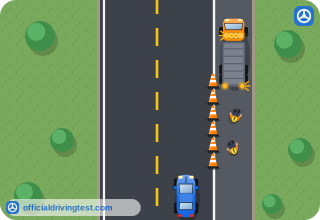
- They are merging too late and creating a hazard
- They are cutting in line and should be kept out
- They are doing it correctly
- They should be warned with the horn
Show answer
Correct answer: They are doing it correctly
The handbook asks drivers to be respectful of those who merge just before the lane ends, because they are doing it correctly.
Source: Colorado Driver Handbook (DR 2337, January 2025), page 19 · Open this page in the manual (Manual page 19)
-
Why should you make right turns from close to the curb, and from a Conflict Zone when one is present?
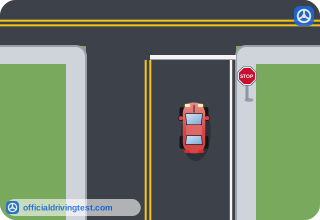
- It lets you complete the turn faster than the other traffic around you
- It keeps you out of the bike lane after you have finished turning
- It helps pedestrians cross the street in front of your vehicle safely
- It helps prevent crashes with bicyclists coming up behind you on the right
Show answer
Correct answer: It helps prevent crashes with bicyclists coming up behind you on the right
The manual says this helps prevent crashes with bicyclists who approach from behind and may otherwise try to pass on the right.
Source: Colorado Driver Handbook (DR 2337, January 2025), page 23 · Open this page in the manual (Manual page 23)
-
Before making a left turn, what should you actively look for?
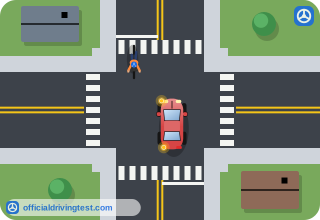
- Only oncoming vehicles in the lane next to the one you are in
- Bicyclists in the bike lane on the left side of the road only
- Bicyclists on the right side or shoulder, and their distance and speed
- Only pedestrians who are walking behind your vehicle on the sidewalk
Show answer
Correct answer: Bicyclists on the right side or shoulder, and their distance and speed
The manual says to actively look for people biking on the right side or on the shoulder and accurately judge their distance and speed before turning.
Source: Colorado Driver Handbook (DR 2337, January 2025), page 23 · Open this page in the manual (Manual page 23)
-
You are driving alongside a bicyclist and preparing to turn right. What should you do?
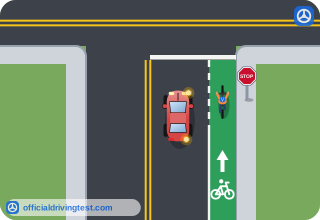
- Speed up and turn in front of the bicyclist before they arrive
- Slow down, yield and let the bicyclist clear the intersection
- Sound your horn and then turn right ahead of the bicyclist
- Stay beside the bicyclist and turn at the same time as they do
Show answer
Correct answer: Slow down, yield and let the bicyclist clear the intersection
The manual says to slow down, yield and let the bicyclist clear the intersection before making your turn.
Source: Colorado Driver Handbook (DR 2337, January 2025), page 23 · Open this page in the manual (Manual page 23)
-
Before turning right at a red light where it is legal, what must you do?
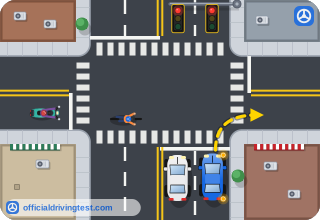
- Slow down and turn if no cars are coming from the left
- Turn without stopping if no pedestrians are present nearby
- Stop only if you can see a bicyclist near your vehicle
- Come to a complete stop and look for bicyclists around you
Show answer
Correct answer: Come to a complete stop and look for bicyclists around you
The manual says to come to a complete stop and look for bicyclists behind or next to your vehicle, turning left from the opposite side, or in the lane you will merge with.
Source: Colorado Driver Handbook (DR 2337, January 2025), page 23 · Open this page in the manual (Manual page 23)