Colorado: Right-of-way and turning — Part 2 Practice Test
Questions in this part include: “What does the Colorado Driver Handbook say the law does about the right-of-way?” · “Who is always responsible for avoiding a crash at a four-way stop, regardless of who has the right-of-way?”
Independent educational site · not affiliated with any government agency or DMV
Ready? Test yourself
- Instant feedback with an explanation
- Every answer cites its source in the manual
- Your best score is saved on this device
Questions are original and based on the official manual "Colorado Driver Handbook" (DR 2337, January 2025), Colorado Division of Motor Vehicles (DMV).
All 17 questions in this practice test
Take the test above first, then use this list to study. Tap “Show answer” to see the correct answer and explanation.
Show the questions and answersHide the questions
-
As you enter or leave a roundabout, you must yield to:
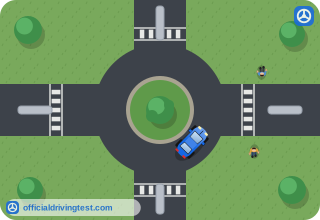
- Only vehicles already in the roundabout, not people in crosswalks
- Pedestrians and bicyclists in any crosswalk, and traffic already inside
- Only pedestrians in marked crosswalks, but not bicyclists
- Only emergency vehicles, since other traffic yields to you
Show answer
Correct answer: Pedestrians and bicyclists in any crosswalk, and traffic already inside
You must yield to pedestrians or bicyclists in any crosswalk and to any traffic already inside the roundabout.
Source: Colorado Driver Handbook (DR 2337, January 2025), page 10 · Open this page in the manual (Manual page 10)
-
In a roundabout, when should you use your turn signals?
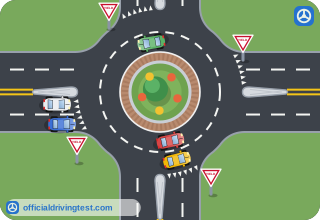
- Only when entering the roundabout
- Only when stopped before entering
- Never, because all traffic flows in the same direction
- When changing lanes and exiting the roundabout
Show answer
Correct answer: When changing lanes and exiting the roundabout
Use your turn signals when changing lanes and exiting the roundabout to alert traffic of your intentions.
Source: Colorado Driver Handbook (DR 2337, January 2025), page 10 · Open this page in the manual (Manual page 10)
-
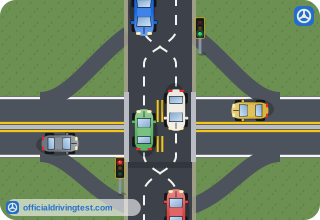
What does a diverging diamond interchange (DDI) give vehicles?
- A stop sign at the end of every ramp
- Roundabouts at the end of each freeway ramp
- Separate lanes that keep trucks off the ramps
- Uninterrupted movements onto the freeway ramps
Show answer
Correct answer: Uninterrupted movements onto the freeway ramps
A DDI crosses traffic to the opposite side of the road across the interchange so vehicles have uninterrupted movements onto the freeway ramps.
Source: Colorado Driver Handbook (DR 2337, January 2025), page 10 · Open this page in the manual (Manual page 10)
-
What does the Colorado Driver Handbook say the law does about the right-of-way?
- It states who must yield, but does not give anyone the right-of-way
- It gives the right-of-way to any driver who has a green traffic signal
- It gives the right-of-way to the vehicle that is traveling fastest
- It gives the right-of-way to the largest vehicle at an intersection
Show answer
Correct answer: It states who must yield, but does not give anyone the right-of-way
The law says who must yield; it never gives anyone the right-of-way, even with a green signal.
Source: Colorado Driver Handbook (DR 2337, January 2025), page 11 · Open this page in the manual (Manual page 11)
-
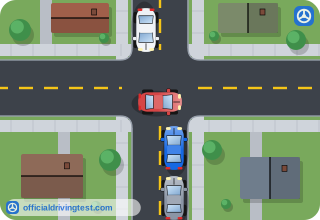
You are approaching an intersection. Whom must you yield the right-of-way to?
- Only drivers of larger vehicles already in the intersection
- Only pedestrians who are in a marked crosswalk
- Pedestrians, bicyclists and drivers already in the intersection
- Only vehicles that are traveling faster than you
Show answer
Correct answer: Pedestrians, bicyclists and drivers already in the intersection
The handbook says you must yield to pedestrians, bicyclists and other drivers already in an intersection you are approaching.
Source: Colorado Driver Handbook (DR 2337, January 2025), page 11 · Open this page in the manual (Manual page 11)
-
At a four-way stop, who must you yield the right-of-way to?
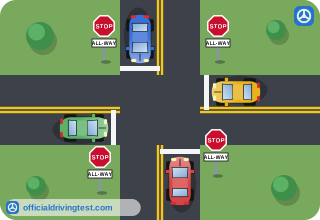
- The vehicle that is going straight ahead
- The vehicle that is turning right
- The vehicle that reached the intersection first
- The largest vehicle at the intersection
Show answer
Correct answer: The vehicle that reached the intersection first
At a four-way stop you yield to the vehicle that reached the intersection first.
Source: Colorado Driver Handbook (DR 2337, January 2025), page 11 · Open this page in the manual (Manual page 11)
-
At a four-way stop, two vehicles reach the intersection at the same time. Which one must yield?
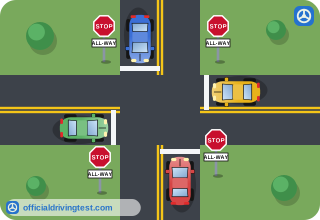
- The vehicle on the right must yield to the vehicle on the left
- The vehicle on the left must yield to the vehicle on the right
- The vehicle that is turning must yield to the vehicle going straight
- The vehicle that is slower must yield to the faster one
Show answer
Correct answer: The vehicle on the left must yield to the vehicle on the right
When more than one vehicle arrives at the same time, the vehicle on the left yields and lets the vehicle on the right go first.
Source: Colorado Driver Handbook (DR 2337, January 2025), page 11 · Open this page in the manual (Manual page 11)
-
Who is always responsible for avoiding a crash at a four-way stop, regardless of who has the right-of-way?
- Only the driver who arrived last
- Only the driver who must yield
- The driver on the right
- You are
Show answer
Correct answer: You are
The handbook says that regardless of who has the right-of-way, you are always responsible for avoiding a crash.
Source: Colorado Driver Handbook (DR 2337, January 2025), page 11 · Open this page in the manual (Manual page 11)
-
What is an uncontrolled intersection?
- An intersection without control devices such as stop signs or lights
- An intersection where the traffic lights are flashing yellow at night
- An intersection that has a stop sign on only one of the roads
- An intersection where more than four roads meet at one point
Show answer
Correct answer: An intersection without control devices such as stop signs or lights
The handbook defines it as an intersection without control devices such as stop signs or traffic lights.
Source: Colorado Driver Handbook (DR 2337, January 2025), page 11 · Open this page in the manual (Manual page 11)
-
Two vehicles reach an uncontrolled intersection at the same time. Which one goes first?
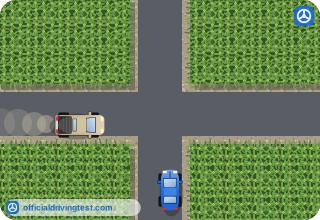
- The vehicle on the left
- The vehicle that is turning left
- The vehicle on the right
- The vehicle that is slower
Show answer
Correct answer: The vehicle on the right
The vehicle on the left must yield and allow the vehicle on the right to go first.
Source: Colorado Driver Handbook (DR 2337, January 2025), page 11 · Open this page in the manual (Manual page 11)
-
Before proceeding through a left turn, what should you always look for and yield to?
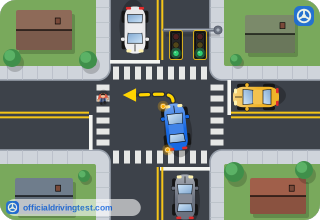
- Only pedestrians who are waiting on the curb
- Pedestrians in the crosswalk and smaller oncoming vehicles
- Only oncoming vehicles that are larger than yours
- Only vehicles that are behind you
Show answer
Correct answer: Pedestrians in the crosswalk and smaller oncoming vehicles
The handbook says to look for and yield to pedestrians in the crosswalk and smaller oncoming vehicles, and to judge their speed and distance.
Source: Colorado Driver Handbook (DR 2337, January 2025), page 11 · Open this page in the manual (Manual page 11)
-
When turning left, you must yield to all oncoming traffic unless you have which of these?
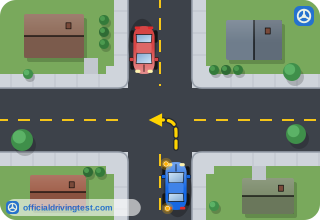
- A green light or a flashing yellow light
- A green arrow or your signal turned on for 3 seconds
- A turn signal on or a bike lane next to you
- A green arrow or you arrived first at a four-way stop
Show answer
Correct answer: A green arrow or you arrived first at a four-way stop
You must yield to all oncoming traffic, unless you have a green arrow or arrived first at a four-way stop.
Source: Colorado Driver Handbook (DR 2337, January 2025), page 11 · Open this page in the manual (Manual page 11)
-
When changing lanes or passing, whom must you yield the right-of-way to?
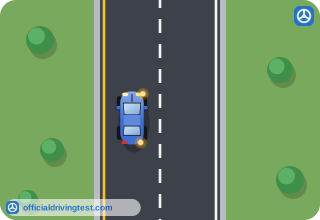
- Vehicles already in the lane you wish to enter or use
- Only vehicles that are traveling faster than you
- Only vehicles that are in the lane you are leaving
- Only vehicles that are signaling a lane change
Show answer
Correct answer: Vehicles already in the lane you wish to enter or use
You must yield to vehicles already in the lane you want to enter or use for passing.
Source: Colorado Driver Handbook (DR 2337, January 2025), page 11 · Open this page in the manual (Manual page 11)
-
When may you NOT change lanes?
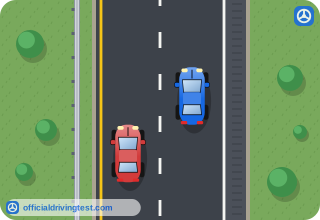
- When your turn signal is on
- When the other vehicle is more than one car length away
- When another vehicle must slow down for you
- When you are traveling faster than the other vehicle
Show answer
Correct answer: When another vehicle must slow down for you
The handbook says not to change lanes if another vehicle must slow down for you.
Source: Colorado Driver Handbook (DR 2337, January 2025), page 11 · Open this page in the manual (Manual page 11)
-
What must you do when merging onto a roadway?
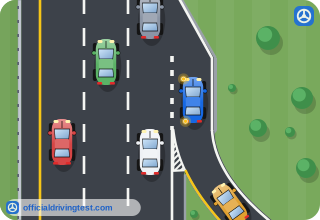
- Merge at once, because vehicles on the roadway must make room
- Yield to all vehicles on the roadway you are merging with
- Yield only to vehicles in the lane next to the merge lane
- Yield only to vehicles that are larger than yours
Show answer
Correct answer: Yield to all vehicles on the roadway you are merging with
The handbook says you must yield to all vehicles on the roadway you are merging with.
Source: Colorado Driver Handbook (DR 2337, January 2025), page 11 · Open this page in the manual (Manual page 11)
-
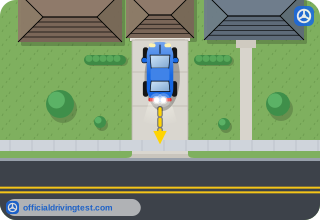
When reversing, to which vehicles must you yield the right-of-way?
- Only vehicles traveling in the same direction
- Only vehicles in the lane directly behind you
- Only vehicles that are larger than yours
- All vehicles close enough to be a hazard
Show answer
Correct answer: All vehicles close enough to be a hazard
When reversing you must yield to all vehicles close enough to be a hazard.
Source: Colorado Driver Handbook (DR 2337, January 2025), page 11 · Open this page in the manual (Manual page 11)
-
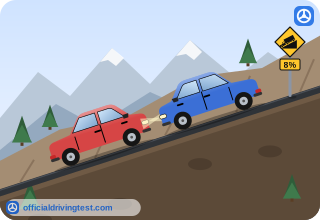
Two vehicles meet on a steep, narrow mountain road that is not wide enough for both. As a general rule, which vehicle must yield?
- The vehicle going downhill
- The vehicle going uphill
- The larger of the two vehicles
- The vehicle that arrived second
Show answer
Correct answer: The vehicle going downhill
The vehicle going downhill must yield by backing up to a wider place or stopping, leaving enough space for the vehicle going uphill, except where it is more practicable for the vehicle going uphill to return to a wider space or turnout.
Source: Colorado Driver Handbook (DR 2337, January 2025), page 11 · Open this page in the manual (Manual page 11)