Colorado: Right-of-way and turning — Part 1 Practice Test
Questions in this part include: “On the drive test, from which part of your lane should you make a right turn?” · “As a general rule, which part of the road must you drive on?”
Independent educational site · not affiliated with any government agency or DMV
Ready? Test yourself
- Instant feedback with an explanation
- Every answer cites its source in the manual
- Your best score is saved on this device
Questions are original and based on the official manual "Colorado Driver Handbook" (DR 2337, January 2025), Colorado Division of Motor Vehicles (DMV).
All 17 questions in this practice test
Take the test above first, then use this list to study. Tap “Show answer” to see the correct answer and explanation.
Show the questions and answersHide the questions
-
On the drive test, from which part of your lane should you make a right turn?
- From the center of your lane
- From the leftmost portion of your lane
- From the rightmost portion of your lane
- From the middle lane of the road
Show answer
Correct answer: From the rightmost portion of your lane
When turning right, always turn from the rightmost portion of your lane.
Source: Colorado Driver Handbook (DR 2337, January 2025), page 1 · Open this page in the manual (Manual page 1)
-
On the drive test, from which part of your lane should you make a left turn?
- From the center of your lane
- From the left-most portion of your lane
- From the rightmost portion of your lane
- From the lane nearest the curb
Show answer
Correct answer: From the left-most portion of your lane
When turning left, always turn from the left-most portion of your lane.
Source: Colorado Driver Handbook (DR 2337, January 2025), page 2 · Open this page in the manual (Manual page 2)
-
After completing a turn on the drive test, where should your vehicle be?
- In the leftmost part of the lane
- In the rightmost part of the lane
- Straddling the lane line until traffic clears
- Centered in the appropriate lane
Show answer
Correct answer: Centered in the appropriate lane
After completing the turn you must make sure the vehicle is centered in the appropriate lane.
Source: Colorado Driver Handbook (DR 2337, January 2025), page 2 · Open this page in the manual (Manual page 2)
-
What should you avoid driving over when you start or finish a turn on the drive test?
- Lane markings and curbs
- Crosswalk lines only
- Painted arrows only
- Manhole covers
Show answer
Correct answer: Lane markings and curbs
Start and finish the turn in the proper lane without driving over lane markings or curbs.
Source: Colorado Driver Handbook (DR 2337, January 2025), page 2 · Open this page in the manual (Manual page 2)
-
What do the stopping requirements say about the vehicle's wheels while you are stopped?
- Turn them toward the direction of your upcoming turn
- Keep them pointed straight ahead until you begin the turn
- Turn them toward the curb while you wait for the light
- Turn them away from the traffic in the opposite lane
Show answer
Correct answer: Keep them pointed straight ahead until you begin the turn
While stopped, keep the wheels pointed straight ahead and do not turn them until you begin to make the turn.
Source: Colorado Driver Handbook (DR 2337, January 2025), page 2 · Open this page in the manual (Manual page 2)
-
On the drive test, when should you look behind you after a turn?
- After each turn
- Only after left turns
- Only after right turns
- Only after turns at signals
Show answer
Correct answer: After each turn
Searching includes looking behind after each turn.
Source: Colorado Driver Handbook (DR 2337, January 2025), page 2 · Open this page in the manual (Manual page 2)
-
As a general rule, which part of the road must you drive on?
- The left half of the road
- The right half of the road
- The center of the road
- Whichever half has less traffic
Show answer
Correct answer: The right half of the road
As a general rule, you must drive your vehicle on the right half of the road.
Source: Colorado Driver Handbook (DR 2337, January 2025), page 9 · Open this page in the manual (Manual page 9)
-
How many lanes should you use when driving on a road with marked lanes?
- Two, if the lane next to you is empty
- Any number needed to pass slower vehicles
- Two, when driving on a multi-lane road
- Only one; do not straddle lanes
Show answer
Correct answer: Only one; do not straddle lanes
You should use only one lane and not straddle lanes.
Source: Colorado Driver Handbook (DR 2337, January 2025), page 9 · Open this page in the manual (Manual page 9)
-
On roads without marked lanes, where should you drive?
- Just to the right of the center of the road
- Just to the left of the center of the road
- In the exact center of the road
- On the shoulder of the road
Show answer
Correct answer: Just to the right of the center of the road
On roads without marked lanes you drive just to the right of the center of the road.
Source: Colorado Driver Handbook (DR 2337, January 2025), page 10 · Open this page in the manual (Manual page 10)
-
When there are no signs or pavement markings to control the use of lanes, what must you not do?
- Drive just to the right of the center
- Use your turn signal when turning
- Drive on the shoulder of the road
- Follow the passing rules for marked roads
Show answer
Correct answer: Drive on the shoulder of the road
On an unmarked road you drive just to the right of the center and do not drive on the shoulder.
Source: Colorado Driver Handbook (DR 2337, January 2025), page 10 · Open this page in the manual (Manual page 10)
-
Which rules for passing and turning apply on unmarked roads?
- Special rules that allow passing anywhere
- The same rules as on marked roads
- No rules, since nothing is marked
- Only the rules for parking lots
Show answer
Correct answer: The same rules as on marked roads
The same rules for passing and turning on marked roads apply with unmarked roads.
Source: Colorado Driver Handbook (DR 2337, January 2025), page 10 · Open this page in the manual (Manual page 10)
-
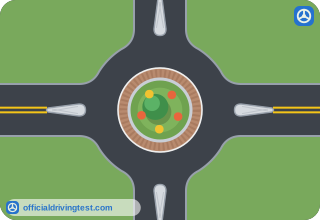
At a roundabout, which traffic yields the right-of-way?
- Traffic inside the roundabout yields to entering traffic
- The faster vehicle yields to the slower one
- Drivers entering from the left side yield
- Entering traffic yields to circulating traffic
Show answer
Correct answer: Entering traffic yields to circulating traffic
Entering traffic yields the right-of-way to circulating traffic.
Source: Colorado Driver Handbook (DR 2337, January 2025), page 10 · Open this page in the manual (Manual page 10)
-
Vehicles in a roundabout travel which way around the center island?
- To the right
- To the left
- Either direction, whichever is shorter
- Straight across the center island
Show answer
Correct answer: To the right
Vehicles travel to the right around a center island.
Source: Colorado Driver Handbook (DR 2337, January 2025), page 10 · Open this page in the manual (Manual page 10)
-
In a roundabout, Colorado law requires drivers to yield the right-of-way to the driver of which vehicles?
- Only emergency vehicles with lights and sirens on
- A passenger car with more than two occupants
- A truck, bus, emergency vehicle or recreational vehicle
- Only trucks carrying hazardous materials
Show answer
Correct answer: A truck, bus, emergency vehicle or recreational vehicle
Colorado law requires yielding to the driver of a truck, bus, emergency vehicle or recreational vehicle (large vehicle).
Source: Colorado Driver Handbook (DR 2337, January 2025), page 10 · Open this page in the manual (Manual page 10)
-
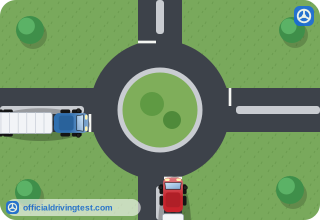
Two drivers of large vehicles enter a roundabout at the same time. Who must yield?
- The driver on the left yields to the driver on the right
- The driver on the right yields to the driver on the left
- The driver of the truck yields to the driver of the bus
- Both drivers must stop completely until one proceeds
Show answer
Correct answer: The driver on the right yields to the driver on the left
When two large vehicles enter at the same time, the driver on the right must yield the right-of-way to the driver on the left.
Source: Colorado Driver Handbook (DR 2337, January 2025), page 10 · Open this page in the manual (Manual page 10)
-
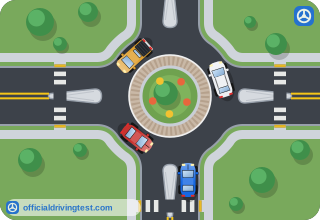
As you approach a roundabout and no large trucks are present, to whom must you yield?
- Approaching traffic on the right
- Traffic waiting behind you
- No one, if you arrived first
- Approaching traffic on the left
Show answer
Correct answer: Approaching traffic on the left
If no large trucks are present, you must yield to approaching traffic on the left.
Source: Colorado Driver Handbook (DR 2337, January 2025), page 10 · Open this page in the manual (Manual page 10)
-
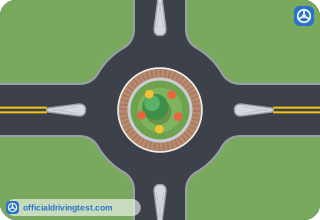
When entering a roundabout, you should not stop completely unless:
- Existing traffic prevents you from merging
- You are in the left lane of the roundabout
- Your turn signal is not working
- You plan to exit at the first exit
Show answer
Correct answer: Existing traffic prevents you from merging
Do not stop completely unless existing traffic prevents you from merging.
Source: Colorado Driver Handbook (DR 2337, January 2025), page 10 · Open this page in the manual (Manual page 10)