Colorado: Right-of-way and turning — Part 3 Practice Test
Questions in this part include: “What does the handbook say about accelerating out of a turn?” · “In intersections with multiple turn lanes, what do you use to identify the correct path?”
Independent educational site · not affiliated with any government agency or DMV
Ready? Test yourself
- Instant feedback with an explanation
- Every answer cites its source in the manual
- Your best score is saved on this device
Questions are original and based on the official manual "Colorado Driver Handbook" (DR 2337, January 2025), Colorado Division of Motor Vehicles (DMV).
All 17 questions in this practice test
Take the test above first, then use this list to study. Tap “Show answer” to see the correct answer and explanation.
Show the questions and answersHide the questions
-
What does the handbook say about accelerating out of a turn?
- Stay at a low speed until the end of the next block
- Accelerate until you reach the speed limit or traffic flow
- Accelerate only after you have signaled once again
- Stop briefly before you enter the new roadway lane
Show answer
Correct answer: Accelerate until you reach the speed limit or traffic flow
The handbook says to accelerate out of turns until you reach the speed limit or flow of traffic.
Source: Colorado Driver Handbook (DR 2337, January 2025), page 12 · Open this page in the manual (Manual page 12)
-
When turning right, where in your lane should you be?
- In the center of your lane
- In the right most part of your lane, near the curb
- In the left side of your lane
- In the left lane, then turn across traffic
Show answer
Correct answer: In the right most part of your lane, near the curb
When turning right you turn from the right most part of your lane and as close to the curb as possible.
Source: Colorado Driver Handbook (DR 2337, January 2025), page 12 · Open this page in the manual (Manual page 12)
-
When turning left, where in your lane should you be?
- In the right most part of your lane
- In the center of your lane
- In the right lane
- In the left side of your lane
Show answer
Correct answer: In the left side of your lane
When turning left you should be in the left side of your lane.
Source: Colorado Driver Handbook (DR 2337, January 2025), page 12 · Open this page in the manual (Manual page 12)
-
From which lane must you begin a right turn?
- The right most lane
- The center lane
- The left lane
- Any lane
Show answer
Correct answer: The right most lane
To make a right turn, you must begin in the right most lane.
Source: Colorado Driver Handbook (DR 2337, January 2025), page 12 · Open this page in the manual (Manual page 12)
-
Where turning from more than one lane is permitted, how are the correct turning lanes indicated?
- By the vehicle driving in front of you
- By police officers who direct each turn
- By traffic signs, signals and/or lane markings
- By the turn signals of other nearby drivers
Show answer
Correct answer: By traffic signs, signals and/or lane markings
Signs, signals and/or lane markings clearly indicate the correct turning lanes where multi-lane turns are permitted.
Source: Colorado Driver Handbook (DR 2337, January 2025), page 12 · Open this page in the manual (Manual page 12)
-
Where should you complete your turn on the new roadway?
- In the lane that is farthest away from you
- In the center of the correct lane, usually the closest one
- In the left lane of the new roadway you enter
- In whichever lane is open at the time you make the turn
Show answer
Correct answer: In the center of the correct lane, usually the closest one
You complete the turn in the center of the correct lane, usually the one closest to you on your side of the street.
Source: Colorado Driver Handbook (DR 2337, January 2025), page 12 · Open this page in the manual (Manual page 12)
-
In intersections with multiple turn lanes, what do you use to identify the correct path?
- The yellow lines in the intersection
- The turn signals of other vehicles
- The position of the curb
- The white lines in the intersection
Show answer
Correct answer: The white lines in the intersection
In intersections with multiple turn lanes, use the white lines in the intersection to identify the correct path.
Source: Colorado Driver Handbook (DR 2337, January 2025), page 12 · Open this page in the manual (Manual page 12)
-
Which of these should you avoid when turning?
- Short turns, wide turns, late turns and straddling lanes
- Turning in the center of the correct lane on the new road
- Using the white lines to identify the correct path
- Accelerating out of the turn to the flow of traffic
Show answer
Correct answer: Short turns, wide turns, late turns and straddling lanes
The handbook says to avoid short turns, wide turns, late turns and straddling lanes.
Source: Colorado Driver Handbook (DR 2337, January 2025), page 13 · Open this page in the manual (Manual page 13)
-
Why does the handbook say crashes are very common during left turns?
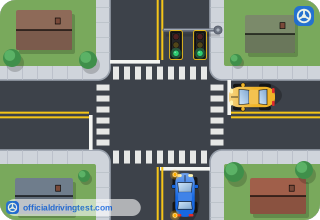
- Drivers often make left turns from the wrong lane of the road
- Left turns are made faster than right turns by most drivers
- Drivers must see, judge and navigate oncoming traffic and pedestrians
- Drivers often forget to signal before they turn left
Show answer
Correct answer: Drivers must see, judge and navigate oncoming traffic and pedestrians
Left turns require drivers to see, judge and navigate oncoming traffic and pedestrians in the intersection.
Source: Colorado Driver Handbook (DR 2337, January 2025), page 13 · Open this page in the manual (Manual page 13)
-
Where should you wait when turning left, until there is a large enough gap in oncoming traffic?
- In the middle of the intersection
- At the stop line or crosswalk
- Past the crosswalk, beside the oncoming lane
- On the left shoulder
Show answer
Correct answer: At the stop line or crosswalk
You wait at the stop line or crosswalk until there is a safe gap in oncoming traffic.
Source: Colorado Driver Handbook (DR 2337, January 2025), page 13 · Open this page in the manual (Manual page 13)
-
Why should you not pull into the intersection while waiting to turn left?
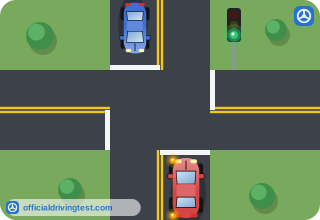
- It lets oncoming drivers see your turn signal much too early
- It prevents you from using your turn signal at the same time
- It makes you stop twice at the same intersection each time
- It blocks the intersection for emergency vehicles and limits visibility
Show answer
Correct answer: It blocks the intersection for emergency vehicles and limits visibility
The handbook lists blocking emergency vehicles, limiting visibility and risking a collision if oncoming traffic runs the red light.
Source: Colorado Driver Handbook (DR 2337, January 2025), page 13 · Open this page in the manual (Manual page 13)
-
While waiting to turn left, what should you never do with your front wheels?
- Turn them toward the left
- Keep them straight
- Turn them toward the right
- Turn them while you press the brake
Show answer
Correct answer: Turn them toward the left
If you are rear ended with your wheels turned left, you would be pushed into oncoming traffic.
Source: Colorado Driver Handbook (DR 2337, January 2025), page 13 · Open this page in the manual (Manual page 13)
-
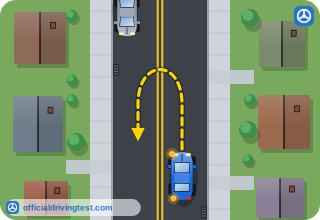
U-turns are forbidden unless which condition is met?
- Whenever you signal and the road has two lanes
- Whenever you are in the left lane of the roadway
- When they can be made without endangering other motorists
- Whenever no police officers are in sight nearby
Show answer
Correct answer: When they can be made without endangering other motorists
U-turns are forbidden unless they can be made without endangering other motorists, and are not allowed where No U-turn signs are posted.
Source: Colorado Driver Handbook (DR 2337, January 2025), page 13 · Open this page in the manual (Manual page 13)
-
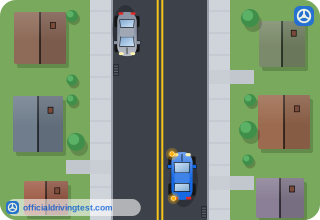
What should you do if you cannot safely make a U-turn?
- Stop in the lane and make the turn when traffic is nearest
- Continue to the next street or turn around area
- Make the turn from the shoulder
- Back up into the nearest driveway
Show answer
Correct answer: Continue to the next street or turn around area
If you cannot safely make a U-turn, continue to the next street or turn around area.
Source: Colorado Driver Handbook (DR 2337, January 2025), page 13 · Open this page in the manual (Manual page 13)
-
What must you never try to do when making a U-turn?
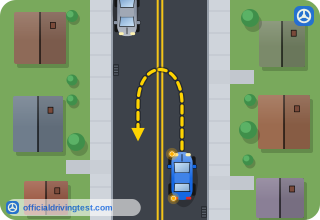
- A U-turn at a street that has a stop sign nearby
- A U-turn that begins from the curb on the right
- A U-turn made after you have signaled your intent
- A sudden U-turn in front of traffic in either direction
Show answer
Correct answer: A sudden U-turn in front of traffic in either direction
Never try to make a sudden U-turn in front of traffic traveling in either direction.
Source: Colorado Driver Handbook (DR 2337, January 2025), page 13 · Open this page in the manual (Manual page 13)
-
What is a two-point turnabout?
- A turn that uses a street, alley or driveway to reverse direction
- A turn made in a U shape on the same roadway
- A turn made on a two-lane roadway that is too narrow for a U-turn
- A turn made from two lanes at once
Show answer
Correct answer: A turn that uses a street, alley or driveway to reverse direction
A two-point turnabout uses a street, alley or driveway to reverse direction when you cannot drive around a block.
Source: Colorado Driver Handbook (DR 2337, January 2025), page 13 · Open this page in the manual (Manual page 13)
-
In a reverse two-point turnabout, how far do you move back before steering?
- Until the front bumper clears the driveway
- Until the rear wheels are in the middle of the driveway
- Until the rear bumper reaches the near edge of the driveway
- Until you reach the far edge of the driveway
Show answer
Correct answer: Until the rear bumper reaches the near edge of the driveway
You move back until the rear bumper reaches the near edge of the driveway.
Source: Colorado Driver Handbook (DR 2337, January 2025), page 13 · Open this page in the manual (Manual page 13)