Colorado: Right-of-way and turning — Part 4 Practice Test
Questions in this part include: “In a reverse two-point turnabout, how do you steer while backing slowly into the driveway?” · “During a three-point turnabout, when should you activate your left turn signal before the turn?”
Independent educational site · not affiliated with any government agency or DMV
Ready? Test yourself
- Instant feedback with an explanation
- Every answer cites its source in the manual
- Your best score is saved on this device
Questions are original and based on the official manual "Colorado Driver Handbook" (DR 2337, January 2025), Colorado Division of Motor Vehicles (DMV).
All 17 questions in this practice test
Take the test above first, then use this list to study. Tap “Show answer” to see the correct answer and explanation.
Show the questions and answersHide the questions
-
In a reverse two-point turnabout, how do you steer while backing slowly into the driveway?
- Steer rapidly all the way to the left
- Steer rapidly all the way to the right
- Keep the wheels straight
- Steer gently a quarter turn to the right
Show answer
Correct answer: Steer rapidly all the way to the right
While backing slowly, you steer rapidly all the way to the right.
Source: Colorado Driver Handbook (DR 2337, January 2025), page 13 · Open this page in the manual (Manual page 13)
-
In a reverse two-point turnabout, what do you do as your vehicle centers in the driveway?
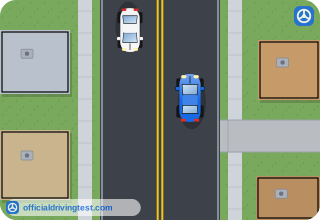
- Turn the wheels all the way to the left and continue backing
- Shift to drive and pull out at once
- Continue backing until you reach the end of the driveway
- Straighten the wheels and stop
Show answer
Correct answer: Straighten the wheels and stop
As the vehicle centers in the driveway, you straighten the wheels and stop.
Source: Colorado Driver Handbook (DR 2337, January 2025), page 13 · Open this page in the manual (Manual page 13)
-
At the start of a forward two-point turnabout, what do you do?
- Check your mirrors and signal your intention to turn left
- Check your mirrors and signal your intention to turn right
- Stop and shift to reverse before you signal
- Signal right and move to the right edge of the road
Show answer
Correct answer: Check your mirrors and signal your intention to turn left
A forward two-point turnabout begins with a mirror check and a left turn signal.
Source: Colorado Driver Handbook (DR 2337, January 2025), page 13 · Open this page in the manual (Manual page 13)
-
In a forward two-point turnabout, where do you turn into the driveway or alley, after moving close to the center of the road?
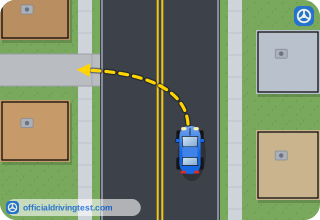
- As wide as possible, to the left side of the driveway
- At the far end of the driveway, after pulling off to the right
- As near as possible to the right side
- As near as possible to the left side
Show answer
Correct answer: As near as possible to the right side
You move close to the center of the road and turn into the driveway or alley as near as possible to the right side.
Source: Colorado Driver Handbook (DR 2337, January 2025), page 13 · Open this page in the manual (Manual page 13)
-
In a forward two-point turnabout, when do you stop after turning into the driveway or alley?
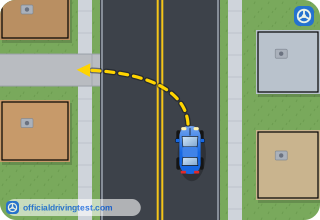
- When the front bumper reaches the far end of the driveway
- As the rear of your vehicle clears the curb or the driveway's edge
- When the rear wheels are well inside the driveway
- When the vehicle is centered in the road ahead
Show answer
Correct answer: As the rear of your vehicle clears the curb or the driveway's edge
You stop as the rear of your vehicle clears the curb or the driveway's edge.
Source: Colorado Driver Handbook (DR 2337, January 2025), page 13 · Open this page in the manual (Manual page 13)
-
After backing out in a forward two-point turnabout, what do you do once the vehicle is centered in the nearest lane?
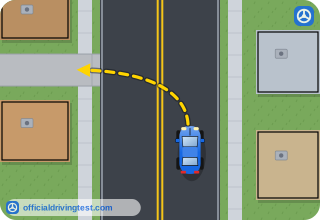
- Keep backing until you reach the far lane
- Leave the right signal on and drive forward
- Shift to park and wait for all traffic to clear
- Straighten the wheels and stop, then shift to drive
Show answer
Correct answer: Straighten the wheels and stop, then shift to drive
You straighten the wheels and stop, then shift to drive, cancel the right signal and move forward.
Source: Colorado Driver Handbook (DR 2337, January 2025), page 13 · Open this page in the manual (Manual page 13)
-
When is a three-point turnabout used?
- To reverse direction on a roadway too narrow for a U-turn
- To reverse direction on any road that has several lanes
- To enter a parking space on a busy city street
- To turn around on a freeway ramp or an interchange
Show answer
Correct answer: To reverse direction on a roadway too narrow for a U-turn
A three-point turnabout is for a roadway too narrow for a U-turn with no way to go around the block or use a two-point turn.
Source: Colorado Driver Handbook (DR 2337, January 2025), page 13 · Open this page in the manual (Manual page 13)
-
On what kind of roadway should a three-point turnabout only be used?
- A four-lane roadway
- A one-way street
- A two-lane roadway
- A roadway with a center turn lane
Show answer
Correct answer: A two-lane roadway
The handbook says to only use a three-point turnabout on a two-lane roadway.
Source: Colorado Driver Handbook (DR 2337, January 2025), page 13 · Open this page in the manual (Manual page 13)
-
What is the first step of a three-point turnabout?
- Signal left and turn hard left toward the other side
- Check mirrors, signal right, and stop on the right side
- Back up to the middle of the road
- Stop in the center of the road
Show answer
Correct answer: Check mirrors, signal right, and stop on the right side
You check mirrors, activate the right turn signal and stop on the right side of the road.
Source: Colorado Driver Handbook (DR 2337, January 2025), page 13 · Open this page in the manual (Manual page 13)
-
During a three-point turnabout, when should you activate your left turn signal before the turn?
- At least 100 feet before the turn, or one second
- Only after you have stopped on the other side
- At least 500 feet before the turn, or five seconds
- At least 200 feet before the turn, or three seconds
Show answer
Correct answer: At least 200 feet before the turn, or three seconds
The left turn signal goes on at least 200 feet before the turn, or a minimum of three seconds.
Source: Colorado Driver Handbook (DR 2337, January 2025), page 13 · Open this page in the manual (Manual page 13)
-
At the end of a three-point turnabout, what must you make sure of before continuing straight in the new direction?
- That your turn signal has canceled
- That your hazard lights are on
- That your headlights are on high beam
- That your emergency brake is set
Show answer
Correct answer: That your turn signal has canceled
The handbook says to make sure your turn signal has canceled, then continue driving straight.
Source: Colorado Driver Handbook (DR 2337, January 2025), page 13 · Open this page in the manual (Manual page 13)
-
Where are U-turns not allowed?
- On every street with a posted speed limit above 30 mph
- In locations marked by No U-turn signs
- On every street that has parked vehicles along it
- On every street within a residence district
Show answer
Correct answer: In locations marked by No U-turn signs
U-turns are not allowed in locations marked by No U-turn signs.
Source: Colorado Driver Handbook (DR 2337, January 2025), page 13 · Open this page in the manual (Manual page 13)
-
Which side should you typically pass another vehicle on?
- On the right
- On the shoulder
- On whichever side has more room
- On the left
Show answer
Correct answer: On the left
The handbook says that typically you should pass on the left.
Source: Colorado Driver Handbook (DR 2337, January 2025), page 15 · Open this page in the manual (Manual page 15)
-
When are you allowed to pass on the right?
- On one way streets and on roadways with two or more lanes of travel in each direction
- On any road with a paved shoulder or a turn lane available to use
- On two-lane roads when the driver ahead is going slowly enough
- On any road at all when no vehicle is coming from the opposite direction
Show answer
Correct answer: On one way streets and on roadways with two or more lanes of travel in each direction
Passing on the right is allowed only on one way streets and on roadways with two or more lanes of travel in each direction.
Source: Colorado Driver Handbook (DR 2337, January 2025), page 15 · Open this page in the manual (Manual page 15)
-
Are you allowed to pass another vehicle by driving off of the pavement or on the shoulder?
- Yes, when the vehicle ahead is slow
- Yes, when no oncoming traffic is in sight
- No, it is not allowed
- Yes, on rural roads
Show answer
Correct answer: No, it is not allowed
The handbook says you are not allowed to pass by driving off of the pavement or on the shoulder.
Source: Colorado Driver Handbook (DR 2337, January 2025), page 15 · Open this page in the manual (Manual page 15)
-
What does the handbook say to judge before deciding to pass another vehicle?
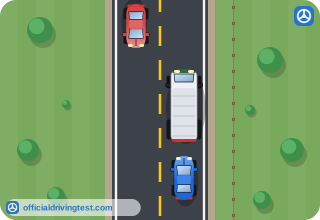
- Whether the driver ahead will move over to let you by
- Whether you will have enough time and room to pass safely
- Whether the road ahead has a paved shoulder to use
- Whether the vehicle ahead is traveling below the limit
Show answer
Correct answer: Whether you will have enough time and room to pass safely
The handbook says to judge whether you will have enough time and room to pass safely by observing the traffic ahead, beside and behind you.
Source: Colorado Driver Handbook (DR 2337, January 2025), page 15 · Open this page in the manual (Manual page 15)
-
After passing a vehicle, when may you return to your previous lane?
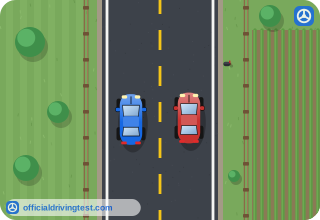
- As soon as your front bumper is past the other vehicle on the road
- When you are about one car length ahead of the other vehicle on the road
- When the driver of the other vehicle signals that you may return
- When you can see both headlights of the vehicle you passed in the rearview mirror
Show answer
Correct answer: When you can see both headlights of the vehicle you passed in the rearview mirror
The handbook says to change one lane back when you can see both headlights of the passed vehicle in the rearview mirror.
Source: Colorado Driver Handbook (DR 2337, January 2025), page 15 · Open this page in the manual (Manual page 15)