School Bus: Loading and unloading students — Part 3
Questions in this part include: “A student who must cross reaches the edge of the road. What does the student do about traffic?” · “All students have left the bus at school. Why do you walk through the bus?”
Independent educational site · not affiliated with any government agency or DMV
Ready? Test yourself
Answer to start, or tap Start below:
A student who must cross reaches the edge of the road. What does the student do about traffic?
- Instant feedback with an explanation
- Every answer cites its source in the manual
- Your best score is saved on this device
- Keyboard: press 1 to 3 to answer and Enter for the next question
Questions are written in our own words from the CDL manual; they are not the real test's questions. With your state chosen, every answer gives its page in your state's CDL manual. Without a state, answers cite the CDL manual, national model as printed by New Jersey (July 2017).
All 21 questions in this practice test
Take the test above first, then use this list to study. Tap “Show answer” to see the correct answer and explanation.
Show the questions and answersHide the questions
-
A student who must cross reaches the edge of the road. What does the student do about traffic?
- Look only toward the left, where the cars pass
- Pause and check every direction to be sure the road is clear
- Walk out fast while looking only at the bus driver
Show answer
Correct answer: Pause and check every direction to be sure the road is clear
At the road's edge the student stops and checks all directions. Crossing starts only when the road is clear.
Source: CDL manual, national model as printed by New Jersey, Section 10 (July 2017)
-
At the edge of the road, what should a student confirm about the bus before crossing?
- That the amber lights are flashing
- That the red lights are still flashing
- That the brake lights are lit
Show answer
Correct answer: That the red lights are still flashing
Before stepping out to cross, a student looks to see that the bus's red lights keep flashing.
Source: CDL manual, national model as printed by New Jersey, Section 10 (July 2017)
-
What must a student wait for before stepping onto the road to cross?
- A wave from the nearest car driver
- A gap in the traffic, with no signal needed
- A signal from the bus driver
Show answer
Correct answer: A signal from the bus driver
The student does not start across on his or her own. The bus driver gives a signal when it is time to cross.
Source: CDL manual, national model as printed by New Jersey, Section 10 (July 2017)
-
When the driver gives the signal, how far in front of the bus should students walk as they cross?
- Tight along the front of the bus, as near as the bumper allows
- Only to the front wheel, then straight across
- Far enough ahead that the driver can see them
Show answer
Correct answer: Far enough ahead that the driver can see them
Students pass in front of the bus at a distance that keeps them in the driver's view. Walking tight against the front hides them from the driver.
Source: CDL manual, national model as printed by New Jersey, Section 10 (July 2017)
-
Partway across the road, students reach the left edge of the bus. What should they do there?
- Stop and watch again for the driver's signal to go on
- Keep going without a pause, since the near lane is clear
- Step around to the rear of the bus and stop there
Show answer
Correct answer: Stop and watch again for the driver's signal to go on
At the left edge of the bus the students stop once more and look to the driver for the signal to continue. They do not simply walk on.
Source: CDL manual, national model as printed by New Jersey, Section 10 (July 2017)
-
While students walk across the road, what should they keep doing?
- Keeping their eyes on the bus driver
- Looking around in every direction
- Watching only the lane in front of them
Show answer
Correct answer: Looking around in every direction
Even with the driver's signal, a student keeps checking all directions while crossing. Traffic could still be a danger.
Source: CDL manual, national model as printed by New Jersey, Section 10 (July 2017)
-
Which rules about how students act outside the bus are the driver expected to enforce?
- The rules the parents of each student set
- Rules and advice from the state and the local area
- The rules the bus company sets for student riders
Show answer
Correct answer: Rules and advice from the state and the local area
The driver sees that students follow what the state and local authorities require or recommend for their behavior outside the bus.
Source: CDL manual, national model as printed by New Jersey, Section 10 (July 2017)
-
Students are unloaded at a school, for example in a parking lot off the public road. How do the laws for this compare with the laws for unloading at stops along the route?
- They are the same everywhere, so nothing changes
- None apply, because the bus is off the road
- They are often different from the route rules
Show answer
Correct answer: They are often different from the route rules
Unloading at a school, especially off the traveled road, is often governed by different state and local rules than unloading along the route. The driver must know and obey them.
Source: CDL manual, national model as printed by New Jersey, Section 10 (July 2017)
-
You stop at the school unloading area. How do you secure the bus before the students leave?
- Set the parking brake and leave the engine idling for the heater
- Leave the key in the ignition and switch on the hazard lights
- Turn off the ignition; take the key if leaving the driver's compartment
Show answer
Correct answer: Turn off the ignition; take the key if leaving the driver's compartment
At school the bus is secured by switching the ignition off. The key comes out whenever the driver leaves the driver's compartment.
Source: CDL manual, national model as printed by New Jersey, Section 10 (July 2017)
-
How should students leave the bus at a school unloading area?
- In an orderly way, without rushing past each other
- Front seats last, after you open the rear door
- Younger students first, then the older ones
Show answer
Correct answer: In an orderly way, without rushing past each other
At the school unloading area the driver has students get off calmly and in order.
Source: CDL manual, national model as printed by New Jersey, Section 10 (July 2017)
-
Students are stepping off the bus at school. What should you watch them do?
- Move quickly away from the unloading area
- Line up next to the door and wait for you
- Stop at the door so you can count each one
Show answer
Correct answer: Move quickly away from the unloading area
While students step off, the driver watches to see that every one of them moves promptly away from the unloading area.
Source: CDL manual, national model as printed by New Jersey, Section 10 (July 2017)
-
All students have left the bus at school. Why do you walk through the bus?
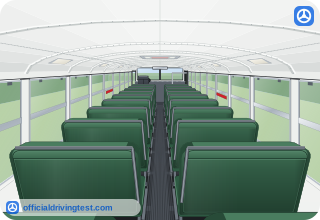
- To find hiding or sleeping students and left items
- To record which seats the students used that day
- To count the empty seats for the trip log
Show answer
Correct answer: To find hiding or sleeping students and left items
A walk through the empty bus finds students who are asleep or hiding, and belongings they left behind.
Source: CDL manual, national model as printed by New Jersey, Section 10 (July 2017)
-
At school you cannot account for a student outside, and the bus is secure. What do you do?
- Move the bus a few feet and see if the student appears
- Wait in your seat until the student comes to you
- Look around and underneath the bus
Show answer
Correct answer: Look around and underneath the bus
A student you cannot see may be next to or under the bus. Once the bus is secured, check around and underneath it before moving.
Source: CDL manual, national model as printed by New Jersey, Section 10 (July 2017)
-
At the school unloading area, what do you do right after closing the door, before engaging the transmission?
- Turn on the amber lights and test the horn
- Check the fuel gauge and reset the mirrors
- Fasten your safety belt and start the engine
Show answer
Correct answer: Fasten your safety belt and start the engine
After the door is closed, the driver fastens the safety belt and starts the engine, then engages the transmission. The bus was shut off earlier, when it was secured at the school.
Source: CDL manual, national model as printed by New Jersey, Section 10 (July 2017)
-
As students walk toward the bus, what should your attention stay on?
- Traffic in the mirrors on the left side
- The door controls and the stop arm switch
- The students, especially any who drop out of view
Show answer
Correct answer: The students, especially any who drop out of view
A student who vanishes from view near the bus may be in danger, so the driver keeps watching the students as they come.
Source: CDL manual, national model as printed by New Jersey, Section 10 (July 2017)
-
Why is it dangerous when a student stops or goes back to pick up a dropped item near the bus?
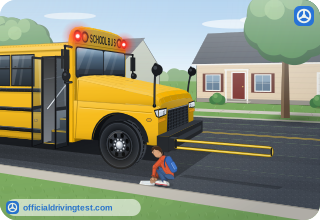
- The student may block the other students at the door
- The student may drop out of the driver's sight
- The student may miss your signal to cross
Show answer
Correct answer: The student may drop out of the driver's sight
A student bending or turning back for an object can end up where the driver cannot see them, at a very dangerous moment.
Source: CDL manual, national model as printed by New Jersey, Section 10 (July 2017)
-
A student drops something next to the bus. What should students be taught to do?
- Leave it, move to safety, and get the driver's attention
- Pick it up fast and hurry back to the line
- Crouch beside it and wait for the driver to look
Show answer
Correct answer: Leave it, move to safety, and get the driver's attention
A student who bends down or goes back for an object can vanish from the driver's view. Students should leave it, step out of the danger zones, and signal the driver.
Source: CDL manual, national model as printed by New Jersey, Section 10 (July 2017)
-
What has injured or killed students as they stepped off a school bus?
- Clothing or a body part snagged in the handrail or door
- The stop signal arm swinging out right beside them
- The bottom step folding up suddenly under their feet
Show answer
Correct answer: Clothing or a body part snagged in the handrail or door
Clothes, bags or even body parts can snag in the handrail or door as a student steps out, so the driver should closely watch every student exiting and confirm each is in a safe location before moving.
Source: CDL manual, national model as printed by New Jersey, Section 10 (July 2017)
-
When do you do a post-trip inspection of a school bus?
- Only at the start of the school week
- When the route or activity trip is done
- Only after a student reports a problem
Show answer
Correct answer: When the route or activity trip is done
A post-trip inspection is done each time a route or school activity trip ends, by walking through and around the bus.
Source: CDL manual, national model as printed by New Jersey, Section 10 (July 2017)
-
During the post-trip inspection, which parts that only school buses have need special attention?
- The wipers, the horn and the fuel cap
- The seat covers, the heater and the radio
- The mirrors, the flashing lights and the stop arm
Show answer
Correct answer: The mirrors, the flashing lights and the stop arm
The mirror systems, the flashing warning lamps and the stop signal arm are the school-bus items to check closely after a trip.
Source: CDL manual, national model as printed by New Jersey, Section 10 (July 2017)
-
You find a problem during the post-trip inspection. What do you do about it?
- Mention it at the next weekly safety meeting
- Repair it yourself before you go home tonight
- Tell your supervisor or school authorities right away
Show answer
Correct answer: Tell your supervisor or school authorities right away
Problems and unusual situations found after a trip are reported at once to the supervisor or school authorities.
Source: CDL manual, national model as printed by New Jersey, Section 10 (July 2017)