School Bus: 20 Hardest Questions
Questions that need a second thought, picked for close numbers, exceptions and easy-to-confuse rules. Take your time.
Independent educational site · not affiliated with any government agency or DMV
Ready? Test yourself
Answer to start, or tap Start below:
A driver realizes the bus has gone past a student's drop-off stop. What should the driver do?
- Instant feedback with an explanation
- Every answer cites its source in the manual
- Your best score is saved on this device
- Keyboard: press 1 to 3 to answer and Enter for the next question
Questions are written in our own words from the CDL manual; they are not the real test's questions. With your state chosen, every answer gives its page in your state's CDL manual. Without a state, answers cite the CDL manual, national model as printed by New Jersey (July 2017).
All 20 questions in this practice test
Take the test above first, then use this list to study. Tap “Show answer” to see the correct answer and explanation.
Show the questions and answersHide the questions
-
A driver realizes the bus has gone past a student's drop-off stop. What should the driver do?
- Keep going forward and follow the local procedures
- Back up slowly to the stop with the hazard lights on
- Stop in the road and let the student walk back alone
Show answer
Correct answer: Keep going forward and follow the local procedures
A bus that has passed a student's stop is not backed up to it. The driver follows the local procedures for handling the missed stop.
Source: CDL manual, national model as printed by New Jersey, Section 10 (July 2017)
-
Where is a blind spot of the outside flat mirrors?
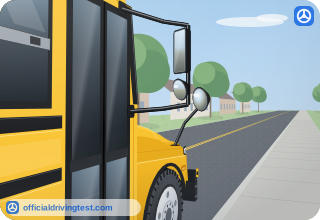
- Directly below and in front of each mirror
- Along the whole length of each side of the bus
- Above each mirror toward the roof line
Show answer
Correct answer: Directly below and in front of each mirror
The flat mirrors cannot show the spot right under and ahead of each mirror, or the spot just behind the rear bumper.
Source: CDL manual, national model as printed by New Jersey, Section 10 (July 2017)
-
Which situation makes evacuation required rather than optional?
- Another vehicle is about to hit the bus
- Power lines are down near the bus
- A student may have a neck injury
Show answer
Correct answer: Another vehicle is about to hit the bus
If a collision is about to happen, the driver has to get students off the bus.
Source: CDL manual, national model as printed by New Jersey, Section 10 (July 2017)
-
You have to back up at a place where you drop students off. When should they get off?
- Before you back, so the area is clear
- While you back, to save time
- After you finish backing
Show answer
Correct answer: After you finish backing
Students must be unloaded only after the backing is done, so none are outside the bus while it moves in reverse.
Source: CDL manual, national model as printed by New Jersey, Section 10 (July 2017)
-
At the school campus, when must you take the key out of the ignition?
- Whenever you step out of the driver's area
- Only when the bus is parked for the night
- Always, as soon as the bus stops
Show answer
Correct answer: Whenever you step out of the driver's area
The key is removed when the driver leaves the driver's compartment.
Source: CDL manual, national model as printed by New Jersey, Section 10 (July 2017)
-
Which view tells you the overhead inside mirror is set at the right height?
- The roof line across the top of the mirror
- The rear window's top edge at the mirror's top
- The center of the aisle in the middle of the mirror
Show answer
Correct answer: The rear window's top edge at the mirror's top
The vertical aim is right when the upper edge of the rear window appears along the top of the mirror.
Source: CDL manual, national model as printed by New Jersey, Section 10 (July 2017)
-
When the radio is missing or broken, who should the driver send for help first?
- Two older, responsible students
- A passing motorist or area resident
- The student sitting closest to the door
Show answer
Correct answer: A passing motorist or area resident
Without a working radio, the driver sends a passing motorist or a nearby resident to call for help.
Source: CDL manual, national model as printed by New Jersey, Section 10 (July 2017)
-
You post a lookout to help you back the bus. What should the lookout do?
- Tell you which way to turn the steering wheel
- Hold traffic back so you can back into the road
- Call out objects, people or cars in your way
Show answer
Correct answer: Call out objects, people or cars in your way
The lookout reports what is in the way, such as obstacles, people or vehicles, and does not direct how the backing is done.
Source: CDL manual, national model as printed by New Jersey, Section 10 (July 2017)
-
About how far ahead of the place where you will pull over should you switch on the right turn signal?
- 25 to 50 feet, about 1 second ahead
- 100 to 300 feet, about 3 to 5 seconds ahead
- 500 to 700 feet, about 15 seconds ahead
Show answer
Correct answer: 100 to 300 feet, about 3 to 5 seconds ahead
The right turn signal should be on about 100 to 300 feet, or 3 to 5 seconds, before the bus pulls over, so following drivers know the bus is about to stop.
Source: CDL manual, national model as printed by New Jersey, Section 10 (July 2017)
-
A crossing has several sets of tracks. Where does the bus make its stop?
- Before every set of tracks
- Only before the first set of tracks
- Between the second and third set of tracks
Show answer
Correct answer: Only before the first set of tracks
The bus stops once, before the first set. When no train is coming on any track, it goes across all of them without stopping again.
Source: CDL manual, national model as printed by New Jersey, Section 10 (July 2017)
-
Which mirrors must you use to watch traffic coming into the large blind area behind the bus?
- The overhead inside rearview mirror
- The exterior side mirrors
- The crossover mirrors
Show answer
Correct answer: The exterior side mirrors
The inside mirror cannot cover the long blind area behind the bus, so the outside side mirrors must be used to follow traffic entering it.
Source: CDL manual, national model as printed by New Jersey, Section 10 (July 2017)
-
On an older ABS system, how long might the yellow lamp stay on after start-up?
- Until the engine has warmed up fully
- Until the parking brake is released
- Until the bus is going over five mph
Show answer
Correct answer: Until the bus is going over five mph
With older systems the lamp can remain lit until the bus is driven faster than five mph.
Source: CDL manual, national model as printed by New Jersey, Section 10 (July 2017)
-
At the school unloading area, what do you do right after closing the door, before engaging the transmission?
- Turn on the amber lights and test the horn
- Check the fuel gauge and reset the mirrors
- Fasten your safety belt and start the engine
Show answer
Correct answer: Fasten your safety belt and start the engine
After the door is closed, the driver fastens the safety belt and starts the engine, then engages the transmission. The bus was shut off earlier, when it was secured at the school.
Source: CDL manual, national model as printed by New Jersey, Section 10 (July 2017)
-
Along the road, in which direction from the bus should a safe place be?
- Toward the oncoming traffic
- Away from the oncoming traffic
- Right beside the bus's service door
Show answer
Correct answer: Toward the oncoming traffic
The safe place lies off the road on the side toward oncoming traffic.
Source: CDL manual, national model as printed by New Jersey, Section 10 (July 2017)
-
Which skid can ABS NOT stop from happening?
- A skid from braking too hard on a wet road
- A skid from locked steering wheels while braking
- A skid from entering a curve at too high a speed
Show answer
Correct answer: A skid from entering a curve at too high a speed
ABS works against skids caused by braking. It cannot stop a skid that comes from spinning the drive wheels or from taking a turn too fast.
Source: CDL manual, national model as printed by New Jersey, Section 10 (July 2017)
-
In the danger zone ahead of a school bus, which stretch is the most dangerous?
- The first 10 feet next to the bumper
- The outer 10 feet at the far edge of the zone
- The middle stretch of the zone, about 10 feet wide
Show answer
Correct answer: The first 10 feet next to the bumper
The 10 feet right in front of the bumper are the riskiest part of the zone ahead of the bus.
Source: CDL manual, national model as printed by New Jersey, Section 10 (July 2017)
-
The gate lowers when the bus is already on the tracks. What should the driver do?
- Stop on the tracks and wait for the gate to rise
- Drive through the gate, even if it breaks
- Back up quickly to the stop line
Show answer
Correct answer: Drive through the gate, even if it breaks
Once the bus has started across and the gate comes down, the driver keeps going and drives through the gate, even if it breaks.
Source: CDL manual, national model as printed by New Jersey, Section 10 (July 2017)
-
When leaving a loading stop on the route, what do you do right before turning off the red lights?
- Turn on the left turn signal
- Check all mirrors again
- Release the parking brake
Show answer
Correct answer: Release the parking brake
The parking brake is released just before the red lights are turned off.
Source: CDL manual, national model as printed by New Jersey, Section 10 (July 2017)
-
Air-braked trucks, buses, trailers and converter dollies must have ABS if they were built on or after which date?
- March 1, 1996
- March 1, 2000
- March 1, 1998
Show answer
Correct answer: March 1, 1998
The Department of Transportation requires ABS on air-braked vehicles built on or after March 1, 1998.
Source: CDL manual, national model as printed by New Jersey, Section 10 (July 2017)
-
The bus stalls on the tracks. Where should the students be led?
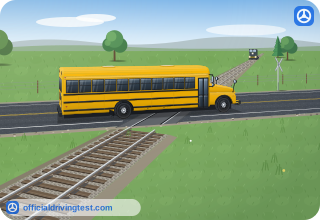
- Far from the bus, angled away from tracks, toward the train
- Straight back along the tracks, away from the train
- Far from the bus, angled away from the tracks and the train
Show answer
Correct answer: Far from the bus, angled away from tracks, toward the train
Everyone leaves the tracks at once and goes well away from the bus at an angle, away from the tracks but in the direction the train comes from.
Source: CDL manual, national model as printed by New Jersey, Section 10 (July 2017)