School Bus: Loading and unloading students
Approaching and making a stop, loading and unloading on the route and at school, students who cross the road, dropped objects, handrail hang-ups and the post-trip inspection. Split into 3 shorter tests so you're not stuck in one long quiz.
Independent educational site · not affiliated with any government agency or DMV
Choose a part
Loading and unloading students — Part 1
Questions in this part include: “Besides the general steps for loading and unloading, what must a driver learn and obey?”
Loading and unloading students — Part 2
Questions in this part include: “After the students are seated, what are you looking for as you check the mirrors again?”
Loading and unloading students — Part 3
Questions in this part include: “A student who must cross reaches the edge of the road. What does the student do about traffic?”
Questions are written in our own words from the CDL manual; they are not the real test's questions. With your state chosen, every answer gives its page in your state's CDL manual. Without a state, answers cite the CDL manual, national model as printed by New Jersey (July 2017).
All 63 Loading and unloading students questions with answers
Choose a part above to take a practice test, or study every question and answer here.
Show the questions and answersHide the questions
1Part 121 questions
-
Each year, how do the numbers of students killed while boarding or leaving a school bus compare with those killed riding inside it?
- More die while boarding or leaving the bus
- More die while riding inside the bus
- The two groups are about equal each year
Show answer
Correct answer: More die while boarding or leaving the bus
Getting on and off the bus is more deadly than riding in it, so a driver's actions at every point of loading and unloading are critical.
Source: CDL manual, national model as printed by New Jersey, Section 10 (July 2017)
-
Besides the general steps for loading and unloading, what must a driver learn and obey?
- The laws and rules of the driver's own state
- The rules of the state where the bus was built
- The rules the bus company sets for its drivers
Show answer
Correct answer: The laws and rules of the driver's own state
The general steps do not replace the law. A driver must know and follow the loading and unloading rules that apply in his or her own state.
Source: CDL manual, national model as printed by New Jersey, Section 10 (July 2017)
-
Who must approve in writing before you move a bus stop to a new place?
- A school district administrator
- The parents of the students at that stop
- The local police department
Show answer
Correct answer: A school district administrator
The school district sets the routes and stops, so only a person from the district can approve a new stop location, and the approval must be in writing.
Source: CDL manual, national model as printed by New Jersey, Section 10 (July 2017)
-
How should you drive as you come up to a school bus stop?
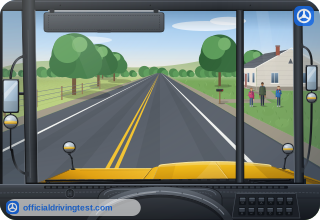
- At normal route speed, then brake hard at the stop
- Slowly and with great care
- Quickly, to keep the route on schedule
Show answer
Correct answer: Slowly and with great care
A stop is a demanding place, with children and traffic close by. The bus should come in slowly and carefully.
Source: CDL manual, national model as printed by New Jersey, Section 10 (July 2017)
-
When should you watch for pedestrians, traffic and objects around a stop?
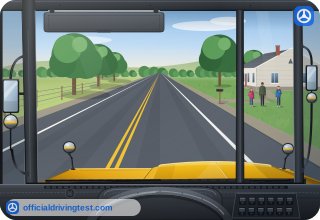
- Before, during and after the stop
- Only while the service door is open
- Only after the bus has come to a complete stop
Show answer
Correct answer: Before, during and after the stop
Danger can appear at any moment around a stop, so the driver keeps looking before the bus stops, while it stops and after it has stopped.
Source: CDL manual, national model as printed by New Jersey, Section 10 (July 2017)
-
How often should you look in the mirrors while coming up to a school bus stop?
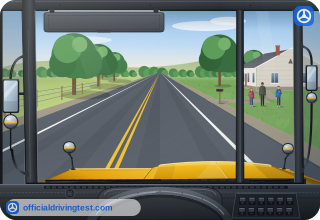
- Once, just before the bus stops
- Continuously, all the way in
- Only after the door has been opened
Show answer
Correct answer: Continuously, all the way in
On the approach the driver keeps checking all the mirrors without a break.
Source: CDL manual, national model as printed by New Jersey, Section 10 (July 2017)
-
On a bus with amber warning lights, how far before the stop should you start flashing them?
- At least 75 feet, about 2 seconds ahead
- At least 200 feet, about 5 to 10 seconds ahead
- At least 500 feet, about 30 seconds ahead
Show answer
Correct answer: At least 200 feet, about 5 to 10 seconds ahead
The amber lights warn other drivers early, so they go on at least 200 feet, or roughly 5 to 10 seconds, before the stop unless state law says otherwise.
Source: CDL manual, national model as printed by New Jersey, Section 10 (July 2017)
-
About how far ahead of the place where you will pull over should you switch on the right turn signal?
- 25 to 50 feet, about 1 second ahead
- 100 to 300 feet, about 3 to 5 seconds ahead
- 500 to 700 feet, about 15 seconds ahead
Show answer
Correct answer: 100 to 300 feet, about 3 to 5 seconds ahead
The right turn signal should be on about 100 to 300 feet, or 3 to 5 seconds, before the bus pulls over, so following drivers know the bus is about to stop.
Source: CDL manual, national model as printed by New Jersey, Section 10 (July 2017)
-
Where on the road should the bus be when you stop for students?
- As far to the right as possible on the roadway
- Near the center of the lane, for the best view
- Fully off the road on the shoulder
Show answer
Correct answer: As far to the right as possible on the roadway
The bus moves as far right as possible on the traveled part of the road when it stops.
Source: CDL manual, national model as printed by New Jersey, Section 10 (July 2017)
-
At the stop, what is the shortest allowed distance between the front bumper and the waiting students?
- 10 feet
- 3 feet
- 25 feet
Show answer
Correct answer: 10 feet
Stopping at least 10 feet back makes the students walk to the bus, which lets the driver see how they move.
Source: CDL manual, national model as printed by New Jersey, Section 10 (July 2017)
-
Once the bus has stopped to pick up students, what should you do with the transmission and parking brake?
- Keep it in gear and hold the bus with the service brake
- Use Neutral and leave the parking brake off for a quick start
- Select Park, or Neutral if there is no Park, and set the parking brake
Show answer
Correct answer: Select Park, or Neutral if there is no Park, and set the parking brake
At every stop the bus is secured by putting the transmission in Park (or in Neutral when there is no Park position) and setting the parking brake.
Source: CDL manual, national model as printed by New Jersey, Section 10 (July 2017)
-
When do you switch on the alternating red lights, and what must be out?
- When traffic is a safe distance back; the stop arm out
- With the amber lights, 200 feet before the stop; the door open
- After students start crossing; the crossing control arm out
Show answer
Correct answer: When traffic is a safe distance back; the stop arm out
The red lights go on once other traffic is a safe distance from the bus, and the stop arm must be extended to warn drivers to stop.
Source: CDL manual, national model as printed by New Jersey, Section 10 (July 2017)
-
Before you fully open the door and wave students forward, what must you confirm?
- The stop arm has been folded back in
- The right turn signal has been turned off
- All the traffic around the bus has stopped
Show answer
Correct answer: All the traffic around the bus has stopped
Students must not move toward the bus until the driver has seen that every vehicle has actually stopped.
Source: CDL manual, national model as printed by New Jersey, Section 10 (July 2017)
-
How should students wait for the bus to arrive at a stop?
- Standing at the road edge, ready to step toward the door
- At the curb, with their backs to the road
- In their set waiting place, turned toward the oncoming bus
Show answer
Correct answer: In their set waiting place, turned toward the oncoming bus
Students wait in the place chosen for them and face the bus as it comes.
Source: CDL manual, national model as printed by New Jersey, Section 10 (July 2017)
-
When are students allowed to start boarding?
- As soon as the bus stops moving
- When the driver gives them the signal
- When the last car behind the bus has passed
Show answer
Correct answer: When the driver gives them the signal
The driver decides when it is safe, so students walk to the bus only after the driver signals them.
Source: CDL manual, national model as printed by New Jersey, Section 10 (July 2017)
-
How can you be sure every student waiting at a stop got on the bus?
- Count them at the stop, then confirm that many got on
- Look at the seats once the bus is moving
- Count only the students you see in the mirror
Show answer
Correct answer: Count them at the stop, then confirm that many got on
Counting the students at the stop and making sure that same number boards shows whether anyone has been left behind.
Source: CDL manual, national model as printed by New Jersey, Section 10 (July 2017)
-
What should you try to learn about the students at each of your stops, if you can?
- Their home phone numbers
- Their grade at school
- Their names
Show answer
Correct answer: Their names
Knowing the students by name helps the driver tell who is missing from a stop.
Source: CDL manual, national model as printed by New Jersey, Section 10 (July 2017)
-
A student who usually waits at the stop has not come. What should you do first?
- Ask the other students where that student is
- Sound the horn until the student appears
- Drive on and tell the school office later
Show answer
Correct answer: Ask the other students where that student is
The students at the stop may know where the missing child is, so ask them before deciding what to do.
Source: CDL manual, national model as printed by New Jersey, Section 10 (July 2017)
-
How should students climb aboard the bus?
- Slowly, side by side, holding the handrail
- Quickly, in single file, without touching the rail
- Slowly, one behind another, holding the handrail
Show answer
Correct answer: Slowly, one behind another, holding the handrail
Students board slowly, in one line, and use the handrail.
Source: CDL manual, national model as printed by New Jersey, Section 10 (July 2017)
-
Which light should be on when students board in the dark?
- The hazard lights
- The high-beam headlights
- The dome light
Show answer
Correct answer: The dome light
The dome light should be on while students load in the dark.
Source: CDL manual, national model as printed by New Jersey, Section 10 (July 2017)
-
What should students be doing before the bus is allowed to move?
- Seated, in any position, as long as they are off the aisle
- Seated and facing the front
- Seated, with their belts checked by the driver
Show answer
Correct answer: Seated and facing the front
All students must be seated and facing forward before the bus moves.
Source: CDL manual, national model as printed by New Jersey, Section 10 (July 2017)
2Part 221 questions
-
After the students are seated, what are you looking for as you check the mirrors again?
- Whether another bus is waiting behind you
- Whether the amber lights are still flashing
- Anyone running to catch the bus
Show answer
Correct answer: Anyone running to catch the bus
Before pulling away, the driver looks in the mirrors for anyone hurrying toward the bus.
Source: CDL manual, national model as printed by New Jersey, Section 10 (July 2017)
-
You cannot tell where a student outside the bus is. What do you do?
- Make the bus safe, pocket the key, look around and under it
- Sound the horn and wait at the wheel
- Radio the school and wait for the student to appear
Show answer
Correct answer: Make the bus safe, pocket the key, look around and under it
The driver makes the bus safe, removes the key and checks all around and underneath it.
Source: CDL manual, national model as printed by New Jersey, Section 10 (July 2017)
-
When every student is accounted for and you are getting ready to pull away from a loading stop, what do you do about the door?
- Keep it open until the bus is moving
- Close it
- Leave it open a little for late students
Show answer
Correct answer: Close it
Closing the door is the first step of getting the bus ready to leave once all students are accounted for.
Source: CDL manual, national model as printed by New Jersey, Section 10 (July 2017)
-
When leaving a loading stop on the route, what step comes right after you close the door?
- Turn on the left turn signal
- Engage the transmission
- Turn off the alternating red lights
Show answer
Correct answer: Engage the transmission
After the door is closed, the driver puts the bus in gear, then releases the parking brake and continues with the remaining steps.
Source: CDL manual, national model as printed by New Jersey, Section 10 (July 2017)
-
When leaving a loading stop on the route, what do you do right before turning off the red lights?
- Turn on the left turn signal
- Check all mirrors again
- Release the parking brake
Show answer
Correct answer: Release the parking brake
The parking brake is released just before the red lights are turned off.
Source: CDL manual, national model as printed by New Jersey, Section 10 (July 2017)
-
What must you do with the alternating flashing red lights as you prepare to leave the stop?
- Turn them off
- Switch them over to the amber lights
- Keep them on until the bus has entered traffic
Show answer
Correct answer: Turn them off
The red lights tell traffic that students are loading, so they are turned off once all students are aboard and the bus is getting ready to move.
Source: CDL manual, national model as printed by New Jersey, Section 10 (July 2017)
-
Which signal do you turn on while getting ready to pull away from the loading stop?
- The left turn signal
- The right turn signal
- The hazard lights
Show answer
Correct answer: The left turn signal
The left signal tells other drivers that the bus is about to pull out and rejoin traffic.
Source: CDL manual, national model as printed by New Jersey, Section 10 (July 2017)
-
Just before moving the bus away from a loaded stop, what should you do about the mirrors?
- Rely on the check made when students boarded
- Look only in the left mirror, since traffic passes there
- Look in every mirror again
Show answer
Correct answer: Look in every mirror again
Things change while the bus is stopped, so the driver looks in every mirror one more time before pulling out.
Source: CDL manual, national model as printed by New Jersey, Section 10 (July 2017)
-
Traffic around the stop is bunched up when you are ready to go. What should you do?
- Edge out slowly so the cars have to give way
- Let the congestion thin out before moving
- Switch on the red lights again to hold the cars back
Show answer
Correct answer: Let the congestion thin out before moving
Pulling out into crowded traffic is risky, so the driver waits for the congestion to clear and then moves when it is safe.
Source: CDL manual, national model as printed by New Jersey, Section 10 (July 2017)
-
When students board at the school campus, what should you do with the ignition?
- Leave the engine idling so the bus stays warm
- Switch it off only after the last student sits down
- Turn it off
Show answer
Correct answer: Turn it off
At the school campus the driver turns the ignition off while students load.
Source: CDL manual, national model as printed by New Jersey, Section 10 (July 2017)
-
At the school campus, when must you take the key out of the ignition?
- Whenever you step out of the driver's area
- Only when the bus is parked for the night
- Always, as soon as the bus stops
Show answer
Correct answer: Whenever you step out of the driver's area
The key is removed when the driver leaves the driver's compartment.
Source: CDL manual, national model as printed by New Jersey, Section 10 (July 2017)
-
Where should you be while students load at the school campus?
- At the back of the bus, watching the rear exit door
- Where you can supervise it, as state or local rules require
- Seated at the wheel with the key in the ignition
Show answer
Correct answer: Where you can supervise it, as state or local rules require
The driver takes the place from which loading can be supervised, as state or local regulations require or recommend.
Source: CDL manual, national model as printed by New Jersey, Section 10 (July 2017)
-
At a stop on the route, when may students get up from their seats to leave the bus?
- As soon as the bus comes to a full stop
- Only after the driver tells them to leave
- Once the first student has opened the door
Show answer
Correct answer: Only after the driver tells them to leave
Students stay in their seats until the driver gives the word to get off. This keeps the exit orderly while the driver checks traffic and mirrors.
Source: CDL manual, national model as printed by New Jersey, Section 10 (July 2017)
-
Why does the driver count students as they get off at a stop?
- To know where every student is before the bus pulls away
- To report the stop's attendance to the school office
- To check that each student paid the right fare
Show answer
Correct answer: To know where every student is before the bus pulls away
Counting students off the bus tells the driver that each one is accounted for and where they are. The bus should not move until that is certain.
Source: CDL manual, national model as printed by New Jersey, Section 10 (July 2017)
-
After students step off the bus along the route, where should they walk to?
- Close to the bus wall, within 2 feet of its side
- A place 10 feet from the bus, where the driver sees all
- To the rear of the bus, near the back bumper
Show answer
Correct answer: A place 10 feet from the bus, where the driver sees all
Students walk clear of the bus, to a place where the driver sees every one of them. Standing against the bus keeps them where the driver cannot watch them.
Source: CDL manual, national model as printed by New Jersey, Section 10 (July 2017)
-
Once the students have unloaded, what is the driver looking for when checking the mirrors again?
- Whether the driver of another bus is waiting behind
- Whether the next stop's students are in sight ahead
- Any student still near the bus or coming back to it
Show answer
Correct answer: Any student still near the bus or coming back to it
A last look in the mirrors makes sure nobody is beside the bus or running back toward it. Only then is it safe to move.
Source: CDL manual, national model as printed by New Jersey, Section 10 (July 2017)
-
After unloading, a driver cannot tell where one student has gone. What is the right action?
- Pull away slowly and watch the mirrors for the student
- Wait inside with the door shut until the student appears
- Secure the bus, then check around it and underneath it
Show answer
Correct answer: Secure the bus, then check around it and underneath it
The driver secures the bus and then walks around it and looks underneath. A student who cannot be seen may be in a spot where the bus could hit him or her.
Source: CDL manual, national model as printed by New Jersey, Section 10 (July 2017)
-
A driver realizes the bus has gone past a student's drop-off stop. What should the driver do?
- Keep going forward and follow the local procedures
- Back up slowly to the stop with the hazard lights on
- Stop in the road and let the student walk back alone
Show answer
Correct answer: Keep going forward and follow the local procedures
A bus that has passed a student's stop is not backed up to it. The driver follows the local procedures for handling the missed stop.
Source: CDL manual, national model as printed by New Jersey, Section 10 (July 2017)
-
What should a driver keep in mind about students who cross the street after leaving the bus?
- They can be trusted to follow every step once trained
- They may not always do what they have been taught
- They should be left to choose their own crossing point
Show answer
Correct answer: They may not always do what they have been taught
Students do not always act the way they have been taught. The driver stays alert and does not count on perfect behavior.
Source: CDL manual, national model as printed by New Jersey, Section 10 (July 2017)
-
A student who must cross the street walks toward the front of the bus first. Where should the student go?
- Right up to the bumper, so the driver sees the face
- Ten feet or more ahead of the bumper's right corner
- Beside the left front tire, next to the driver's door
Show answer
Correct answer: Ten feet or more ahead of the bumper's right corner
The student goes out in front of the bumper's right corner, well clear of the bus. Standing close to the front puts the student where the driver cannot see.
Source: CDL manual, national model as printed by New Jersey, Section 10 (July 2017)
-
A student stands at the right edge of the road before crossing. Which part of the student should the driver be able to see?
- The student's knees
- The student's feet
- The student's shoulders
Show answer
Correct answer: The student's feet
The student stops at the right edge of the road, and the driver should see the feet. This shows the student is in a place the driver can watch.
Source: CDL manual, national model as printed by New Jersey, Section 10 (July 2017)
3Part 321 questions
-
A student who must cross reaches the edge of the road. What does the student do about traffic?
- Look only toward the left, where the cars pass
- Pause and check every direction to be sure the road is clear
- Walk out fast while looking only at the bus driver
Show answer
Correct answer: Pause and check every direction to be sure the road is clear
At the road's edge the student stops and checks all directions. Crossing starts only when the road is clear.
Source: CDL manual, national model as printed by New Jersey, Section 10 (July 2017)
-
At the edge of the road, what should a student confirm about the bus before crossing?
- That the amber lights are flashing
- That the red lights are still flashing
- That the brake lights are lit
Show answer
Correct answer: That the red lights are still flashing
Before stepping out to cross, a student looks to see that the bus's red lights keep flashing.
Source: CDL manual, national model as printed by New Jersey, Section 10 (July 2017)
-
What must a student wait for before stepping onto the road to cross?
- A wave from the nearest car driver
- A gap in the traffic, with no signal needed
- A signal from the bus driver
Show answer
Correct answer: A signal from the bus driver
The student does not start across on his or her own. The bus driver gives a signal when it is time to cross.
Source: CDL manual, national model as printed by New Jersey, Section 10 (July 2017)
-
When the driver gives the signal, how far in front of the bus should students walk as they cross?
- Tight along the front of the bus, as near as the bumper allows
- Only to the front wheel, then straight across
- Far enough ahead that the driver can see them
Show answer
Correct answer: Far enough ahead that the driver can see them
Students pass in front of the bus at a distance that keeps them in the driver's view. Walking tight against the front hides them from the driver.
Source: CDL manual, national model as printed by New Jersey, Section 10 (July 2017)
-
Partway across the road, students reach the left edge of the bus. What should they do there?
- Stop and watch again for the driver's signal to go on
- Keep going without a pause, since the near lane is clear
- Step around to the rear of the bus and stop there
Show answer
Correct answer: Stop and watch again for the driver's signal to go on
At the left edge of the bus the students stop once more and look to the driver for the signal to continue. They do not simply walk on.
Source: CDL manual, national model as printed by New Jersey, Section 10 (July 2017)
-
While students walk across the road, what should they keep doing?
- Keeping their eyes on the bus driver
- Looking around in every direction
- Watching only the lane in front of them
Show answer
Correct answer: Looking around in every direction
Even with the driver's signal, a student keeps checking all directions while crossing. Traffic could still be a danger.
Source: CDL manual, national model as printed by New Jersey, Section 10 (July 2017)
-
Which rules about how students act outside the bus are the driver expected to enforce?
- The rules the parents of each student set
- Rules and advice from the state and the local area
- The rules the bus company sets for student riders
Show answer
Correct answer: Rules and advice from the state and the local area
The driver sees that students follow what the state and local authorities require or recommend for their behavior outside the bus.
Source: CDL manual, national model as printed by New Jersey, Section 10 (July 2017)
-
Students are unloaded at a school, for example in a parking lot off the public road. How do the laws for this compare with the laws for unloading at stops along the route?
- They are the same everywhere, so nothing changes
- None apply, because the bus is off the road
- They are often different from the route rules
Show answer
Correct answer: They are often different from the route rules
Unloading at a school, especially off the traveled road, is often governed by different state and local rules than unloading along the route. The driver must know and obey them.
Source: CDL manual, national model as printed by New Jersey, Section 10 (July 2017)
-
You stop at the school unloading area. How do you secure the bus before the students leave?
- Set the parking brake and leave the engine idling for the heater
- Leave the key in the ignition and switch on the hazard lights
- Turn off the ignition; take the key if leaving the driver's compartment
Show answer
Correct answer: Turn off the ignition; take the key if leaving the driver's compartment
At school the bus is secured by switching the ignition off. The key comes out whenever the driver leaves the driver's compartment.
Source: CDL manual, national model as printed by New Jersey, Section 10 (July 2017)
-
How should students leave the bus at a school unloading area?
- In an orderly way, without rushing past each other
- Front seats last, after you open the rear door
- Younger students first, then the older ones
Show answer
Correct answer: In an orderly way, without rushing past each other
At the school unloading area the driver has students get off calmly and in order.
Source: CDL manual, national model as printed by New Jersey, Section 10 (July 2017)
-
Students are stepping off the bus at school. What should you watch them do?
- Move quickly away from the unloading area
- Line up next to the door and wait for you
- Stop at the door so you can count each one
Show answer
Correct answer: Move quickly away from the unloading area
While students step off, the driver watches to see that every one of them moves promptly away from the unloading area.
Source: CDL manual, national model as printed by New Jersey, Section 10 (July 2017)
-
All students have left the bus at school. Why do you walk through the bus?
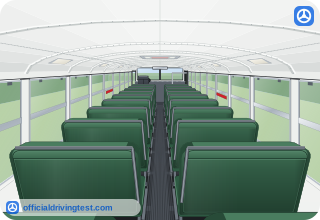
- To find hiding or sleeping students and left items
- To record which seats the students used that day
- To count the empty seats for the trip log
Show answer
Correct answer: To find hiding or sleeping students and left items
A walk through the empty bus finds students who are asleep or hiding, and belongings they left behind.
Source: CDL manual, national model as printed by New Jersey, Section 10 (July 2017)
-
At school you cannot account for a student outside, and the bus is secure. What do you do?
- Move the bus a few feet and see if the student appears
- Wait in your seat until the student comes to you
- Look around and underneath the bus
Show answer
Correct answer: Look around and underneath the bus
A student you cannot see may be next to or under the bus. Once the bus is secured, check around and underneath it before moving.
Source: CDL manual, national model as printed by New Jersey, Section 10 (July 2017)
-
At the school unloading area, what do you do right after closing the door, before engaging the transmission?
- Turn on the amber lights and test the horn
- Check the fuel gauge and reset the mirrors
- Fasten your safety belt and start the engine
Show answer
Correct answer: Fasten your safety belt and start the engine
After the door is closed, the driver fastens the safety belt and starts the engine, then engages the transmission. The bus was shut off earlier, when it was secured at the school.
Source: CDL manual, national model as printed by New Jersey, Section 10 (July 2017)
-
As students walk toward the bus, what should your attention stay on?
- Traffic in the mirrors on the left side
- The door controls and the stop arm switch
- The students, especially any who drop out of view
Show answer
Correct answer: The students, especially any who drop out of view
A student who vanishes from view near the bus may be in danger, so the driver keeps watching the students as they come.
Source: CDL manual, national model as printed by New Jersey, Section 10 (July 2017)
-
Why is it dangerous when a student stops or goes back to pick up a dropped item near the bus?
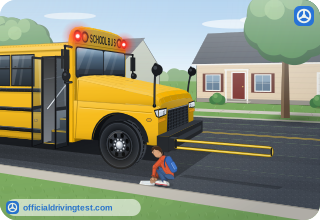
- The student may block the other students at the door
- The student may drop out of the driver's sight
- The student may miss your signal to cross
Show answer
Correct answer: The student may drop out of the driver's sight
A student bending or turning back for an object can end up where the driver cannot see them, at a very dangerous moment.
Source: CDL manual, national model as printed by New Jersey, Section 10 (July 2017)
-
A student drops something next to the bus. What should students be taught to do?
- Leave it, move to safety, and get the driver's attention
- Pick it up fast and hurry back to the line
- Crouch beside it and wait for the driver to look
Show answer
Correct answer: Leave it, move to safety, and get the driver's attention
A student who bends down or goes back for an object can vanish from the driver's view. Students should leave it, step out of the danger zones, and signal the driver.
Source: CDL manual, national model as printed by New Jersey, Section 10 (July 2017)
-
What has injured or killed students as they stepped off a school bus?
- Clothing or a body part snagged in the handrail or door
- The stop signal arm swinging out right beside them
- The bottom step folding up suddenly under their feet
Show answer
Correct answer: Clothing or a body part snagged in the handrail or door
Clothes, bags or even body parts can snag in the handrail or door as a student steps out, so the driver should closely watch every student exiting and confirm each is in a safe location before moving.
Source: CDL manual, national model as printed by New Jersey, Section 10 (July 2017)
-
When do you do a post-trip inspection of a school bus?
- Only at the start of the school week
- When the route or activity trip is done
- Only after a student reports a problem
Show answer
Correct answer: When the route or activity trip is done
A post-trip inspection is done each time a route or school activity trip ends, by walking through and around the bus.
Source: CDL manual, national model as printed by New Jersey, Section 10 (July 2017)
-
During the post-trip inspection, which parts that only school buses have need special attention?
- The wipers, the horn and the fuel cap
- The seat covers, the heater and the radio
- The mirrors, the flashing lights and the stop arm
Show answer
Correct answer: The mirrors, the flashing lights and the stop arm
The mirror systems, the flashing warning lamps and the stop signal arm are the school-bus items to check closely after a trip.
Source: CDL manual, national model as printed by New Jersey, Section 10 (July 2017)
-
You find a problem during the post-trip inspection. What do you do about it?
- Mention it at the next weekly safety meeting
- Repair it yourself before you go home tonight
- Tell your supervisor or school authorities right away
Show answer
Correct answer: Tell your supervisor or school authorities right away
Problems and unusual situations found after a trip are reported at once to the supervisor or school authorities.
Source: CDL manual, national model as printed by New Jersey, Section 10 (July 2017)