School Bus: Evacuation and railroad crossings — Part 1
Questions in this part include: “When an emergency begins, what comes first and matters most before the driver decides about evacuating?” · “When must the driver evacuate because of a hazardous materials spill?”
Independent educational site · not affiliated with any government agency or DMV
Ready? Test yourself
Answer to start, or tap Start below:
When an emergency begins, what comes first and matters most before the driver decides about evacuating?
- Instant feedback with an explanation
- Every answer cites its source in the manual
- Your best score is saved on this device
- Keyboard: press 1 to 3 to answer and Enter for the next question
Questions are written in our own words from the CDL manual; they are not the real test's questions. With your state chosen, every answer gives its page in your state's CDL manual. Without a state, answers cite the CDL manual, national model as printed by New Jersey (July 2017).
All 19 questions in this practice test
Take the test above first, then use this list to study. Tap “Show answer” to see the correct answer and explanation.
Show the questions and answersHide the questions
-
When an emergency begins, what comes first and matters most before the driver decides about evacuating?
- Recognize what the hazard is
- Ask students whether they feel safe
- Set out emergency warning devices
Show answer
Correct answer: Recognize what the hazard is
Spotting the danger comes before every other step in judging whether students must leave the bus.
Source: CDL manual, national model as printed by New Jersey, Section 10 (July 2017)
-
If there is time during an emergency, whom should the driver contact before deciding to evacuate?
- The school principal
- The dispatcher
- Each student's parents
Show answer
Correct answer: The dispatcher
When time allows, the driver tells the dispatcher what is happening before choosing to evacuate.
Source: CDL manual, national model as printed by New Jersey, Section 10 (July 2017)
-
In most emergencies, where are students best kept as long as staying adds no needless risk?
- Standing beside the road
- Aboard the bus
- Inside the closest building
Show answer
Correct answer: Aboard the bus
Control and safety are usually best when students stay on the bus, unless staying exposes them to unnecessary risk or injury.
Source: CDL manual, national model as printed by New Jersey, Section 10 (July 2017)
-
How quickly must the driver make the decision to evacuate?
- Promptly, before the chance to act is lost
- After waiting to see if the danger passes
- Only after all students are counted
Show answer
Correct answer: Promptly, before the chance to act is lost
The choice to evacuate cannot be put off; it has to be made in good time.
Source: CDL manual, national model as printed by New Jersey, Section 10 (July 2017)
-
With some hazardous spills, which choice can be the safer one for students?
- Keeping them aboard, away from contact
- Walking them through it to the far side
- Leading them 50 feet downwind
Show answer
Correct answer: Keeping them aboard, away from contact
Sometimes staying on the bus keeps students from touching the spilled material.
Source: CDL manual, national model as printed by New Jersey, Section 10 (July 2017)
-
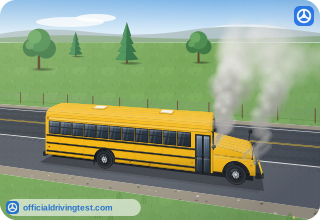
What must a driver do when the bus is burning or a fire may start?
- Wait for the fire department aboard
- Open the windows and stay seated
- Evacuate the bus
Show answer
Correct answer: Evacuate the bus
Fire or the threat of fire always requires getting students off the bus.
Source: CDL manual, national model as printed by New Jersey, Section 10 (July 2017)
-
In which situation must the driver evacuate the bus?
- The bus has stalled at or beside a rail crossing
- A student has a medical emergency
- The bus has stopped near downed power lines
Show answer
Correct answer: The bus has stalled at or beside a rail crossing
A bus stalled on or next to a railroad crossing is one of the cases where evacuation is required.
Source: CDL manual, national model as printed by New Jersey, Section 10 (July 2017)
-
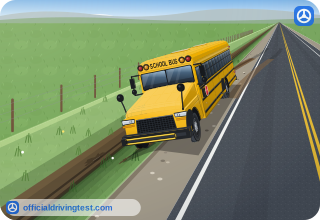
What must the driver do if the bus could shift position in a way that makes the danger greater?
- Keep students seated and wait
- Move the bus forward a little first
- Evacuate the bus
Show answer
Correct answer: Evacuate the bus
A bus whose position may change and worsen the danger has to be evacuated.
Source: CDL manual, national model as printed by New Jersey, Section 10 (July 2017)
-
Which situation makes evacuation required rather than optional?
- Another vehicle is about to hit the bus
- Power lines are down near the bus
- A student may have a neck injury
Show answer
Correct answer: Another vehicle is about to hit the bus
If a collision is about to happen, the driver has to get students off the bus.
Source: CDL manual, national model as printed by New Jersey, Section 10 (July 2017)
-
When must the driver evacuate because of a hazardous materials spill?
- Whenever any spill is seen on the road
- Only when the bus itself is leaking fuel
- When the spill creates a need to leave quickly
Show answer
Correct answer: When the spill creates a need to leave quickly
A hazardous materials spill requires evacuation when students need to be moved away from it quickly.
Source: CDL manual, national model as printed by New Jersey, Section 10 (July 2017)
-
When the driver can plan ahead, how many older student helpers should be given to each emergency exit?
- Two
- Three
- One
Show answer
Correct answer: Two
Two responsible older students at every exit are taught to help the others off the bus.
Source: CDL manual, national model as printed by New Jersey, Section 10 (July 2017)
-
Besides the helpers at the exits, what job goes to one more student assistant?
- Guiding evacuated students to a safe place
- Calling the dispatcher from the radio
- Writing down each student's name
Show answer
Correct answer: Guiding evacuated students to a safe place
A separate student assistant walks the evacuated students to a safe place.
Source: CDL manual, national model as printed by New Jersey, Section 10 (July 2017)
-
Why must every student, not just the older ones, be taught the evacuation procedures?
- Younger students open exits more quickly
- Older students are not allowed to help
- Responsible older students may not be aboard
Show answer
Correct answer: Responsible older students may not be aboard
There may be no responsible older students on the bus when an emergency happens, so everyone needs to know what to do.
Source: CDL manual, national model as printed by New Jersey, Section 10 (July 2017)
-
Besides knowing how to use the exits, what must all students learn about an evacuation?
- To follow all the driver's instructions
- To lead the others to the safe place
- To pick two helpers for each exit
Show answer
Correct answer: To follow all the driver's instructions
Students are taught to listen to the driver and carry out every instruction given.
Source: CDL manual, national model as printed by New Jersey, Section 10 (July 2017)
-
At the very least, how far off the road should a safe place for evacuated students be?
- 30 feet
- 100 feet
- 60 feet
Show answer
Correct answer: 100 feet
A safe place is 100 feet or more from the road, so students are not struck by debris if another vehicle hits the bus.
Source: CDL manual, national model as printed by New Jersey, Section 10 (July 2017)
-
Along the road, in which direction from the bus should a safe place be?
- Toward the oncoming traffic
- Away from the oncoming traffic
- Right beside the bus's service door
Show answer
Correct answer: Toward the oncoming traffic
The safe place lies off the road on the side toward oncoming traffic.
Source: CDL manual, national model as printed by New Jersey, Section 10 (July 2017)
-
If the bus is burning, where should the driver lead students?
- Upwind of the bus
- Toward the nearest ditch or culvert
- Downwind, at least 300 feet away
Show answer
Correct answer: Upwind of the bus
When fire is present, students are led upwind of the bus.
Source: CDL manual, national model as printed by New Jersey, Section 10 (July 2017)
-
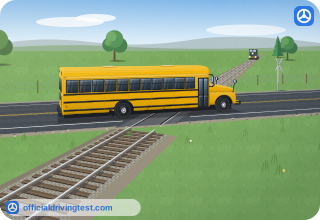
When a bus must be evacuated near railroad tracks, where should students be led?
- Near the tracks, to watch for the train
- Along the tracks, away from the train
- Far from the tracks, toward an oncoming train
Show answer
Correct answer: Far from the tracks, toward an oncoming train
Students should be taken as far from the tracks as possible, heading in the direction an oncoming train is coming from.
Source: CDL manual, national model as printed by New Jersey, Section 10 (July 2017)
-
If spilled hazardous materials are a risk, how far upwind of the bus should students be led, at the least?
- 150 feet
- 300 feet
- 500 feet
Show answer
Correct answer: 300 feet
With a hazardous spill, students go upwind at least 300 feet from the bus.
Source: CDL manual, national model as printed by New Jersey, Section 10 (July 2017)