School Bus: Loading and unloading students — Part 1
Questions in this part include: “Besides the general steps for loading and unloading, what must a driver learn and obey?” · “When do you switch on the alternating red lights, and what must be out?”
Independent educational site · not affiliated with any government agency or DMV
Ready? Test yourself
Answer to start, or tap Start below:
Each year, how do the numbers of students killed while boarding or leaving a school bus compare with those killed riding inside it?
- Instant feedback with an explanation
- Every answer cites its source in the manual
- Your best score is saved on this device
- Keyboard: press 1 to 3 to answer and Enter for the next question
Questions are written in our own words from the CDL manual; they are not the real test's questions. With your state chosen, every answer gives its page in your state's CDL manual. Without a state, answers cite the CDL manual, national model as printed by New Jersey (July 2017).
All 21 questions in this practice test
Take the test above first, then use this list to study. Tap “Show answer” to see the correct answer and explanation.
Show the questions and answersHide the questions
-
Each year, how do the numbers of students killed while boarding or leaving a school bus compare with those killed riding inside it?
- More die while boarding or leaving the bus
- More die while riding inside the bus
- The two groups are about equal each year
Show answer
Correct answer: More die while boarding or leaving the bus
Getting on and off the bus is more deadly than riding in it, so a driver's actions at every point of loading and unloading are critical.
Source: CDL manual, national model as printed by New Jersey, Section 10 (July 2017)
-
Besides the general steps for loading and unloading, what must a driver learn and obey?
- The laws and rules of the driver's own state
- The rules of the state where the bus was built
- The rules the bus company sets for its drivers
Show answer
Correct answer: The laws and rules of the driver's own state
The general steps do not replace the law. A driver must know and follow the loading and unloading rules that apply in his or her own state.
Source: CDL manual, national model as printed by New Jersey, Section 10 (July 2017)
-
Who must approve in writing before you move a bus stop to a new place?
- A school district administrator
- The parents of the students at that stop
- The local police department
Show answer
Correct answer: A school district administrator
The school district sets the routes and stops, so only a person from the district can approve a new stop location, and the approval must be in writing.
Source: CDL manual, national model as printed by New Jersey, Section 10 (July 2017)
-
How should you drive as you come up to a school bus stop?
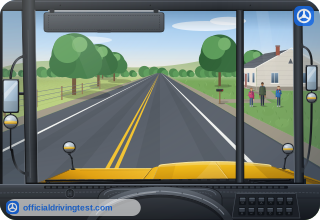
- At normal route speed, then brake hard at the stop
- Slowly and with great care
- Quickly, to keep the route on schedule
Show answer
Correct answer: Slowly and with great care
A stop is a demanding place, with children and traffic close by. The bus should come in slowly and carefully.
Source: CDL manual, national model as printed by New Jersey, Section 10 (July 2017)
-
When should you watch for pedestrians, traffic and objects around a stop?
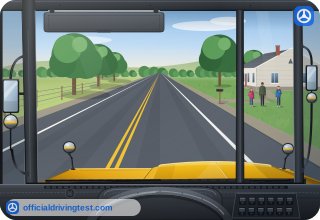
- Before, during and after the stop
- Only while the service door is open
- Only after the bus has come to a complete stop
Show answer
Correct answer: Before, during and after the stop
Danger can appear at any moment around a stop, so the driver keeps looking before the bus stops, while it stops and after it has stopped.
Source: CDL manual, national model as printed by New Jersey, Section 10 (July 2017)
-
How often should you look in the mirrors while coming up to a school bus stop?
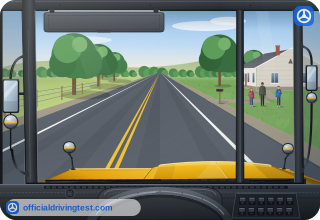
- Once, just before the bus stops
- Continuously, all the way in
- Only after the door has been opened
Show answer
Correct answer: Continuously, all the way in
On the approach the driver keeps checking all the mirrors without a break.
Source: CDL manual, national model as printed by New Jersey, Section 10 (July 2017)
-
On a bus with amber warning lights, how far before the stop should you start flashing them?
- At least 75 feet, about 2 seconds ahead
- At least 200 feet, about 5 to 10 seconds ahead
- At least 500 feet, about 30 seconds ahead
Show answer
Correct answer: At least 200 feet, about 5 to 10 seconds ahead
The amber lights warn other drivers early, so they go on at least 200 feet, or roughly 5 to 10 seconds, before the stop unless state law says otherwise.
Source: CDL manual, national model as printed by New Jersey, Section 10 (July 2017)
-
About how far ahead of the place where you will pull over should you switch on the right turn signal?
- 25 to 50 feet, about 1 second ahead
- 100 to 300 feet, about 3 to 5 seconds ahead
- 500 to 700 feet, about 15 seconds ahead
Show answer
Correct answer: 100 to 300 feet, about 3 to 5 seconds ahead
The right turn signal should be on about 100 to 300 feet, or 3 to 5 seconds, before the bus pulls over, so following drivers know the bus is about to stop.
Source: CDL manual, national model as printed by New Jersey, Section 10 (July 2017)
-
Where on the road should the bus be when you stop for students?
- As far to the right as possible on the roadway
- Near the center of the lane, for the best view
- Fully off the road on the shoulder
Show answer
Correct answer: As far to the right as possible on the roadway
The bus moves as far right as possible on the traveled part of the road when it stops.
Source: CDL manual, national model as printed by New Jersey, Section 10 (July 2017)
-
At the stop, what is the shortest allowed distance between the front bumper and the waiting students?
- 10 feet
- 3 feet
- 25 feet
Show answer
Correct answer: 10 feet
Stopping at least 10 feet back makes the students walk to the bus, which lets the driver see how they move.
Source: CDL manual, national model as printed by New Jersey, Section 10 (July 2017)
-
Once the bus has stopped to pick up students, what should you do with the transmission and parking brake?
- Keep it in gear and hold the bus with the service brake
- Use Neutral and leave the parking brake off for a quick start
- Select Park, or Neutral if there is no Park, and set the parking brake
Show answer
Correct answer: Select Park, or Neutral if there is no Park, and set the parking brake
At every stop the bus is secured by putting the transmission in Park (or in Neutral when there is no Park position) and setting the parking brake.
Source: CDL manual, national model as printed by New Jersey, Section 10 (July 2017)
-
When do you switch on the alternating red lights, and what must be out?
- When traffic is a safe distance back; the stop arm out
- With the amber lights, 200 feet before the stop; the door open
- After students start crossing; the crossing control arm out
Show answer
Correct answer: When traffic is a safe distance back; the stop arm out
The red lights go on once other traffic is a safe distance from the bus, and the stop arm must be extended to warn drivers to stop.
Source: CDL manual, national model as printed by New Jersey, Section 10 (July 2017)
-
Before you fully open the door and wave students forward, what must you confirm?
- The stop arm has been folded back in
- The right turn signal has been turned off
- All the traffic around the bus has stopped
Show answer
Correct answer: All the traffic around the bus has stopped
Students must not move toward the bus until the driver has seen that every vehicle has actually stopped.
Source: CDL manual, national model as printed by New Jersey, Section 10 (July 2017)
-
How should students wait for the bus to arrive at a stop?
- Standing at the road edge, ready to step toward the door
- At the curb, with their backs to the road
- In their set waiting place, turned toward the oncoming bus
Show answer
Correct answer: In their set waiting place, turned toward the oncoming bus
Students wait in the place chosen for them and face the bus as it comes.
Source: CDL manual, national model as printed by New Jersey, Section 10 (July 2017)
-
When are students allowed to start boarding?
- As soon as the bus stops moving
- When the driver gives them the signal
- When the last car behind the bus has passed
Show answer
Correct answer: When the driver gives them the signal
The driver decides when it is safe, so students walk to the bus only after the driver signals them.
Source: CDL manual, national model as printed by New Jersey, Section 10 (July 2017)
-
How can you be sure every student waiting at a stop got on the bus?
- Count them at the stop, then confirm that many got on
- Look at the seats once the bus is moving
- Count only the students you see in the mirror
Show answer
Correct answer: Count them at the stop, then confirm that many got on
Counting the students at the stop and making sure that same number boards shows whether anyone has been left behind.
Source: CDL manual, national model as printed by New Jersey, Section 10 (July 2017)
-
What should you try to learn about the students at each of your stops, if you can?
- Their home phone numbers
- Their grade at school
- Their names
Show answer
Correct answer: Their names
Knowing the students by name helps the driver tell who is missing from a stop.
Source: CDL manual, national model as printed by New Jersey, Section 10 (July 2017)
-
A student who usually waits at the stop has not come. What should you do first?
- Ask the other students where that student is
- Sound the horn until the student appears
- Drive on and tell the school office later
Show answer
Correct answer: Ask the other students where that student is
The students at the stop may know where the missing child is, so ask them before deciding what to do.
Source: CDL manual, national model as printed by New Jersey, Section 10 (July 2017)
-
How should students climb aboard the bus?
- Slowly, side by side, holding the handrail
- Quickly, in single file, without touching the rail
- Slowly, one behind another, holding the handrail
Show answer
Correct answer: Slowly, one behind another, holding the handrail
Students board slowly, in one line, and use the handrail.
Source: CDL manual, national model as printed by New Jersey, Section 10 (July 2017)
-
Which light should be on when students board in the dark?
- The hazard lights
- The high-beam headlights
- The dome light
Show answer
Correct answer: The dome light
The dome light should be on while students load in the dark.
Source: CDL manual, national model as printed by New Jersey, Section 10 (July 2017)
-
What should students be doing before the bus is allowed to move?
- Seated, in any position, as long as they are off the aisle
- Seated and facing the front
- Seated, with their belts checked by the driver
Show answer
Correct answer: Seated and facing the front
All students must be seated and facing forward before the bus moves.
Source: CDL manual, national model as printed by New Jersey, Section 10 (July 2017)