School Bus: Evacuation and railroad crossings — Part 4
Questions in this part include: “Where on the road should the bus be as it approaches a crossing, if possible?” · “The gate lowers when the bus is already on the tracks. What should the driver do?”
Independent educational site · not affiliated with any government agency or DMV
Ready? Test yourself
Answer to start, or tap Start below:
Where on the road should the bus be as it approaches a crossing, if possible?
- Instant feedback with an explanation
- Every answer cites its source in the manual
- Your best score is saved on this device
- Keyboard: press 1 to 3 to answer and Enter for the next question
Questions are written in our own words from the CDL manual; they are not the real test's questions. With your state chosen, every answer gives its page in your state's CDL manual. Without a state, answers cite the CDL manual, national model as printed by New Jersey (July 2017).
All 18 questions in this practice test
Take the test above first, then use this list to study. Tap “Show answer” to see the correct answer and explanation.
Show the questions and answersHide the questions
-
Where on the road should the bus be as it approaches a crossing, if possible?
- On the right side of the roadway
- Near the center line
- Straddling the shoulder and the lane
Show answer
Correct answer: On the right side of the roadway
The bus should keep to the right side of the road when it can on the way to the tracks.
Source: CDL manual, national model as printed by New Jersey, Section 10 (July 2017)
-
Why should the driver pick an escape route before reaching a crossing?
- To plan a detour around any slow trains ahead
- To have a way out if brakes fail or trouble comes
- To keep a safe distance from the gate arm itself
Show answer
Correct answer: To have a way out if brakes fail or trouble comes
If the brakes fail or something goes wrong behind the bus, a route already chosen gives the driver a place to go.
Source: CDL manual, national model as printed by New Jersey, Section 10 (July 2017)
-
At a railroad crossing, what is the allowed stopping distance from the nearest rail?
- 15 to 50 feet
- 5 to 15 feet
- 50 to 100 feet
Show answer
Correct answer: 15 to 50 feet
The bus stops at least 15 feet but not more than 50 feet from the closest rail, in the spot that gives the best view of the tracks.
Source: CDL manual, national model as printed by New Jersey, Section 10 (July 2017)
-
With the bus stopped at the crossing, how should the driver hold it?
- Park or Neutral, then hold the service or parking brake
- Leave it in gear with a foot resting on the clutch
- Keep the engine revving in low gear, ready to go
Show answer
Correct answer: Park or Neutral, then hold the service or parking brake
The transmission goes into Park, or Neutral if there is no Park, and the bus is held with the service brake or the parking brakes.
Source: CDL manual, national model as printed by New Jersey, Section 10 (July 2017)
-
Once stopped at the crossing, what should be done about noise inside the bus?
- Switch off sound sources and ask the riders for silence
- Turn the radio down but keep it on for dispatch
- Ask the students to talk quietly and keep the fan on
Show answer
Correct answer: Switch off sound sources and ask the riders for silence
The driver needs to hear a train, so sources of noise are switched off and the students are asked to be silent.
Source: CDL manual, national model as printed by New Jersey, Section 10 (July 2017)
-
What helps the driver hear a train while the bus is stopped at the tracks?
- Opening the passenger windows on the right side
- Opening the service door and the driver's window
- Opening the emergency roof hatch
Show answer
Correct answer: Opening the service door and the driver's window
With the service door and the driver's window open, the driver can look and listen properly for any train coming.
Source: CDL manual, national model as printed by New Jersey, Section 10 (July 2017)
-
After stopping and listening, what should the driver do right before moving onto the tracks?
- Sound the horn twice
- Check the crossing signals one more time
- Ask the students to look for trains
Show answer
Correct answer: Check the crossing signals one more time
Before moving onto the tracks, the driver checks the crossing signals again.
Source: CDL manual, national model as printed by New Jersey, Section 10 (July 2017)
-
A crossing has several sets of tracks. Where does the bus make its stop?
- Before every set of tracks
- Only before the first set of tracks
- Between the second and third set of tracks
Show answer
Correct answer: Only before the first set of tracks
The bus stops once, before the first set. When no train is coming on any track, it goes across all of them without stopping again.
Source: CDL manual, national model as printed by New Jersey, Section 10 (July 2017)
-
How should the gears be handled while the bus goes over the tracks?
- Start in low gear and shift up quickly to clear the tracks
- Choose any gear and shift if the engine labors
- Use a low gear and do not shift on the crossing
Show answer
Correct answer: Use a low gear and do not shift on the crossing
The driver picks a low gear before the rails and stays in it until the bus is across.
Source: CDL manual, national model as printed by New Jersey, Section 10 (July 2017)
-
The gate lowers when the bus is already on the tracks. What should the driver do?
- Stop on the tracks and wait for the gate to rise
- Drive through the gate, even if it breaks
- Back up quickly to the stop line
Show answer
Correct answer: Drive through the gate, even if it breaks
Once the bus has started across and the gate comes down, the driver keeps going and drives through the gate, even if it breaks.
Source: CDL manual, national model as printed by New Jersey, Section 10 (July 2017)
-
The bus stalls on the tracks. Where should the students be led?
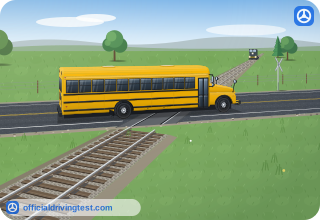
- Far from the bus, angled away from tracks, toward the train
- Straight back along the tracks, away from the train
- Far from the bus, angled away from the tracks and the train
Show answer
Correct answer: Far from the bus, angled away from tracks, toward the train
Everyone leaves the tracks at once and goes well away from the bus at an angle, away from the tracks but in the direction the train comes from.
Source: CDL manual, national model as printed by New Jersey, Section 10 (July 2017)
-
A police officer is directing traffic at a railroad crossing. What should the bus driver do?
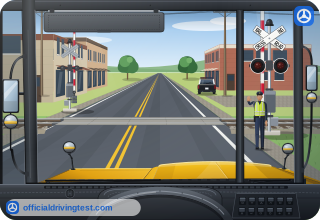
- Follow the crossing signal if it differs
- Cross as soon as the way looks clear
- Follow the officer's directions
Show answer
Correct answer: Follow the officer's directions
An officer at the crossing is in charge, so the driver does what the officer directs.
Source: CDL manual, national model as printed by New Jersey, Section 10 (July 2017)
-
No officer is at the crossing and the driver thinks the signal is faulty. What is the correct step?
- Cross when no train is visible
- Wait for another vehicle to cross first
- Call the dispatcher for instructions
Show answer
Correct answer: Call the dispatcher for instructions
With no officer to direct traffic, the driver reports a suspected signal problem to the dispatcher and asks how to go on.
Source: CDL manual, national model as printed by New Jersey, Section 10 (July 2017)
-
What should a driver aim for when planning a route that has railroad crossings?
- Crossings where trains run least often
- Crossings reached at normal traffic speed
- The longest possible view along the tracks
Show answer
Correct answer: The longest possible view along the tracks
A route should give the driver as much view down the track as possible at each crossing.
Source: CDL manual, national model as printed by New Jersey, Section 10 (July 2017)
-
When is it acceptable to start across tracks where the view is partly blocked?
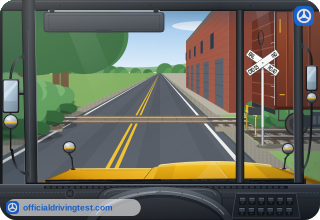
- When the view is long enough to be sure no train comes
- When the horn has been sounded and nothing answers
- When other traffic ahead is already crossing too
Show answer
Correct answer: When the view is long enough to be sure no train comes
The driver may cross only when the view along the track is long enough to be certain that no train approaches. Routes should be planned for the best sight distance.
Source: CDL manual, national model as printed by New Jersey, Section 10 (July 2017)
-
The active signals at a crossing show the tracks are clear. What should the driver do?
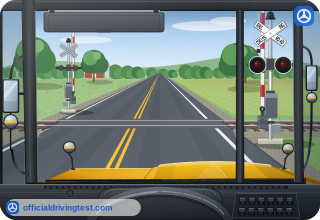
- Cross at once, because the signals are reliable
- Sound the horn and then cross without stopping
- Look and listen personally to be sure it is safe
Show answer
Correct answer: Look and listen personally to be sure it is safe
Clear signals are not enough. The driver also looks and listens before going across.
Source: CDL manual, national model as printed by New Jersey, Section 10 (July 2017)
-
A signal or stop sign stands just beyond the tracks. What must the driver be sure of before crossing?
- That the bus can stop within 15 feet past the last rail
- That there is room for the whole bus to clear the rails
- That the signal ahead is green when the bus reaches it
Show answer
Correct answer: That there is room for the whole bus to clear the rails
The bus may have to stop at the signal or stop sign beyond the tracks, so the whole bus must fit past the rails.
Source: CDL manual, national model as printed by New Jersey, Section 10 (July 2017)
-
How much room is enough on the far side of a crossing where the bus might have to stop?
- The bus length plus 5 feet
- The bus length plus 15 feet
- The bus length plus 50 feet
Show answer
Correct answer: The bus length plus 15 feet
As a rule of thumb, the space past the tracks should equal the bus length plus another 15 feet, so the whole bus can clear the rails if it must stop.
Source: CDL manual, national model as printed by New Jersey, Section 10 (July 2017)
-
Only in Arizona's manual
A school bus is getting close to a railroad crossing. At what distance from the crossing should you have shut off the radio and other sound sources?
- 50 feet
- 15 feet
- 200 feet
Show answer
Correct answer: 50 feet
Sound sources in the bus must be off by the time you are within 50 feet of the crossing, so you can hear a train.
Source: CDL manual, national model as printed by New Jersey, Section 10 (July 2017)
-
Only in Arizona's manual
A school bus nears a railroad crossing. At least how far before the crossing should the driver turn on the hazard lights?
- About 200 feet
- About 100 feet
- About 50 feet
Show answer
Correct answer: About 100 feet
The driver turns on the hazard lights roughly 100 feet or more before the crossing, so others know what the bus will do.
Source: CDL manual, national model as printed by New Jersey, Section 10 (July 2017)