School Bus: Evacuation and railroad crossings — Part 3
Questions in this part include: “At a crossing with no signals or gates, who decides whether it is safe to go on?” · “The red lights at a crossing start to flash while the bus is approaching. What does this tell the driver?”
Independent educational site · not affiliated with any government agency or DMV
Ready? Test yourself
Answer to start, or tap Start below:
Which equipment makes a railroad crossing an active crossing?
- Instant feedback with an explanation
- Every answer cites its source in the manual
- Your best score is saved on this device
- Keyboard: press 1 to 3 to answer and Enter for the next question
Questions are written in our own words from the CDL manual; they are not the real test's questions. With your state chosen, every answer gives its page in your state's CDL manual. Without a state, answers cite the CDL manual, national model as printed by New Jersey (July 2017).
All 18 questions in this practice test
Take the test above first, then use this list to study. Tap “Show answer” to see the correct answer and explanation.
Show the questions and answersHide the questions
-
At a crossing with no signals or gates, who decides whether it is safe to go on?
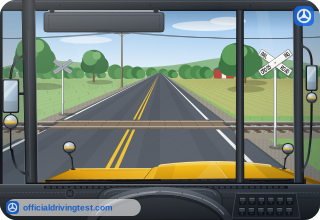
- The driver with the dispatcher on the radio
- The driver alone, after searching for trains
- The vehicle ahead, once it has crossed
Show answer
Correct answer: The driver alone, after searching for trains
Nothing controls traffic at a passive crossing, so the driver makes the decision alone after looking for a train and judging the clear space.
Source: CDL manual, national model as printed by New Jersey, Section 10 (July 2017)
-
Which equipment makes a railroad crossing an active crossing?
- Yellow round warning signs and pavement markings
- Flashing red lights, sometimes with bells and gates
- A cross-buck sign and a white stop line on the road
Show answer
Correct answer: Flashing red lights, sometimes with bells and gates
An active crossing has a device installed at the tracks that controls traffic, such as flashing red lights, bells and gates. Signs and road markings alone belong to passive crossings.
Source: CDL manual, national model as printed by New Jersey, Section 10 (July 2017)
-
A round yellow sign with a black symbol stands ahead of a public railroad crossing. What should the driver do when seeing it?
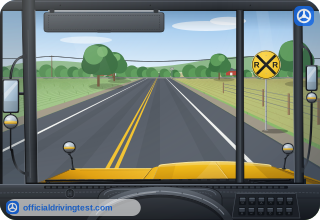
- Stop right there and wait for a railroad worker
- Keep speed steady and use the horn at the crossing
- Slow down, look and listen, and be ready to stop
Show answer
Correct answer: Slow down, look and listen, and be ready to stop
This sign warns that tracks are ahead. The driver should slow down, watch and listen for a train, and be ready to stop at the tracks.
Source: CDL manual, national model as printed by New Jersey, Section 10 (July 2017)
-
A large X with the letters RR is painted on the lane ahead. Which sign gives the same message?
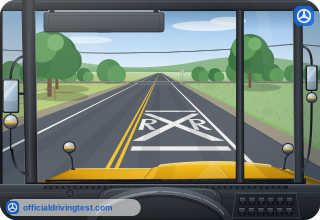
- The cross-buck sign at the tracks
- The sign that shows the number of tracks
- The round black-on-yellow advance warning sign
Show answer
Correct answer: The round black-on-yellow advance warning sign
The painted X with RR carries the same warning as the round yellow advance sign: a crossing is ahead, so slow down and be ready to stop.
Source: CDL manual, national model as printed by New Jersey, Section 10 (July 2017)
-
On a two-lane road, what is painted together with the X and the letters RR before a crossing?
- A speed limit number
- A yield line of white triangles
- A no-passing marking
Show answer
Correct answer: A no-passing marking
On two-lane roads the railroad pavement marking comes with a no-passing marking.
Source: CDL manual, national model as printed by New Jersey, Section 10 (July 2017)
-
A white line is painted across the lane before the tracks. Where must the front of the bus be when it stops?
- Right on the line, so the driver sees the tracks
- Behind the line
- Past the line, but before the first rail
Show answer
Correct answer: Behind the line
When a stop line is painted before the tracks, the bus has to stop with its front end behind it.
Source: CDL manual, national model as printed by New Jersey, Section 10 (July 2017)
-
What does a driver owe to a train at a crossing marked by a cross-buck sign?
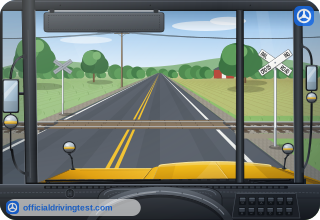
- Slow down and cross if no gate is down
- Stop only if a train is already in sight
- Give the train the right-of-way
Show answer
Correct answer: Give the train the right-of-way
The cross-buck marks the crossing and means the train goes first, so the driver must give way to it.
Source: CDL manual, national model as printed by New Jersey, Section 10 (July 2017)
-
There is a cross-buck but no white line on the pavement. Where should the bus stop?
- Beside the cross-buck sign
- Before the cross-buck sign
- Just past the cross-buck sign
Show answer
Correct answer: Before the cross-buck sign
With no painted stop line, the cross-buck itself is the limit: the bus stops before reaching it.
Source: CDL manual, national model as printed by New Jersey, Section 10 (July 2017)
-
What does an extra sign mounted under a cross-buck tell the driver?
- How many sets of tracks the road crosses
- How fast the trains usually travel
- Whether the crossing has a gate
Show answer
Correct answer: How many sets of tracks the road crosses
At a crossing with several sets of tracks, the sign below the cross-buck shows how many tracks there are.
Source: CDL manual, national model as printed by New Jersey, Section 10 (July 2017)
-
The red lights at a crossing start to flash while the bus is approaching. What does this tell the driver?
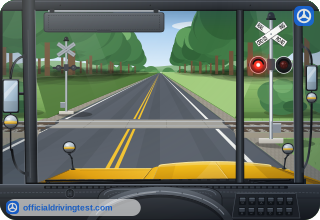
- A train is coming and the bus must stop
- The signal is testing, so the bus may continue
- Only the next lane has to wait for the train
Show answer
Correct answer: A train is coming and the bus must stop
Flashing red lights at a crossing mean a train is approaching, and the bus has to stop and give it the right-of-way.
Source: CDL manual, national model as printed by New Jersey, Section 10 (July 2017)
-
A crossing has several tracks. What must the driver confirm before starting across?
- That every track is clear
- That the nearest track is clear
- That the track with the signal is clear
Show answer
Correct answer: That every track is clear
A second train may be coming on another track, so the driver must see that all of the tracks are clear.
Source: CDL manual, national model as printed by New Jersey, Section 10 (July 2017)
-
A train has passed a gated crossing. When may the bus start moving again?
- As soon as the train's last car has gone by
- When the gates are up, even if the lights still flash
- When the gates are up and the lights have stopped flashing
Show answer
Correct answer: When the gates are up and the lights have stopped flashing
The driver waits for both signs of safety: the gates raised and the lights off. Then the bus can proceed if it is safe.
Source: CDL manual, national model as printed by New Jersey, Section 10 (July 2017)
-
The train is gone but the gate arm still blocks the lane. What should the driver do?
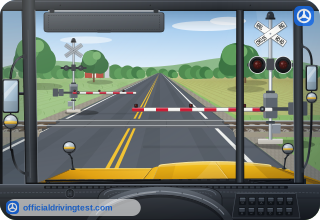
- Call the dispatcher for instructions
- Drive around the gate after looking both ways
- Wait a few minutes, then cross if no train is seen
Show answer
Correct answer: Call the dispatcher for instructions
If the gate is still down after the train has passed, the driver does not go around it. The driver calls the dispatcher instead.
Source: CDL manual, national model as printed by New Jersey, Section 10 (July 2017)
-
As a general practice, how must a school bus handle railroad crossings?
- Stop only at crossings that have no signals at all
- Stop only when a train is already in sight ahead
- Stop at every crossing and make sure it is safe
Show answer
Correct answer: Stop at every crossing and make sure it is safe
Rules differ by state, but in general a school bus stops at every crossing and goes on only after making sure the way is safe.
Source: CDL manual, national model as printed by New Jersey, Section 10 (July 2017)
-
Why can a train not stop in time for a bus that is on the tracks?
- Its brakes cannot be used near a crossing
- Its size and weight keep it from stopping quickly
- Its engineer must keep to a fixed timetable
Show answer
Correct answer: Its size and weight keep it from stopping quickly
A train is so big and heavy that it cannot stop fast, and it cannot swerve away, so the bus driver must prevent the crash.
Source: CDL manual, national model as printed by New Jersey, Section 10 (July 2017)
-
While approaching a railroad crossing, what should the driver do about speed and brakes?
- Keep speed steady and test the brakes at the tracks
- Slow down, shift lower in a manual bus, and test the brakes
- Speed up slightly so the bus clears the tracks sooner
Show answer
Correct answer: Slow down, shift lower in a manual bus, and test the brakes
The driver slows down early, using a lower gear in a manual bus, and tries the brakes to be sure they work before reaching the tracks.
Source: CDL manual, national model as printed by New Jersey, Section 10 (July 2017)
-
About how far before a railroad crossing should the hazard lights be turned on?
- 100 feet
- 500 feet
- 200 feet
Show answer
Correct answer: 200 feet
Switching on the hazard lights about 200 feet ahead lets other drivers know what the bus is about to do.
Source: CDL manual, national model as printed by New Jersey, Section 10 (July 2017)
-
Besides watching ahead, what should the driver check while approaching a crossing?
- The traffic behind the bus
- The fuel and temperature gauges
- The signals at the next intersection
Show answer
Correct answer: The traffic behind the bus
On the way to a crossing the driver scans the surroundings and also checks the traffic behind the bus.
Source: CDL manual, national model as printed by New Jersey, Section 10 (July 2017)