School Bus: Evacuation and railroad crossings
When to evacuate the bus, choosing a safe place, the evacuation steps, crossing types, warning signs and devices, the steps at a railroad crossing and special situations. Split into 4 shorter tests so you're not stuck in one long quiz.
Independent educational site · not affiliated with any government agency or DMV
Choose a part
Evacuation and railroad crossings — Part 1
Questions in this part include: “When an emergency begins, what comes first and matters most before the driver decides about evacuating?”
Evacuation and railroad crossings — Part 2
Questions in this part include: “A bus is in the path of a sighted tornado and no building is close. Where should students be taken?”
Evacuation and railroad crossings — Part 3
Questions in this part include: “At a crossing with no signals or gates, who decides whether it is safe to go on?”
Evacuation and railroad crossings — Part 4
Questions in this part include: “Where on the road should the bus be as it approaches a crossing, if possible?”
Questions are written in our own words from the CDL manual; they are not the real test's questions. With your state chosen, every answer gives its page in your state's CDL manual. Without a state, answers cite the CDL manual, national model as printed by New Jersey (July 2017).
All 73 Evacuation and railroad crossings questions with answers
Choose a part above to take a practice test, or study every question and answer here.
Show the questions and answersHide the questions
1Part 119 questions
-
When an emergency begins, what comes first and matters most before the driver decides about evacuating?
- Recognize what the hazard is
- Ask students whether they feel safe
- Set out emergency warning devices
Show answer
Correct answer: Recognize what the hazard is
Spotting the danger comes before every other step in judging whether students must leave the bus.
Source: CDL manual, national model as printed by New Jersey, Section 10 (July 2017)
-
If there is time during an emergency, whom should the driver contact before deciding to evacuate?
- The school principal
- The dispatcher
- Each student's parents
Show answer
Correct answer: The dispatcher
When time allows, the driver tells the dispatcher what is happening before choosing to evacuate.
Source: CDL manual, national model as printed by New Jersey, Section 10 (July 2017)
-
In most emergencies, where are students best kept as long as staying adds no needless risk?
- Standing beside the road
- Aboard the bus
- Inside the closest building
Show answer
Correct answer: Aboard the bus
Control and safety are usually best when students stay on the bus, unless staying exposes them to unnecessary risk or injury.
Source: CDL manual, national model as printed by New Jersey, Section 10 (July 2017)
-
How quickly must the driver make the decision to evacuate?
- Promptly, before the chance to act is lost
- After waiting to see if the danger passes
- Only after all students are counted
Show answer
Correct answer: Promptly, before the chance to act is lost
The choice to evacuate cannot be put off; it has to be made in good time.
Source: CDL manual, national model as printed by New Jersey, Section 10 (July 2017)
-
With some hazardous spills, which choice can be the safer one for students?
- Keeping them aboard, away from contact
- Walking them through it to the far side
- Leading them 50 feet downwind
Show answer
Correct answer: Keeping them aboard, away from contact
Sometimes staying on the bus keeps students from touching the spilled material.
Source: CDL manual, national model as printed by New Jersey, Section 10 (July 2017)
-
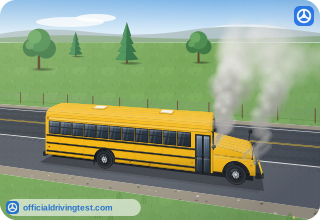
What must a driver do when the bus is burning or a fire may start?
- Wait for the fire department aboard
- Open the windows and stay seated
- Evacuate the bus
Show answer
Correct answer: Evacuate the bus
Fire or the threat of fire always requires getting students off the bus.
Source: CDL manual, national model as printed by New Jersey, Section 10 (July 2017)
-
In which situation must the driver evacuate the bus?
- The bus has stalled at or beside a rail crossing
- A student has a medical emergency
- The bus has stopped near downed power lines
Show answer
Correct answer: The bus has stalled at or beside a rail crossing
A bus stalled on or next to a railroad crossing is one of the cases where evacuation is required.
Source: CDL manual, national model as printed by New Jersey, Section 10 (July 2017)
-
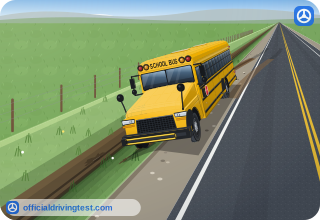
What must the driver do if the bus could shift position in a way that makes the danger greater?
- Keep students seated and wait
- Move the bus forward a little first
- Evacuate the bus
Show answer
Correct answer: Evacuate the bus
A bus whose position may change and worsen the danger has to be evacuated.
Source: CDL manual, national model as printed by New Jersey, Section 10 (July 2017)
-
Which situation makes evacuation required rather than optional?
- Another vehicle is about to hit the bus
- Power lines are down near the bus
- A student may have a neck injury
Show answer
Correct answer: Another vehicle is about to hit the bus
If a collision is about to happen, the driver has to get students off the bus.
Source: CDL manual, national model as printed by New Jersey, Section 10 (July 2017)
-
When must the driver evacuate because of a hazardous materials spill?
- Whenever any spill is seen on the road
- Only when the bus itself is leaking fuel
- When the spill creates a need to leave quickly
Show answer
Correct answer: When the spill creates a need to leave quickly
A hazardous materials spill requires evacuation when students need to be moved away from it quickly.
Source: CDL manual, national model as printed by New Jersey, Section 10 (July 2017)
-
When the driver can plan ahead, how many older student helpers should be given to each emergency exit?
- Two
- Three
- One
Show answer
Correct answer: Two
Two responsible older students at every exit are taught to help the others off the bus.
Source: CDL manual, national model as printed by New Jersey, Section 10 (July 2017)
-
Besides the helpers at the exits, what job goes to one more student assistant?
- Guiding evacuated students to a safe place
- Calling the dispatcher from the radio
- Writing down each student's name
Show answer
Correct answer: Guiding evacuated students to a safe place
A separate student assistant walks the evacuated students to a safe place.
Source: CDL manual, national model as printed by New Jersey, Section 10 (July 2017)
-
Why must every student, not just the older ones, be taught the evacuation procedures?
- Younger students open exits more quickly
- Older students are not allowed to help
- Responsible older students may not be aboard
Show answer
Correct answer: Responsible older students may not be aboard
There may be no responsible older students on the bus when an emergency happens, so everyone needs to know what to do.
Source: CDL manual, national model as printed by New Jersey, Section 10 (July 2017)
-
Besides knowing how to use the exits, what must all students learn about an evacuation?
- To follow all the driver's instructions
- To lead the others to the safe place
- To pick two helpers for each exit
Show answer
Correct answer: To follow all the driver's instructions
Students are taught to listen to the driver and carry out every instruction given.
Source: CDL manual, national model as printed by New Jersey, Section 10 (July 2017)
-
At the very least, how far off the road should a safe place for evacuated students be?
- 30 feet
- 100 feet
- 60 feet
Show answer
Correct answer: 100 feet
A safe place is 100 feet or more from the road, so students are not struck by debris if another vehicle hits the bus.
Source: CDL manual, national model as printed by New Jersey, Section 10 (July 2017)
-
Along the road, in which direction from the bus should a safe place be?
- Toward the oncoming traffic
- Away from the oncoming traffic
- Right beside the bus's service door
Show answer
Correct answer: Toward the oncoming traffic
The safe place lies off the road on the side toward oncoming traffic.
Source: CDL manual, national model as printed by New Jersey, Section 10 (July 2017)
-
If the bus is burning, where should the driver lead students?
- Upwind of the bus
- Toward the nearest ditch or culvert
- Downwind, at least 300 feet away
Show answer
Correct answer: Upwind of the bus
When fire is present, students are led upwind of the bus.
Source: CDL manual, national model as printed by New Jersey, Section 10 (July 2017)
-
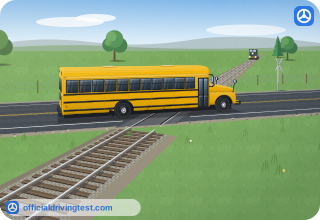
When a bus must be evacuated near railroad tracks, where should students be led?
- Near the tracks, to watch for the train
- Along the tracks, away from the train
- Far from the tracks, toward an oncoming train
Show answer
Correct answer: Far from the tracks, toward an oncoming train
Students should be taken as far from the tracks as possible, heading in the direction an oncoming train is coming from.
Source: CDL manual, national model as printed by New Jersey, Section 10 (July 2017)
-
If spilled hazardous materials are a risk, how far upwind of the bus should students be led, at the least?
- 150 feet
- 300 feet
- 500 feet
Show answer
Correct answer: 300 feet
With a hazardous spill, students go upwind at least 300 feet from the bus.
Source: CDL manual, national model as printed by New Jersey, Section 10 (July 2017)
2Part 218 questions
-
A bus is in the path of a sighted tornado and no building is close. Where should students be taken?
- Beside the bus, out of the wind
- A tall tree at the roadside
- A nearby ditch or culvert
Show answer
Correct answer: A nearby ditch or culvert
If no building is handy, students go to a ditch or culvert, far enough from the bus that it cannot fall on them.
Source: CDL manual, national model as printed by New Jersey, Section 10 (July 2017)
-
During a tornado, how should students be positioned once they reach a ditch or culvert?
- Lying face down with hands over their heads
- Standing up against the bank
- Crouched upright with arms at their sides
Show answer
Correct answer: Lying face down with hands over their heads
Students lie face down and cover their heads with their hands for protection.
Source: CDL manual, national model as printed by New Jersey, Section 10 (July 2017)
-
Which kind of ground should be avoided when picking a place for evacuated students?
- Land upwind of the bus
- Land off the road toward oncoming traffic
- Land subject to flash floods
Show answer
Correct answer: Land subject to flash floods
Spots prone to flash floods are dangerous, so students should be kept away from them.
Source: CDL manual, national model as printed by New Jersey, Section 10 (July 2017)
-
When securing the bus before an evacuation, where should the transmission be placed?
- Drive, with the brake held down
- Park, or Neutral if no Park exists
- Reverse, with the engine idling
Show answer
Correct answer: Park, or Neutral if no Park exists
The transmission goes in Park, or in Neutral on a bus that has no Park position.
Source: CDL manual, national model as printed by New Jersey, Section 10 (July 2017)
-
Which braking step belongs to securing the bus for an evacuation?
- Pumping the service brake
- Setting the parking brakes
- Releasing the parking brake
Show answer
Correct answer: Setting the parking brakes
The parking brakes are set so the bus cannot roll while students leave.
Source: CDL manual, national model as printed by New Jersey, Section 10 (July 2017)
-
What should happen to the engine when the driver secures the bus for an evacuation?
- It is left running for the radio
- It is shut off only after all students are out
- It is shut off
Show answer
Correct answer: It is shut off
The engine is turned off as part of securing the bus.
Source: CDL manual, national model as printed by New Jersey, Section 10 (July 2017)
-
What should the driver do with the ignition key when securing the bus for an evacuation?
- Leave it in for a quick restart
- Take it out only after all students leave
- Take it out before ordering the evacuation
Show answer
Correct answer: Take it out before ordering the evacuation
Removing the ignition key is one of the steps for securing the bus.
Source: CDL manual, national model as printed by New Jersey, Section 10 (July 2017)
-
Which lights should the driver turn on while securing the bus for an evacuation?
- The alternating flashing red lights
- The interior dome light
- The hazard-warning lights
Show answer
Correct answer: The hazard-warning lights
Activating the hazard-warning lights is one of the steps for securing the bus.
Source: CDL manual, national model as printed by New Jersey, Section 10 (July 2017)
-
If time allows, what should the driver tell the dispatch office before students leave?
- The location, the conditions, and help needed
- The students' names, ages, and home addresses
- The route's start time, stops, and student count
Show answer
Correct answer: The location, the conditions, and help needed
The dispatcher should learn where the evacuation is, what the conditions are, and what help is needed.
Source: CDL manual, national model as printed by New Jersey, Section 10 (July 2017)
-
If the radio or phone still works, where should the driver leave it for later use?
- Left clipped to the dashboard panel
- Dangling out of the driver's window
- Tucked into the driver's coat pocket
Show answer
Correct answer: Dangling out of the driver's window
The microphone or phone is left hanging out of the driver's window so it can be used again later.
Source: CDL manual, national model as printed by New Jersey, Section 10 (July 2017)
-
When the radio is missing or broken, who should the driver send for help first?
- Two older, responsible students
- A passing motorist or area resident
- The student sitting closest to the door
Show answer
Correct answer: A passing motorist or area resident
Without a working radio, the driver sends a passing motorist or a nearby resident to call for help.
Source: CDL manual, national model as printed by New Jersey, Section 10 (July 2017)
-
When no motorist or resident can be sent, what is the last resort for getting help?
- Sending one student alone
- Walking everyone to the nearest town
- Sending two older, responsible students
Show answer
Correct answer: Sending two older, responsible students
Only as a final option does the driver send two older, responsible students to get help.
Source: CDL manual, national model as printed by New Jersey, Section 10 (July 2017)
-
When may a driver move a student who might have a neck or spinal injury?
- Whenever the bus must be cleared
- Only if life is in immediate danger
- Once the student says it feels fine
Show answer
Correct answer: Only if life is in immediate danger
Moving a student with a possible neck or spinal injury can cause more harm, so it is done only when that student's life is in immediate danger.
Source: CDL manual, national model as printed by New Jersey, Section 10 (July 2017)
-
After the students are off the bus, what should the driver do before joining them?
- Move the bus a short way off the road
- Lock the doors and windows
- Walk the bus aisle for any students left
Show answer
Correct answer: Walk the bus aisle for any students left
The driver walks through the bus to make sure nobody is still aboard, and picks up the emergency equipment.
Source: CDL manual, national model as printed by New Jersey, Section 10 (July 2017)
-
During the final walk through the bus, what should the driver also bring out?
- All the students' school bags
- The emergency equipment
- The radio microphone
Show answer
Correct answer: The emergency equipment
While checking the bus for anyone left, the driver also takes out the emergency equipment.
Source: CDL manual, national model as printed by New Jersey, Section 10 (July 2017)
-
After rejoining the waiting students, what must the driver do?
- Count every student and check on them
- Send older students to walk home
- Get everyone back on the bus
Show answer
Correct answer: Count every student and check on them
The driver counts every student and makes sure each one is safe.
Source: CDL manual, national model as printed by New Jersey, Section 10 (July 2017)
-
What should the driver do to protect the scene of an evacuation?
- Leave the scene clear of any markers
- Ask passing drivers to direct traffic
- Set out warning devices where appropriate
Show answer
Correct answer: Set out warning devices where appropriate
Emergency warning devices are placed where needed so approaching traffic is alerted.
Source: CDL manual, national model as printed by New Jersey, Section 10 (July 2017)
-
What kind of railroad crossing has no traffic control device of its own?
- An active crossing with flashing lights
- An active crossing with gates and bells
- A passive crossing
Show answer
Correct answer: A passive crossing
A passive crossing has no signal or gate at all, so the driver has to search for trains personally and decide if crossing is safe.
Source: CDL manual, national model as printed by New Jersey, Section 10 (July 2017)
3Part 318 questions
-
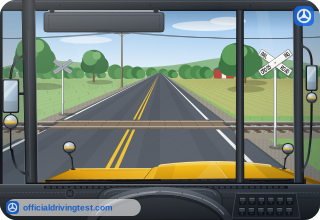
At a crossing with no signals or gates, who decides whether it is safe to go on?
- The driver with the dispatcher on the radio
- The driver alone, after searching for trains
- The vehicle ahead, once it has crossed
Show answer
Correct answer: The driver alone, after searching for trains
Nothing controls traffic at a passive crossing, so the driver makes the decision alone after looking for a train and judging the clear space.
Source: CDL manual, national model as printed by New Jersey, Section 10 (July 2017)
-
Which equipment makes a railroad crossing an active crossing?
- Yellow round warning signs and pavement markings
- Flashing red lights, sometimes with bells and gates
- A cross-buck sign and a white stop line on the road
Show answer
Correct answer: Flashing red lights, sometimes with bells and gates
An active crossing has a device installed at the tracks that controls traffic, such as flashing red lights, bells and gates. Signs and road markings alone belong to passive crossings.
Source: CDL manual, national model as printed by New Jersey, Section 10 (July 2017)
-
A round yellow sign with a black symbol stands ahead of a public railroad crossing. What should the driver do when seeing it?
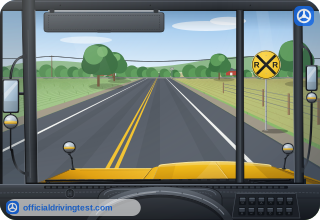
- Stop right there and wait for a railroad worker
- Keep speed steady and use the horn at the crossing
- Slow down, look and listen, and be ready to stop
Show answer
Correct answer: Slow down, look and listen, and be ready to stop
This sign warns that tracks are ahead. The driver should slow down, watch and listen for a train, and be ready to stop at the tracks.
Source: CDL manual, national model as printed by New Jersey, Section 10 (July 2017)
-
A large X with the letters RR is painted on the lane ahead. Which sign gives the same message?
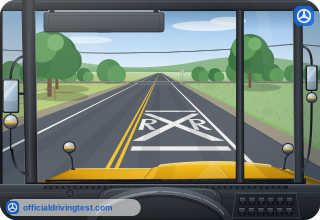
- The cross-buck sign at the tracks
- The sign that shows the number of tracks
- The round black-on-yellow advance warning sign
Show answer
Correct answer: The round black-on-yellow advance warning sign
The painted X with RR carries the same warning as the round yellow advance sign: a crossing is ahead, so slow down and be ready to stop.
Source: CDL manual, national model as printed by New Jersey, Section 10 (July 2017)
-
On a two-lane road, what is painted together with the X and the letters RR before a crossing?
- A speed limit number
- A yield line of white triangles
- A no-passing marking
Show answer
Correct answer: A no-passing marking
On two-lane roads the railroad pavement marking comes with a no-passing marking.
Source: CDL manual, national model as printed by New Jersey, Section 10 (July 2017)
-
A white line is painted across the lane before the tracks. Where must the front of the bus be when it stops?
- Right on the line, so the driver sees the tracks
- Behind the line
- Past the line, but before the first rail
Show answer
Correct answer: Behind the line
When a stop line is painted before the tracks, the bus has to stop with its front end behind it.
Source: CDL manual, national model as printed by New Jersey, Section 10 (July 2017)
-
What does a driver owe to a train at a crossing marked by a cross-buck sign?
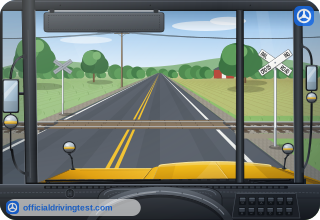
- Slow down and cross if no gate is down
- Stop only if a train is already in sight
- Give the train the right-of-way
Show answer
Correct answer: Give the train the right-of-way
The cross-buck marks the crossing and means the train goes first, so the driver must give way to it.
Source: CDL manual, national model as printed by New Jersey, Section 10 (July 2017)
-
There is a cross-buck but no white line on the pavement. Where should the bus stop?
- Beside the cross-buck sign
- Before the cross-buck sign
- Just past the cross-buck sign
Show answer
Correct answer: Before the cross-buck sign
With no painted stop line, the cross-buck itself is the limit: the bus stops before reaching it.
Source: CDL manual, national model as printed by New Jersey, Section 10 (July 2017)
-
What does an extra sign mounted under a cross-buck tell the driver?
- How many sets of tracks the road crosses
- How fast the trains usually travel
- Whether the crossing has a gate
Show answer
Correct answer: How many sets of tracks the road crosses
At a crossing with several sets of tracks, the sign below the cross-buck shows how many tracks there are.
Source: CDL manual, national model as printed by New Jersey, Section 10 (July 2017)
-
The red lights at a crossing start to flash while the bus is approaching. What does this tell the driver?
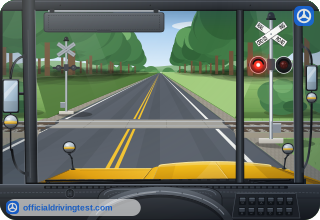
- A train is coming and the bus must stop
- The signal is testing, so the bus may continue
- Only the next lane has to wait for the train
Show answer
Correct answer: A train is coming and the bus must stop
Flashing red lights at a crossing mean a train is approaching, and the bus has to stop and give it the right-of-way.
Source: CDL manual, national model as printed by New Jersey, Section 10 (July 2017)
-
A crossing has several tracks. What must the driver confirm before starting across?
- That every track is clear
- That the nearest track is clear
- That the track with the signal is clear
Show answer
Correct answer: That every track is clear
A second train may be coming on another track, so the driver must see that all of the tracks are clear.
Source: CDL manual, national model as printed by New Jersey, Section 10 (July 2017)
-
A train has passed a gated crossing. When may the bus start moving again?
- As soon as the train's last car has gone by
- When the gates are up, even if the lights still flash
- When the gates are up and the lights have stopped flashing
Show answer
Correct answer: When the gates are up and the lights have stopped flashing
The driver waits for both signs of safety: the gates raised and the lights off. Then the bus can proceed if it is safe.
Source: CDL manual, national model as printed by New Jersey, Section 10 (July 2017)
-
The train is gone but the gate arm still blocks the lane. What should the driver do?
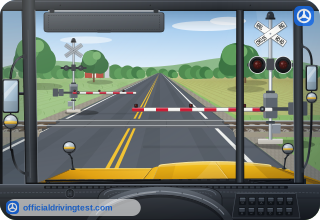
- Call the dispatcher for instructions
- Drive around the gate after looking both ways
- Wait a few minutes, then cross if no train is seen
Show answer
Correct answer: Call the dispatcher for instructions
If the gate is still down after the train has passed, the driver does not go around it. The driver calls the dispatcher instead.
Source: CDL manual, national model as printed by New Jersey, Section 10 (July 2017)
-
As a general practice, how must a school bus handle railroad crossings?
- Stop only at crossings that have no signals at all
- Stop only when a train is already in sight ahead
- Stop at every crossing and make sure it is safe
Show answer
Correct answer: Stop at every crossing and make sure it is safe
Rules differ by state, but in general a school bus stops at every crossing and goes on only after making sure the way is safe.
Source: CDL manual, national model as printed by New Jersey, Section 10 (July 2017)
-
Why can a train not stop in time for a bus that is on the tracks?
- Its brakes cannot be used near a crossing
- Its size and weight keep it from stopping quickly
- Its engineer must keep to a fixed timetable
Show answer
Correct answer: Its size and weight keep it from stopping quickly
A train is so big and heavy that it cannot stop fast, and it cannot swerve away, so the bus driver must prevent the crash.
Source: CDL manual, national model as printed by New Jersey, Section 10 (July 2017)
-
While approaching a railroad crossing, what should the driver do about speed and brakes?
- Keep speed steady and test the brakes at the tracks
- Slow down, shift lower in a manual bus, and test the brakes
- Speed up slightly so the bus clears the tracks sooner
Show answer
Correct answer: Slow down, shift lower in a manual bus, and test the brakes
The driver slows down early, using a lower gear in a manual bus, and tries the brakes to be sure they work before reaching the tracks.
Source: CDL manual, national model as printed by New Jersey, Section 10 (July 2017)
-
About how far before a railroad crossing should the hazard lights be turned on?
- 100 feet
- 500 feet
- 200 feet
Show answer
Correct answer: 200 feet
Switching on the hazard lights about 200 feet ahead lets other drivers know what the bus is about to do.
Source: CDL manual, national model as printed by New Jersey, Section 10 (July 2017)
-
Besides watching ahead, what should the driver check while approaching a crossing?
- The traffic behind the bus
- The fuel and temperature gauges
- The signals at the next intersection
Show answer
Correct answer: The traffic behind the bus
On the way to a crossing the driver scans the surroundings and also checks the traffic behind the bus.
Source: CDL manual, national model as printed by New Jersey, Section 10 (July 2017)
4Part 418 questions
-
Where on the road should the bus be as it approaches a crossing, if possible?
- On the right side of the roadway
- Near the center line
- Straddling the shoulder and the lane
Show answer
Correct answer: On the right side of the roadway
The bus should keep to the right side of the road when it can on the way to the tracks.
Source: CDL manual, national model as printed by New Jersey, Section 10 (July 2017)
-
Why should the driver pick an escape route before reaching a crossing?
- To plan a detour around any slow trains ahead
- To have a way out if brakes fail or trouble comes
- To keep a safe distance from the gate arm itself
Show answer
Correct answer: To have a way out if brakes fail or trouble comes
If the brakes fail or something goes wrong behind the bus, a route already chosen gives the driver a place to go.
Source: CDL manual, national model as printed by New Jersey, Section 10 (July 2017)
-
At a railroad crossing, what is the allowed stopping distance from the nearest rail?
- 15 to 50 feet
- 5 to 15 feet
- 50 to 100 feet
Show answer
Correct answer: 15 to 50 feet
The bus stops at least 15 feet but not more than 50 feet from the closest rail, in the spot that gives the best view of the tracks.
Source: CDL manual, national model as printed by New Jersey, Section 10 (July 2017)
-
With the bus stopped at the crossing, how should the driver hold it?
- Park or Neutral, then hold the service or parking brake
- Leave it in gear with a foot resting on the clutch
- Keep the engine revving in low gear, ready to go
Show answer
Correct answer: Park or Neutral, then hold the service or parking brake
The transmission goes into Park, or Neutral if there is no Park, and the bus is held with the service brake or the parking brakes.
Source: CDL manual, national model as printed by New Jersey, Section 10 (July 2017)
-
Once stopped at the crossing, what should be done about noise inside the bus?
- Switch off sound sources and ask the riders for silence
- Turn the radio down but keep it on for dispatch
- Ask the students to talk quietly and keep the fan on
Show answer
Correct answer: Switch off sound sources and ask the riders for silence
The driver needs to hear a train, so sources of noise are switched off and the students are asked to be silent.
Source: CDL manual, national model as printed by New Jersey, Section 10 (July 2017)
-
What helps the driver hear a train while the bus is stopped at the tracks?
- Opening the passenger windows on the right side
- Opening the service door and the driver's window
- Opening the emergency roof hatch
Show answer
Correct answer: Opening the service door and the driver's window
With the service door and the driver's window open, the driver can look and listen properly for any train coming.
Source: CDL manual, national model as printed by New Jersey, Section 10 (July 2017)
-
After stopping and listening, what should the driver do right before moving onto the tracks?
- Sound the horn twice
- Check the crossing signals one more time
- Ask the students to look for trains
Show answer
Correct answer: Check the crossing signals one more time
Before moving onto the tracks, the driver checks the crossing signals again.
Source: CDL manual, national model as printed by New Jersey, Section 10 (July 2017)
-
A crossing has several sets of tracks. Where does the bus make its stop?
- Before every set of tracks
- Only before the first set of tracks
- Between the second and third set of tracks
Show answer
Correct answer: Only before the first set of tracks
The bus stops once, before the first set. When no train is coming on any track, it goes across all of them without stopping again.
Source: CDL manual, national model as printed by New Jersey, Section 10 (July 2017)
-
How should the gears be handled while the bus goes over the tracks?
- Start in low gear and shift up quickly to clear the tracks
- Choose any gear and shift if the engine labors
- Use a low gear and do not shift on the crossing
Show answer
Correct answer: Use a low gear and do not shift on the crossing
The driver picks a low gear before the rails and stays in it until the bus is across.
Source: CDL manual, national model as printed by New Jersey, Section 10 (July 2017)
-
The gate lowers when the bus is already on the tracks. What should the driver do?
- Stop on the tracks and wait for the gate to rise
- Drive through the gate, even if it breaks
- Back up quickly to the stop line
Show answer
Correct answer: Drive through the gate, even if it breaks
Once the bus has started across and the gate comes down, the driver keeps going and drives through the gate, even if it breaks.
Source: CDL manual, national model as printed by New Jersey, Section 10 (July 2017)
-
The bus stalls on the tracks. Where should the students be led?
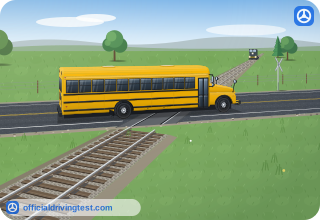
- Far from the bus, angled away from tracks, toward the train
- Straight back along the tracks, away from the train
- Far from the bus, angled away from the tracks and the train
Show answer
Correct answer: Far from the bus, angled away from tracks, toward the train
Everyone leaves the tracks at once and goes well away from the bus at an angle, away from the tracks but in the direction the train comes from.
Source: CDL manual, national model as printed by New Jersey, Section 10 (July 2017)
-
A police officer is directing traffic at a railroad crossing. What should the bus driver do?
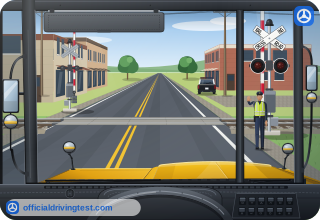
- Follow the crossing signal if it differs
- Cross as soon as the way looks clear
- Follow the officer's directions
Show answer
Correct answer: Follow the officer's directions
An officer at the crossing is in charge, so the driver does what the officer directs.
Source: CDL manual, national model as printed by New Jersey, Section 10 (July 2017)
-
No officer is at the crossing and the driver thinks the signal is faulty. What is the correct step?
- Cross when no train is visible
- Wait for another vehicle to cross first
- Call the dispatcher for instructions
Show answer
Correct answer: Call the dispatcher for instructions
With no officer to direct traffic, the driver reports a suspected signal problem to the dispatcher and asks how to go on.
Source: CDL manual, national model as printed by New Jersey, Section 10 (July 2017)
-
What should a driver aim for when planning a route that has railroad crossings?
- Crossings where trains run least often
- Crossings reached at normal traffic speed
- The longest possible view along the tracks
Show answer
Correct answer: The longest possible view along the tracks
A route should give the driver as much view down the track as possible at each crossing.
Source: CDL manual, national model as printed by New Jersey, Section 10 (July 2017)
-
When is it acceptable to start across tracks where the view is partly blocked?
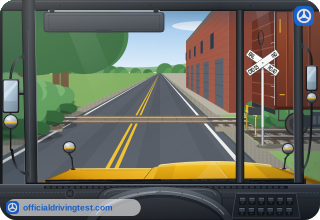
- When the view is long enough to be sure no train comes
- When the horn has been sounded and nothing answers
- When other traffic ahead is already crossing too
Show answer
Correct answer: When the view is long enough to be sure no train comes
The driver may cross only when the view along the track is long enough to be certain that no train approaches. Routes should be planned for the best sight distance.
Source: CDL manual, national model as printed by New Jersey, Section 10 (July 2017)
-
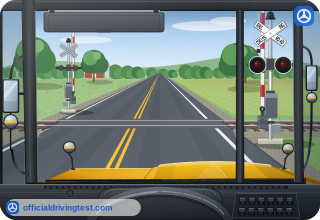
The active signals at a crossing show the tracks are clear. What should the driver do?
- Cross at once, because the signals are reliable
- Sound the horn and then cross without stopping
- Look and listen personally to be sure it is safe
Show answer
Correct answer: Look and listen personally to be sure it is safe
Clear signals are not enough. The driver also looks and listens before going across.
Source: CDL manual, national model as printed by New Jersey, Section 10 (July 2017)
-
A signal or stop sign stands just beyond the tracks. What must the driver be sure of before crossing?
- That the bus can stop within 15 feet past the last rail
- That there is room for the whole bus to clear the rails
- That the signal ahead is green when the bus reaches it
Show answer
Correct answer: That there is room for the whole bus to clear the rails
The bus may have to stop at the signal or stop sign beyond the tracks, so the whole bus must fit past the rails.
Source: CDL manual, national model as printed by New Jersey, Section 10 (July 2017)
-
How much room is enough on the far side of a crossing where the bus might have to stop?
- The bus length plus 5 feet
- The bus length plus 15 feet
- The bus length plus 50 feet
Show answer
Correct answer: The bus length plus 15 feet
As a rule of thumb, the space past the tracks should equal the bus length plus another 15 feet, so the whole bus can clear the rails if it must stop.
Source: CDL manual, national model as printed by New Jersey, Section 10 (July 2017)
-
Only in Arizona's manual
A school bus is getting close to a railroad crossing. At what distance from the crossing should you have shut off the radio and other sound sources?
- 50 feet
- 15 feet
- 200 feet
Show answer
Correct answer: 50 feet
Sound sources in the bus must be off by the time you are within 50 feet of the crossing, so you can hear a train.
Source: CDL manual, national model as printed by New Jersey, Section 10 (July 2017)
-
Only in Arizona's manual
A school bus nears a railroad crossing. At least how far before the crossing should the driver turn on the hazard lights?
- About 200 feet
- About 100 feet
- About 50 feet
Show answer
Correct answer: About 100 feet
The driver turns on the hazard lights roughly 100 feet or more before the crossing, so others know what the bus will do.
Source: CDL manual, national model as printed by New Jersey, Section 10 (July 2017)