Hazardous Materials: Hazardous materials emergencies — Part 3
Questions in this part include: “A radioactive material has leaked in your vehicle. What is needed before you use the vehicle again?” · “When phoning in a hazardous materials incident, what should the caller say about danger at the scene?”
Independent educational site · not affiliated with any government agency or DMV
Ready? Test yourself
Answer to start, or tap Start below:
A radioactive material has leaked in your vehicle. What is needed before you use the vehicle again?
- Instant feedback with an explanation
- Every answer cites its source in the manual
- Your best score is saved on this device
- Keyboard: press 1 to 3 to answer and Enter for the next question
Questions are written in our own words from the CDL manual; they are not the real test's questions. With your state chosen, every answer gives its page in your state's CDL manual. Without a state, answers cite the CDL manual, national model as printed by New Jersey (July 2017).
All 19 questions in this practice test
Take the test above first, then use this list to study. Tap “Show answer” to see the correct answer and explanation.
Show the questions and answersHide the questions
-
A radioactive material has leaked in your vehicle. What is needed before you use the vehicle again?
- A full day of airing out with the doors open
- Cleaning and a check with a survey meter
- A written statement from the shipper
Show answer
Correct answer: Cleaning and a check with a survey meter
After a radioactive spill, the vehicle stays out of use until it has been cleaned and checked with a survey meter.
Source: CDL manual, national model as printed by New Jersey, Section 9 (July 2017)
-
Parts of your vehicle got wet from a corrosive liquid. How should they be cleaned?
- Wiped dry with a clean cloth
- Covered with sand and left to dry
- Thoroughly washed with water
Show answer
Correct answer: Thoroughly washed with water
Any part of the vehicle that touched a corrosive liquid needs a thorough wash with water.
Source: CDL manual, national model as printed by New Jersey, Section 9 (July 2017)
-
After you unload a leaking load of corrosives, what should be done before the vehicle is loaded again?
- Leave the interior closed for a day
- Put a layer of paper on the floor
- Clean the inside soon after unloading
Show answer
Correct answer: Clean the inside soon after unloading
Washing out the interior soon after unloading removes corrosive residue before new cargo goes in.
Source: CDL manual, national model as printed by New Jersey, Section 9 (July 2017)
-
A corrosive liquid is leaking from your vehicle and you can do it safely. What should you do about the liquid?
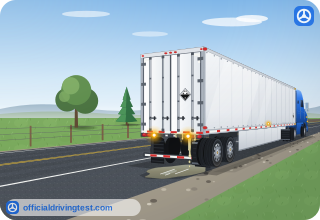
- Wash it down the nearest drain
- Spread it out so that it dries faster
- Contain it and keep people from the fumes
Show answer
Correct answer: Contain it and keep people from the fumes
When it is safe, hold the leaking liquid in one place, and keep bystanders away from both the liquid and its fumes.
Source: CDL manual, national model as printed by New Jersey, Section 9 (July 2017)
-
Which center helps coordinate the response to chemical hazards and supports police and firefighters?
- The National Response Center
- A local police dispatch center
- The shipper's customer service office
Show answer
Correct answer: The National Response Center
The National Response Center coordinates emergency response to chemical hazards and serves as a resource for police and fire crews.
Source: CDL manual, national model as printed by New Jersey, Section 9 (July 2017)
-
When can a driver reach the National Response Center by its toll-free telephone line?
- Only during weekday business hours
- Only after the carrier has filed a written report
- Any hour of the day or night
Show answer
Correct answer: Any hour of the day or night
The center runs a toll-free line that is open 24 hours a day.
Source: CDL manual, national model as printed by New Jersey, Section 9 (July 2017)
-
After a hazardous materials incident that meets the reporting conditions, who must telephone the National Response Center?
- Only the shipper who loaded the cargo
- Only the local fire department
- The driver or the driver's employer
Show answer
Correct answer: The driver or the driver's employer
Either the driver or the employer has to make the call when an incident reaches the reporting conditions.
Source: CDL manual, national model as printed by New Jersey, Section 9 (July 2017)
-
A hazardous materials incident causes estimated property damage above what amount before the National Response Center must be called?
- $10,000
- $100,000
- $50,000
Show answer
Correct answer: $50,000
Property damage estimated at more than $50,000 from a hazardous materials incident must be reported by phone.
Source: CDL manual, national model as printed by New Jersey, Section 9 (July 2017)
-
The general public is moved away because of a hazardous materials incident. How long must the evacuation last before a call to the National Response Center is required?
- More than one hour
- More than six hours
- Any amount of time at all
Show answer
Correct answer: More than one hour
Reporting is required when the public is evacuated for longer than one hour.
Source: CDL manual, national model as printed by New Jersey, Section 9 (July 2017)
-
What is the telephone number of the National Response Center?
- (800) 424-8802
- (800) 424-9300
- (800) 424-8208
Show answer
Correct answer: (800) 424-8802
The National Response Center can be reached at (800) 424-8802.
Source: CDL manual, national model as printed by New Jersey, Section 9 (July 2017)
-
When phoning in a hazardous materials incident, what should the caller say about danger at the scene?
- Whether the road has been cleaned up
- Whether people are still in danger there
- Whether the vehicle can be driven away
Show answer
Correct answer: Whether people are still in danger there
The caller should say what kind of incident it is and whether there is still a danger to life at the scene.
Source: CDL manual, national model as printed by New Jersey, Section 9 (July 2017)
-
A reportable quantity of a hazardous substance was released. Besides the basics, what should the caller tell the National Response Center?
- The shipper's name and how much substance was discharged
- The driver's license number and years of experience
- The names of the people who unloaded the cargo
Show answer
Correct answer: The shipper's name and how much substance was discharged
When a reportable quantity is involved, the caller gives the shipper's name and the amount of the substance that was discharged.
Source: CDL manual, national model as printed by New Jersey, Section 9 (July 2017)
-
How soon after an incident must a carrier send in a detailed written report?
- Within 30 days
- Within 10 days
- Within 90 days
Show answer
Correct answer: Within 30 days
The carrier has 30 days from the incident to make its detailed written report.
Source: CDL manual, national model as printed by New Jersey, Section 9 (July 2017)
-
What was CHEMTREC set up to give to emergency personnel?
- Permits to move hazardous cargo from place to place
- Technical facts about what hazardous materials are like
- Money to pay for the cleanup of hazardous spills
Show answer
Correct answer: Technical facts about what hazardous materials are like
CHEMTREC supplies emergency personnel with technical information about what hazardous materials are like physically.
Source: CDL manual, national model as printed by New Jersey, Section 9 (July 2017)
-
A driver calls CHEMTREC about a problem. What happens with the National Response Center?
- Nothing, so the driver must call it separately every time
- CHEMTREC passes the problem to it when appropriate
- It takes over and CHEMTREC closes the case
Show answer
Correct answer: CHEMTREC passes the problem to it when appropriate
The two centers stay in close contact, so a call to one is passed to the other when appropriate.
Source: CDL manual, national model as printed by New Jersey, Section 9 (July 2017)
-
What must a driver limit for packages carrying radioactive yellow-II or yellow-III labels?
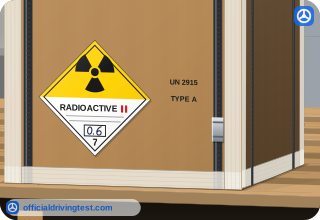
- How long they stay near people, animals or film
- How many of them may ride on a single axle
- How fast the vehicle may travel while carrying them
Show answer
Correct answer: How long they stay near people, animals or film
These labeled packages may not be left near people, animals or undeveloped film for longer than the separation table allows.
Source: CDL manual, national model as printed by New Jersey, Section 9 (July 2017)
-
A shipment has a total transport index of 5.1 to 10.0. What is the minimum distance in feet to undeveloped film when the packages stay 8 to 12 hours?
- 9 feet
- 15 feet
- 11 feet
Show answer
Correct answer: 11 feet
For a transport index of 5.1 to 10.0, packages kept 8 to 12 hours must be 11 feet from undeveloped film.
Source: CDL manual, national model as printed by New Jersey, Section 9 (July 2017)
-
Into how many major hazard classes are hazardous materials categorized?
- Six
- Twelve
- Nine
Show answer
Correct answer: Nine
There are nine major hazard classes, plus extra categories for consumer commodities and combustible liquids.
Source: CDL manual, national model as printed by New Jersey, Section 9 (July 2017)
-
Hydrochloric acid and battery fluid belong to which hazard class number?
- Class 6
- Class 7
- Class 8
Show answer
Correct answer: Class 8
Corrosives such as hydrochloric acid and battery fluid are Class 8.
Source: CDL manual, national model as printed by New Jersey, Section 9 (July 2017)
-
Only in Arizona's manual
Hazardous cargo from your truck spills and contaminates a roadway and a ditch. Who pays for the cleanup?
- The carrier
- The state highway agency
- The local fire department
Show answer
Correct answer: The carrier
The carrier carries the cost of cleaning up places that its cargo contaminates, and this cost is very high.
Source: CDL manual, national model as printed by New Jersey, Section 9 (July 2017)
-
Only in Arizona's manual
Which result of a hazardous materials incident means you or your employer must telephone the National Response Center?
- Traffic is slowed for ten minutes
- An injured person needs a hospital stay
- The delivery arrives an hour late
Show answer
Correct answer: An injured person needs a hospital stay
You or your employer must call the National Response Center when a hazardous materials incident leaves someone hurt badly enough to need a hospital stay.
Source: CDL manual, national model as printed by New Jersey, Section 9 (July 2017)