Hazardous Materials: Hazardous materials emergencies
The Emergency Response Guidebook, crashes and incidents, fires, responses to specific hazards, and required notification. Split into 3 shorter tests so you're not stuck in one long quiz.
Independent educational site · not affiliated with any government agency or DMV
Choose a part
Hazardous materials emergencies — Part 1
Questions in this part include: “How can a firefighter look up a product in the Emergency Response Guidebook?”
Hazardous materials emergencies — Part 2
Questions in this part include: “When must you leave a leaking vehicle where it is?”
Hazardous materials emergencies — Part 3
Questions in this part include: “A radioactive material has leaked in your vehicle. What is needed before you use the vehicle again?”
Questions are written in our own words from the CDL manual; they are not the real test's questions. With your state chosen, every answer gives its page in your state's CDL manual. Without a state, answers cite the CDL manual, national model as printed by New Jersey (July 2017).
All 58 Hazardous materials emergencies questions with answers
Choose a part above to take a practice test, or study every question and answer here.
Show the questions and answersHide the questions
1Part 120 questions
-
How can a firefighter look up a product in the Emergency Response Guidebook?
- By the carrier's name and the truck's license plate
- By the proper shipping name or the identification number
- By the color of the placard and the size of the package
Show answer
Correct answer: By the proper shipping name or the identification number
Responders look up the product by its proper shipping name or its identification number, taken from the shipping paper, so those must be right.
Source: CDL manual, national model as printed by New Jersey, Section 9 (July 2017)
-
At the scene of a crash with hazardous materials, what is one of your jobs as the driver?
- Move the load to another truck yourself
- Keep bystanders away from the scene
- Open the cargo area to look at the damage
Show answer
Correct answer: Keep bystanders away from the scene
A driver must keep people back from the scene so that nobody is hurt by the hazardous materials.
Source: CDL manual, national model as printed by New Jersey, Section 9 (July 2017)
-
When may you try to limit the spread of a hazardous material at a crash scene?
- Only when you can do it safely
- Whenever the load belongs to your employer
- Only after the police have left the scene
Show answer
Correct answer: Only when you can do it safely
Limiting the spread of the material is part of the driver's job, but only if it can be done without putting yourself at risk.
Source: CDL manual, national model as printed by New Jersey, Section 9 (July 2017)
-
Besides handing over papers, what must you pass on to responders about the load?
- The route the truck took before the incident
- The danger the hazardous materials present
- Your hours of service for the day
Show answer
Correct answer: The danger the hazardous materials present
A driver at the scene must tell the emergency personnel how dangerous the hazardous materials are.
Source: CDL manual, national model as printed by New Jersey, Section 9 (July 2017)
-
What should you hand to emergency responders when they arrive at a hazardous materials crash?
- Your trip log and your fuel receipts
- Your medical card and insurance policy
- The shipping papers and response information
Show answer
Correct answer: The shipping papers and response information
Responders need the shipping papers and the emergency response information to know what the load is and how to deal with it.
Source: CDL manual, national model as printed by New Jersey, Section 9 (July 2017)
-
Where should people be kept in relation to the wind at a hazardous materials incident?
- Downwind, so they can see what is happening
- Upwind and far away from the incident
- Beside the vehicle, in a single group
Show answer
Correct answer: Upwind and far away from the incident
Bystanders belong far away and upwind, so any fumes are blown away from them.
Source: CDL manual, national model as printed by New Jersey, Section 9 (July 2017)
-
You are not trained or equipped for it. What should you do about a fire in a load of hazardous materials?
- Use the fire extinguisher until the flames are out
- Do not try to fight it; call for help instead
- Drive to a truck stop where there is water
Show answer
Correct answer: Do not try to fight it; call for help instead
Hazardous materials fires need special training and protective gear. Without them, do not fight the fire.
Source: CDL manual, national model as printed by New Jersey, Section 9 (July 2017)
-
What may you use the fire extinguisher for on a small truck fire?
- To put out a fire that is burning in the cargo
- To cool the cargo area before opening the doors
- To keep the fire from reaching the cargo
Show answer
Correct answer: To keep the fire from reaching the cargo
A small truck fire may be fought with the extinguisher to stop it from spreading to the cargo until the fire department comes.
Source: CDL manual, national model as printed by New Jersey, Section 9 (July 2017)
-
You suspect a fire in the trailer. The trailer doors feel hot. What do you do?
- Open them quickly and use the extinguisher inside
- Keep them closed, because there may be a cargo fire
- Open them a little to let the heat escape
Show answer
Correct answer: Keep them closed, because there may be a cargo fire
Hot doors point to a cargo fire. Leave them shut and wait for the firefighters.
Source: CDL manual, national model as printed by New Jersey, Section 9 (July 2017)
-
Why is it better not to open the doors of a trailer that has a cargo fire?
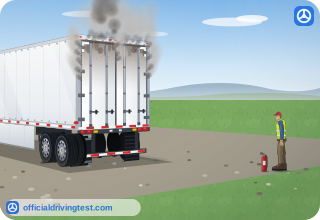
- Fresh air can make the fire burn harder
- The smoke will turn the cargo toxic
- The doors may be locked by the heat
Show answer
Correct answer: Fresh air can make the fire burn harder
Fresh air feeds a fire. With the doors shut, many fires only smolder and do less damage until help arrives.
Source: CDL manual, national model as printed by New Jersey, Section 9 (July 2017)
-
What is the rule when the cargo itself is already burning?
- Fight it only if the extinguisher is full
- Do not fight it, because it is not safe
- Fight it from the upwind side of the truck
Show answer
Correct answer: Do not fight it, because it is not safe
A burning cargo is too dangerous for the driver to fight. Warn others, keep them away and give the papers to the responders.
Source: CDL manual, national model as printed by New Jersey, Section 9 (July 2017)
-
How should you find out what material is leaking from your cargo?
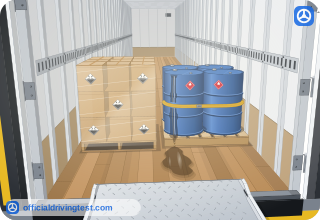
- Check the papers, labels or package location
- Smell the leak from a short distance
- Take a sample and check it in the guidebook
Show answer
Correct answer: Check the papers, labels or package location
Use the paperwork, the labels or the position of the package to identify the material. Never touch or sniff it.
Source: CDL manual, national model as printed by New Jersey, Section 9 (July 2017)
-
What should you do about touching a material that is leaking from your cargo?
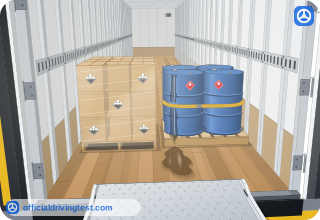
- Touch it only while wearing work gloves
- Never touch it, since people often get hurt that way
- Touch it briefly to find where it comes from
Show answer
Correct answer: Never touch it, since people often get hurt that way
Do not touch leaking material; many people have been injured by doing so.
Source: CDL manual, national model as printed by New Jersey, Section 9 (July 2017)
-
Why must you not use smell to find a leak or to tell what is leaking?
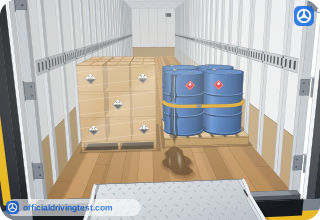
- Most hazardous materials have no smell at all
- Toxic gases can ruin smell and still harm you
- The smell of fuel would hide the material
Show answer
Correct answer: Toxic gases can ruin smell and still harm you
Poisonous gas can ruin your ability to smell it, and it may injure or kill you even when it has no odor.
Source: CDL manual, national model as printed by New Jersey, Section 9 (July 2017)
-
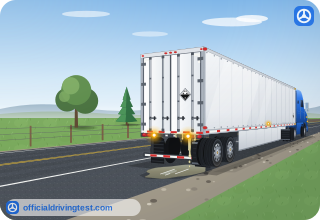
What must you never do near a leak or spill of hazardous materials?
- Use your phone or radio
- Stand upwind of the spill
- Eat, drink or smoke
Show answer
Correct answer: Eat, drink or smoke
Eating, drinking and smoking are all forbidden anywhere near a leak or spill of hazardous materials.
Source: CDL manual, national model as printed by New Jersey, Section 9 (July 2017)
-
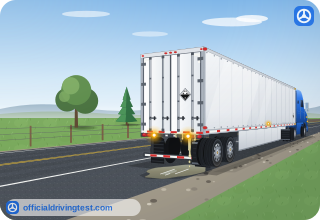
Hazardous materials are spilling from your truck. How far should you move it?
- As far as the next exit
- Back to the shipper's loading dock
- No more than safety requires
Show answer
Correct answer: No more than safety requires
Moving a spilling vehicle spreads the contamination. Move it only as much as safety demands, such as off the road and away from people.
Source: CDL manual, national model as printed by New Jersey, Section 9 (July 2017)
-
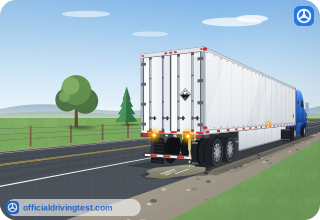
Your load is leaking and you have no phone. Why not keep driving to find help?
- The shipper would not pay for the delay
- Your hours of service would run out sooner
- The leak would spread contamination on the way
Show answer
Correct answer: The leak would spread contamination on the way
Driving on leaves a long trail of contamination, and the carrier pays for the cleanup of roads, lots and ditches. The costs are enormous.
Source: CDL manual, national model as printed by New Jersey, Section 9 (July 2017)
-
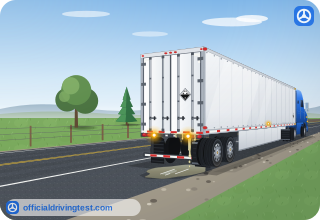
Your vehicle is spilling hazardous materials. Which order of actions is right?
- Drive to the nearest truck stop, then call for help
- Park, then walk to the nearest phone and wait there
- Park, secure the area, stay, then get help
Show answer
Correct answer: Park, secure the area, stay, then get help
Park the vehicle, secure the area and stay there while you call for help or send someone else.
Source: CDL manual, national model as printed by New Jersey, Section 9 (July 2017)
-
You send someone to get help for a spill. Which item should you give that person?
- The weight of the full trailer
- Your exact location and direction of travel
- The date of your last vehicle inspection
Show answer
Correct answer: Your exact location and direction of travel
Responders need your exact location and direction of travel, along with a description of the emergency, so they can find you.
Source: CDL manual, national model as printed by New Jersey, Section 9 (July 2017)
-
There is a lot of information to pass on when you send someone for help. What is wise to do?
- Give it by radio before the person leaves
- Write it down for the person to carry
- Let the person ask the dispatcher for it
Show answer
Correct answer: Write it down for the person to carry
A written note helps the messenger report everything, so the response team can bring the right equipment the first time.
Source: CDL manual, national model as printed by New Jersey, Section 9 (July 2017)
2Part 219 questions
-
When must you leave a leaking vehicle where it is?
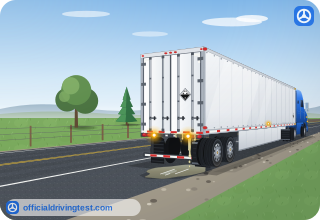
- If the move would cause contamination or damage it
- If the leak has not yet been traced to a source
- If the shipper has not yet been told about it
Show answer
Correct answer: If the move would cause contamination or damage it
Do not move the vehicle when moving it would spread contamination or damage the vehicle.
Source: CDL manual, national model as printed by New Jersey, Section 9 (July 2017)
-
Your vehicle is leaking hazardous materials. Where should you stay in relation to places where people gather?
- Upwind and away from them
- Downwind of them, so fumes blow away from you
- Next to them, if you park on the road shoulder
Show answer
Correct answer: Upwind and away from them
Stay upwind and keep clear of rest areas, truck stops, cafes and other businesses, so you do not expose people to the material.
Source: CDL manual, national model as printed by New Jersey, Section 9 (July 2017)
-
You find a leaking container in your load. What should you not try to do without training and equipment?
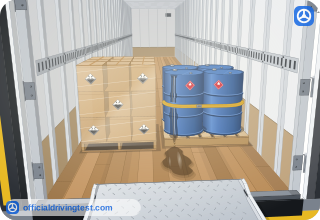
- Repair the leak or repack the container
- Call your dispatcher or supervisor
- Keep bystanders away from the spill
Show answer
Correct answer: Repair the leak or repack the container
Repacking containers or repairing leaks is unsafe unless you are trained and equipped. Call your dispatcher or supervisor for instructions.
Source: CDL manual, national model as printed by New Jersey, Section 9 (July 2017)
-
Your truck with explosives breaks down. What must you not allow near the vehicle?
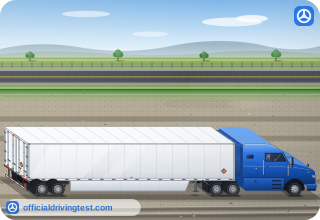
- Any other traffic on the road
- People who work for the carrier
- Smoking or an open fire
Show answer
Correct answer: Smoking or an open fire
Smoking or an open fire near explosives could set them off, so keep both away and keep bystanders back.
Source: CDL manual, national model as printed by New Jersey, Section 9 (July 2017)
-
Explosives on your vehicle catch fire. Whom should you warn, and about what?
- Responders, about a toxic smoke risk
- Other drivers, about a blocked lane
- Everyone nearby, about an explosion
Show answer
Correct answer: Everyone nearby, about an explosion
When explosives are burning, warn everyone close by that they could explode.
Source: CDL manual, national model as printed by New Jersey, Section 9 (July 2017)
-
Vehicles carrying explosives are in a collision and must be separated. How far away must the explosives be placed?
- At least 200 feet from vehicles and occupied buildings
- At least 150 feet from vehicles and occupied buildings
- At least 500 feet from vehicles and occupied buildings
Show answer
Correct answer: At least 200 feet from vehicles and occupied buildings
Explosives are unloaded before vehicles are pulled apart, and set down 200 feet or more away from them and from any building with people in it.
Source: CDL manual, national model as printed by New Jersey, Section 9 (July 2017)
-
Compressed gas is leaking from your vehicle. Who may go close to it?
- Only people working to clear the gas or the wreck
- Any bystander wearing a dust mask and gloves
- Any driver who carries a fire extinguisher
Show answer
Correct answer: Only people working to clear the gas or the wreck
Only people who are working to remove the hazard or the wreckage may get close to a compressed gas leak.
Source: CDL manual, national model as printed by New Jersey, Section 9 (July 2017)
-
Compressed gas is involved in an accident. Whom must you notify?
- The state transportation office
- The shipper
- The manufacturer of the tank
Show answer
Correct answer: The shipper
The shipper must be told whenever compressed gas is involved in any accident.
Source: CDL manual, national model as printed by New Jersey, Section 9 (July 2017)
-
On a public road, when may you move flammable compressed gas from one tank into another?
- Only to fuel road construction or maintenance machinery
- Only when the first tank is already half empty
- Only if the second tank carries matching placards
Show answer
Correct answer: Only to fuel road construction or maintenance machinery
Transferring flammable compressed gas on a public road is not allowed, except when fueling machinery for road construction or maintenance.
Source: CDL manual, national model as printed by New Jersey, Section 9 (July 2017)
-
Your truck with flammable liquid breaks down. What should you do about bystanders?
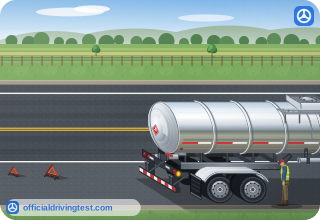
- Ask them to direct traffic around the truck
- Let them watch from the roadside
- Keep them from gathering and from smoking
Show answer
Correct answer: Keep them from gathering and from smoking
Stop bystanders from gathering, warn them of the danger and keep them from smoking.
Source: CDL manual, national model as printed by New Jersey, Section 9 (July 2017)
-
Your cargo tank of flammable liquid is leaking. How far may you drive it?
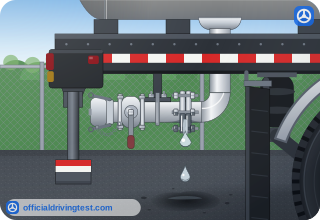
- Only as far as needed to reach a safe place
- To the next terminal of your carrier
- To the end of your planned route
Show answer
Correct answer: Only as far as needed to reach a safe place
A leaking tank may be driven only as far as a safe place requires, and you should leave the roadway if that can be done safely.
Source: CDL manual, national model as printed by New Jersey, Section 9 (July 2017)
-
When may flammable liquid be moved between two vehicles on a public road?
- Whenever a second driver helps
- Only in an emergency
- Any time the roadside is clear of people
Show answer
Correct answer: Only in an emergency
Moving flammable liquid between vehicles on a public road is allowed only in an emergency.
Source: CDL manual, national model as printed by New Jersey, Section 9 (July 2017)
-
Packages of flammable solids are smoldering after a spill. What should you not do with them?
- Open them to see what is inside
- Take them off the vehicle if it is safe
- Warn others about the fire hazard
Show answer
Correct answer: Open them to see what is inside
Smoldering flammable-solid packages must stay closed; take them off the vehicle only if you can do so safely.
Source: CDL manual, national model as printed by New Jersey, Section 9 (July 2017)
-
Class 4 or 5 materials have spilled. Which other packages should you remove if it lowers the fire hazard?
- Packages that are placed near the cab
- Packages that have not been broken open
- Packages that carry a Class 3 label
Show answer
Correct answer: Packages that have not been broken open
Besides smoldering packages, unbroken packages may be taken off the vehicle when that reduces the fire hazard.
Source: CDL manual, national model as printed by New Jersey, Section 9 (July 2017)
-
A poison gas or poison material you carry might also burn. What extra care is called for?
- Treat it like a Class 7 material
- Add the care used for flammables
- Move it away from the driver's seat
Show answer
Correct answer: Add the care used for flammables
Many poisons are also flammable. When that is possible, add the precautions for flammables, including no smoking, open flame or welding.
Source: CDL manual, national model as printed by New Jersey, Section 9 (July 2017)
-
After a leak of poison gas or poison material, what must happen before the vehicle is used again?
- It must be parked for one full day
- It must be checked for stray poison
- It must be repainted with new placards
Show answer
Correct answer: It must be checked for stray poison
Poison may be left on the vehicle after a leak, so it must be checked for stray poison before it returns to service.
Source: CDL manual, national model as printed by New Jersey, Section 9 (July 2017)
-
A package of infectious substances is damaged while you handle it. What should you do?
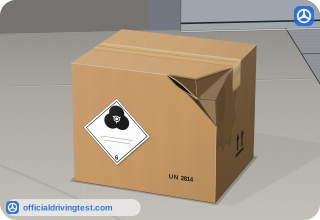
- Contact your supervisor right away
- Tape the package and deliver it
- Wash the package and keep it in the cab
Show answer
Correct answer: Contact your supervisor right away
Tell your supervisor immediately. Packages that look damaged or leaking should not be accepted for transport.
Source: CDL manual, national model as printed by New Jersey, Section 9 (July 2017)
-
A package of infectious substances looks damaged or leaking. What is the rule for it?
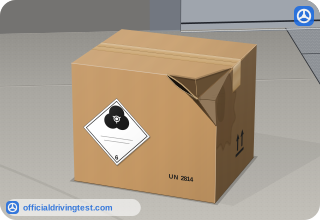
- It should not be accepted for shipment
- Accept it if it is wrapped in plastic
- Accept it but load it nearest the door
Show answer
Correct answer: It should not be accepted for shipment
A package that appears damaged or shows signs of leakage should not be accepted.
Source: CDL manual, national model as printed by New Jersey, Section 9 (July 2017)
-
Radioactive material leaks or a package breaks. Whom do you tell, and how soon?
- Only the shipper, after the vehicle is cleaned
- Your supervisor or dispatcher, right away
- The nearest hospital, within the same shift
Show answer
Correct answer: Your supervisor or dispatcher, right away
A leak or broken radioactive package must be reported to the dispatcher or supervisor without delay.
Source: CDL manual, national model as printed by New Jersey, Section 9 (July 2017)
3Part 319 questions
-
A radioactive material has leaked in your vehicle. What is needed before you use the vehicle again?
- A full day of airing out with the doors open
- Cleaning and a check with a survey meter
- A written statement from the shipper
Show answer
Correct answer: Cleaning and a check with a survey meter
After a radioactive spill, the vehicle stays out of use until it has been cleaned and checked with a survey meter.
Source: CDL manual, national model as printed by New Jersey, Section 9 (July 2017)
-
Parts of your vehicle got wet from a corrosive liquid. How should they be cleaned?
- Wiped dry with a clean cloth
- Covered with sand and left to dry
- Thoroughly washed with water
Show answer
Correct answer: Thoroughly washed with water
Any part of the vehicle that touched a corrosive liquid needs a thorough wash with water.
Source: CDL manual, national model as printed by New Jersey, Section 9 (July 2017)
-
After you unload a leaking load of corrosives, what should be done before the vehicle is loaded again?
- Leave the interior closed for a day
- Put a layer of paper on the floor
- Clean the inside soon after unloading
Show answer
Correct answer: Clean the inside soon after unloading
Washing out the interior soon after unloading removes corrosive residue before new cargo goes in.
Source: CDL manual, national model as printed by New Jersey, Section 9 (July 2017)
-
A corrosive liquid is leaking from your vehicle and you can do it safely. What should you do about the liquid?
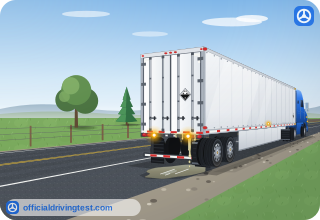
- Wash it down the nearest drain
- Spread it out so that it dries faster
- Contain it and keep people from the fumes
Show answer
Correct answer: Contain it and keep people from the fumes
When it is safe, hold the leaking liquid in one place, and keep bystanders away from both the liquid and its fumes.
Source: CDL manual, national model as printed by New Jersey, Section 9 (July 2017)
-
Which center helps coordinate the response to chemical hazards and supports police and firefighters?
- The National Response Center
- A local police dispatch center
- The shipper's customer service office
Show answer
Correct answer: The National Response Center
The National Response Center coordinates emergency response to chemical hazards and serves as a resource for police and fire crews.
Source: CDL manual, national model as printed by New Jersey, Section 9 (July 2017)
-
When can a driver reach the National Response Center by its toll-free telephone line?
- Only during weekday business hours
- Only after the carrier has filed a written report
- Any hour of the day or night
Show answer
Correct answer: Any hour of the day or night
The center runs a toll-free line that is open 24 hours a day.
Source: CDL manual, national model as printed by New Jersey, Section 9 (July 2017)
-
After a hazardous materials incident that meets the reporting conditions, who must telephone the National Response Center?
- Only the shipper who loaded the cargo
- Only the local fire department
- The driver or the driver's employer
Show answer
Correct answer: The driver or the driver's employer
Either the driver or the employer has to make the call when an incident reaches the reporting conditions.
Source: CDL manual, national model as printed by New Jersey, Section 9 (July 2017)
-
A hazardous materials incident causes estimated property damage above what amount before the National Response Center must be called?
- $10,000
- $100,000
- $50,000
Show answer
Correct answer: $50,000
Property damage estimated at more than $50,000 from a hazardous materials incident must be reported by phone.
Source: CDL manual, national model as printed by New Jersey, Section 9 (July 2017)
-
The general public is moved away because of a hazardous materials incident. How long must the evacuation last before a call to the National Response Center is required?
- More than one hour
- More than six hours
- Any amount of time at all
Show answer
Correct answer: More than one hour
Reporting is required when the public is evacuated for longer than one hour.
Source: CDL manual, national model as printed by New Jersey, Section 9 (July 2017)
-
What is the telephone number of the National Response Center?
- (800) 424-8802
- (800) 424-9300
- (800) 424-8208
Show answer
Correct answer: (800) 424-8802
The National Response Center can be reached at (800) 424-8802.
Source: CDL manual, national model as printed by New Jersey, Section 9 (July 2017)
-
When phoning in a hazardous materials incident, what should the caller say about danger at the scene?
- Whether the road has been cleaned up
- Whether people are still in danger there
- Whether the vehicle can be driven away
Show answer
Correct answer: Whether people are still in danger there
The caller should say what kind of incident it is and whether there is still a danger to life at the scene.
Source: CDL manual, national model as printed by New Jersey, Section 9 (July 2017)
-
A reportable quantity of a hazardous substance was released. Besides the basics, what should the caller tell the National Response Center?
- The shipper's name and how much substance was discharged
- The driver's license number and years of experience
- The names of the people who unloaded the cargo
Show answer
Correct answer: The shipper's name and how much substance was discharged
When a reportable quantity is involved, the caller gives the shipper's name and the amount of the substance that was discharged.
Source: CDL manual, national model as printed by New Jersey, Section 9 (July 2017)
-
How soon after an incident must a carrier send in a detailed written report?
- Within 30 days
- Within 10 days
- Within 90 days
Show answer
Correct answer: Within 30 days
The carrier has 30 days from the incident to make its detailed written report.
Source: CDL manual, national model as printed by New Jersey, Section 9 (July 2017)
-
What was CHEMTREC set up to give to emergency personnel?
- Permits to move hazardous cargo from place to place
- Technical facts about what hazardous materials are like
- Money to pay for the cleanup of hazardous spills
Show answer
Correct answer: Technical facts about what hazardous materials are like
CHEMTREC supplies emergency personnel with technical information about what hazardous materials are like physically.
Source: CDL manual, national model as printed by New Jersey, Section 9 (July 2017)
-
A driver calls CHEMTREC about a problem. What happens with the National Response Center?
- Nothing, so the driver must call it separately every time
- CHEMTREC passes the problem to it when appropriate
- It takes over and CHEMTREC closes the case
Show answer
Correct answer: CHEMTREC passes the problem to it when appropriate
The two centers stay in close contact, so a call to one is passed to the other when appropriate.
Source: CDL manual, national model as printed by New Jersey, Section 9 (July 2017)
-
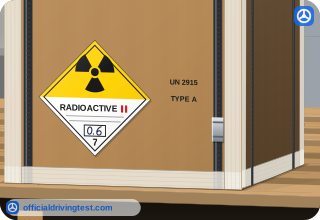
What must a driver limit for packages carrying radioactive yellow-II or yellow-III labels?
- How long they stay near people, animals or film
- How many of them may ride on a single axle
- How fast the vehicle may travel while carrying them
Show answer
Correct answer: How long they stay near people, animals or film
These labeled packages may not be left near people, animals or undeveloped film for longer than the separation table allows.
Source: CDL manual, national model as printed by New Jersey, Section 9 (July 2017)
-
A shipment has a total transport index of 5.1 to 10.0. What is the minimum distance in feet to undeveloped film when the packages stay 8 to 12 hours?
- 9 feet
- 15 feet
- 11 feet
Show answer
Correct answer: 11 feet
For a transport index of 5.1 to 10.0, packages kept 8 to 12 hours must be 11 feet from undeveloped film.
Source: CDL manual, national model as printed by New Jersey, Section 9 (July 2017)
-
Into how many major hazard classes are hazardous materials categorized?
- Six
- Twelve
- Nine
Show answer
Correct answer: Nine
There are nine major hazard classes, plus extra categories for consumer commodities and combustible liquids.
Source: CDL manual, national model as printed by New Jersey, Section 9 (July 2017)
-
Hydrochloric acid and battery fluid belong to which hazard class number?
- Class 6
- Class 7
- Class 8
Show answer
Correct answer: Class 8
Corrosives such as hydrochloric acid and battery fluid are Class 8.
Source: CDL manual, national model as printed by New Jersey, Section 9 (July 2017)
-
Only in Arizona's manual
Hazardous cargo from your truck spills and contaminates a roadway and a ditch. Who pays for the cleanup?
- The carrier
- The state highway agency
- The local fire department
Show answer
Correct answer: The carrier
The carrier carries the cost of cleaning up places that its cargo contaminates, and this cost is very high.
Source: CDL manual, national model as printed by New Jersey, Section 9 (July 2017)
-
Only in Arizona's manual
Which result of a hazardous materials incident means you or your employer must telephone the National Response Center?
- Traffic is slowed for ten minutes
- An injured person needs a hospital stay
- The delivery arrives an hour late
Show answer
Correct answer: An injured person needs a hospital stay
You or your employer must call the National Response Center when a hazardous materials incident leaves someone hurt badly enough to need a hospital stay.
Source: CDL manual, national model as printed by New Jersey, Section 9 (July 2017)