Hazardous Materials: Hazardous materials emergencies — Part 2
Questions in this part include: “When must you leave a leaking vehicle where it is?” · “Your truck with flammable liquid breaks down. What should you do about bystanders?”
Independent educational site · not affiliated with any government agency or DMV
Ready? Test yourself
Answer to start, or tap Start below:
Your vehicle is leaking hazardous materials. Where should you stay in relation to places where people gather?
- Instant feedback with an explanation
- Every answer cites its source in the manual
- Your best score is saved on this device
- Keyboard: press 1 to 3 to answer and Enter for the next question
Questions are written in our own words from the CDL manual; they are not the real test's questions. With your state chosen, every answer gives its page in your state's CDL manual. Without a state, answers cite the CDL manual, national model as printed by New Jersey (July 2017).
All 19 questions in this practice test
Take the test above first, then use this list to study. Tap “Show answer” to see the correct answer and explanation.
Show the questions and answersHide the questions
-
When must you leave a leaking vehicle where it is?
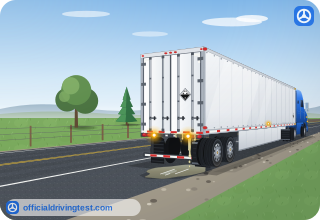
- If the move would cause contamination or damage it
- If the leak has not yet been traced to a source
- If the shipper has not yet been told about it
Show answer
Correct answer: If the move would cause contamination or damage it
Do not move the vehicle when moving it would spread contamination or damage the vehicle.
Source: CDL manual, national model as printed by New Jersey, Section 9 (July 2017)
-
Your vehicle is leaking hazardous materials. Where should you stay in relation to places where people gather?
- Upwind and away from them
- Downwind of them, so fumes blow away from you
- Next to them, if you park on the road shoulder
Show answer
Correct answer: Upwind and away from them
Stay upwind and keep clear of rest areas, truck stops, cafes and other businesses, so you do not expose people to the material.
Source: CDL manual, national model as printed by New Jersey, Section 9 (July 2017)
-
You find a leaking container in your load. What should you not try to do without training and equipment?
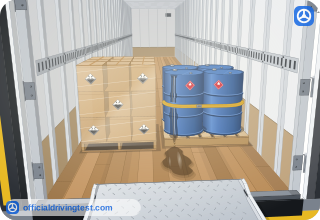
- Repair the leak or repack the container
- Call your dispatcher or supervisor
- Keep bystanders away from the spill
Show answer
Correct answer: Repair the leak or repack the container
Repacking containers or repairing leaks is unsafe unless you are trained and equipped. Call your dispatcher or supervisor for instructions.
Source: CDL manual, national model as printed by New Jersey, Section 9 (July 2017)
-
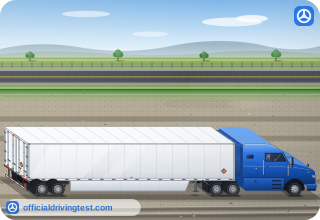
Your truck with explosives breaks down. What must you not allow near the vehicle?
- Any other traffic on the road
- People who work for the carrier
- Smoking or an open fire
Show answer
Correct answer: Smoking or an open fire
Smoking or an open fire near explosives could set them off, so keep both away and keep bystanders back.
Source: CDL manual, national model as printed by New Jersey, Section 9 (July 2017)
-
Explosives on your vehicle catch fire. Whom should you warn, and about what?
- Responders, about a toxic smoke risk
- Other drivers, about a blocked lane
- Everyone nearby, about an explosion
Show answer
Correct answer: Everyone nearby, about an explosion
When explosives are burning, warn everyone close by that they could explode.
Source: CDL manual, national model as printed by New Jersey, Section 9 (July 2017)
-
Vehicles carrying explosives are in a collision and must be separated. How far away must the explosives be placed?
- At least 200 feet from vehicles and occupied buildings
- At least 150 feet from vehicles and occupied buildings
- At least 500 feet from vehicles and occupied buildings
Show answer
Correct answer: At least 200 feet from vehicles and occupied buildings
Explosives are unloaded before vehicles are pulled apart, and set down 200 feet or more away from them and from any building with people in it.
Source: CDL manual, national model as printed by New Jersey, Section 9 (July 2017)
-
Compressed gas is leaking from your vehicle. Who may go close to it?
- Only people working to clear the gas or the wreck
- Any bystander wearing a dust mask and gloves
- Any driver who carries a fire extinguisher
Show answer
Correct answer: Only people working to clear the gas or the wreck
Only people who are working to remove the hazard or the wreckage may get close to a compressed gas leak.
Source: CDL manual, national model as printed by New Jersey, Section 9 (July 2017)
-
Compressed gas is involved in an accident. Whom must you notify?
- The state transportation office
- The shipper
- The manufacturer of the tank
Show answer
Correct answer: The shipper
The shipper must be told whenever compressed gas is involved in any accident.
Source: CDL manual, national model as printed by New Jersey, Section 9 (July 2017)
-
On a public road, when may you move flammable compressed gas from one tank into another?
- Only to fuel road construction or maintenance machinery
- Only when the first tank is already half empty
- Only if the second tank carries matching placards
Show answer
Correct answer: Only to fuel road construction or maintenance machinery
Transferring flammable compressed gas on a public road is not allowed, except when fueling machinery for road construction or maintenance.
Source: CDL manual, national model as printed by New Jersey, Section 9 (July 2017)
-
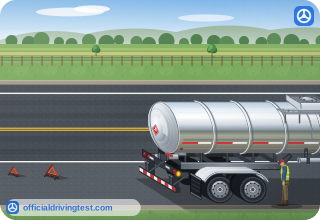
Your truck with flammable liquid breaks down. What should you do about bystanders?
- Ask them to direct traffic around the truck
- Let them watch from the roadside
- Keep them from gathering and from smoking
Show answer
Correct answer: Keep them from gathering and from smoking
Stop bystanders from gathering, warn them of the danger and keep them from smoking.
Source: CDL manual, national model as printed by New Jersey, Section 9 (July 2017)
-
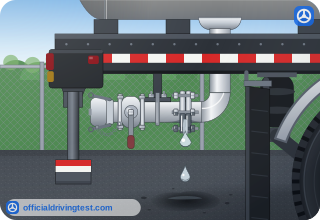
Your cargo tank of flammable liquid is leaking. How far may you drive it?
- Only as far as needed to reach a safe place
- To the next terminal of your carrier
- To the end of your planned route
Show answer
Correct answer: Only as far as needed to reach a safe place
A leaking tank may be driven only as far as a safe place requires, and you should leave the roadway if that can be done safely.
Source: CDL manual, national model as printed by New Jersey, Section 9 (July 2017)
-
When may flammable liquid be moved between two vehicles on a public road?
- Whenever a second driver helps
- Only in an emergency
- Any time the roadside is clear of people
Show answer
Correct answer: Only in an emergency
Moving flammable liquid between vehicles on a public road is allowed only in an emergency.
Source: CDL manual, national model as printed by New Jersey, Section 9 (July 2017)
-
Packages of flammable solids are smoldering after a spill. What should you not do with them?
- Open them to see what is inside
- Take them off the vehicle if it is safe
- Warn others about the fire hazard
Show answer
Correct answer: Open them to see what is inside
Smoldering flammable-solid packages must stay closed; take them off the vehicle only if you can do so safely.
Source: CDL manual, national model as printed by New Jersey, Section 9 (July 2017)
-
Class 4 or 5 materials have spilled. Which other packages should you remove if it lowers the fire hazard?
- Packages that are placed near the cab
- Packages that have not been broken open
- Packages that carry a Class 3 label
Show answer
Correct answer: Packages that have not been broken open
Besides smoldering packages, unbroken packages may be taken off the vehicle when that reduces the fire hazard.
Source: CDL manual, national model as printed by New Jersey, Section 9 (July 2017)
-
A poison gas or poison material you carry might also burn. What extra care is called for?
- Treat it like a Class 7 material
- Add the care used for flammables
- Move it away from the driver's seat
Show answer
Correct answer: Add the care used for flammables
Many poisons are also flammable. When that is possible, add the precautions for flammables, including no smoking, open flame or welding.
Source: CDL manual, national model as printed by New Jersey, Section 9 (July 2017)
-
After a leak of poison gas or poison material, what must happen before the vehicle is used again?
- It must be parked for one full day
- It must be checked for stray poison
- It must be repainted with new placards
Show answer
Correct answer: It must be checked for stray poison
Poison may be left on the vehicle after a leak, so it must be checked for stray poison before it returns to service.
Source: CDL manual, national model as printed by New Jersey, Section 9 (July 2017)
-
A package of infectious substances is damaged while you handle it. What should you do?
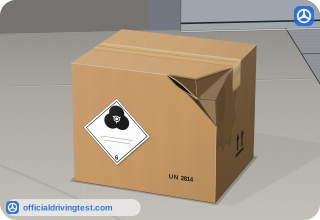
- Contact your supervisor right away
- Tape the package and deliver it
- Wash the package and keep it in the cab
Show answer
Correct answer: Contact your supervisor right away
Tell your supervisor immediately. Packages that look damaged or leaking should not be accepted for transport.
Source: CDL manual, national model as printed by New Jersey, Section 9 (July 2017)
-
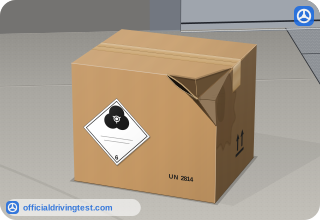
A package of infectious substances looks damaged or leaking. What is the rule for it?
- It should not be accepted for shipment
- Accept it if it is wrapped in plastic
- Accept it but load it nearest the door
Show answer
Correct answer: It should not be accepted for shipment
A package that appears damaged or shows signs of leakage should not be accepted.
Source: CDL manual, national model as printed by New Jersey, Section 9 (July 2017)
-
Radioactive material leaks or a package breaks. Whom do you tell, and how soon?
- Only the shipper, after the vehicle is cleaned
- Your supervisor or dispatcher, right away
- The nearest hospital, within the same shift
Show answer
Correct answer: Your supervisor or dispatcher, right away
A leak or broken radioactive package must be reported to the dispatcher or supervisor without delay.
Source: CDL manual, national model as printed by New Jersey, Section 9 (July 2017)