General Knowledge: Driving in winter and in very hot weather — Part 3
Questions in this part include: “What can happen if you press hard on the brake and the accelerator together while drying the brakes?” · “Why must you wait for the cooling system to cool before taking off the radiator cap?”
Independent educational site · not affiliated with any government agency or DMV
Ready? Test yourself
Answer to start, or tap Start below:
What can happen if you press hard on the brake and the accelerator together while drying the brakes?
- Instant feedback with an explanation
- Every answer cites its source in the manual
- Your best score is saved on this device
- Keyboard: press 1 to 3 to answer and Enter for the next question
Questions are written in our own words from the CDL manual; they are not the real test's questions. With your state chosen, every answer gives its page in your state's CDL manual. Without a state, answers cite the CDL manual, national model as printed by New Jersey (July 2017).
All 17 questions in this practice test
Take the test above first, then use this list to study. Tap “Show answer” to see the correct answer and explanation.
Show the questions and answersHide the questions
-
What can happen if you press hard on the brake and the accelerator together while drying the brakes?
- The drums and linings can overheat
- The engine will stall right away
- The tires will cool too quickly
Show answer
Correct answer: The drums and linings can overheat
Too much pressure on both pedals at once can overheat the brake drums and linings.
Source: CDL manual, national model as printed by New Jersey, Sections 1 to 3 (July 2017)
-
In very hot weather, how often should you inspect the tires?
- Every four hours or every 200 miles
- Every two hours or every 100 miles
- Every hour or every 50 miles
Show answer
Correct answer: Every two hours or every 100 miles
Hot weather is hard on tires, so look at them every two hours or every 100 miles.
Source: CDL manual, national model as printed by New Jersey, Sections 1 to 3 (July 2017)
-
The tire pressure rises in very hot weather. What should you do about it?
- Let air out until it reads normal
- Leave the air in the tires
- Add more air to balance it
Show answer
Correct answer: Leave the air in the tires
Heat raises tire pressure, but air you release would leave the tires underinflated once they cool.
Source: CDL manual, national model as printed by New Jersey, Sections 1 to 3 (July 2017)
-
What should you do when you cannot keep your hand on a tire because it is so hot?
- Remain stopped until it cools off
- Drive slowly to the next stop
- Pour cold water on it
Show answer
Correct answer: Remain stopped until it cools off
Driving on a very hot tire can lead to a blowout or a fire, so wait for it to cool.
Source: CDL manual, national model as printed by New Jersey, Sections 1 to 3 (July 2017)
-
Besides lubricating the engine, what else does engine oil do?
- It cleans the air filter
- It helps keep the engine cool
- It raises the coolant level
Show answer
Correct answer: It helps keep the engine cool
Engine oil also helps cool the engine, so enough oil matters in hot weather.
Source: CDL manual, national model as printed by New Jersey, Sections 1 to 3 (July 2017)
-
What does antifreeze do for the engine in very hot weather?
- It does nothing until the weather turns cold
- It helps the engine in hot conditions too
- It only protects the heater
Show answer
Correct answer: It helps the engine in hot conditions too
Antifreeze helps the engine in hot conditions as well as in cold ones.
Source: CDL manual, national model as printed by New Jersey, Sections 1 to 3 (July 2017)
-
The coolant temperature gauge rises above the highest safe reading. What should you do?
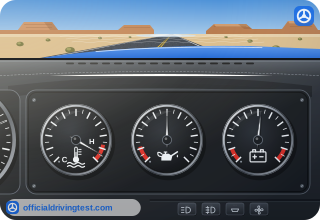
- Keep driving until the next scheduled stop
- Stop as soon as it is safe and find the problem
- Drive faster to get more air to the radiator
Show answer
Correct answer: Stop as soon as it is safe and find the problem
A reading that high can lead to engine failure or fire, so stop safely and find out what is wrong.
Source: CDL manual, national model as printed by New Jersey, Sections 1 to 3 (July 2017)
-
When may you remove the cap of a coolant container while the engine is hot?
- When the engine has run for only a few minutes
- When it is not connected to the pressurized system
- When the coolant gauge shows the normal range
Show answer
Correct answer: When it is not connected to the pressurized system
A container outside the pressurized system can be opened to add coolant even at operating temperature.
Source: CDL manual, national model as printed by New Jersey, Sections 1 to 3 (July 2017)
-
Why must you wait for the cooling system to cool before taking off the radiator cap?
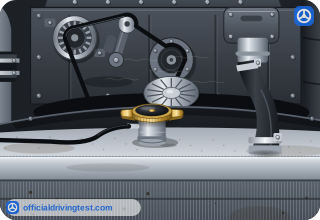
- Steam and boiling water can spray and burn you
- The cap would be too tight to turn by hand
- The coolant would lose its antifreeze power
Show answer
Correct answer: Steam and boiling water can spray and burn you
The system is under pressure, so hot steam and water can shoot out and badly burn you.
Source: CDL manual, national model as printed by New Jersey, Sections 1 to 3 (July 2017)
-
How can you tell that a radiator cap is probably cool enough to open?
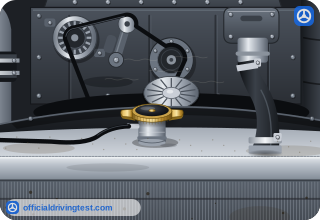
- The temperature gauge shows normal
- You can touch it with your bare hand
- The engine has been off for ten minutes
Show answer
Correct answer: You can touch it with your bare hand
A cap you can hold in your bare hand is most likely cool enough to open.
Source: CDL manual, national model as printed by New Jersey, Sections 1 to 3 (July 2017)
-
What should you use to protect your hands when you open a radiator cap?
- A thin plastic bag over the hand
- A wet paper towel
- Gloves or a thick cloth
Show answer
Correct answer: Gloves or a thick cloth
Wear gloves or hold a thick cloth over the cap to protect your hands.
Source: CDL manual, national model as printed by New Jersey, Sections 1 to 3 (July 2017)
-
When you open a radiator cap on a cooled system, how far do you turn it first?
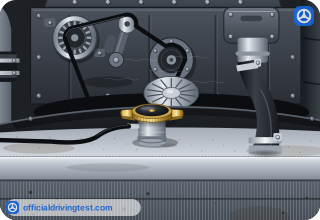
- All the way off in one move
- A quarter turn, then pull it up
- Slowly to the first stop
Show answer
Correct answer: Slowly to the first stop
Turning slowly to the first stop releases the pressure seal. Then step back while the pressure is let out.
Source: CDL manual, national model as printed by New Jersey, Sections 1 to 3 (July 2017)
-
After all the pressure has been let out of the cooling system, how do you take the cap off?
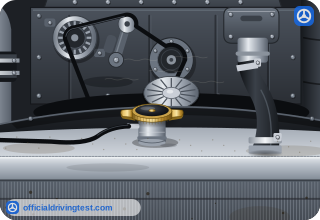
- Press down and turn it further
- Pull straight up on it
- Tap it with a tool until it loosens
Show answer
Correct answer: Press down and turn it further
With the pressure gone, push the cap downward while turning it further to take it off.
Source: CDL manual, national model as printed by New Jersey, Sections 1 to 3 (July 2017)
-
Why can loose engine belts make the engine overheat?
- They let too much oil reach the radiator
- They will not turn the water pump or fan properly
- They press too hard on the radiator hoses
Show answer
Correct answer: They will not turn the water pump or fan properly
Loose belts cannot drive the water pump and fan well, so the engine runs too hot.
Source: CDL manual, national model as printed by New Jersey, Sections 1 to 3 (July 2017)
-
What can a broken coolant hose cause while you are driving?
- A flat tire on the drive axle
- The engine can fail or catch fire
- The coolant can freeze in the radiator
Show answer
Correct answer: The engine can fail or catch fire
A hose that breaks while you drive can make the engine fail or catch fire.
Source: CDL manual, national model as printed by New Jersey, Sections 1 to 3 (July 2017)
-
In very hot weather, why should you watch for spots where tar comes up to the road surface?
- They can puncture the tires
- They are very slippery
- They hide holes in the pavement
Show answer
Correct answer: They are very slippery
In extreme heat, tar can seep up to the pavement, and those patches are very slippery.
Source: CDL manual, national model as printed by New Jersey, Sections 1 to 3 (July 2017)
-
How does driving at high speed in desert heat affect the tires and the engine?
- It cools them with the extra air flow
- It adds heat and raises the risk of failure
- It makes no difference to either of them
Show answer
Correct answer: It adds heat and raises the risk of failure
High speed makes more heat in the tires and the engine, which raises the chance of tire failure, engine failure or fire.
Source: CDL manual, national model as printed by New Jersey, Sections 1 to 3 (July 2017)