General Knowledge: Railroad crossings and mountain driving — Part 1
Questions in this part include: “Which of these must your safe speed on a long downgrade suit?” · “Besides the painted markings, what sign is also placed near a crossing on a two-lane road?”
Independent educational site · not affiliated with any government agency or DMV
Ready? Test yourself
Answer to start, or tap Start below:
Which signs should you look for and obey when you approach a mountain grade?
- Instant feedback with an explanation
- Every answer cites its source in the manual
- Your best score is saved on this device
- Keyboard: press 1 to 3 to answer and Enter for the next question
Questions are written in our own words from the CDL manual; they are not the real test's questions. With your state chosen, every answer gives its page in your state's CDL manual. Without a state, answers cite the CDL manual, national model as printed by New Jersey (July 2017).
All 19 questions in this practice test
Take the test above first, then use this list to study. Tap “Show answer” to see the correct answer and explanation.
Show the questions and answersHide the questions
-
Which of these must your safe speed on a long downgrade suit?
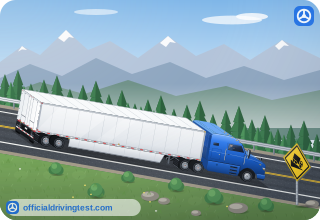
- The number of hours left in your driving day
- The age and make of your tractor
- The total weight of the vehicle and cargo
Show answer
Correct answer: The total weight of the vehicle and cargo
A safe speed has to suit the total weight of the vehicle and cargo, as well as the grade, the road and the weather.
Source: CDL manual, national model as printed by New Jersey, Sections 1 to 3 (July 2017)
-
Which signs should you look for and obey when you approach a mountain grade?
- Signs showing the distance to the next town
- Signs showing the next rest area
- Signs showing how long and steep the grade is
Show answer
Correct answer: Signs showing how long and steep the grade is
Warning signs tell you how long and how steep the grade is, which helps you choose a safe speed.
Source: CDL manual, national model as printed by New Jersey, Sections 1 to 3 (July 2017)
-
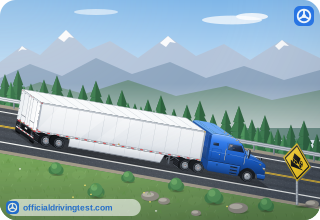
Why should engine braking do most of the work on a long downgrade?
- It keeps the tires from wearing unevenly on the grade
- It keeps the transmission from getting too hot
- It saves the brakes for slowing or stopping later
Show answer
Correct answer: It saves the brakes for slowing or stopping later
Using engine braking keeps the brakes ready for slowing or stopping as road and traffic conditions demand.
Source: CDL manual, national model as printed by New Jersey, Sections 1 to 3 (July 2017)
-
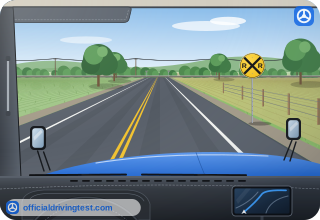
How should a driver approach every railroad-highway grade crossing?
- Expecting a train only if lights flash
- Expecting that a train may be coming
- Expecting a train only at night or in fog
Show answer
Correct answer: Expecting that a train may be coming
Every crossing is dangerous, and it is hard to judge how far away a train is or how fast it moves. Always be ready for a train.
Source: CDL manual, national model as printed by New Jersey, Sections 1 to 3 (July 2017)
-
What is a passive railroad crossing?
- One with a gate but no flashing lights
- One with flashing lights but no bells
- One with no traffic control device at all
Show answer
Correct answer: One with no traffic control device at all
A passive crossing has no traffic control device, so the driver alone must spot the crossing, look for a train and decide if it is safe to cross.
Source: CDL manual, national model as printed by New Jersey, Sections 1 to 3 (July 2017)
-
What makes a railroad crossing an active crossing?
- The driver alone decides whether to stop or go
- A traffic control device, like flashing red lights
- It has no signs, signals or markings at all
Show answer
Correct answer: A traffic control device, like flashing red lights
An active crossing has a traffic control device, such as flashing red lights with or without bells, or lights with bells and gates.
Source: CDL manual, national model as printed by New Jersey, Sections 1 to 3 (July 2017)
-
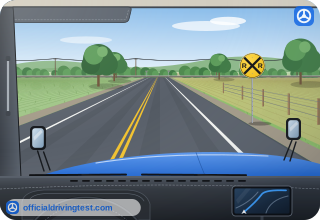
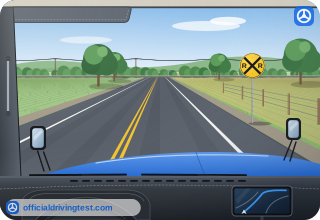
A round yellow sign with a black railroad symbol is ahead. What does it tell you to do?
- Stop at once and wait for a signal to go
- Slow down, look and listen, be ready to stop
- Keep your speed and sound the horn
Show answer
Correct answer: Slow down, look and listen, be ready to stop
A round yellow sign ahead of a public crossing is a cue to reduce speed, watch and listen for a train, and be prepared to stop.
Source: CDL manual, national model as printed by New Jersey, Sections 1 to 3 (July 2017)
-
Which vehicles are required to stop at a public railroad crossing marked by the advance warning sign?
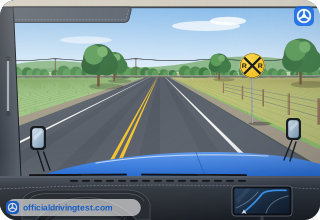
- Only vehicles carrying heavy freight loads
- Only vehicles that are pulling a trailer
- Passenger-carrying and hazmat-carrying vehicles
Show answer
Correct answer: Passenger-carrying and hazmat-carrying vehicles
Passenger-carrying vehicles and vehicles carrying hazardous materials must stop at these crossings.
Source: CDL manual, national model as printed by New Jersey, Sections 1 to 3 (July 2017)
-
A railroad warning "X" with the letters RR is painted on the road. What does it mean?
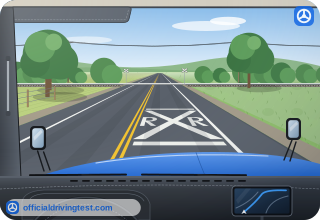
- Only that the tracks are no longer used
- That passing is allowed before the tracks
- The same as the advance warning sign
Show answer
Correct answer: The same as the advance warning sign
The painted X and RR, together with a marking that bans passing on two-lane roads, warn you just like the advance warning sign.
Source: CDL manual, national model as printed by New Jersey, Sections 1 to 3 (July 2017)
-
Besides the painted markings, what sign is also placed near a crossing on a two-lane road?
- A no passing zone sign
- A minimum speed sign
- A truck route sign
Show answer
Correct answer: A no passing zone sign
On two-lane roads a no passing zone sign is also used near the crossing.
Source: CDL manual, national model as printed by New Jersey, Sections 1 to 3 (July 2017)
-
A white stop line is painted before the tracks. Where must a school bus stop in relation to it?
- With its front wheels on the line
- With the front of the bus behind the line
- With the front of the bus just past the line
Show answer
Correct answer: With the front of the bus behind the line
If a white line is painted ahead of the rails, a school bus has to halt with its front end short of that line.
Source: CDL manual, national model as printed by New Jersey, Sections 1 to 3 (July 2017)
-
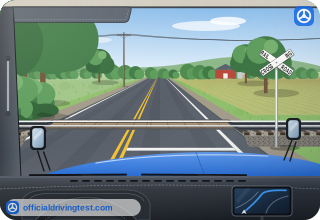
What does a cross-buck sign at a grade crossing require of you?
- Treat it as a warning, with no duty to yield
- Give the train the right to go first
- Stop every time, even with no train in sight
Show answer
Correct answer: Give the train the right to go first
The cross-buck marks the grade crossing and requires you to give the train the right-of-way.
Source: CDL manual, national model as printed by New Jersey, Sections 1 to 3 (July 2017)
-
No stop line is painted. How far from the nearest rail must a vehicle that has to stop at a crossing stop?
- At least 15 feet but not over 50 feet
- At least 5 feet but not over 15 feet
- At least 50 feet but not over 100 feet
Show answer
Correct answer: At least 15 feet but not over 50 feet
With no painted line, a vehicle that has to stop waits at least 15 feet and no more than 50 feet back from the closest rail.
Source: CDL manual, national model as printed by New Jersey, Sections 1 to 3 (July 2017)
-
A sign is mounted below a cross-buck where the road crosses more than one track. What does it show?
- The maximum safe speed over the tracks
- The number of tracks
- The number of trains each hour
Show answer
Correct answer: The number of tracks
Where a road crosses several tracks, a sign under the cross-buck tells how many tracks there are.
Source: CDL manual, national model as printed by New Jersey, Sections 1 to 3 (July 2017)
-
The red lights at a crossing begin to flash. What must you do?
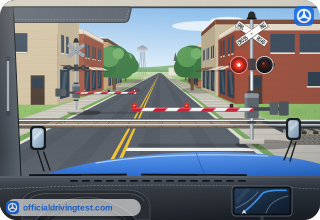
- Stop, because a train is approaching
- Slow down and cross if the tracks look clear
- Stop only if you can see the train
Show answer
Correct answer: Stop, because a train is approaching
Flashing red lights mean a train is coming. Stop and yield; where several tracks exist, confirm each one is clear before you cross.
Source: CDL manual, national model as printed by New Jersey, Sections 1 to 3 (July 2017)
-
You stopped at a crossing with gates. When may you start across?
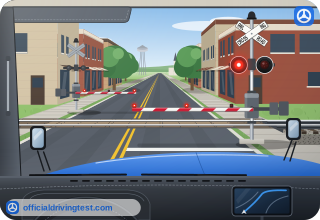
- Once the gates are up and lights stop flashing
- As soon as the last train car passes you
- When the gates begin to rise from the road
Show answer
Correct answer: Once the gates are up and lights stop flashing
Stay stopped until the gates are raised and the lights have stopped flashing, then go when it is safe.
Source: CDL manual, national model as printed by New Jersey, Sections 1 to 3 (July 2017)
-
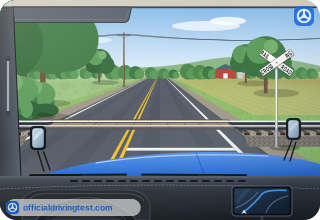
Why should you never try to beat a train to a crossing?
- Racing a train is legal only on passive crossings
- It is very hard to judge how fast a train moves
- Your engine may stall on the tracks
Show answer
Correct answer: It is very hard to judge how fast a train moves
The speed of an approaching train is extremely hard to judge, so racing it is never safe.
Source: CDL manual, national model as printed by New Jersey, Sections 1 to 3 (July 2017)
-
How fast may you approach a railroad crossing?
- At the posted limit for the road
- At a speed that lets you stop short of the tracks
- At a speed that keeps you moving at a steady pace
Show answer
Correct answer: At a speed that lets you stop short of the tracks
Reduce speed to match how far you can see trains in each direction, so you can always stop short of the tracks if needed.
Source: CDL manual, national model as printed by New Jersey, Sections 1 to 3 (July 2017)
-
Why should you not count on hearing a train before a crossing?
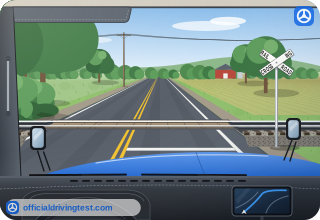
- Some trains may not sound their horns at some crossings
- Train horns are rarely used on any crossing
- Train horns are always quieter than truck engines
Show answer
Correct answer: Some trains may not sound their horns at some crossings
At some crossings trains do not or may not sound horns, and noise inside your vehicle can hide the sound until the train is very close.
Source: CDL manual, national model as printed by New Jersey, Sections 1 to 3 (July 2017)