General Knowledge: Driving in winter and in very hot weather
Getting the vehicle ready for winter, driving on slippery roads, and driving in very hot weather. Split into 3 shorter tests so you're not stuck in one long quiz.
Independent educational site · not affiliated with any government agency or DMV
Choose a part
Driving in winter and in very hot weather — Part 1
Questions in this part include: “Before winter driving, what can you use to check that the cooling system holds enough antifreeze?”
Driving in winter and in very hot weather — Part 2
Questions in this part include: “On a cold winter road, what does it tell you when other vehicles throw up no spray?”
Driving in winter and in very hot weather — Part 3
Questions in this part include: “What can happen if you press hard on the brake and the accelerator together while drying the brakes?”
Questions are written in our own words from the CDL manual; they are not the real test's questions. With your state chosen, every answer gives its page in your state's CDL manual. Without a state, answers cite the CDL manual, national model as printed by New Jersey (July 2017).
All 51 Driving in winter and in very hot weather questions with answers
Choose a part above to take a practice test, or study every question and answer here.
Show the questions and answersHide the questions
1Part 117 questions
-
Before winter driving, what can you use to check that the cooling system holds enough antifreeze?
- A tire tread gauge
- The engine oil dipstick
- A special coolant tester
Show answer
Correct answer: A special coolant tester
A special coolant tester shows whether there is enough antifreeze to protect the system from freezing.
Source: CDL manual, national model as printed by New Jersey, Sections 1 to 3 (July 2017)
-
What can happen in winter if the wiper blades do not press hard enough against the glass?
- They may freeze the washer fluid in the lines
- They may not sweep the snow off properly
- They may scratch the glass when the snow is deep
Show answer
Correct answer: They may not sweep the snow off properly
Blades that do not press firmly enough cannot clear the glass well, so snow may stay on the windshield.
Source: CDL manual, national model as printed by New Jersey, Sections 1 to 3 (July 2017)
-
What should you put in the washer reservoir so the washer liquid does not freeze?
- Engine coolant from the radiator
- Windshield washer antifreeze
- Diesel fuel conditioner
Show answer
Correct answer: Windshield washer antifreeze
Windshield washer antifreeze keeps the washer liquid from freezing in cold weather.
Source: CDL manual, national model as printed by New Jersey, Sections 1 to 3 (July 2017)
-
Your wipers fail while you are driving in snow and you cannot see well. What should you do?
- Slow to a crawl and keep driving to the next town
- Follow the taillights of the vehicle ahead
- Stop safely and fix the problem
Show answer
Correct answer: Stop safely and fix the problem
When you cannot see well enough, you should not keep going. Stop in a safe place and repair the problem first.
Source: CDL manual, national model as printed by New Jersey, Sections 1 to 3 (July 2017)
-
Apart from the front tires, what is the smallest tread depth the other tires must have?
- 1/32 inch
- 3/32 inch
- 2/32 inch
Show answer
Correct answer: 2/32 inch
Tires other than the front ones need at least 2/32 inch of tread depth.
Source: CDL manual, national model as printed by New Jersey, Sections 1 to 3 (July 2017)
-
What should you carry along with the right number of tire chains?
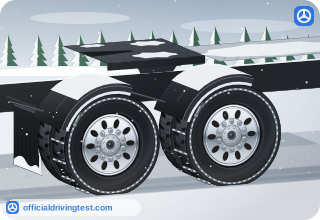
- Extra side-chain tensioners
- Extra cross-links
- A spare set of wheel chocks
Show answer
Correct answer: Extra cross-links
Carry the right number of chains plus extra cross-links, and check them for worn or broken parts.
Source: CDL manual, national model as printed by New Jersey, Sections 1 to 3 (July 2017)
-
When should you learn how to put on tire chains?
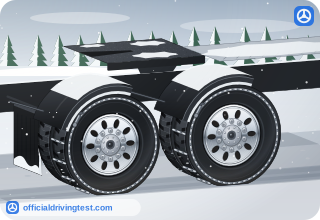
- Before you need to use them in snow and ice
- At the side of the road when the snow starts
- After a mechanic has checked them
Show answer
Correct answer: Before you need to use them in snow and ice
Chains are hard to fit in the middle of a storm, so practice putting them on ahead of time.
Source: CDL manual, national model as printed by New Jersey, Sections 1 to 3 (July 2017)
-
In bad weather, when should you check that your lights and reflectors are clean and working?
- Only before the trip begins
- Only when a warning light comes on
- From time to time during the trip
Show answer
Correct answer: From time to time during the trip
Lights and reflectors matter even more in bad weather, so check them now and then while you drive.
Source: CDL manual, national model as printed by New Jersey, Sections 1 to 3 (July 2017)
-
What should you do about ice and snow on the glass and mirrors before you start a winter trip?
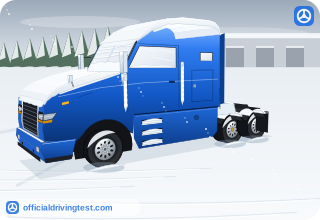
- Let the heater melt them while you drive
- Clear them off before you start
- Clear only the windshield
Show answer
Correct answer: Clear them off before you start
Ice and snow on the windshield, windows and mirrors must be removed before you start; use a scraper, snow brush and defroster as needed.
Source: CDL manual, national model as printed by New Jersey, Sections 1 to 3 (July 2017)
-
Why should you clear snow and ice off the steps, hand holds and deck plates of your vehicle?
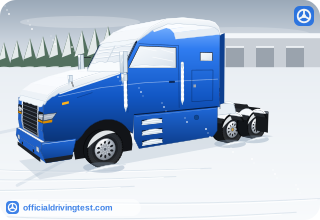
- It keeps the cab warmer
- It lowers the danger of slipping
- It stops the paint from cracking
Show answer
Correct answer: It lowers the danger of slipping
Ice and snow on the places where you step or grab make slips more likely, so they must be cleared.
Source: CDL manual, national model as printed by New Jersey, Sections 1 to 3 (July 2017)
-
What can happen when the radiator shutters are frozen closed, or the winterfront covers too much of the radiator?
- The heater will stop working
- The tires may lose air pressure
- The engine may overheat and stop
Show answer
Correct answer: The engine may overheat and stop
Frozen shutters or a winterfront closed too much can make the engine overheat and stop.
Source: CDL manual, national model as printed by New Jersey, Sections 1 to 3 (July 2017)
-
When is an exhaust leak especially dangerous?
- When the engine is idling in the yard
- When the engine has just been started cold
- When the cab ventilation may be poor
Show answer
Correct answer: When the cab ventilation may be poor
With the windows up and little fresh air, poisonous gas from a leak can build up inside the cab.
Source: CDL manual, national model as printed by New Jersey, Sections 1 to 3 (July 2017)
-
What effect does carbon monoxide leaking from the exhaust into the cab have on a driver?
- Extra alertness
- Muscle cramps
- Sleepiness
Show answer
Correct answer: Sleepiness
Carbon monoxide makes a driver sleepy, and in large amounts it can kill.
Source: CDL manual, national model as printed by New Jersey, Sections 1 to 3 (July 2017)
-
What is the basic way to drive on slippery roads?
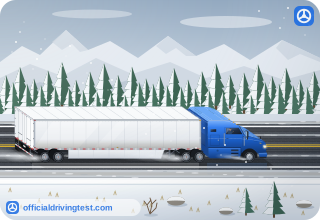
- In a high gear with the engine brake on
- Slowly and smoothly
- At the posted speed, with a longer following gap
Show answer
Correct answer: Slowly and smoothly
On slippery roads drive slowly and smoothly.
Source: CDL manual, national model as printed by New Jersey, Sections 1 to 3 (July 2017)
-
What should you do when the road is very slippery?
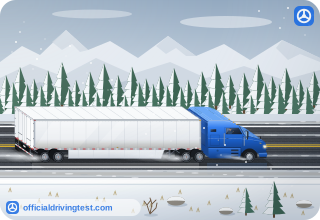
- Stop driving at the first safe place
- Keep going but use only the trailer brakes
- Switch on the engine brake and continue
Show answer
Correct answer: Stop driving at the first safe place
On a very slippery road the best choice is not to drive, so pull into the first safe place and stop.
Source: CDL manual, national model as printed by New Jersey, Sections 1 to 3 (July 2017)
-
How should you begin driving on a winter road?
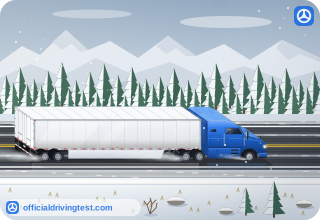
- At normal speed to warm the tires
- Quickly, to build momentum before the slippery spots
- Gently and slowly, to get the feel of the road
Show answer
Correct answer: Gently and slowly, to get the feel of the road
Start gently and slowly so you can sense how slippery the road is before you speed up.
Source: CDL manual, national model as printed by New Jersey, Sections 1 to 3 (July 2017)
-
Which parts of the road deserve special attention when you check for ice?
- Long straight stretches and hills
- Bridges and overpasses
- Wide shoulders and rest areas
Show answer
Correct answer: Bridges and overpasses
Ice is especially likely on bridges and overpasses, so watch those spots.
Source: CDL manual, national model as printed by New Jersey, Sections 1 to 3 (July 2017)
2Part 217 questions
-
On a cold winter road, what does it tell you when other vehicles throw up no spray?
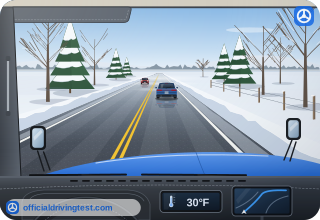
- That the road is only wet with slush
- That the road has just been salted
- That ice has formed on the road
Show answer
Correct answer: That ice has formed on the road
When there is no spray behind other vehicles, the road surface is probably covered with ice.
Source: CDL manual, national model as printed by New Jersey, Sections 1 to 3 (July 2017)
-
What does ice on your mirrors and wiper blades suggest about the road?
- The road is probably icy too
- The road is probably dry underneath
- The road is probably only wet
Show answer
Correct answer: The road is probably icy too
Ice on the mirrors and wipers is a sign that the road surface is probably icy too.
Source: CDL manual, national model as printed by New Jersey, Sections 1 to 3 (July 2017)
-
How should you make turns and use the brakes on a slippery road?
- Turn normally but brake firmly to slow down
- Turn gently and brake no harder than needed
- Brake hard before each turn
Show answer
Correct answer: Turn gently and brake no harder than needed
Make turns as gently as possible, and do not brake any harder than necessary.
Source: CDL manual, national model as printed by New Jersey, Sections 1 to 3 (July 2017)
-
Why should you avoid the engine brake or speed retarder on a slippery road?
- They use too much fuel
- They cannot slow a loaded truck
- They can make the driving wheels skid
Show answer
Correct answer: They can make the driving wheels skid
On a slippery surface, these devices can make the driving wheels skid, so do not use them.
Source: CDL manual, national model as printed by New Jersey, Sections 1 to 3 (July 2017)
-
On a slippery road, how should you handle your speed?
- Keep a steady speed by watching far ahead
- Speed up and slow down often to test grip
- Match the speed of faster traffic around you
Show answer
Correct answer: Keep a steady speed by watching far ahead
Go slowly and look far ahead so that you can keep a steady speed and avoid slowing down and speeding up.
Source: CDL manual, national model as printed by New Jersey, Sections 1 to 3 (July 2017)
-
How should you handle a curve on a slippery winter road?
- Brake lightly through the middle of the curve
- Go in slowly and avoid braking while in it
- Speed up gently to keep your traction
Show answer
Correct answer: Go in slowly and avoid braking while in it
Reduce your speed before the curve and do not brake inside it.
Source: CDL manual, national model as printed by New Jersey, Sections 1 to 3 (July 2017)
-
What happens to a road surface when the temperature rises to where the ice starts to melt?
- The road becomes even more slippery
- The road gets much better grip
- The road becomes dry almost at once
Show answer
Correct answer: The road becomes even more slippery
Melting ice makes the surface even slipperier, so you should slow down more.
Source: CDL manual, national model as printed by New Jersey, Sections 1 to 3 (July 2017)
-
On slippery roads, how should you position your vehicle in relation to others?
- Avoid driving alongside other vehicles
- Stay beside other vehicles for safety
- Move up close behind the vehicle ahead
Show answer
Correct answer: Avoid driving alongside other vehicles
Do not drive next to other vehicles, and keep a longer following distance.
Source: CDL manual, national model as printed by New Jersey, Sections 1 to 3 (July 2017)
-
On a slippery road, what should you do when you see a traffic jam ahead?
- Slow down or stop and wait for it to clear
- Pass the slow traffic quickly
- Brake as hard as you can at the last moment
Show answer
Correct answer: Slow down or stop and wait for it to clear
Slow down early, or stop, until the jam clears, and try to slow down gradually.
Source: CDL manual, national model as printed by New Jersey, Sections 1 to 3 (July 2017)
-
On a slippery road, how should you prepare for stops?
- Expect stops early and slow down gradually
- Wait until the last moment, then brake firmly
- Coast in neutral until the vehicle stops
Show answer
Correct answer: Expect stops early and slow down gradually
Anticipate stops early and slow down gradually.
Source: CDL manual, national model as printed by New Jersey, Sections 1 to 3 (July 2017)
-
What should you do when you see snowplows and salt or sand trucks?
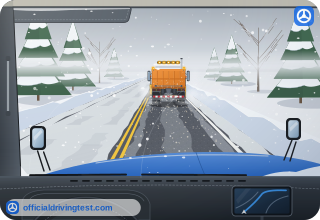
- Pass them as quickly as possible
- Stay right behind them on the cleared lane
- Give them plenty of room
Show answer
Correct answer: Give them plenty of room
Snowplows and the trucks that spread salt or sand need a wide gap from you.
Source: CDL manual, national model as printed by New Jersey, Sections 1 to 3 (July 2017)
-
Which problem can water in the brakes cause?
- Engine overheating
- Pulling to one side
- Air lines freezing
Show answer
Correct answer: Pulling to one side
Wet brakes can be weak, apply unevenly or grab, which can cause wheel lockups and pulling to one side.
Source: CDL manual, national model as printed by New Jersey, Sections 1 to 3 (July 2017)
-
Before you drive through deep standing water, what should you do with your speed and gear?
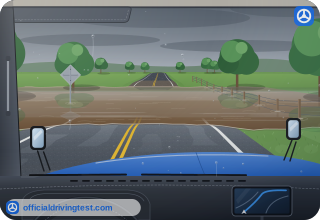
- Hold your speed and use a high gear
- Shift to a higher gear to keep moving
- Slow down and select a low gear
Show answer
Correct answer: Slow down and select a low gear
Reduce speed and put the transmission in a low gear before you cross the water.
Source: CDL manual, national model as printed by New Jersey, Sections 1 to 3 (July 2017)
-
Why do you gently press the brakes before entering deep water?
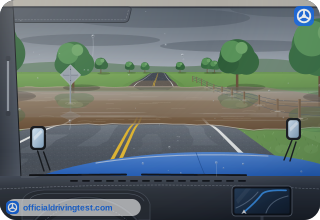
- It warms the tires so that they grip the wet road better
- It holds the brake surfaces closed so dirt and water stay out
- It lets the air tanks fill faster before you cross
Show answer
Correct answer: It holds the brake surfaces closed so dirt and water stay out
A light touch on the brakes before the water helps keep dirt and water away from the braking surfaces.
Source: CDL manual, national model as printed by New Jersey, Sections 1 to 3 (July 2017)
-
When you must cross deep water, what should you do with the engine speed and the brakes?
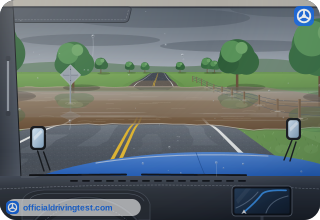
- Keep the engine at idle with the brakes off
- Lower the rpm and let the brakes go fully
- Raise the rpm and keep light pressure on the brakes
Show answer
Correct answer: Raise the rpm and keep light pressure on the brakes
Raise the engine rpm and keep light brake pressure while you cross the water.
Source: CDL manual, national model as printed by New Jersey, Sections 1 to 3 (July 2017)
-
After you leave deep water, how can you dry out wet brakes?
- Keep light pressure on them for a short distance
- Park and wait for them to dry in the air
- Pump them hard several times at once
Show answer
Correct answer: Keep light pressure on them for a short distance
Braking lightly for a short stretch warms the brakes and dries them.
Source: CDL manual, national model as printed by New Jersey, Sections 1 to 3 (July 2017)
-
Before making a test stop to check the brakes after crossing water, what must you make sure of?
- That the trailer is empty
- That no one is following you
- That the tires have cooled down
Show answer
Correct answer: That no one is following you
Make sure nobody is behind you, and then press the brakes to see whether they work well.
Source: CDL manual, national model as printed by New Jersey, Sections 1 to 3 (July 2017)
3Part 317 questions
-
What can happen if you press hard on the brake and the accelerator together while drying the brakes?
- The drums and linings can overheat
- The engine will stall right away
- The tires will cool too quickly
Show answer
Correct answer: The drums and linings can overheat
Too much pressure on both pedals at once can overheat the brake drums and linings.
Source: CDL manual, national model as printed by New Jersey, Sections 1 to 3 (July 2017)
-
In very hot weather, how often should you inspect the tires?
- Every four hours or every 200 miles
- Every two hours or every 100 miles
- Every hour or every 50 miles
Show answer
Correct answer: Every two hours or every 100 miles
Hot weather is hard on tires, so look at them every two hours or every 100 miles.
Source: CDL manual, national model as printed by New Jersey, Sections 1 to 3 (July 2017)
-
The tire pressure rises in very hot weather. What should you do about it?
- Let air out until it reads normal
- Leave the air in the tires
- Add more air to balance it
Show answer
Correct answer: Leave the air in the tires
Heat raises tire pressure, but air you release would leave the tires underinflated once they cool.
Source: CDL manual, national model as printed by New Jersey, Sections 1 to 3 (July 2017)
-
What should you do when you cannot keep your hand on a tire because it is so hot?
- Remain stopped until it cools off
- Drive slowly to the next stop
- Pour cold water on it
Show answer
Correct answer: Remain stopped until it cools off
Driving on a very hot tire can lead to a blowout or a fire, so wait for it to cool.
Source: CDL manual, national model as printed by New Jersey, Sections 1 to 3 (July 2017)
-
Besides lubricating the engine, what else does engine oil do?
- It cleans the air filter
- It helps keep the engine cool
- It raises the coolant level
Show answer
Correct answer: It helps keep the engine cool
Engine oil also helps cool the engine, so enough oil matters in hot weather.
Source: CDL manual, national model as printed by New Jersey, Sections 1 to 3 (July 2017)
-
What does antifreeze do for the engine in very hot weather?
- It does nothing until the weather turns cold
- It helps the engine in hot conditions too
- It only protects the heater
Show answer
Correct answer: It helps the engine in hot conditions too
Antifreeze helps the engine in hot conditions as well as in cold ones.
Source: CDL manual, national model as printed by New Jersey, Sections 1 to 3 (July 2017)
-
The coolant temperature gauge rises above the highest safe reading. What should you do?
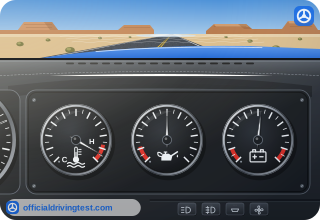
- Keep driving until the next scheduled stop
- Stop as soon as it is safe and find the problem
- Drive faster to get more air to the radiator
Show answer
Correct answer: Stop as soon as it is safe and find the problem
A reading that high can lead to engine failure or fire, so stop safely and find out what is wrong.
Source: CDL manual, national model as printed by New Jersey, Sections 1 to 3 (July 2017)
-
When may you remove the cap of a coolant container while the engine is hot?
- When the engine has run for only a few minutes
- When it is not connected to the pressurized system
- When the coolant gauge shows the normal range
Show answer
Correct answer: When it is not connected to the pressurized system
A container outside the pressurized system can be opened to add coolant even at operating temperature.
Source: CDL manual, national model as printed by New Jersey, Sections 1 to 3 (July 2017)
-
Why must you wait for the cooling system to cool before taking off the radiator cap?
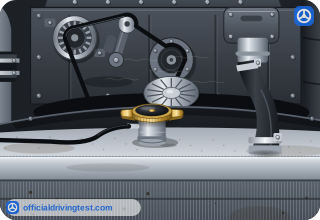
- Steam and boiling water can spray and burn you
- The cap would be too tight to turn by hand
- The coolant would lose its antifreeze power
Show answer
Correct answer: Steam and boiling water can spray and burn you
The system is under pressure, so hot steam and water can shoot out and badly burn you.
Source: CDL manual, national model as printed by New Jersey, Sections 1 to 3 (July 2017)
-
How can you tell that a radiator cap is probably cool enough to open?
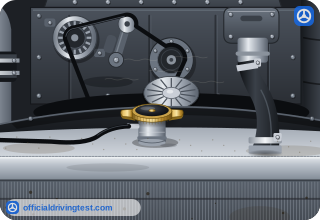
- The temperature gauge shows normal
- You can touch it with your bare hand
- The engine has been off for ten minutes
Show answer
Correct answer: You can touch it with your bare hand
A cap you can hold in your bare hand is most likely cool enough to open.
Source: CDL manual, national model as printed by New Jersey, Sections 1 to 3 (July 2017)
-
What should you use to protect your hands when you open a radiator cap?
- A thin plastic bag over the hand
- A wet paper towel
- Gloves or a thick cloth
Show answer
Correct answer: Gloves or a thick cloth
Wear gloves or hold a thick cloth over the cap to protect your hands.
Source: CDL manual, national model as printed by New Jersey, Sections 1 to 3 (July 2017)
-
When you open a radiator cap on a cooled system, how far do you turn it first?
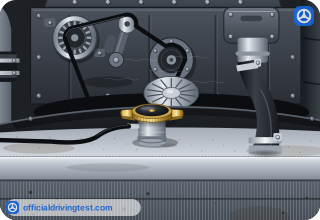
- All the way off in one move
- A quarter turn, then pull it up
- Slowly to the first stop
Show answer
Correct answer: Slowly to the first stop
Turning slowly to the first stop releases the pressure seal. Then step back while the pressure is let out.
Source: CDL manual, national model as printed by New Jersey, Sections 1 to 3 (July 2017)
-
After all the pressure has been let out of the cooling system, how do you take the cap off?
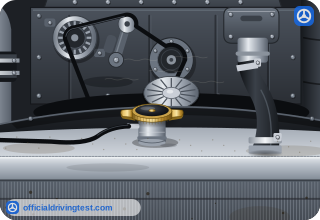
- Press down and turn it further
- Pull straight up on it
- Tap it with a tool until it loosens
Show answer
Correct answer: Press down and turn it further
With the pressure gone, push the cap downward while turning it further to take it off.
Source: CDL manual, national model as printed by New Jersey, Sections 1 to 3 (July 2017)
-
Why can loose engine belts make the engine overheat?
- They let too much oil reach the radiator
- They will not turn the water pump or fan properly
- They press too hard on the radiator hoses
Show answer
Correct answer: They will not turn the water pump or fan properly
Loose belts cannot drive the water pump and fan well, so the engine runs too hot.
Source: CDL manual, national model as printed by New Jersey, Sections 1 to 3 (July 2017)
-
What can a broken coolant hose cause while you are driving?
- A flat tire on the drive axle
- The engine can fail or catch fire
- The coolant can freeze in the radiator
Show answer
Correct answer: The engine can fail or catch fire
A hose that breaks while you drive can make the engine fail or catch fire.
Source: CDL manual, national model as printed by New Jersey, Sections 1 to 3 (July 2017)
-
In very hot weather, why should you watch for spots where tar comes up to the road surface?
- They can puncture the tires
- They are very slippery
- They hide holes in the pavement
Show answer
Correct answer: They are very slippery
In extreme heat, tar can seep up to the pavement, and those patches are very slippery.
Source: CDL manual, national model as printed by New Jersey, Sections 1 to 3 (July 2017)
-
How does driving at high speed in desert heat affect the tires and the engine?
- It cools them with the extra air flow
- It adds heat and raises the risk of failure
- It makes no difference to either of them
Show answer
Correct answer: It adds heat and raises the risk of failure
High speed makes more heat in the tires and the engine, which raises the chance of tire failure, engine failure or fire.
Source: CDL manual, national model as printed by New Jersey, Sections 1 to 3 (July 2017)