General Knowledge: Driving in winter and in very hot weather — Part 1
Questions in this part include: “Before winter driving, what can you use to check that the cooling system holds enough antifreeze?” · “What should you do about ice and snow on the glass and mirrors before you start a winter trip?”
Independent educational site · not affiliated with any government agency or DMV
Ready? Test yourself
Answer to start, or tap Start below:
Before winter driving, what can you use to check that the cooling system holds enough antifreeze?
- Instant feedback with an explanation
- Every answer cites its source in the manual
- Your best score is saved on this device
- Keyboard: press 1 to 3 to answer and Enter for the next question
Questions are written in our own words from the CDL manual; they are not the real test's questions. With your state chosen, every answer gives its page in your state's CDL manual. Without a state, answers cite the CDL manual, national model as printed by New Jersey (July 2017).
All 17 questions in this practice test
Take the test above first, then use this list to study. Tap “Show answer” to see the correct answer and explanation.
Show the questions and answersHide the questions
-
Before winter driving, what can you use to check that the cooling system holds enough antifreeze?
- A tire tread gauge
- The engine oil dipstick
- A special coolant tester
Show answer
Correct answer: A special coolant tester
A special coolant tester shows whether there is enough antifreeze to protect the system from freezing.
Source: CDL manual, national model as printed by New Jersey, Sections 1 to 3 (July 2017)
-
What can happen in winter if the wiper blades do not press hard enough against the glass?
- They may freeze the washer fluid in the lines
- They may not sweep the snow off properly
- They may scratch the glass when the snow is deep
Show answer
Correct answer: They may not sweep the snow off properly
Blades that do not press firmly enough cannot clear the glass well, so snow may stay on the windshield.
Source: CDL manual, national model as printed by New Jersey, Sections 1 to 3 (July 2017)
-
What should you put in the washer reservoir so the washer liquid does not freeze?
- Engine coolant from the radiator
- Windshield washer antifreeze
- Diesel fuel conditioner
Show answer
Correct answer: Windshield washer antifreeze
Windshield washer antifreeze keeps the washer liquid from freezing in cold weather.
Source: CDL manual, national model as printed by New Jersey, Sections 1 to 3 (July 2017)
-
Your wipers fail while you are driving in snow and you cannot see well. What should you do?
- Slow to a crawl and keep driving to the next town
- Follow the taillights of the vehicle ahead
- Stop safely and fix the problem
Show answer
Correct answer: Stop safely and fix the problem
When you cannot see well enough, you should not keep going. Stop in a safe place and repair the problem first.
Source: CDL manual, national model as printed by New Jersey, Sections 1 to 3 (July 2017)
-
Apart from the front tires, what is the smallest tread depth the other tires must have?
- 1/32 inch
- 3/32 inch
- 2/32 inch
Show answer
Correct answer: 2/32 inch
Tires other than the front ones need at least 2/32 inch of tread depth.
Source: CDL manual, national model as printed by New Jersey, Sections 1 to 3 (July 2017)
-
What should you carry along with the right number of tire chains?
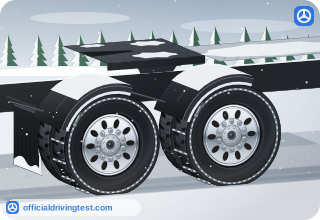
- Extra side-chain tensioners
- Extra cross-links
- A spare set of wheel chocks
Show answer
Correct answer: Extra cross-links
Carry the right number of chains plus extra cross-links, and check them for worn or broken parts.
Source: CDL manual, national model as printed by New Jersey, Sections 1 to 3 (July 2017)
-
When should you learn how to put on tire chains?
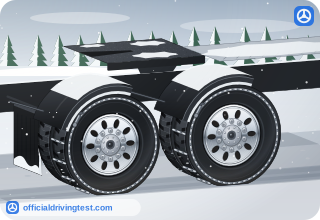
- Before you need to use them in snow and ice
- At the side of the road when the snow starts
- After a mechanic has checked them
Show answer
Correct answer: Before you need to use them in snow and ice
Chains are hard to fit in the middle of a storm, so practice putting them on ahead of time.
Source: CDL manual, national model as printed by New Jersey, Sections 1 to 3 (July 2017)
-
In bad weather, when should you check that your lights and reflectors are clean and working?
- Only before the trip begins
- Only when a warning light comes on
- From time to time during the trip
Show answer
Correct answer: From time to time during the trip
Lights and reflectors matter even more in bad weather, so check them now and then while you drive.
Source: CDL manual, national model as printed by New Jersey, Sections 1 to 3 (July 2017)
-
What should you do about ice and snow on the glass and mirrors before you start a winter trip?
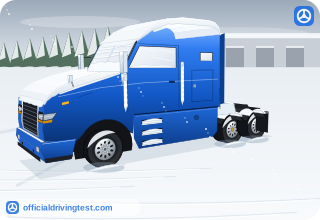
- Let the heater melt them while you drive
- Clear them off before you start
- Clear only the windshield
Show answer
Correct answer: Clear them off before you start
Ice and snow on the windshield, windows and mirrors must be removed before you start; use a scraper, snow brush and defroster as needed.
Source: CDL manual, national model as printed by New Jersey, Sections 1 to 3 (July 2017)
-
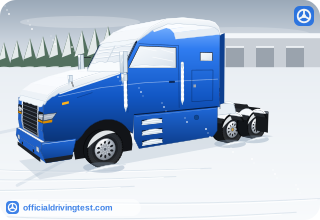
Why should you clear snow and ice off the steps, hand holds and deck plates of your vehicle?
- It keeps the cab warmer
- It lowers the danger of slipping
- It stops the paint from cracking
Show answer
Correct answer: It lowers the danger of slipping
Ice and snow on the places where you step or grab make slips more likely, so they must be cleared.
Source: CDL manual, national model as printed by New Jersey, Sections 1 to 3 (July 2017)
-
What can happen when the radiator shutters are frozen closed, or the winterfront covers too much of the radiator?
- The heater will stop working
- The tires may lose air pressure
- The engine may overheat and stop
Show answer
Correct answer: The engine may overheat and stop
Frozen shutters or a winterfront closed too much can make the engine overheat and stop.
Source: CDL manual, national model as printed by New Jersey, Sections 1 to 3 (July 2017)
-
When is an exhaust leak especially dangerous?
- When the engine is idling in the yard
- When the engine has just been started cold
- When the cab ventilation may be poor
Show answer
Correct answer: When the cab ventilation may be poor
With the windows up and little fresh air, poisonous gas from a leak can build up inside the cab.
Source: CDL manual, national model as printed by New Jersey, Sections 1 to 3 (July 2017)
-
What effect does carbon monoxide leaking from the exhaust into the cab have on a driver?
- Extra alertness
- Muscle cramps
- Sleepiness
Show answer
Correct answer: Sleepiness
Carbon monoxide makes a driver sleepy, and in large amounts it can kill.
Source: CDL manual, national model as printed by New Jersey, Sections 1 to 3 (July 2017)
-
What is the basic way to drive on slippery roads?
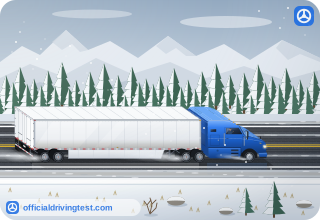
- In a high gear with the engine brake on
- Slowly and smoothly
- At the posted speed, with a longer following gap
Show answer
Correct answer: Slowly and smoothly
On slippery roads drive slowly and smoothly.
Source: CDL manual, national model as printed by New Jersey, Sections 1 to 3 (July 2017)
-
What should you do when the road is very slippery?
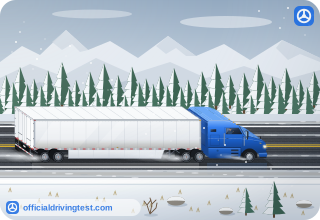
- Stop driving at the first safe place
- Keep going but use only the trailer brakes
- Switch on the engine brake and continue
Show answer
Correct answer: Stop driving at the first safe place
On a very slippery road the best choice is not to drive, so pull into the first safe place and stop.
Source: CDL manual, national model as printed by New Jersey, Sections 1 to 3 (July 2017)
-
How should you begin driving on a winter road?
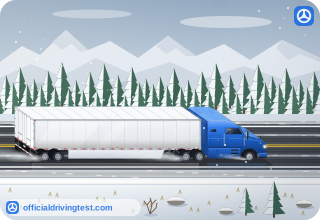
- At normal speed to warm the tires
- Quickly, to build momentum before the slippery spots
- Gently and slowly, to get the feel of the road
Show answer
Correct answer: Gently and slowly, to get the feel of the road
Start gently and slowly so you can sense how slippery the road is before you speed up.
Source: CDL manual, national model as printed by New Jersey, Sections 1 to 3 (July 2017)
-
Which parts of the road deserve special attention when you check for ice?
- Long straight stretches and hills
- Bridges and overpasses
- Wide shoulders and rest areas
Show answer
Correct answer: Bridges and overpasses
Ice is especially likely on bridges and overpasses, so watch those spots.
Source: CDL manual, national model as printed by New Jersey, Sections 1 to 3 (July 2017)