General Knowledge: Driving in winter and in very hot weather — Part 2
Questions in this part include: “On a cold winter road, what does it tell you when other vehicles throw up no spray?” · “On a slippery road, what should you do when you see a traffic jam ahead?”
Independent educational site · not affiliated with any government agency or DMV
Ready? Test yourself
Answer to start, or tap Start below:
What does ice on your mirrors and wiper blades suggest about the road?
- Instant feedback with an explanation
- Every answer cites its source in the manual
- Your best score is saved on this device
- Keyboard: press 1 to 3 to answer and Enter for the next question
Questions are written in our own words from the CDL manual; they are not the real test's questions. With your state chosen, every answer gives its page in your state's CDL manual. Without a state, answers cite the CDL manual, national model as printed by New Jersey (July 2017).
All 17 questions in this practice test
Take the test above first, then use this list to study. Tap “Show answer” to see the correct answer and explanation.
Show the questions and answersHide the questions
-
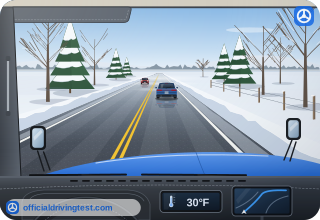
On a cold winter road, what does it tell you when other vehicles throw up no spray?
- That the road is only wet with slush
- That the road has just been salted
- That ice has formed on the road
Show answer
Correct answer: That ice has formed on the road
When there is no spray behind other vehicles, the road surface is probably covered with ice.
Source: CDL manual, national model as printed by New Jersey, Sections 1 to 3 (July 2017)
-
What does ice on your mirrors and wiper blades suggest about the road?
- The road is probably icy too
- The road is probably dry underneath
- The road is probably only wet
Show answer
Correct answer: The road is probably icy too
Ice on the mirrors and wipers is a sign that the road surface is probably icy too.
Source: CDL manual, national model as printed by New Jersey, Sections 1 to 3 (July 2017)
-
How should you make turns and use the brakes on a slippery road?
- Turn normally but brake firmly to slow down
- Turn gently and brake no harder than needed
- Brake hard before each turn
Show answer
Correct answer: Turn gently and brake no harder than needed
Make turns as gently as possible, and do not brake any harder than necessary.
Source: CDL manual, national model as printed by New Jersey, Sections 1 to 3 (July 2017)
-
Why should you avoid the engine brake or speed retarder on a slippery road?
- They use too much fuel
- They cannot slow a loaded truck
- They can make the driving wheels skid
Show answer
Correct answer: They can make the driving wheels skid
On a slippery surface, these devices can make the driving wheels skid, so do not use them.
Source: CDL manual, national model as printed by New Jersey, Sections 1 to 3 (July 2017)
-
On a slippery road, how should you handle your speed?
- Keep a steady speed by watching far ahead
- Speed up and slow down often to test grip
- Match the speed of faster traffic around you
Show answer
Correct answer: Keep a steady speed by watching far ahead
Go slowly and look far ahead so that you can keep a steady speed and avoid slowing down and speeding up.
Source: CDL manual, national model as printed by New Jersey, Sections 1 to 3 (July 2017)
-
How should you handle a curve on a slippery winter road?
- Brake lightly through the middle of the curve
- Go in slowly and avoid braking while in it
- Speed up gently to keep your traction
Show answer
Correct answer: Go in slowly and avoid braking while in it
Reduce your speed before the curve and do not brake inside it.
Source: CDL manual, national model as printed by New Jersey, Sections 1 to 3 (July 2017)
-
What happens to a road surface when the temperature rises to where the ice starts to melt?
- The road becomes even more slippery
- The road gets much better grip
- The road becomes dry almost at once
Show answer
Correct answer: The road becomes even more slippery
Melting ice makes the surface even slipperier, so you should slow down more.
Source: CDL manual, national model as printed by New Jersey, Sections 1 to 3 (July 2017)
-
On slippery roads, how should you position your vehicle in relation to others?
- Avoid driving alongside other vehicles
- Stay beside other vehicles for safety
- Move up close behind the vehicle ahead
Show answer
Correct answer: Avoid driving alongside other vehicles
Do not drive next to other vehicles, and keep a longer following distance.
Source: CDL manual, national model as printed by New Jersey, Sections 1 to 3 (July 2017)
-
On a slippery road, what should you do when you see a traffic jam ahead?
- Slow down or stop and wait for it to clear
- Pass the slow traffic quickly
- Brake as hard as you can at the last moment
Show answer
Correct answer: Slow down or stop and wait for it to clear
Slow down early, or stop, until the jam clears, and try to slow down gradually.
Source: CDL manual, national model as printed by New Jersey, Sections 1 to 3 (July 2017)
-
On a slippery road, how should you prepare for stops?
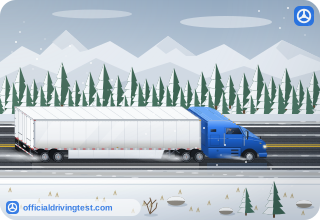
- Expect stops early and slow down gradually
- Wait until the last moment, then brake firmly
- Coast in neutral until the vehicle stops
Show answer
Correct answer: Expect stops early and slow down gradually
Anticipate stops early and slow down gradually.
Source: CDL manual, national model as printed by New Jersey, Sections 1 to 3 (July 2017)
-
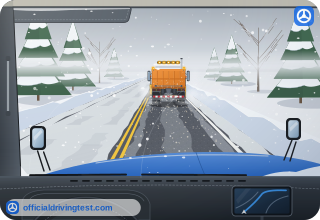
What should you do when you see snowplows and salt or sand trucks?
- Pass them as quickly as possible
- Stay right behind them on the cleared lane
- Give them plenty of room
Show answer
Correct answer: Give them plenty of room
Snowplows and the trucks that spread salt or sand need a wide gap from you.
Source: CDL manual, national model as printed by New Jersey, Sections 1 to 3 (July 2017)
-
Which problem can water in the brakes cause?
- Engine overheating
- Pulling to one side
- Air lines freezing
Show answer
Correct answer: Pulling to one side
Wet brakes can be weak, apply unevenly or grab, which can cause wheel lockups and pulling to one side.
Source: CDL manual, national model as printed by New Jersey, Sections 1 to 3 (July 2017)
-
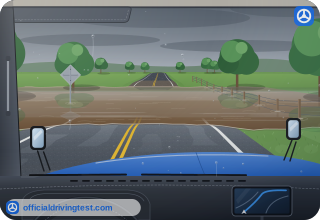
Before you drive through deep standing water, what should you do with your speed and gear?
- Hold your speed and use a high gear
- Shift to a higher gear to keep moving
- Slow down and select a low gear
Show answer
Correct answer: Slow down and select a low gear
Reduce speed and put the transmission in a low gear before you cross the water.
Source: CDL manual, national model as printed by New Jersey, Sections 1 to 3 (July 2017)
-
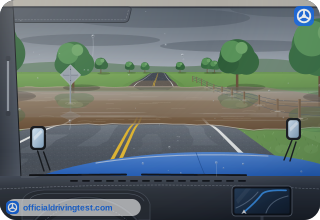
Why do you gently press the brakes before entering deep water?
- It warms the tires so that they grip the wet road better
- It holds the brake surfaces closed so dirt and water stay out
- It lets the air tanks fill faster before you cross
Show answer
Correct answer: It holds the brake surfaces closed so dirt and water stay out
A light touch on the brakes before the water helps keep dirt and water away from the braking surfaces.
Source: CDL manual, national model as printed by New Jersey, Sections 1 to 3 (July 2017)
-
When you must cross deep water, what should you do with the engine speed and the brakes?
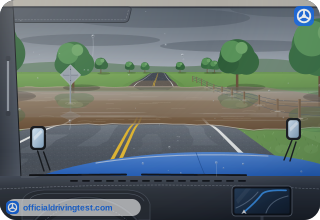
- Keep the engine at idle with the brakes off
- Lower the rpm and let the brakes go fully
- Raise the rpm and keep light pressure on the brakes
Show answer
Correct answer: Raise the rpm and keep light pressure on the brakes
Raise the engine rpm and keep light brake pressure while you cross the water.
Source: CDL manual, national model as printed by New Jersey, Sections 1 to 3 (July 2017)
-
After you leave deep water, how can you dry out wet brakes?
- Keep light pressure on them for a short distance
- Park and wait for them to dry in the air
- Pump them hard several times at once
Show answer
Correct answer: Keep light pressure on them for a short distance
Braking lightly for a short stretch warms the brakes and dries them.
Source: CDL manual, national model as printed by New Jersey, Sections 1 to 3 (July 2017)
-
Before making a test stop to check the brakes after crossing water, what must you make sure of?
- That the trailer is empty
- That no one is following you
- That the tires have cooled down
Show answer
Correct answer: That no one is following you
Make sure nobody is behind you, and then press the brakes to see whether they work well.
Source: CDL manual, national model as printed by New Jersey, Sections 1 to 3 (July 2017)