General Knowledge: Railroad crossings and mountain driving — Part 3
Questions in this part include: “Which climb will make you use the lowest gears?” · “Why might a modern truck need a lower gear going down a hill than going up it?”
Independent educational site · not affiliated with any government agency or DMV
Ready? Test yourself
Answer to start, or tap Start below:
Which climb will make you use the lowest gears?
- Instant feedback with an explanation
- Every answer cites its source in the manual
- Your best score is saved on this device
- Keyboard: press 1 to 3 to answer and Enter for the next question
Questions are written in our own words from the CDL manual; they are not the real test's questions. With your state chosen, every answer gives its page in your state's CDL manual. Without a state, answers cite the CDL manual, national model as printed by New Jersey (July 2017).
All 18 questions in this practice test
Take the test above first, then use this list to study. Tap “Show answer” to see the correct answer and explanation.
Show the questions and answersHide the questions
-
Which climb will make you use the lowest gears?
- A gentle, short grade with a heavy load
- A steep, long grade with a light load
- A steep, long grade with a heavy load
Show answer
Correct answer: A steep, long grade with a heavy load
Gravity slows you more on a steeper or longer grade and with a heavier load, so you need lower gears to keep climbing.
Source: CDL manual, national model as printed by New Jersey, Sections 1 to 3 (July 2017)
-
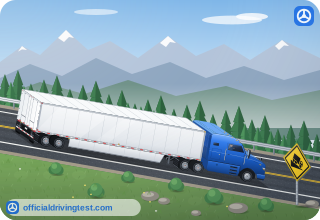
What does gravity do to a truck coming down a long, steep downgrade?
- It helps the brakes hold the vehicle back
- It makes the vehicle go faster
- It has little effect on a loaded vehicle
Show answer
Correct answer: It makes the vehicle go faster
On a long, steep downgrade gravity pulls the vehicle faster, so you must choose a safe speed and use a low gear.
Source: CDL manual, national model as printed by New Jersey, Sections 1 to 3 (July 2017)
-
What should you do about long, steep grades on your route before you drive?
- Wait until the grade to judge it by eye
- Learn about them ahead of time
- Decide your speed from your engine size alone
Show answer
Correct answer: Learn about them ahead of time
Finding out about steep grades in advance, for example by asking drivers who know them, helps you choose safe speeds.
Source: CDL manual, national model as printed by New Jersey, Sections 1 to 3 (July 2017)
-
How can you learn what speeds are safe on a grade you do not know?
- Follow the first truck you meet on it
- Ask drivers who are familiar with the grade
- Copy the speed of the car traffic
Show answer
Correct answer: Ask drivers who are familiar with the grade
Drivers who know a grade can tell you which speeds are safe on it, so ask them when you can.
Source: CDL manual, national model as printed by New Jersey, Sections 1 to 3 (July 2017)
-
How slowly should you go down a long, steep grade?
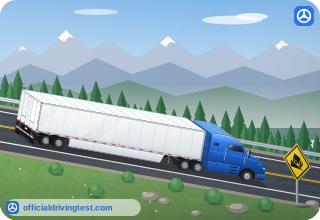
- Slowly enough that the brakes can hold without overheating
- Slowly enough that you never touch the brakes
- Slowly enough to match the car traffic around you
Show answer
Correct answer: Slowly enough that the brakes can hold without overheating
Your speed must let the brakes hold the vehicle back without becoming too hot, because overheated brakes fade.
Source: CDL manual, national model as printed by New Jersey, Sections 1 to 3 (July 2017)
-
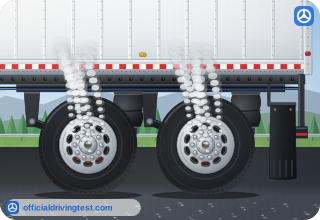
What happens to brakes that are getting too hot on a long downgrade?
- They grab harder and stop the vehicle sooner
- They need more pressure for the same stopping power
- They lock up and stay locked until they cool
Show answer
Correct answer: They need more pressure for the same stopping power
Overheated brakes fade: you have to press harder for the same effect, and with continued hard use they can stop working at all.
Source: CDL manual, national model as printed by New Jersey, Sections 1 to 3 (July 2017)
-
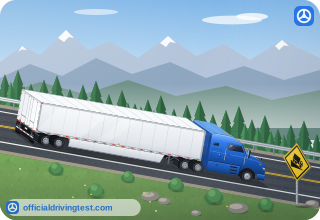
Why should you shift to a low gear before you start down a steep grade?
- Low gears use less fuel on a downgrade
- You may be unable to downshift later
- The brakes cool faster in a low gear
Show answer
Correct answer: You may be unable to downshift later
Once the truck is going fast you may not get into a lower gear, or any gear, and all engine braking can be lost.
Source: CDL manual, national model as printed by New Jersey, Sections 1 to 3 (July 2017)
-
At high speed, you push an automatic gearbox down into a lower gear by force. What can happen?
- The engine braking effect increases
- The truck stops more quickly
- The transmission may be damaged
Show answer
Correct answer: The transmission may be damaged
Forcing the downshift at high speed can damage the transmission and can also cost you all engine braking.
Source: CDL manual, national model as printed by New Jersey, Sections 1 to 3 (July 2017)
-
What gear rule worked for older trucks going down a hill?
- The same gear you would need to climb it
- The gear one step higher than for the climb
- The lowest gear the truck has, every time
Show answer
Correct answer: The same gear you would need to climb it
For older trucks, the gear needed to climb a hill was also the gear to use going down it; modern trucks may need lower ones.
Source: CDL manual, national model as printed by New Jersey, Sections 1 to 3 (July 2017)
-
Why might a modern truck need a lower gear going down a hill than going up it?
- Modern trucks have heavier frames and bodies
- Modern trucks have weaker engines for climbing
- They have less friction and air drag holding them back
Show answer
Correct answer: They have less friction and air drag holding them back
Modern trucks are built with parts that create little friction and with smooth shapes, so little holds them back downhill, even though they can climb in higher gears.
Source: CDL manual, national model as printed by New Jersey, Sections 1 to 3 (July 2017)
-
What causes brakes to fade or fail on a long downgrade?
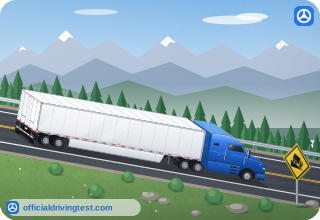
- Too much heat from using them too much
- Cold brake drums that have not warmed up
- Too much engine braking
Show answer
Correct answer: Too much heat from using them too much
Overusing the brakes instead of relying on engine braking builds up heat, and excessive heat makes brakes fade or fail.
Source: CDL manual, national model as printed by New Jersey, Sections 1 to 3 (July 2017)
-
What happens to the other brakes when some brakes are out of adjustment?
- They can overheat and fade
- They wear more slowly
- They work harder without any risk
Show answer
Correct answer: They can overheat and fade
Brakes out of adjustment quit doing their share first, so the others carry extra work, overheat and fade. Check adjustment often.
Source: CDL manual, national model as printed by New Jersey, Sections 1 to 3 (July 2017)
-
Why must brake adjustment be checked frequently?
- Brake drums shrink as they get older
- Hot brake linings wear out sooner
- Loose adjusters spread dust onto the tires
Show answer
Correct answer: Hot brake linings wear out sooner
Brakes drift out of adjustment fast and linings wear faster when hot, so adjustment needs frequent checks.
Source: CDL manual, national model as printed by New Jersey, Sections 1 to 3 (July 2017)
-
On a long downgrade, how firmly should you press the brakes each time?
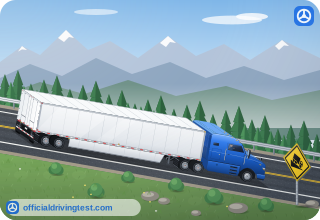
- As hard as you can until the vehicle stops
- Lightly enough that you barely notice it
- Just firmly enough to feel a clear slowdown
Show answer
Correct answer: Just firmly enough to feel a clear slowdown
Each application should be firm enough that you notice the vehicle slowing, but not harder.
Source: CDL manual, national model as printed by New Jersey, Sections 1 to 3 (July 2017)
-
About how long should each brake application last when you brake down a long grade?
- About three seconds
- About one second
- About ten seconds
Show answer
Correct answer: About three seconds
Each application should last about three seconds, then you release until speed returns to the safe speed.
Source: CDL manual, national model as printed by New Jersey, Sections 1 to 3 (July 2017)
-
Your safe speed on a downgrade is 40 mph and you have just braked from 40 mph. At what speed do you release the brakes?
- About 35 mph
- About 30 mph
- About 38 mph
Show answer
Correct answer: About 35 mph
Brake until the speed has dropped about 5 mph under your safe speed, which is 35 mph here, then release and let speed build back to 40.
Source: CDL manual, national model as printed by New Jersey, Sections 1 to 3 (July 2017)
-
How does an escape ramp slow a runaway vehicle?
- With a long bed of loose, soft material
- With a short wall of hard concrete
- With a steep drop-off at the end
Show answer
Correct answer: With a long bed of loose, soft material
The soft, loose bed slows the vehicle safely, sometimes together with an uphill slope, without hurting the people inside.
Source: CDL manual, national model as printed by New Jersey, Sections 1 to 3 (July 2017)
-
How do drivers learn where escape ramps are on a mountain road?
- By lines painted along the shoulder
- By a radio call from the weigh station
- By signs that show their locations
Show answer
Correct answer: By signs that show their locations
Signs show where escape ramps are, and you should know their locations on your route before you need one.
Source: CDL manual, national model as printed by New Jersey, Sections 1 to 3 (July 2017)