General Knowledge: Railroad crossings and mountain driving — Part 2
Questions in this part include: “How can you tell a public crossing where trains do not sound their horns?” · “What problem can a crossing with steep approaches cause for your vehicle?”
Independent educational site · not affiliated with any government agency or DMV
Ready? Test yourself
Answer to start, or tap Start below:
How can you tell a public crossing where trains do not sound their horns?
- Instant feedback with an explanation
- Every answer cites its source in the manual
- Your best score is saved on this device
- Keyboard: press 1 to 3 to answer and Enter for the next question
Questions are written in our own words from the CDL manual; they are not the real test's questions. With your state chosen, every answer gives its page in your state's CDL manual. Without a state, answers cite the CDL manual, national model as printed by New Jersey (July 2017).
All 19 questions in this practice test
Take the test above first, then use this list to study. Tap “Show answer” to see the correct answer and explanation.
Show the questions and answersHide the questions
-
How can you tell a public crossing where trains do not sound their horns?
- The crossing has no cross-buck sign
- A sign should mark the crossing as horn-free
- Its advance warning sign is white, not yellow
Show answer
Correct answer: A sign should mark the crossing as horn-free
Trains do not blow horns at some crossings, and signs should mark those public crossings.
Source: CDL manual, national model as printed by New Jersey, Sections 1 to 3 (July 2017)
-
What may keep you from hearing a train horn until the train is very near?
- Noise from inside your own vehicle cab
- Wind blowing across an open crossing
- Distance from the track at a passive crossing
Show answer
Correct answer: Noise from inside your own vehicle cab
Sound inside your cab can hide the horn, so a train may be dangerously close before you hear it.
Source: CDL manual, national model as printed by New Jersey, Sections 1 to 3 (July 2017)
-
A crossing has gates and flashing lights. How much should you depend on them to warn of a train?
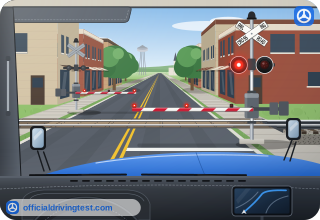
- Fully, once you have stopped and looked once
- Not only on them; keep watching for trains
- Fully at crossings that also have a flagman
Show answer
Correct answer: Not only on them; keep watching for trains
Do not rely only on signals, gates or flagmen. Be especially alert at crossings that have no gates or flashing lights.
Source: CDL manual, national model as printed by New Jersey, Sections 1 to 3 (July 2017)
-
At which crossings should you be especially alert for trains?
- Only crossings that lie in rural country
- Crossings that have a flagman on duty
- Crossings without gates or flashing lights
Show answer
Correct answer: Crossings without gates or flashing lights
Where there are no gates or flashing lights, nothing warns you of a train, so you must watch even more carefully.
Source: CDL manual, national model as printed by New Jersey, Sections 1 to 3 (July 2017)
-
At a crossing with two tracks, why look both ways again after one train passes?
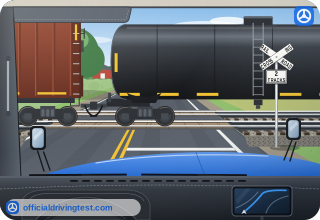
- One train can block your view of another train
- The first train may stop and back up
- The signals reset only after both tracks clear
Show answer
Correct answer: One train can block your view of another train
A train on one track can hide another one. After one train clears, check that no other train is near before you cross.
Source: CDL manual, national model as printed by New Jersey, Sections 1 to 3 (July 2017)
-
Compared with country crossings, how risky are crossings and rail yards in town?
- Less dangerous, since traffic moves slowly there
- More dangerous only at rush hour
- Just as dangerous as crossings in the country
Show answer
Correct answer: Just as dangerous as crossings in the country
Crossings in towns and yards are as dangerous as rural ones, so approach them with the same caution.
Source: CDL manual, national model as printed by New Jersey, Sections 1 to 3 (July 2017)
-
For which reason must a vehicle make a full stop at a grade crossing?
- The road beyond the crossing is rough or narrow
- The cargo makes a stop mandatory by regulation
- The vehicle is traveling with no cargo load
Show answer
Correct answer: The cargo makes a stop mandatory by regulation
A full stop is required when state or federal rules call for it because of the cargo, or when the law otherwise requires it.
Source: CDL manual, national model as printed by New Jersey, Sections 1 to 3 (July 2017)
-
What should you do about traffic behind you when you must stop at a crossing?
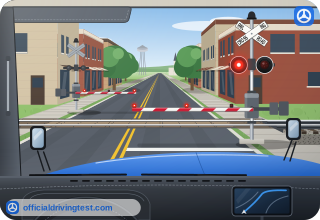
- Brake hard to alert the driver behind
- Check behind, stop gradually, use pullout lane
- Stop quickly so the driver behind sees you
Show answer
Correct answer: Check behind, stop gradually, use pullout lane
Look for vehicles behind you and slow down gradually, using a pullout lane if there is one.
Source: CDL manual, national model as printed by New Jersey, Sections 1 to 3 (July 2017)
-
What should you turn on when you are stopping at a railroad crossing?
- Your four-way emergency flashers
- Your high beam headlights
- Your right turn signal only
Show answer
Correct answer: Your four-way emergency flashers
When stopping at a crossing, you should turn on your four-way emergency flashers.
Source: CDL manual, national model as printed by New Jersey, Sections 1 to 3 (July 2017)
-
What problem can a crossing with steep approaches cause for your vehicle?
- Your brakes may fade on the tracks
- Your tires may lose air on the tracks
- Your unit may hang up on the tracks
Show answer
Correct answer: Your unit may hang up on the tracks
A steep approach can leave your unit stuck on the rails.
Source: CDL manual, national model as printed by New Jersey, Sections 1 to 3 (July 2017)
-
Before starting across the tracks, what must you be sure of?
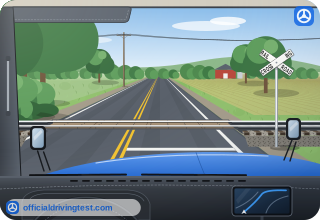
- That you can get all the way across
- That the signals are not flashing yet
- That the vehicle ahead is moving
Show answer
Correct answer: That you can get all the way across
Never let traffic trap you so that you must stop on the tracks. Be sure there is room to get fully across before you go.
Source: CDL manual, national model as printed by New Jersey, Sections 1 to 3 (July 2017)
-
How long, at least, does a typical tractor-trailer need to clear a single track?
- 14 seconds
- 8 seconds
- 10 seconds
Show answer
Correct answer: 14 seconds
Clearing one track takes a typical tractor-trailer 14 seconds or more, while two tracks take over 15 seconds.
Source: CDL manual, national model as printed by New Jersey, Sections 1 to 3 (July 2017)
-
How long does a typical tractor-trailer need to clear a double track?
- Over 15 seconds
- Under 10 seconds
- Under 12 seconds
Show answer
Correct answer: Over 15 seconds
Two tracks take a typical tractor-trailer longer than one, over 15 seconds.
Source: CDL manual, national model as printed by New Jersey, Sections 1 to 3 (July 2017)
-
What should you avoid doing while your vehicle is on the railroad tracks?
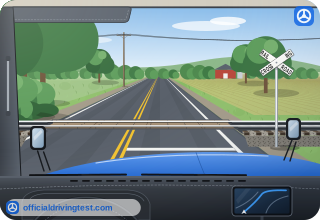
- Shifting gears
- Using the horn
- Releasing the clutch slowly
Show answer
Correct answer: Shifting gears
Do not change gears while your vehicle is crossing the railroad tracks.
Source: CDL manual, national model as printed by New Jersey, Sections 1 to 3 (July 2017)
-
Which of these can get stuck on a raised railroad crossing?
- A straight truck with high ground clearance
- A high-hood tractor with no trailer
- A low-slung car carrier
Show answer
Correct answer: A low-slung car carrier
Low-slung units such as lowboys, car carriers, moving vans and possum-belly livestock trailers can get stuck on raised crossings.
Source: CDL manual, national model as printed by New Jersey, Sections 1 to 3 (July 2017)
-
A single-axle tractor pulls a long trailer. What can make this rig get stuck on a raised crossing?
- The trailer's kingpin sits too far forward
- The tractor's one axle is too light to grip the rails
- The landing gear is set for a tandem-axle tractor
Show answer
Correct answer: The landing gear is set for a tandem-axle tractor
This setup, a single-axle tractor with a long trailer whose landing gear is set for a tandem-axle tractor, can get stuck on a raised crossing.
Source: CDL manual, national model as printed by New Jersey, Sections 1 to 3 (July 2017)
-
Your rig is stuck on railroad tracks. What should you do first?
- Set the flashers and keep trying to drive off
- Try to rock the rig free with the clutch
- Get out and move away from the tracks
Show answer
Correct answer: Get out and move away from the tracks
Get out and away from the tracks, then check the signposts for emergency information and call 911 or another emergency number.
Source: CDL manual, national model as printed by New Jersey, Sections 1 to 3 (July 2017)
-
Where can you find emergency notification information at a railroad crossing?
- On the pavement markings before the tracks
- On the signposts or signal housing at the crossing
- On the posted speed limit sign near the road
Show answer
Correct answer: On the signposts or signal housing at the crossing
Crossings carry emergency contact information on the signposts or the signal housing, so look there when you are stuck.
Source: CDL manual, national model as printed by New Jersey, Sections 1 to 3 (July 2017)
-
When you call to report a stuck vehicle at a crossing, which detail is especially useful if it is posted?
- The railroad's train schedule number
- The DOT number of the crossing
- The license plate number of your tractor
Show answer
Correct answer: The DOT number of the crossing
The DOT number identifies the exact crossing, so give it, along with any landmarks, when you call 911 or another emergency number.
Source: CDL manual, national model as printed by New Jersey, Sections 1 to 3 (July 2017)