General Knowledge: Railroad crossings and mountain driving
Railroad-highway crossings and their warnings, and choosing a safe speed and gear on long grades. Split into 3 shorter tests so you're not stuck in one long quiz.
Independent educational site · not affiliated with any government agency or DMV
Choose a part
Railroad crossings and mountain driving — Part 1
Questions in this part include: “Which of these must your safe speed on a long downgrade suit?”
Railroad crossings and mountain driving — Part 2
Questions in this part include: “How can you tell a public crossing where trains do not sound their horns?”
Railroad crossings and mountain driving — Part 3
Questions in this part include: “Which climb will make you use the lowest gears?”
Questions are written in our own words from the CDL manual; they are not the real test's questions. With your state chosen, every answer gives its page in your state's CDL manual. Without a state, answers cite the CDL manual, national model as printed by New Jersey (July 2017).
All 56 Railroad crossings and mountain driving questions with answers
Choose a part above to take a practice test, or study every question and answer here.
Show the questions and answersHide the questions
1Part 119 questions
-
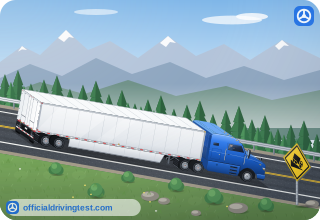
Which of these must your safe speed on a long downgrade suit?
- The number of hours left in your driving day
- The age and make of your tractor
- The total weight of the vehicle and cargo
Show answer
Correct answer: The total weight of the vehicle and cargo
A safe speed has to suit the total weight of the vehicle and cargo, as well as the grade, the road and the weather.
Source: CDL manual, national model as printed by New Jersey, Sections 1 to 3 (July 2017)
-
Which signs should you look for and obey when you approach a mountain grade?
- Signs showing the distance to the next town
- Signs showing the next rest area
- Signs showing how long and steep the grade is
Show answer
Correct answer: Signs showing how long and steep the grade is
Warning signs tell you how long and how steep the grade is, which helps you choose a safe speed.
Source: CDL manual, national model as printed by New Jersey, Sections 1 to 3 (July 2017)
-
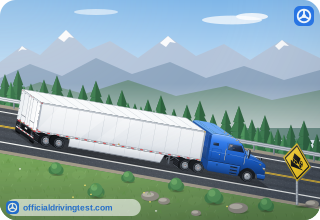
Why should engine braking do most of the work on a long downgrade?
- It keeps the tires from wearing unevenly on the grade
- It keeps the transmission from getting too hot
- It saves the brakes for slowing or stopping later
Show answer
Correct answer: It saves the brakes for slowing or stopping later
Using engine braking keeps the brakes ready for slowing or stopping as road and traffic conditions demand.
Source: CDL manual, national model as printed by New Jersey, Sections 1 to 3 (July 2017)
-
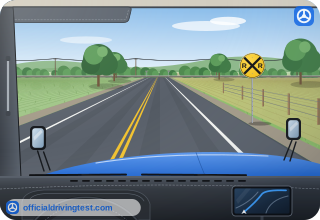
How should a driver approach every railroad-highway grade crossing?
- Expecting a train only if lights flash
- Expecting that a train may be coming
- Expecting a train only at night or in fog
Show answer
Correct answer: Expecting that a train may be coming
Every crossing is dangerous, and it is hard to judge how far away a train is or how fast it moves. Always be ready for a train.
Source: CDL manual, national model as printed by New Jersey, Sections 1 to 3 (July 2017)
-
What is a passive railroad crossing?
- One with a gate but no flashing lights
- One with flashing lights but no bells
- One with no traffic control device at all
Show answer
Correct answer: One with no traffic control device at all
A passive crossing has no traffic control device, so the driver alone must spot the crossing, look for a train and decide if it is safe to cross.
Source: CDL manual, national model as printed by New Jersey, Sections 1 to 3 (July 2017)
-
What makes a railroad crossing an active crossing?
- The driver alone decides whether to stop or go
- A traffic control device, like flashing red lights
- It has no signs, signals or markings at all
Show answer
Correct answer: A traffic control device, like flashing red lights
An active crossing has a traffic control device, such as flashing red lights with or without bells, or lights with bells and gates.
Source: CDL manual, national model as printed by New Jersey, Sections 1 to 3 (July 2017)
-
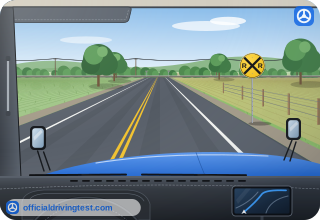
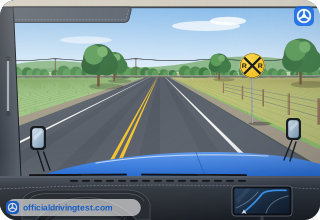
A round yellow sign with a black railroad symbol is ahead. What does it tell you to do?
- Stop at once and wait for a signal to go
- Slow down, look and listen, be ready to stop
- Keep your speed and sound the horn
Show answer
Correct answer: Slow down, look and listen, be ready to stop
A round yellow sign ahead of a public crossing is a cue to reduce speed, watch and listen for a train, and be prepared to stop.
Source: CDL manual, national model as printed by New Jersey, Sections 1 to 3 (July 2017)
-
Which vehicles are required to stop at a public railroad crossing marked by the advance warning sign?
- Only vehicles carrying heavy freight loads
- Only vehicles that are pulling a trailer
- Passenger-carrying and hazmat-carrying vehicles
Show answer
Correct answer: Passenger-carrying and hazmat-carrying vehicles
Passenger-carrying vehicles and vehicles carrying hazardous materials must stop at these crossings.
Source: CDL manual, national model as printed by New Jersey, Sections 1 to 3 (July 2017)
-
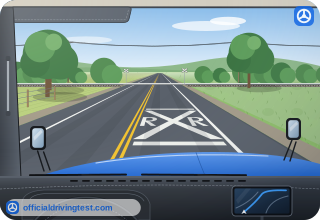
A railroad warning "X" with the letters RR is painted on the road. What does it mean?
- Only that the tracks are no longer used
- That passing is allowed before the tracks
- The same as the advance warning sign
Show answer
Correct answer: The same as the advance warning sign
The painted X and RR, together with a marking that bans passing on two-lane roads, warn you just like the advance warning sign.
Source: CDL manual, national model as printed by New Jersey, Sections 1 to 3 (July 2017)
-
Besides the painted markings, what sign is also placed near a crossing on a two-lane road?
- A no passing zone sign
- A minimum speed sign
- A truck route sign
Show answer
Correct answer: A no passing zone sign
On two-lane roads a no passing zone sign is also used near the crossing.
Source: CDL manual, national model as printed by New Jersey, Sections 1 to 3 (July 2017)
-
A white stop line is painted before the tracks. Where must a school bus stop in relation to it?
- With its front wheels on the line
- With the front of the bus behind the line
- With the front of the bus just past the line
Show answer
Correct answer: With the front of the bus behind the line
If a white line is painted ahead of the rails, a school bus has to halt with its front end short of that line.
Source: CDL manual, national model as printed by New Jersey, Sections 1 to 3 (July 2017)
-
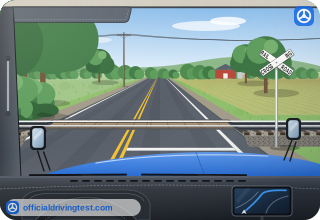
What does a cross-buck sign at a grade crossing require of you?
- Treat it as a warning, with no duty to yield
- Give the train the right to go first
- Stop every time, even with no train in sight
Show answer
Correct answer: Give the train the right to go first
The cross-buck marks the grade crossing and requires you to give the train the right-of-way.
Source: CDL manual, national model as printed by New Jersey, Sections 1 to 3 (July 2017)
-
No stop line is painted. How far from the nearest rail must a vehicle that has to stop at a crossing stop?
- At least 15 feet but not over 50 feet
- At least 5 feet but not over 15 feet
- At least 50 feet but not over 100 feet
Show answer
Correct answer: At least 15 feet but not over 50 feet
With no painted line, a vehicle that has to stop waits at least 15 feet and no more than 50 feet back from the closest rail.
Source: CDL manual, national model as printed by New Jersey, Sections 1 to 3 (July 2017)
-
A sign is mounted below a cross-buck where the road crosses more than one track. What does it show?
- The maximum safe speed over the tracks
- The number of tracks
- The number of trains each hour
Show answer
Correct answer: The number of tracks
Where a road crosses several tracks, a sign under the cross-buck tells how many tracks there are.
Source: CDL manual, national model as printed by New Jersey, Sections 1 to 3 (July 2017)
-
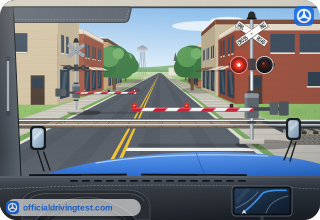
The red lights at a crossing begin to flash. What must you do?
- Stop, because a train is approaching
- Slow down and cross if the tracks look clear
- Stop only if you can see the train
Show answer
Correct answer: Stop, because a train is approaching
Flashing red lights mean a train is coming. Stop and yield; where several tracks exist, confirm each one is clear before you cross.
Source: CDL manual, national model as printed by New Jersey, Sections 1 to 3 (July 2017)
-
You stopped at a crossing with gates. When may you start across?
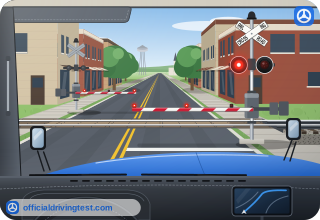
- Once the gates are up and lights stop flashing
- As soon as the last train car passes you
- When the gates begin to rise from the road
Show answer
Correct answer: Once the gates are up and lights stop flashing
Stay stopped until the gates are raised and the lights have stopped flashing, then go when it is safe.
Source: CDL manual, national model as printed by New Jersey, Sections 1 to 3 (July 2017)
-
Why should you never try to beat a train to a crossing?
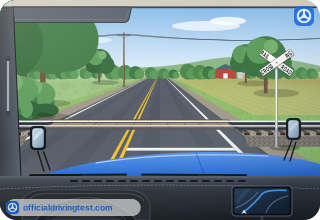
- Racing a train is legal only on passive crossings
- It is very hard to judge how fast a train moves
- Your engine may stall on the tracks
Show answer
Correct answer: It is very hard to judge how fast a train moves
The speed of an approaching train is extremely hard to judge, so racing it is never safe.
Source: CDL manual, national model as printed by New Jersey, Sections 1 to 3 (July 2017)
-
How fast may you approach a railroad crossing?
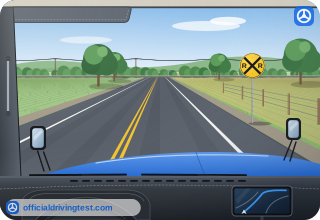
- At the posted limit for the road
- At a speed that lets you stop short of the tracks
- At a speed that keeps you moving at a steady pace
Show answer
Correct answer: At a speed that lets you stop short of the tracks
Reduce speed to match how far you can see trains in each direction, so you can always stop short of the tracks if needed.
Source: CDL manual, national model as printed by New Jersey, Sections 1 to 3 (July 2017)
-
Why should you not count on hearing a train before a crossing?
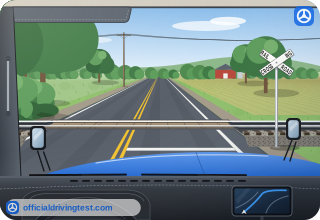
- Some trains may not sound their horns at some crossings
- Train horns are rarely used on any crossing
- Train horns are always quieter than truck engines
Show answer
Correct answer: Some trains may not sound their horns at some crossings
At some crossings trains do not or may not sound horns, and noise inside your vehicle can hide the sound until the train is very close.
Source: CDL manual, national model as printed by New Jersey, Sections 1 to 3 (July 2017)
2Part 219 questions
-
How can you tell a public crossing where trains do not sound their horns?
- The crossing has no cross-buck sign
- A sign should mark the crossing as horn-free
- Its advance warning sign is white, not yellow
Show answer
Correct answer: A sign should mark the crossing as horn-free
Trains do not blow horns at some crossings, and signs should mark those public crossings.
Source: CDL manual, national model as printed by New Jersey, Sections 1 to 3 (July 2017)
-
What may keep you from hearing a train horn until the train is very near?
- Noise from inside your own vehicle cab
- Wind blowing across an open crossing
- Distance from the track at a passive crossing
Show answer
Correct answer: Noise from inside your own vehicle cab
Sound inside your cab can hide the horn, so a train may be dangerously close before you hear it.
Source: CDL manual, national model as printed by New Jersey, Sections 1 to 3 (July 2017)
-
A crossing has gates and flashing lights. How much should you depend on them to warn of a train?
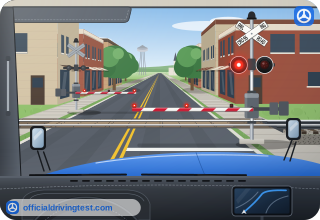
- Fully, once you have stopped and looked once
- Not only on them; keep watching for trains
- Fully at crossings that also have a flagman
Show answer
Correct answer: Not only on them; keep watching for trains
Do not rely only on signals, gates or flagmen. Be especially alert at crossings that have no gates or flashing lights.
Source: CDL manual, national model as printed by New Jersey, Sections 1 to 3 (July 2017)
-
At which crossings should you be especially alert for trains?
- Only crossings that lie in rural country
- Crossings that have a flagman on duty
- Crossings without gates or flashing lights
Show answer
Correct answer: Crossings without gates or flashing lights
Where there are no gates or flashing lights, nothing warns you of a train, so you must watch even more carefully.
Source: CDL manual, national model as printed by New Jersey, Sections 1 to 3 (July 2017)
-
At a crossing with two tracks, why look both ways again after one train passes?
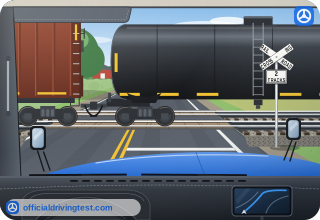
- One train can block your view of another train
- The first train may stop and back up
- The signals reset only after both tracks clear
Show answer
Correct answer: One train can block your view of another train
A train on one track can hide another one. After one train clears, check that no other train is near before you cross.
Source: CDL manual, national model as printed by New Jersey, Sections 1 to 3 (July 2017)
-
Compared with country crossings, how risky are crossings and rail yards in town?
- Less dangerous, since traffic moves slowly there
- More dangerous only at rush hour
- Just as dangerous as crossings in the country
Show answer
Correct answer: Just as dangerous as crossings in the country
Crossings in towns and yards are as dangerous as rural ones, so approach them with the same caution.
Source: CDL manual, national model as printed by New Jersey, Sections 1 to 3 (July 2017)
-
For which reason must a vehicle make a full stop at a grade crossing?
- The road beyond the crossing is rough or narrow
- The cargo makes a stop mandatory by regulation
- The vehicle is traveling with no cargo load
Show answer
Correct answer: The cargo makes a stop mandatory by regulation
A full stop is required when state or federal rules call for it because of the cargo, or when the law otherwise requires it.
Source: CDL manual, national model as printed by New Jersey, Sections 1 to 3 (July 2017)
-
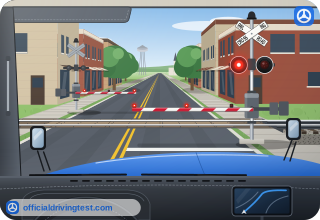
What should you do about traffic behind you when you must stop at a crossing?
- Brake hard to alert the driver behind
- Check behind, stop gradually, use pullout lane
- Stop quickly so the driver behind sees you
Show answer
Correct answer: Check behind, stop gradually, use pullout lane
Look for vehicles behind you and slow down gradually, using a pullout lane if there is one.
Source: CDL manual, national model as printed by New Jersey, Sections 1 to 3 (July 2017)
-
What should you turn on when you are stopping at a railroad crossing?
- Your four-way emergency flashers
- Your high beam headlights
- Your right turn signal only
Show answer
Correct answer: Your four-way emergency flashers
When stopping at a crossing, you should turn on your four-way emergency flashers.
Source: CDL manual, national model as printed by New Jersey, Sections 1 to 3 (July 2017)
-
What problem can a crossing with steep approaches cause for your vehicle?
- Your brakes may fade on the tracks
- Your tires may lose air on the tracks
- Your unit may hang up on the tracks
Show answer
Correct answer: Your unit may hang up on the tracks
A steep approach can leave your unit stuck on the rails.
Source: CDL manual, national model as printed by New Jersey, Sections 1 to 3 (July 2017)
-
Before starting across the tracks, what must you be sure of?
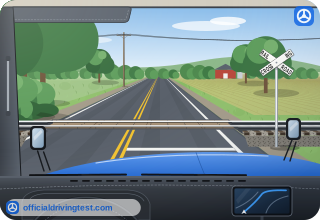
- That you can get all the way across
- That the signals are not flashing yet
- That the vehicle ahead is moving
Show answer
Correct answer: That you can get all the way across
Never let traffic trap you so that you must stop on the tracks. Be sure there is room to get fully across before you go.
Source: CDL manual, national model as printed by New Jersey, Sections 1 to 3 (July 2017)
-
How long, at least, does a typical tractor-trailer need to clear a single track?
- 14 seconds
- 8 seconds
- 10 seconds
Show answer
Correct answer: 14 seconds
Clearing one track takes a typical tractor-trailer 14 seconds or more, while two tracks take over 15 seconds.
Source: CDL manual, national model as printed by New Jersey, Sections 1 to 3 (July 2017)
-
How long does a typical tractor-trailer need to clear a double track?
- Over 15 seconds
- Under 10 seconds
- Under 12 seconds
Show answer
Correct answer: Over 15 seconds
Two tracks take a typical tractor-trailer longer than one, over 15 seconds.
Source: CDL manual, national model as printed by New Jersey, Sections 1 to 3 (July 2017)
-
What should you avoid doing while your vehicle is on the railroad tracks?
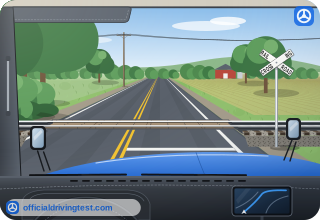
- Shifting gears
- Using the horn
- Releasing the clutch slowly
Show answer
Correct answer: Shifting gears
Do not change gears while your vehicle is crossing the railroad tracks.
Source: CDL manual, national model as printed by New Jersey, Sections 1 to 3 (July 2017)
-
Which of these can get stuck on a raised railroad crossing?
- A straight truck with high ground clearance
- A high-hood tractor with no trailer
- A low-slung car carrier
Show answer
Correct answer: A low-slung car carrier
Low-slung units such as lowboys, car carriers, moving vans and possum-belly livestock trailers can get stuck on raised crossings.
Source: CDL manual, national model as printed by New Jersey, Sections 1 to 3 (July 2017)
-
A single-axle tractor pulls a long trailer. What can make this rig get stuck on a raised crossing?
- The trailer's kingpin sits too far forward
- The tractor's one axle is too light to grip the rails
- The landing gear is set for a tandem-axle tractor
Show answer
Correct answer: The landing gear is set for a tandem-axle tractor
This setup, a single-axle tractor with a long trailer whose landing gear is set for a tandem-axle tractor, can get stuck on a raised crossing.
Source: CDL manual, national model as printed by New Jersey, Sections 1 to 3 (July 2017)
-
Your rig is stuck on railroad tracks. What should you do first?
- Set the flashers and keep trying to drive off
- Try to rock the rig free with the clutch
- Get out and move away from the tracks
Show answer
Correct answer: Get out and move away from the tracks
Get out and away from the tracks, then check the signposts for emergency information and call 911 or another emergency number.
Source: CDL manual, national model as printed by New Jersey, Sections 1 to 3 (July 2017)
-
Where can you find emergency notification information at a railroad crossing?
- On the pavement markings before the tracks
- On the signposts or signal housing at the crossing
- On the posted speed limit sign near the road
Show answer
Correct answer: On the signposts or signal housing at the crossing
Crossings carry emergency contact information on the signposts or the signal housing, so look there when you are stuck.
Source: CDL manual, national model as printed by New Jersey, Sections 1 to 3 (July 2017)
-
When you call to report a stuck vehicle at a crossing, which detail is especially useful if it is posted?
- The railroad's train schedule number
- The DOT number of the crossing
- The license plate number of your tractor
Show answer
Correct answer: The DOT number of the crossing
The DOT number identifies the exact crossing, so give it, along with any landmarks, when you call 911 or another emergency number.
Source: CDL manual, national model as printed by New Jersey, Sections 1 to 3 (July 2017)
3Part 318 questions
-
Which climb will make you use the lowest gears?
- A gentle, short grade with a heavy load
- A steep, long grade with a light load
- A steep, long grade with a heavy load
Show answer
Correct answer: A steep, long grade with a heavy load
Gravity slows you more on a steeper or longer grade and with a heavier load, so you need lower gears to keep climbing.
Source: CDL manual, national model as printed by New Jersey, Sections 1 to 3 (July 2017)
-
What does gravity do to a truck coming down a long, steep downgrade?
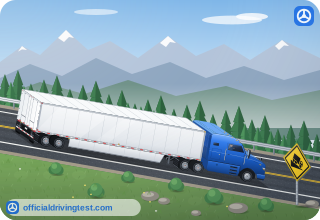
- It helps the brakes hold the vehicle back
- It makes the vehicle go faster
- It has little effect on a loaded vehicle
Show answer
Correct answer: It makes the vehicle go faster
On a long, steep downgrade gravity pulls the vehicle faster, so you must choose a safe speed and use a low gear.
Source: CDL manual, national model as printed by New Jersey, Sections 1 to 3 (July 2017)
-
What should you do about long, steep grades on your route before you drive?
- Wait until the grade to judge it by eye
- Learn about them ahead of time
- Decide your speed from your engine size alone
Show answer
Correct answer: Learn about them ahead of time
Finding out about steep grades in advance, for example by asking drivers who know them, helps you choose safe speeds.
Source: CDL manual, national model as printed by New Jersey, Sections 1 to 3 (July 2017)
-
How can you learn what speeds are safe on a grade you do not know?
- Follow the first truck you meet on it
- Ask drivers who are familiar with the grade
- Copy the speed of the car traffic
Show answer
Correct answer: Ask drivers who are familiar with the grade
Drivers who know a grade can tell you which speeds are safe on it, so ask them when you can.
Source: CDL manual, national model as printed by New Jersey, Sections 1 to 3 (July 2017)
-
How slowly should you go down a long, steep grade?
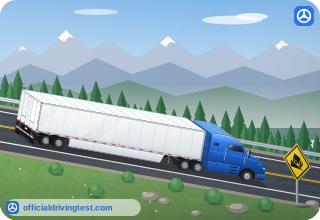
- Slowly enough that the brakes can hold without overheating
- Slowly enough that you never touch the brakes
- Slowly enough to match the car traffic around you
Show answer
Correct answer: Slowly enough that the brakes can hold without overheating
Your speed must let the brakes hold the vehicle back without becoming too hot, because overheated brakes fade.
Source: CDL manual, national model as printed by New Jersey, Sections 1 to 3 (July 2017)
-
What happens to brakes that are getting too hot on a long downgrade?
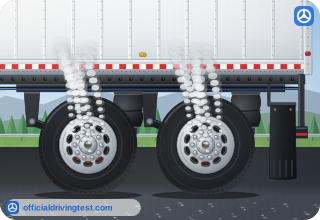
- They grab harder and stop the vehicle sooner
- They need more pressure for the same stopping power
- They lock up and stay locked until they cool
Show answer
Correct answer: They need more pressure for the same stopping power
Overheated brakes fade: you have to press harder for the same effect, and with continued hard use they can stop working at all.
Source: CDL manual, national model as printed by New Jersey, Sections 1 to 3 (July 2017)
-
Why should you shift to a low gear before you start down a steep grade?
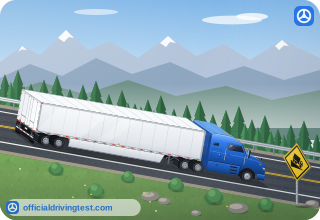
- Low gears use less fuel on a downgrade
- You may be unable to downshift later
- The brakes cool faster in a low gear
Show answer
Correct answer: You may be unable to downshift later
Once the truck is going fast you may not get into a lower gear, or any gear, and all engine braking can be lost.
Source: CDL manual, national model as printed by New Jersey, Sections 1 to 3 (July 2017)
-
At high speed, you push an automatic gearbox down into a lower gear by force. What can happen?
- The engine braking effect increases
- The truck stops more quickly
- The transmission may be damaged
Show answer
Correct answer: The transmission may be damaged
Forcing the downshift at high speed can damage the transmission and can also cost you all engine braking.
Source: CDL manual, national model as printed by New Jersey, Sections 1 to 3 (July 2017)
-
What gear rule worked for older trucks going down a hill?
- The same gear you would need to climb it
- The gear one step higher than for the climb
- The lowest gear the truck has, every time
Show answer
Correct answer: The same gear you would need to climb it
For older trucks, the gear needed to climb a hill was also the gear to use going down it; modern trucks may need lower ones.
Source: CDL manual, national model as printed by New Jersey, Sections 1 to 3 (July 2017)
-
Why might a modern truck need a lower gear going down a hill than going up it?
- Modern trucks have heavier frames and bodies
- Modern trucks have weaker engines for climbing
- They have less friction and air drag holding them back
Show answer
Correct answer: They have less friction and air drag holding them back
Modern trucks are built with parts that create little friction and with smooth shapes, so little holds them back downhill, even though they can climb in higher gears.
Source: CDL manual, national model as printed by New Jersey, Sections 1 to 3 (July 2017)
-
What causes brakes to fade or fail on a long downgrade?
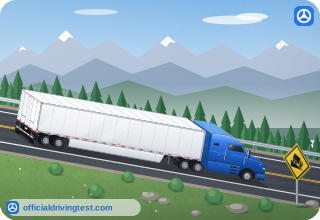
- Too much heat from using them too much
- Cold brake drums that have not warmed up
- Too much engine braking
Show answer
Correct answer: Too much heat from using them too much
Overusing the brakes instead of relying on engine braking builds up heat, and excessive heat makes brakes fade or fail.
Source: CDL manual, national model as printed by New Jersey, Sections 1 to 3 (July 2017)
-
What happens to the other brakes when some brakes are out of adjustment?
- They can overheat and fade
- They wear more slowly
- They work harder without any risk
Show answer
Correct answer: They can overheat and fade
Brakes out of adjustment quit doing their share first, so the others carry extra work, overheat and fade. Check adjustment often.
Source: CDL manual, national model as printed by New Jersey, Sections 1 to 3 (July 2017)
-
Why must brake adjustment be checked frequently?
- Brake drums shrink as they get older
- Hot brake linings wear out sooner
- Loose adjusters spread dust onto the tires
Show answer
Correct answer: Hot brake linings wear out sooner
Brakes drift out of adjustment fast and linings wear faster when hot, so adjustment needs frequent checks.
Source: CDL manual, national model as printed by New Jersey, Sections 1 to 3 (July 2017)
-
On a long downgrade, how firmly should you press the brakes each time?
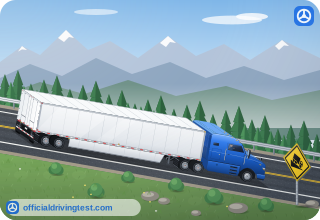
- As hard as you can until the vehicle stops
- Lightly enough that you barely notice it
- Just firmly enough to feel a clear slowdown
Show answer
Correct answer: Just firmly enough to feel a clear slowdown
Each application should be firm enough that you notice the vehicle slowing, but not harder.
Source: CDL manual, national model as printed by New Jersey, Sections 1 to 3 (July 2017)
-
About how long should each brake application last when you brake down a long grade?
- About three seconds
- About one second
- About ten seconds
Show answer
Correct answer: About three seconds
Each application should last about three seconds, then you release until speed returns to the safe speed.
Source: CDL manual, national model as printed by New Jersey, Sections 1 to 3 (July 2017)
-
Your safe speed on a downgrade is 40 mph and you have just braked from 40 mph. At what speed do you release the brakes?
- About 35 mph
- About 30 mph
- About 38 mph
Show answer
Correct answer: About 35 mph
Brake until the speed has dropped about 5 mph under your safe speed, which is 35 mph here, then release and let speed build back to 40.
Source: CDL manual, national model as printed by New Jersey, Sections 1 to 3 (July 2017)
-
How does an escape ramp slow a runaway vehicle?
- With a long bed of loose, soft material
- With a short wall of hard concrete
- With a steep drop-off at the end
Show answer
Correct answer: With a long bed of loose, soft material
The soft, loose bed slows the vehicle safely, sometimes together with an uphill slope, without hurting the people inside.
Source: CDL manual, national model as printed by New Jersey, Sections 1 to 3 (July 2017)
-
How do drivers learn where escape ramps are on a mountain road?
- By lines painted along the shoulder
- By a radio call from the weigh station
- By signs that show their locations
Show answer
Correct answer: By signs that show their locations
Signs show where escape ramps are, and you should know their locations on your route before you need one.
Source: CDL manual, national model as printed by New Jersey, Sections 1 to 3 (July 2017)