California: Sharing the road
Safely sharing the road with motorcycles, bicycles, trucks, and buses. Split into 4 shorter tests so you're not stuck in one long quiz.
Independent educational site · not affiliated with any government agency or DMV
Choose a part
Sharing the road — Part 1
Questions in this part include: “How may a bicyclist show which way they plan to turn?”
StartSharing the road — Part 2
Questions in this part include: “A large vehicle traveling at 55 mph may need how much distance to stop?”
StartSharing the road — Part 3
Questions in this part include: “What is the maximum speed a neighborhood electric vehicle (NEV) or low-speed vehicle (LSV) can reach?”
StartSharing the road — Part 4
Questions in this part include: “Which of these is a legal reason for a bicyclist to leave the right edge of the road and take more of the lane?”
StartAll 71 Sharing the road questions with answers
Choose a part above to take a practice test, or study every question and answer here.
Show the questions and answersHide the questions
-
How may a bicyclist show which way they plan to turn?
- By holding an arm straight out, pointing toward the turn.
- By raising both arms overhead.
- Bicyclists are not allowed to signal with their arms.
- By tapping the rear fender twice.
Show answer
Correct answer: By holding an arm straight out, pointing toward the turn.
A bicyclist may signal a turn by holding an arm straight out and pointing in the direction they intend to go.
Source: California Driver Handbook (2025), page 10 · Open this page in the manual (Manual page 10)
-
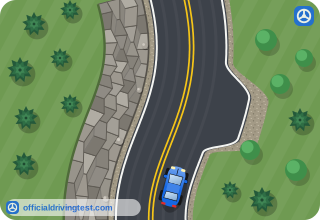
What is a turnout area or lane for?
- Emergency parking only.
- Picking up and dropping off passengers.
- Making U-turns.
- Letting the vehicles behind you get past.
Show answer
Correct answer: Letting the vehicles behind you get past.
Merge into a turnout area or lane so the vehicles behind you can pass.
Source: California Driver Handbook (2025), page 16 · Open this page in the manual (Manual page 16)
-
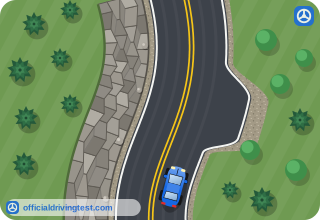
Driving slowly on a two-lane road where passing is unsafe, when must you use a turnout?
- As soon as any car appears behind you.
- When a truck is behind you.
- When five or more vehicles are following you.
- Only when a posted sign specifically orders you to do so.
Show answer
Correct answer: When five or more vehicles are following you.
You must use a turnout to let others pass when you are driving slowly on a two-lane road, passing is unsafe, and five or more vehicles are following you.
Source: California Driver Handbook (2025), page 16 · Open this page in the manual (Manual page 16)
-
How are bicycle lanes usually marked?
- With a double yellow line.
- With a single solid white line and signs, sometimes on bright green paint.
- With raised reflectors only.
- They carry no markings; drivers are expected to judge where they are.
Show answer
Correct answer: With a single solid white line and signs, sometimes on bright green paint.
Bike lanes are typically marked by a single solid white line and signs, and are sometimes painted bright green. The solid line usually becomes a dashed line near an intersection.
Source: California Driver Handbook (2025), page 17 · Open this page in the manual (Manual page 17)
-
When may you legally drive in a bicycle lane?
- Any time the bike lane looks empty ahead of you and you stay below the speed limit posted for that street.
- To park where allowed, to enter or leave the road, or when turning within 200 feet of an intersection.
- Whenever you need to pass a slow vehicle.
- Never, for any reason.
Show answer
Correct answer: To park where allowed, to enter or leave the road, or when turning within 200 feet of an intersection.
Driving in a bike lane is illegal except to park where permitted, to enter or leave the road, or to turn within 200 feet of an intersection. Check your blind spots first.
Source: California Driver Handbook (2025), page 17 · Open this page in the manual (Manual page 17)
-
What sets a buffered bike lane apart?
- It uses a different colour of asphalt.
- It is open only in daylight.
- Chevrons or diagonal markings give extra separation from traffic and parked cars.
- It runs against the flow of traffic so that riders can see the cars approaching them.
Show answer
Correct answer: Chevrons or diagonal markings give extra separation from traffic and parked cars.
A buffered bike lane uses chevrons or diagonal markings to create greater separation from moving traffic and from on-street parking.
Source: California Driver Handbook (2025), page 17 · Open this page in the manual (Manual page 17)
-
What is a bicycle boulevard?
- A wide bike lane along a freeway shoulder.
- A bike path with its own traffic signals.
- A route reserved for electric bicycles.
- A shared street that prioritizes bicycle travel.
Show answer
Correct answer: A shared street that prioritizes bicycle travel.
A bicycle boulevard prioritizes bicycle travel on streets shared with vehicles. A bike route, by contrast, uses signs and shared road markings to mark a preferred cycling route.
Source: California Driver Handbook (2025), page 17 · Open this page in the manual (Manual page 17)
-
What defines a separated bikeway, also called a cycle track or protected bike lane?
- Green paint on the pavement.
- The fact that it runs in one direction only, with no markings at the intersections.
- A posted 15 mph speed limit.
- Physical separation from motor traffic, for the exclusive use of bicyclists.
Show answer
Correct answer: Physical separation from motor traffic, for the exclusive use of bicyclists.
A separated bikeway is physically separated from motor traffic and is for bicyclists only. The separation can be flexible posts, a grade change, rigid barriers, or on-street parking.
Source: California Driver Handbook (2025), page 17 · Open this page in the manual (Manual page 17)
-
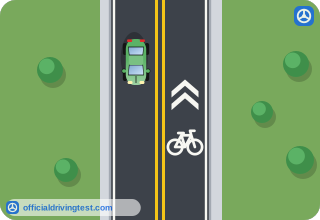
What do shared roadway bicycle markings (sharrows) tell drivers?
- Bicycles are banned from that lane and must use the sidewalk or the next street over.
- The lane is about to end.
- Bicyclists may occupy the lane, and the markings help them ride in a safe position.
- Parking is permitted there.
Show answer
Correct answer: Bicyclists may occupy the lane, and the markings help them ride in a safe position.
Sharrows alert drivers that bicyclists can occupy the lane and help bicyclists keep a safe position in traffic.
Source: California Driver Handbook (2025), page 17 · Open this page in the manual (Manual page 17)
-
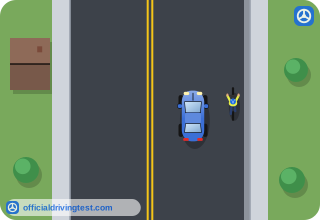
How much space must be kept between a car and a bicyclist sharing the roadway?
- One foot
- Three feet
- Six feet
- Whatever distance the driver judges comfortable at the time
Show answer
Correct answer: Three feet
Three feet of distance must be kept between your vehicle and a bicyclist.
Source: California Driver Handbook (2025), page 17 · Open this page in the manual (Manual page 17)
-
How close to a right turn may you drive inside a bike lane?
- Within 50 feet of the turn
- Within 100 feet of the turn
- Within 200 feet of the turn
- You may never use the bike lane for a turn
Show answer
Correct answer: Within 200 feet of the turn
You may drive in a bike lane within 200 feet of your right turn, after checking your blind spots for bicyclists.
Source: California Driver Handbook (2025), page 17 · Open this page in the manual (Manual page 17)
-
What is the rule for areas marked for public transit buses?
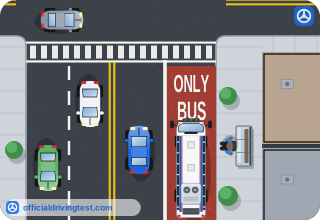
- You may use them outside rush hour.
- They may be used to make U-turns.
- You may drive in them at any hour, provided you are carrying at least one other passenger in the vehicle.
- Driving, stopping, parking or leaving a vehicle there is illegal, but you may cross one to turn right.
Show answer
Correct answer: Driving, stopping, parking or leaving a vehicle there is illegal, but you may cross one to turn right.
It is illegal to drive, stop, park or leave a vehicle in a lane designated for public transit buses, but you may cross a bus lane to make a right turn.
Source: California Driver Handbook (2025), page 18 · Open this page in the manual (Manual page 18)
-
May a bicyclist use the left turn lane to make a left turn?
- No, bicyclists must dismount and walk.
- Only on one-way streets.
- Yes, it is legal.
- Only where the street has no marked bicycle lane running alongside it.
Show answer
Correct answer: Yes, it is legal.
Bicyclists may legally use the left turn lane for their left turns.
Source: California Driver Handbook (2025), page 22 · Open this page in the manual (Manual page 22)
-
You see this orange-and-red triangle on the back of a vehicle ahead. What does it tell you?
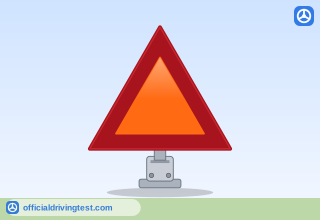
- The vehicle travels much more slowly than normal traffic
- The vehicle is carrying hazardous materials
- The vehicle is about to turn left at the next corner
- The vehicle is being towed
Show answer
Correct answer: The vehicle travels much more slowly than normal traffic
The orange and red triangle marks a slow-moving vehicle, such as a road maintenance vehicle, which usually travels at 25 mph or less.
Source: California Driver Handbook (2025), page 45 · Open this page in the manual (Manual page 45)
-
What is meant by the "No Zones" around a large truck?
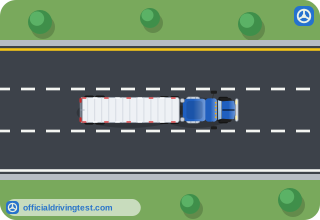
- Lanes where trucks are not permitted to drive
- Large blind spots where the driver cannot see you
- The space a truck needs in order to brake
- Areas of the road where trucks may not stop
Show answer
Correct answer: Large blind spots where the driver cannot see you
Large vehicle and truck drivers have a better view in front and bigger mirrors, but they also have large blind spots, called No Zones.
Source: California Driver Handbook (2025), page 42 · Open this page in the manual (Manual page 42)
-
You are driving behind a large truck and cannot see its side mirrors. What does this tell you?
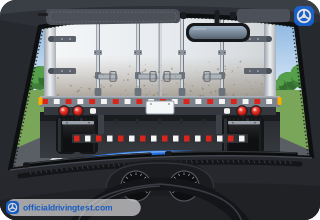
- The truck driver cannot see you either.
- The mirrors are folded in for the highway.
- You are at a safe following distance.
- The truck is about to change lanes.
Show answer
Correct answer: The truck driver cannot see you either.
The rule is simple: if the truck's side mirrors are not visible to you, the driver cannot see your vehicle.
Source: California Driver Handbook (2025), page 42 · Open this page in the manual (Manual page 42)
-
Why do large vehicles and commercial trucks keep extra space in front of them while traveling?
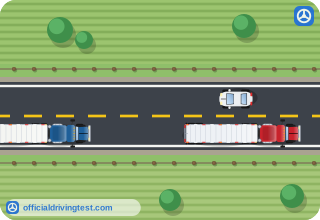
- To let other drivers merge in front of them
- To save fuel on long trips
- To have room in case they need to stop suddenly
- Because the law sets a minimum gap of five lengths
Show answer
Correct answer: To have room in case they need to stop suddenly
Large vehicles need more distance to stop, so they build in a cushion of space ahead for a sudden stop.
Source: California Driver Handbook (2025), page 42 · Open this page in the manual (Manual page 42)
-
About how far does an average passenger vehicle traveling at 55 mph need in order to stop?
- Within 100 feet
- Within 300 feet
- Within 500 feet
- Within 800 feet
Show answer
Correct answer: Within 300 feet
The handbook gives 300 feet as the stopping distance for an average passenger vehicle at 55 mph.
Source: California Driver Handbook (2025), page 42 · Open this page in the manual (Manual page 42)
-
A large vehicle traveling at 55 mph may need how much distance to stop?
- The same distance as a passenger vehicle
- Up to 200 feet
- Up to 400 feet
- Up to 1,000 feet
Show answer
Correct answer: Up to 400 feet
At the same 55 mph, a large vehicle can take up to 400 feet to stop, far more than a car.
Source: California Driver Handbook (2025), page 42 · Open this page in the manual (Manual page 42)
-
Which truck will take the longest distance to come to a safe stop?
- An empty truck at low speed
- An empty truck at high speed
- A loaded truck at low speed
- A loaded truck at high speed
Show answer
Correct answer: A loaded truck at high speed
Stopping distance grows with both weight and speed, so a loaded truck moving fast needs the most room.
Source: California Driver Handbook (2025), page 42 · Open this page in the manual (Manual page 42)
-
Why is it dangerous to move in front of a large vehicle and then slow down or stop?
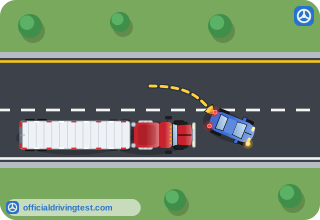
- It will not be able to stop fast enough to avoid hitting you.
- The large vehicle will be forced to use the shoulder.
- Your brake lights will be hidden by its height.
- It is only a problem on wet roads.
Show answer
Correct answer: It will not be able to stop fast enough to avoid hitting you.
Cutting in and slowing down steals the truck's stopping cushion, and it cannot brake quickly enough to avoid you.
Source: California Driver Handbook (2025), page 43 · Open this page in the manual (Manual page 43)
-
When a vehicle makes a turn, how do the rear wheels travel compared with the front wheels?
- They follow exactly the same path.
- They follow a shorter path.
- They follow a wider path.
- They lift slightly off the pavement.
Show answer
Correct answer: They follow a shorter path.
The rear wheels cut inside the path of the front wheels during a turn.
Source: California Driver Handbook (2025), page 43 · Open this page in the manual (Manual page 43)
-
Why must large vehicle and truck drivers often swing wide to complete a turn?
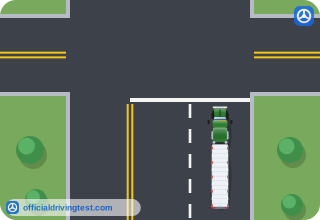
- Their mirrors block the view of the corner.
- Their steering is limited to gentle turns only.
- Their length widens the gap between the front and rear wheel paths.
- They are required by law to use two lanes at every corner.
Show answer
Correct answer: Their length widens the gap between the front and rear wheel paths.
Length increases the difference between the front and rear wheel paths, so long vehicles need a wide arc to get around a corner.
Source: California Driver Handbook (2025), page 43 · Open this page in the manual (Manual page 43)
-
You are following a large vehicle and want to pass it. What should you check first?
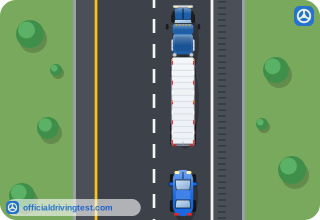
- Its turn signals, in case it swings wide
- Whether its trailer is loaded or empty
- The number of axles it has
- Whether its headlights are switched on
Show answer
Correct answer: Its turn signals, in case it swings wide
A long vehicle can look like it is turning one way while it is actually swinging wide to turn the other, so read its signals before passing.
Source: California Driver Handbook (2025), page 43 · Open this page in the manual (Manual page 43)
-
On a divided highway with four or more lanes in one direction, which lanes may large vehicles and trucks use?
- Any lane they choose
- The two far-right lanes
- The far-left lane only
- The two center lanes
Show answer
Correct answer: The two far-right lanes
Where there are four or more lanes in one direction, large vehicles and trucks may be driven in the two lanes farthest to the right.
Source: California Driver Handbook (2025), page 43 · Open this page in the manual (Manual page 43)
-
Your exit is coming up and a large truck is in the lane you need. What should you avoid doing?
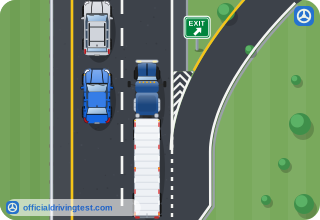
- Slowing down and taking your turn behind the truck
- Signaling your intention early
- Changing lanes directly in front of the truck
- Checking the truck's mirrors before you move
Show answer
Correct answer: Changing lanes directly in front of the truck
Cutting into the space directly ahead of a large vehicle to make an exit or turn removes the room it needs to stop.
Source: California Driver Handbook (2025), page 43 · Open this page in the manual (Manual page 43)
-
What is the correct way to pass a large vehicle?
- Pass on the left and then move ahead of it without lingering.
- Pass on the right, where the driver's mirrors are larger.
- Stay beside it for a while so the driver knows you are there.
- Match its speed in the next lane until your exit.
Show answer
Correct answer: Pass on the left and then move ahead of it without lingering.
Always pass a large vehicle on the left and move clear of it; riding alongside makes it hard for the driver to avoid road hazards.
Source: California Driver Handbook (2025), page 43 · Open this page in the manual (Manual page 43)
-
Drivers often misjudge large vehicles because those vehicles:
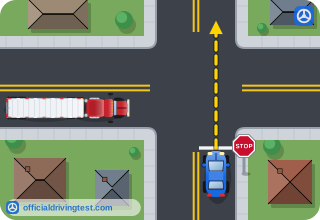
- appear to travel slower than they are
- always travel below the speed limit
- brake more quickly than cars
- are easier to see at night
Show answer
Correct answer: appear to travel slower than they are
Drivers often underestimate the size and speed of large vehicles, as they often appear to be traveling slower.
Source: California Driver Handbook (2025), page 43 · Open this page in the manual (Manual page 43)
-
What is a safety zone?
- A parking area at the curb reserved for buses and trolleys
- A space for pedestrians waiting for buses, streetcars, and trolleys
- The shoulder where disabled vehicles may stop
- A painted island that separates lanes of opposing traffic
Show answer
Correct answer: A space for pedestrians waiting for buses, streetcars, and trolleys
Safety zones are set aside on the road for pedestrians waiting to board buses, streetcars, and trolleys.
Source: California Driver Handbook (2025), page 43 · Open this page in the manual (Manual page 43)
-
When may you drive through a safety zone?
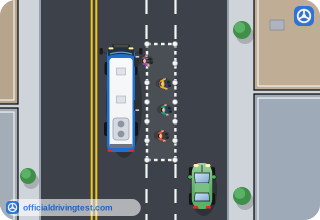
- When no pedestrians are waiting there
- When traffic in your lane has stopped
- Never, under any condition
- When you keep your speed under 10 mph
Show answer
Correct answer: Never, under any condition
Driving through a safety zone is prohibited under all circumstances.
Source: California Driver Handbook (2025), page 43 · Open this page in the manual (Manual page 43)
-
A bus is stopped at a safety zone. If you pass it, what is the maximum speed allowed?
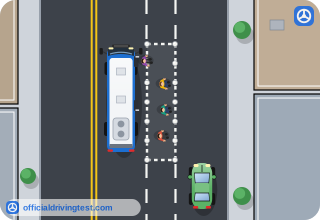
- 5 mph
- 10 mph
- 15 mph
- 25 mph
Show answer
Correct answer: 10 mph
When a bus, streetcar, or trolley is stopped at a safety zone or a traffic light, you may pass at no more than 10 mph.
Source: California Driver Handbook (2025), page 43 · Open this page in the manual (Manual page 43)
-
How can you recognize a safety zone on the roadway?
- By raised markers and dotted white lines
- By a solid yellow border painted around it
- By red curb paint along the edge
- By an overhead flashing yellow beacon
Show answer
Correct answer: By raised markers and dotted white lines
Safety zones are outlined with raised buttons or markers and dotted white lines on the pavement.
Source: California Driver Handbook (2025), page 43 · Open this page in the manual (Manual page 43)
-
Under California law, how do the rights and responsibilities of a motorcyclist compare to those of a car driver?
- They are the same
- Motorcyclists have fewer rights because their vehicle is smaller
- Motorcyclists must always yield to every car on the road
- Motorcyclists are exempt from most traffic laws
Show answer
Correct answer: They are the same
The handbook states plainly that motorcyclists have the same rights and responsibilities as other vehicle drivers.
Source: California Driver Handbook (2025), page 44 · Open this page in the manual (Manual page 44)
-
Why should you look carefully and use your mirrors before changing lanes or entering a road?
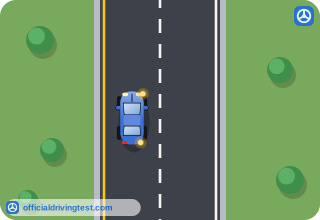
- Because motorcycles are small and disappear easily into blind spots
- Because mirrors are the only legal way to check traffic
- Because motorcycles are required to travel in your blind spot
- Because motorcycles always travel faster than the speed limit
Show answer
Correct answer: Because motorcycles are small and disappear easily into blind spots
A motorcycle's small size makes it hard to spot, so it can vanish in a vehicle's blind spot during a lane change.
Source: California Driver Handbook (2025), page 44 · Open this page in the manual (Manual page 44)
-
How much of the lane should you leave to a motorcyclist whenever it is possible?
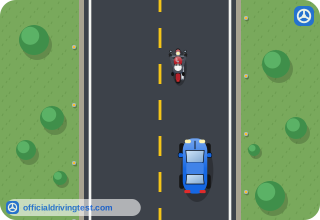
- Only the right half of the lane
- Nothing, since motorcycles must use the shoulder
- Just enough room for the handlebars
- The full lane
Show answer
Correct answer: The full lane
Whenever possible, give a motorcycle the entire width of the lane so the rider can maneuver safely.
Source: California Driver Handbook (2025), page 44 · Open this page in the manual (Manual page 44)
-
In California, what is the legal status of lane splitting (a motorcycle sharing a lane with other vehicles)?
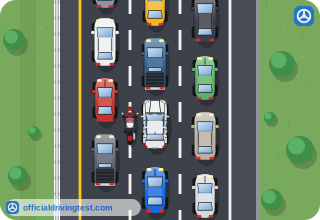
- It is illegal everywhere in the state
- It is legal only on freeways after dark
- It is legal to share lanes with motorcycles
- It is legal only when traffic is completely stopped
Show answer
Correct answer: It is legal to share lanes with motorcycles
California allows motorcycles to share a lane with other vehicles; this practice is called lane splitting.
Source: California Driver Handbook (2025), page 44 · Open this page in the manual (Manual page 44)
-
A motorcycle is travelling ahead of you in your lane and there is room beside it. What should you do?
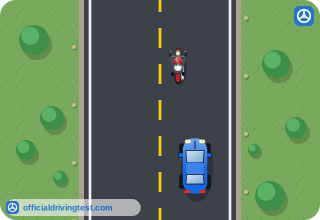
- Squeeze past it on the left inside the same lane
- Sound your horn and move up beside it
- Never pass it within the same lane
- Pass it in the lane only if you stay under 25 mph
Show answer
Correct answer: Never pass it within the same lane
Drivers are told never to try to pass a motorcycle inside the lane they are sharing with it.
Source: California Driver Handbook (2025), page 44 · Open this page in the manual (Manual page 44)
-
You are parked at the curb and about to get out of your car on the traffic side. What does the handbook tell you to do first?
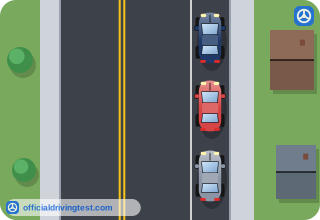
- Open the door slowly so traffic can see it
- Check for motorcyclists before opening the door
- Turn on the hazard lights and step out
- Wait for a passenger to open it for you
Show answer
Correct answer: Check for motorcyclists before opening the door
A door opened into traffic can strike a passing rider, so look for motorcyclists before you open it.
Source: California Driver Handbook (2025), page 44 · Open this page in the manual (Manual page 44)
-
When a motorcyclist wants to pass you and conditions allow, what is a helpful thing to do?
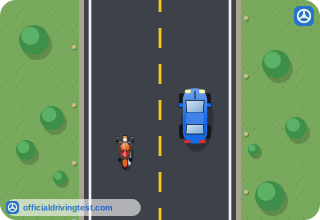
- Brake hard so the rider goes by quickly
- Move toward one side of your lane to give the rider more room
- Speed up until the rider gives up
- Drive onto the shoulder and stop
Show answer
Correct answer: Move toward one side of your lane to give the rider more room
Shifting to one side of your lane, when it is safe, widens the gap a motorcyclist needs to pass.
Source: California Driver Handbook (2025), page 44 · Open this page in the manual (Manual page 44)
-
Why can a motorcyclist suddenly change speed or direction?
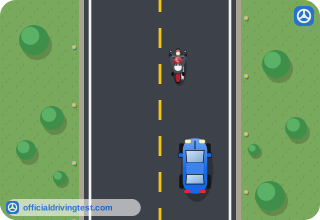
- Because of road conditions
- Because motorcycles have no brakes at low speed
- Because riders are not required to signal
- Because motorcycles cannot legally travel in a straight line
Show answer
Correct answer: Because of road conditions
The handbook states that road conditions can cause motorcyclists to suddenly change speed or direction.
Source: California Driver Handbook (2025), page 44 · Open this page in the manual (Manual page 44)
-
An orange and red triangle on the back of a vehicle ahead tells you that the vehicle usually travels at what speed?
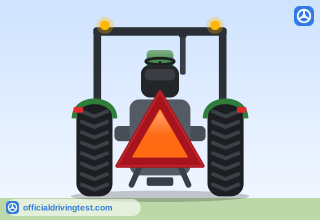
- 45 mph or less
- 35 mph or less
- 25 mph or less
- Exactly the posted speed limit
Show answer
Correct answer: 25 mph or less
The orange and red triangle marks a slow-moving vehicle, such as road maintenance equipment, that normally travels 25 mph or slower.
Source: California Driver Handbook (2025), page 45 · Open this page in the manual (Manual page 45)
-
What is the maximum speed a neighborhood electric vehicle (NEV) or low-speed vehicle (LSV) can reach?
- 15 mph
- 25 mph
- 35 mph
- 45 mph
Show answer
Correct answer: 25 mph
NEVs and LSVs reach a maximum speed of 25 mph, so adjust your speed to share the road with them.
Source: California Driver Handbook (2025), page 46 · Open this page in the manual (Manual page 46)
-
NEVs and low-speed vehicles are not allowed on roads where the speed limit is above:
- 25 mph
- 30 mph
- 35 mph
- 55 mph
Show answer
Correct answer: 35 mph
These vehicles are restricted from any roadway posted higher than 35 mph. Signs such as NEV ROUTE warn you where they travel.
Source: California Driver Handbook (2025), page 46 · Open this page in the manual (Manual page 46)
-
Which statement about horse-drawn vehicles and riders on horseback is correct?
- They must always travel on the sidewalk
- They may use the road only between sunrise and sunset
- They are banned from all paved public roads
- They may share the road; scaring horses on purpose is illegal
Show answer
Correct answer: They may share the road; scaring horses on purpose is illegal
Animal-drawn vehicles and riders are legal road users, and intentionally scaring horses or livestock is illegal.
Source: California Driver Handbook (2025), page 46 · Open this page in the manual (Manual page 46)
-
Bicyclists on California roads have:
- Rights only, with no legal duties
- The same rights and responsibilities as other drivers
- The same status as pedestrians at all times
- Rights only on streets with painted bike lanes
Show answer
Correct answer: The same rights and responsibilities as other drivers
A bicyclist is treated as a road user with the same rights and duties as any other driver.
Source: California Driver Handbook (2025), page 46 · Open this page in the manual (Manual page 46)
-
Can a bicyclist ever legally ride on a freeway in California?
- Never, under any circumstances
- Yes, where there is no alternate route and it is not banned
- Yes, on any freeway, but only in the far-left lane
- Yes, but only with a special permit issued by DMV
Show answer
Correct answer: Yes, where there is no alternate route and it is not banned
Some freeway segments are open to bicycles where no alternate route exists and no law forbids it.
Source: California Driver Handbook (2025), page 46 · Open this page in the manual (Manual page 46)
-
On a one-way street, where may a bicyclist choose to ride?
- Only in the exact center of the road
- Near the left curb or left edge of the road
- Only on the sidewalk
- Facing oncoming vehicles
Show answer
Correct answer: Near the left curb or left edge of the road
Because all traffic flows one way, a bicyclist may legally ride near the left curb or edge.
Source: California Driver Handbook (2025), page 46 · Open this page in the manual (Manual page 46)
-
Which bicyclists are required to wear a helmet in California?
- Only riders using a freeway shoulder
- Riders under 18 years old
- Riders over 65 years old
- Nobody; helmets are only recommended
Show answer
Correct answer: Riders under 18 years old
State law requires a helmet for any bicyclist under the age of 18.
Source: California Driver Handbook (2025), page 47 · Open this page in the manual (Manual page 47)
-
In which direction must a bicyclist ride on the roadway?
- Facing oncoming traffic, like a pedestrian
- Whichever direction has less traffic
- The same direction as traffic
- Any direction while inside a bike lane
Show answer
Correct answer: The same direction as traffic
Bicyclists ride with the flow of traffic, not against it.
Source: California Driver Handbook (2025), page 47 · Open this page in the manual (Manual page 47)
-
May a bicyclist ride on the sidewalk?
- Yes, sidewalks are always open to bicycles
- Only if the rider is over 18
- Yes, but only after dark
- No, unless the city allows it
Show answer
Correct answer: No, unless the city allows it
Sidewalk riding is prohibited unless the local city permits it, so rules vary by city.
Source: California Driver Handbook (2025), page 47 · Open this page in the manual (Manual page 47)
-
Where should a bicyclist ride when a usable bike lane is available?
- In the bike lane whenever possible, or a through traffic lane
- On the painted shoulder line only
- In the left-turn lane
- Anywhere, because bike lanes are optional in every case
Show answer
Correct answer: In the bike lane whenever possible, or a through traffic lane
Bicyclists should use a bike lane whenever they can, and otherwise ride in a regular through lane.
Source: California Driver Handbook (2025), page 47 · Open this page in the manual (Manual page 47)
-
When riding after dark, a bicycle must have a front lamp showing a white light visible from at least:
- 100 feet
- 200 feet
- 300 feet
- 500 feet
Show answer
Correct answer: 300 feet
The required front lamp must throw a white light that can be seen from 300 feet away.
Source: California Driver Handbook (2025), page 47 · Open this page in the manual (Manual page 47)
-
At night, a bicycle's rear equipment (a built-in red reflector, a solid red light, or a flashing red light) must be visible from:
- 200 feet
- 300 feet
- 400 feet
- 500 feet
Show answer
Correct answer: 500 feet
Rear red reflectors or lights must be visible from 500 feet so drivers behind can see the rider in time.
Source: California Driver Handbook (2025), page 47 · Open this page in the manual (Manual page 47)
-
A white or yellow reflector on each pedal, or on the rider's shoes or ankles, must be visible from at least:
- 200 feet
- 50 feet
- 300 feet
- 500 feet
Show answer
Correct answer: 200 feet
Pedal, shoe, or ankle reflectors must be visible from 200 feet; their movement helps drivers recognize a cyclist.
Source: California Driver Handbook (2025), page 47 · Open this page in the manual (Manual page 47)
-
A bicyclist who is moving more slowly than the flow of traffic must generally ride:
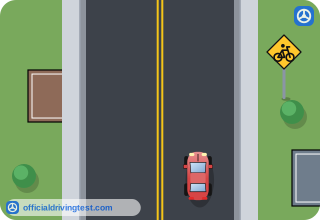
- In the middle of the lane, to be more visible
- As close as possible to the right curb or edge
- On the left side of the lane
- Wherever there is the most shade
Show answer
Correct answer: As close as possible to the right curb or edge
Slower bicyclists keep to the right curb or edge, with a short list of legal exceptions.
Source: California Driver Handbook (2025), page 47 · Open this page in the manual (Manual page 47)
-
Which of these is a legal reason for a bicyclist to leave the right edge of the road and take more of the lane?
- The rider wants to go faster
- The lane is too narrow to share side by side
- The rider is not wearing a helmet
- Traffic behind the rider is moving slowly
Show answer
Correct answer: The lane is too narrow to share side by side
A lane too narrow to share side by side is one of the listed exceptions, along with passing, avoiding a hazard, and preparing to turn.
Source: California Driver Handbook (2025), page 48 · Open this page in the manual (Manual page 48)
-
To safely pass a bicyclist who is riding in the travel lane, what may you need to do?
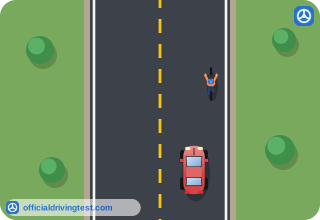
- Flash your headlights and drive through the gap
- Stay in the lane and hug the bicycle to save time
- Pass on the right shoulder
- Change lanes, pass safely, then return to your lane
Show answer
Correct answer: Change lanes, pass safely, then return to your lane
You may need to change to another lane, pass safely, then return to your original lane, leaving space between your vehicle and the bicyclist.
Source: California Driver Handbook (2025), page 48 · Open this page in the manual (Manual page 48)
-
If you cannot change lanes to pass a bicyclist, how much space must you leave between your vehicle and the rider?
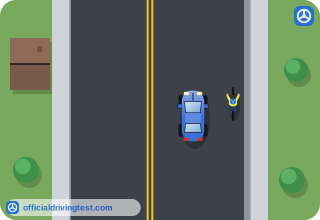
- At least one foot
- At least two feet
- At least three feet
- At least ten feet
Show answer
Correct answer: At least three feet
A minimum of three feet of clearance is required when you pass a bicyclist without changing lanes.
Source: California Driver Handbook (2025), page 48 · Open this page in the manual (Manual page 48)
-
The road is too tight to give a bicyclist three feet of clearance and you cannot change lanes. What does the handbook require?
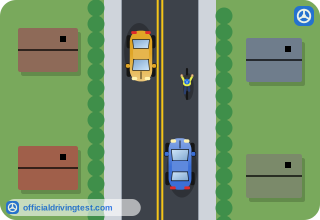
- Pass anyway at a slow, careful speed
- Do not pass until you can give three feet
- Pass using the shoulder
- Signal the rider to stop and wait
Show answer
Correct answer: Do not pass until you can give three feet
If three feet is not available, you must wait to pass rather than squeeze by the bicyclist.
Source: California Driver Handbook (2025), page 48 · Open this page in the manual (Manual page 48)
-
You are preparing to make a right turn across a bike lane. How far before the turn may you enter that bike lane?
- No more than 200 feet before the turn
- At least 500 feet before the turn
- Anywhere along the block
- Only within 50 feet of the corner
Show answer
Correct answer: No more than 200 feet before the turn
Drivers may enter a bike lane no more than 200 feet before beginning the turn, and only when it is safe.
Source: California Driver Handbook (2025), page 48 · Open this page in the manual (Manual page 48)
-
A bicyclist is riding beside you and you want to turn right at the next corner. What is the correct move?
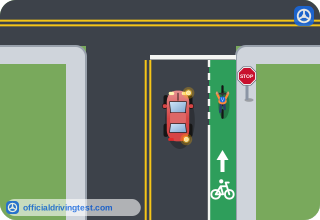
- Speed up and turn in front of the bicyclist
- Merge safely behind the bicyclist before turning
- Turn wide from the left lane
- Stop in the intersection and wave the rider around
Show answer
Correct answer: Merge safely behind the bicyclist before turning
Merging in behind the bicyclist before you turn avoids cutting the rider off at the corner.
Source: California Driver Handbook (2025), page 48 · Open this page in the manual (Manual page 48)
-
When you pass a bicyclist on a street lined with parked cars, why does extra space matter so much?
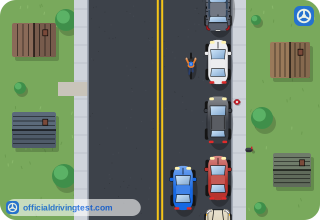
- So the rider is not forced into parked cars or open doors
- So the rider can reach the sidewalk faster
- Because parked cars block the bike lane by law
- Because bicycles must stay two feet from the curb
Show answer
Correct answer: So the rider is not forced into parked cars or open doors
Crowding a rider toward parked cars exposes them to doors that suddenly swing open.
Source: California Driver Handbook (2025), page 48 · Open this page in the manual (Manual page 48)
-
Which lane must you use when towing a trailer or driving a truck with three or more axles?
- The far-left lane
- Any lane, as long as you keep up with traffic
- The far-right lane or one marked for slower vehicles
- The carpool lane
Show answer
Correct answer: The far-right lane or one marked for slower vehicles
Vehicles towing, and trucks with three or more axles, are limited to the far-right lane or a marked slow-vehicle lane.
Source: California Driver Handbook (2025), page 50 · Open this page in the manual (Manual page 50)
-
You are towing a trailer on a road with four lanes in your direction and no lanes marked for slow vehicles. Which lanes may you use?
- Only the two right-hand lanes
- Any of the four lanes
- The two middle lanes
- Only the single right-hand lane
Show answer
Correct answer: Only the two right-hand lanes
With four or more lanes in your direction and no marked slow lane, you are limited to the two right-most lanes.
Source: California Driver Handbook (2025), page 50 · Open this page in the manual (Manual page 50)
-
A school bus ahead begins flashing yellow lights. What does this mean?
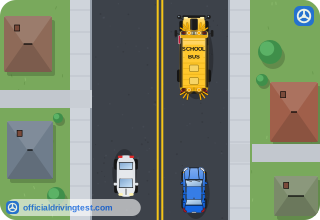
- The bus is about to turn left
- The bus has mechanical trouble
- The bus is empty and you may pass freely
- The bus is preparing to stop, so slow down
Show answer
Correct answer: The bus is preparing to stop, so slow down
Flashing yellow lights are the warning that the bus is about to stop to let children off.
Source: California Driver Handbook (2025), page 50 · Open this page in the manual (Manual page 50)
-
A school bus on an undivided two-way street is flashing its red lights. What must you do?
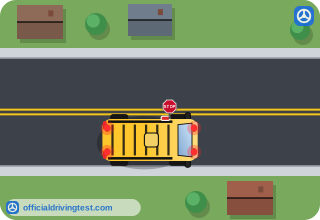
- Stop only if you are behind the bus
- Slow to 15 mph and keep moving
- Stop from either direction and wait
- Pass slowly on the left
Show answer
Correct answer: Stop from either direction and wait
Flashing red lights require traffic in both directions to stop until the children are safely across and the lights stop.
Source: California Driver Handbook (2025), page 51 · Open this page in the manual (Manual page 51)
-
What can happen if you fail to stop for a school bus that is flashing red lights?
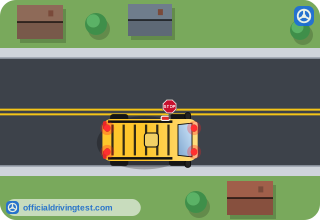
- A written warning only
- A fine of up to $1,000 and suspension of your driving privilege for one year
- A $50 fine
- Nothing, if no child was hurt
Show answer
Correct answer: A fine of up to $1,000 and suspension of your driving privilege for one year
The penalty can reach a $1,000 fine plus a one-year suspension of your driving privilege.
Source: California Driver Handbook (2025), page 51 · Open this page in the manual (Manual page 51)
-
You are on a divided highway with two lanes in each direction. A school bus on the opposite side flashes red lights. What must you do?
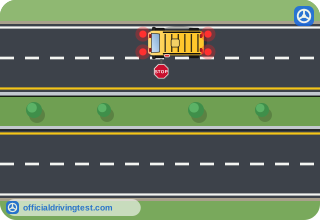
- Pull onto the shoulder and wait
- Stop until the lights stop flashing
- Stop and then proceed at 15 mph
- You are not required to stop
Show answer
Correct answer: You are not required to stop
When the bus is on the other side of a divided or multilane highway with two or more lanes each way, you do not have to stop.
Source: California Driver Handbook (2025), page 51 · Open this page in the manual (Manual page 51)
-
When following a motorcyclist, when should you create more space in front of your vehicle?
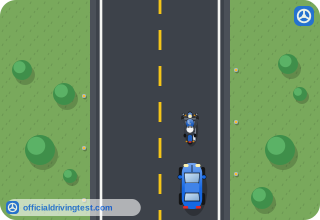
- On metal surfaces (bridge gratings, railroad tracks) and gravel
- Only when the motorcyclist is signaling a turn or lane change
- Never, since a motorcycle needs less following distance than a car
- Only on freeways where the speed limit is 65 mph or higher
Show answer
Correct answer: On metal surfaces (bridge gratings, railroad tracks) and gravel
The handbook says to create more space in front of your vehicle when following motorcyclists on metal surfaces (bridge gratings, railroad tracks, etc.) and gravel.
Source: California Driver Handbook (2025), page 57 · Open this page in the manual (Manual page 57)
-
To keep enough room to maneuver at your sides, you should:
- Stay level with the vehicle beside you so the driver can see you
- Drive close to parked cars to stay clear of moving traffic
- Avoid driving directly alongside other vehicles or in their blind spots
- Keep your vehicle centered between two lanes on wide roads
Show answer
Correct answer: Avoid driving directly alongside other vehicles or in their blind spots
Driving alongside another vehicle or sitting in its blind spot leaves you nowhere to go if that driver moves over.
Source: California Driver Handbook (2025), page 58 · Open this page in the manual (Manual page 58)
-
On a two-lane road you have an oncoming vehicle to your left and a bicyclist ahead on your right. What is the best action?
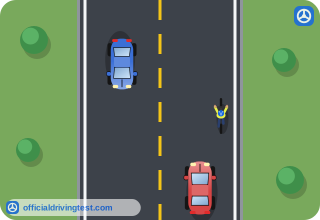
- Keep your speed and drive between the oncoming vehicle and the bicyclist
- Slow down, let the oncoming vehicle pass, then give the bicyclist at least three feet
- Sound your horn so the bicyclist moves onto the shoulder, then pass
- Stop completely in your lane until the vehicle and the bicyclist are gone
Show answer
Correct answer: Slow down, let the oncoming vehicle pass, then give the bicyclist at least three feet
Take one hazard at a time: give way to the greater danger first, then pass the bicyclist with at least three feet of space.
Source: California Driver Handbook (2025), page 68 · Open this page in the manual (Manual page 68)