California: Sharing the road — Part 3 Practice Test
Questions in this part include: “What is the maximum speed a neighborhood electric vehicle (NEV) or low-speed vehicle (LSV) can reach?” · “Which bicyclists are required to wear a helmet in California?”
Independent educational site · not affiliated with any government agency or DMV
Ready? Test yourself
- Instant feedback with an explanation
- Every answer cites its source in the manual
- Your best score is saved on this device
Questions are original and based on the official manual "California Driver Handbook" (2025), California DMV.
All 18 questions in this practice test
Take the test above first, then use this list to study. Tap “Show answer” to see the correct answer and explanation.
Show the questions and answersHide the questions
-
A motorcycle is travelling ahead of you in your lane and there is room beside it. What should you do?
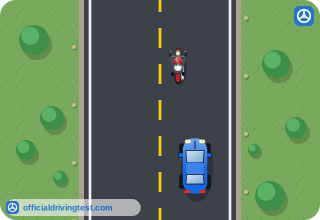
- Squeeze past it on the left inside the same lane
- Sound your horn and move up beside it
- Never pass it within the same lane
- Pass it in the lane only if you stay under 25 mph
Show answer
Correct answer: Never pass it within the same lane
Drivers are told never to try to pass a motorcycle inside the lane they are sharing with it.
Source: California Driver Handbook (2025), page 44 · Open this page in the manual (Manual page 44)
-
You are parked at the curb and about to get out of your car on the traffic side. What does the handbook tell you to do first?
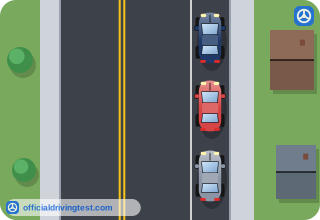
- Open the door slowly so traffic can see it
- Check for motorcyclists before opening the door
- Turn on the hazard lights and step out
- Wait for a passenger to open it for you
Show answer
Correct answer: Check for motorcyclists before opening the door
A door opened into traffic can strike a passing rider, so look for motorcyclists before you open it.
Source: California Driver Handbook (2025), page 44 · Open this page in the manual (Manual page 44)
-
When a motorcyclist wants to pass you and conditions allow, what is a helpful thing to do?
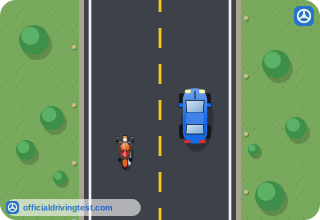
- Brake hard so the rider goes by quickly
- Move toward one side of your lane to give the rider more room
- Speed up until the rider gives up
- Drive onto the shoulder and stop
Show answer
Correct answer: Move toward one side of your lane to give the rider more room
Shifting to one side of your lane, when it is safe, widens the gap a motorcyclist needs to pass.
Source: California Driver Handbook (2025), page 44 · Open this page in the manual (Manual page 44)
-
Why can a motorcyclist suddenly change speed or direction?
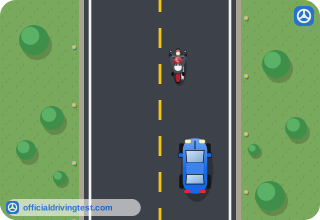
- Because of road conditions
- Because motorcycles have no brakes at low speed
- Because riders are not required to signal
- Because motorcycles cannot legally travel in a straight line
Show answer
Correct answer: Because of road conditions
The handbook states that road conditions can cause motorcyclists to suddenly change speed or direction.
Source: California Driver Handbook (2025), page 44 · Open this page in the manual (Manual page 44)
-
An orange and red triangle on the back of a vehicle ahead tells you that the vehicle usually travels at what speed?
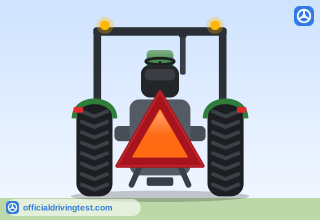
- 45 mph or less
- 35 mph or less
- 25 mph or less
- Exactly the posted speed limit
Show answer
Correct answer: 25 mph or less
The orange and red triangle marks a slow-moving vehicle, such as road maintenance equipment, that normally travels 25 mph or slower.
Source: California Driver Handbook (2025), page 45 · Open this page in the manual (Manual page 45)
-
What is the maximum speed a neighborhood electric vehicle (NEV) or low-speed vehicle (LSV) can reach?
- 15 mph
- 25 mph
- 35 mph
- 45 mph
Show answer
Correct answer: 25 mph
NEVs and LSVs reach a maximum speed of 25 mph, so adjust your speed to share the road with them.
Source: California Driver Handbook (2025), page 46 · Open this page in the manual (Manual page 46)
-
NEVs and low-speed vehicles are not allowed on roads where the speed limit is above:
- 25 mph
- 30 mph
- 35 mph
- 55 mph
Show answer
Correct answer: 35 mph
These vehicles are restricted from any roadway posted higher than 35 mph. Signs such as NEV ROUTE warn you where they travel.
Source: California Driver Handbook (2025), page 46 · Open this page in the manual (Manual page 46)
-
Which statement about horse-drawn vehicles and riders on horseback is correct?
- They must always travel on the sidewalk
- They may use the road only between sunrise and sunset
- They are banned from all paved public roads
- They may share the road; scaring horses on purpose is illegal
Show answer
Correct answer: They may share the road; scaring horses on purpose is illegal
Animal-drawn vehicles and riders are legal road users, and intentionally scaring horses or livestock is illegal.
Source: California Driver Handbook (2025), page 46 · Open this page in the manual (Manual page 46)
-
Bicyclists on California roads have:
- Rights only, with no legal duties
- The same rights and responsibilities as other drivers
- The same status as pedestrians at all times
- Rights only on streets with painted bike lanes
Show answer
Correct answer: The same rights and responsibilities as other drivers
A bicyclist is treated as a road user with the same rights and duties as any other driver.
Source: California Driver Handbook (2025), page 46 · Open this page in the manual (Manual page 46)
-
Can a bicyclist ever legally ride on a freeway in California?
- Never, under any circumstances
- Yes, where there is no alternate route and it is not banned
- Yes, on any freeway, but only in the far-left lane
- Yes, but only with a special permit issued by DMV
Show answer
Correct answer: Yes, where there is no alternate route and it is not banned
Some freeway segments are open to bicycles where no alternate route exists and no law forbids it.
Source: California Driver Handbook (2025), page 46 · Open this page in the manual (Manual page 46)
-
On a one-way street, where may a bicyclist choose to ride?
- Only in the exact center of the road
- Near the left curb or left edge of the road
- Only on the sidewalk
- Facing oncoming vehicles
Show answer
Correct answer: Near the left curb or left edge of the road
Because all traffic flows one way, a bicyclist may legally ride near the left curb or edge.
Source: California Driver Handbook (2025), page 46 · Open this page in the manual (Manual page 46)
-
Which bicyclists are required to wear a helmet in California?
- Only riders using a freeway shoulder
- Riders under 18 years old
- Riders over 65 years old
- Nobody; helmets are only recommended
Show answer
Correct answer: Riders under 18 years old
State law requires a helmet for any bicyclist under the age of 18.
Source: California Driver Handbook (2025), page 47 · Open this page in the manual (Manual page 47)
-
In which direction must a bicyclist ride on the roadway?
- Facing oncoming traffic, like a pedestrian
- Whichever direction has less traffic
- The same direction as traffic
- Any direction while inside a bike lane
Show answer
Correct answer: The same direction as traffic
Bicyclists ride with the flow of traffic, not against it.
Source: California Driver Handbook (2025), page 47 · Open this page in the manual (Manual page 47)
-
May a bicyclist ride on the sidewalk?
- Yes, sidewalks are always open to bicycles
- Only if the rider is over 18
- Yes, but only after dark
- No, unless the city allows it
Show answer
Correct answer: No, unless the city allows it
Sidewalk riding is prohibited unless the local city permits it, so rules vary by city.
Source: California Driver Handbook (2025), page 47 · Open this page in the manual (Manual page 47)
-
Where should a bicyclist ride when a usable bike lane is available?
- In the bike lane whenever possible, or a through traffic lane
- On the painted shoulder line only
- In the left-turn lane
- Anywhere, because bike lanes are optional in every case
Show answer
Correct answer: In the bike lane whenever possible, or a through traffic lane
Bicyclists should use a bike lane whenever they can, and otherwise ride in a regular through lane.
Source: California Driver Handbook (2025), page 47 · Open this page in the manual (Manual page 47)
-
When riding after dark, a bicycle must have a front lamp showing a white light visible from at least:
- 100 feet
- 200 feet
- 300 feet
- 500 feet
Show answer
Correct answer: 300 feet
The required front lamp must throw a white light that can be seen from 300 feet away.
Source: California Driver Handbook (2025), page 47 · Open this page in the manual (Manual page 47)
-
At night, a bicycle's rear equipment (a built-in red reflector, a solid red light, or a flashing red light) must be visible from:
- 200 feet
- 300 feet
- 400 feet
- 500 feet
Show answer
Correct answer: 500 feet
Rear red reflectors or lights must be visible from 500 feet so drivers behind can see the rider in time.
Source: California Driver Handbook (2025), page 47 · Open this page in the manual (Manual page 47)
-
A white or yellow reflector on each pedal, or on the rider's shoes or ankles, must be visible from at least:
- 200 feet
- 50 feet
- 300 feet
- 500 feet
Show answer
Correct answer: 200 feet
Pedal, shoe, or ankle reflectors must be visible from 200 feet; their movement helps drivers recognize a cyclist.
Source: California Driver Handbook (2025), page 47 · Open this page in the manual (Manual page 47)