California: Sharing the road — Part 4 Practice Test
Questions in this part include: “Which of these is a legal reason for a bicyclist to leave the right edge of the road and take more of the lane?” · “You are preparing to make a right turn across a bike lane. How far before the turn may you enter that bike lane?”
Independent educational site · not affiliated with any government agency or DMV
Ready? Test yourself
- Instant feedback with an explanation
- Every answer cites its source in the manual
- Your best score is saved on this device
Questions are original and based on the official manual "California Driver Handbook" (2025), California DMV.
All 17 questions in this practice test
Take the test above first, then use this list to study. Tap “Show answer” to see the correct answer and explanation.
Show the questions and answersHide the questions
-
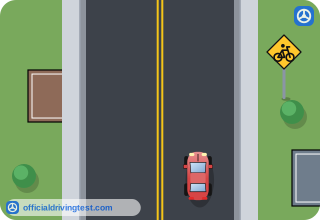
A bicyclist who is moving more slowly than the flow of traffic must generally ride:
- In the middle of the lane, to be more visible
- As close as possible to the right curb or edge
- On the left side of the lane
- Wherever there is the most shade
Show answer
Correct answer: As close as possible to the right curb or edge
Slower bicyclists keep to the right curb or edge, with a short list of legal exceptions.
Source: California Driver Handbook (2025), page 47 · Open this page in the manual (Manual page 47)
-
Which of these is a legal reason for a bicyclist to leave the right edge of the road and take more of the lane?
- The rider wants to go faster
- The lane is too narrow to share side by side
- The rider is not wearing a helmet
- Traffic behind the rider is moving slowly
Show answer
Correct answer: The lane is too narrow to share side by side
A lane too narrow to share side by side is one of the listed exceptions, along with passing, avoiding a hazard, and preparing to turn.
Source: California Driver Handbook (2025), page 48 · Open this page in the manual (Manual page 48)
-
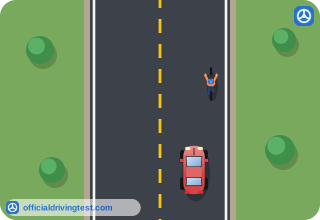
To safely pass a bicyclist who is riding in the travel lane, what may you need to do?
- Flash your headlights and drive through the gap
- Stay in the lane and hug the bicycle to save time
- Pass on the right shoulder
- Change lanes, pass safely, then return to your lane
Show answer
Correct answer: Change lanes, pass safely, then return to your lane
You may need to change to another lane, pass safely, then return to your original lane, leaving space between your vehicle and the bicyclist.
Source: California Driver Handbook (2025), page 48 · Open this page in the manual (Manual page 48)
-
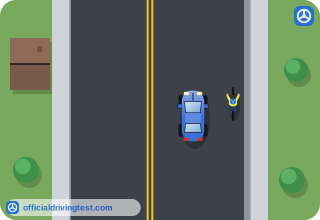
If you cannot change lanes to pass a bicyclist, how much space must you leave between your vehicle and the rider?
- At least one foot
- At least two feet
- At least three feet
- At least ten feet
Show answer
Correct answer: At least three feet
A minimum of three feet of clearance is required when you pass a bicyclist without changing lanes.
Source: California Driver Handbook (2025), page 48 · Open this page in the manual (Manual page 48)
-
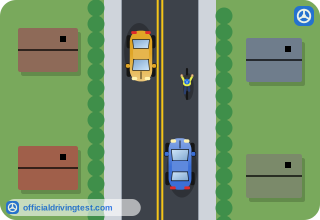
The road is too tight to give a bicyclist three feet of clearance and you cannot change lanes. What does the handbook require?
- Pass anyway at a slow, careful speed
- Do not pass until you can give three feet
- Pass using the shoulder
- Signal the rider to stop and wait
Show answer
Correct answer: Do not pass until you can give three feet
If three feet is not available, you must wait to pass rather than squeeze by the bicyclist.
Source: California Driver Handbook (2025), page 48 · Open this page in the manual (Manual page 48)
-
You are preparing to make a right turn across a bike lane. How far before the turn may you enter that bike lane?
- No more than 200 feet before the turn
- At least 500 feet before the turn
- Anywhere along the block
- Only within 50 feet of the corner
Show answer
Correct answer: No more than 200 feet before the turn
Drivers may enter a bike lane no more than 200 feet before beginning the turn, and only when it is safe.
Source: California Driver Handbook (2025), page 48 · Open this page in the manual (Manual page 48)
-
A bicyclist is riding beside you and you want to turn right at the next corner. What is the correct move?
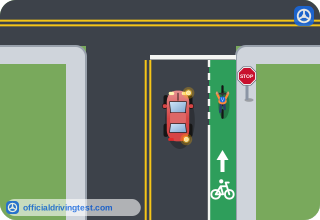
- Speed up and turn in front of the bicyclist
- Merge safely behind the bicyclist before turning
- Turn wide from the left lane
- Stop in the intersection and wave the rider around
Show answer
Correct answer: Merge safely behind the bicyclist before turning
Merging in behind the bicyclist before you turn avoids cutting the rider off at the corner.
Source: California Driver Handbook (2025), page 48 · Open this page in the manual (Manual page 48)
-
When you pass a bicyclist on a street lined with parked cars, why does extra space matter so much?
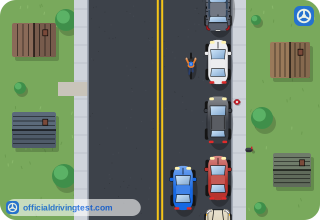
- So the rider is not forced into parked cars or open doors
- So the rider can reach the sidewalk faster
- Because parked cars block the bike lane by law
- Because bicycles must stay two feet from the curb
Show answer
Correct answer: So the rider is not forced into parked cars or open doors
Crowding a rider toward parked cars exposes them to doors that suddenly swing open.
Source: California Driver Handbook (2025), page 48 · Open this page in the manual (Manual page 48)
-
Which lane must you use when towing a trailer or driving a truck with three or more axles?
- The far-left lane
- Any lane, as long as you keep up with traffic
- The far-right lane or one marked for slower vehicles
- The carpool lane
Show answer
Correct answer: The far-right lane or one marked for slower vehicles
Vehicles towing, and trucks with three or more axles, are limited to the far-right lane or a marked slow-vehicle lane.
Source: California Driver Handbook (2025), page 50 · Open this page in the manual (Manual page 50)
-
You are towing a trailer on a road with four lanes in your direction and no lanes marked for slow vehicles. Which lanes may you use?
- Only the two right-hand lanes
- Any of the four lanes
- The two middle lanes
- Only the single right-hand lane
Show answer
Correct answer: Only the two right-hand lanes
With four or more lanes in your direction and no marked slow lane, you are limited to the two right-most lanes.
Source: California Driver Handbook (2025), page 50 · Open this page in the manual (Manual page 50)
-
A school bus ahead begins flashing yellow lights. What does this mean?
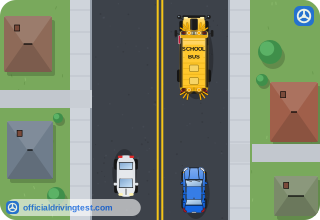
- The bus is about to turn left
- The bus has mechanical trouble
- The bus is empty and you may pass freely
- The bus is preparing to stop, so slow down
Show answer
Correct answer: The bus is preparing to stop, so slow down
Flashing yellow lights are the warning that the bus is about to stop to let children off.
Source: California Driver Handbook (2025), page 50 · Open this page in the manual (Manual page 50)
-
A school bus on an undivided two-way street is flashing its red lights. What must you do?
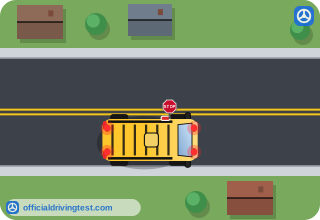
- Stop only if you are behind the bus
- Slow to 15 mph and keep moving
- Stop from either direction and wait
- Pass slowly on the left
Show answer
Correct answer: Stop from either direction and wait
Flashing red lights require traffic in both directions to stop until the children are safely across and the lights stop.
Source: California Driver Handbook (2025), page 51 · Open this page in the manual (Manual page 51)
-
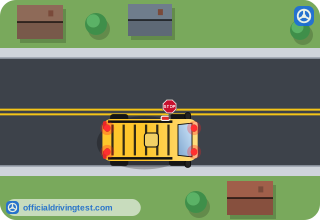
What can happen if you fail to stop for a school bus that is flashing red lights?
- A written warning only
- A fine of up to $1,000 and suspension of your driving privilege for one year
- A $50 fine
- Nothing, if no child was hurt
Show answer
Correct answer: A fine of up to $1,000 and suspension of your driving privilege for one year
The penalty can reach a $1,000 fine plus a one-year suspension of your driving privilege.
Source: California Driver Handbook (2025), page 51 · Open this page in the manual (Manual page 51)
-
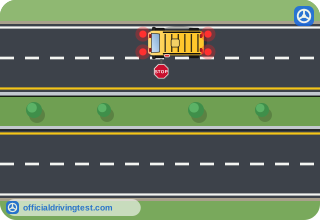
You are on a divided highway with two lanes in each direction. A school bus on the opposite side flashes red lights. What must you do?
- Pull onto the shoulder and wait
- Stop until the lights stop flashing
- Stop and then proceed at 15 mph
- You are not required to stop
Show answer
Correct answer: You are not required to stop
When the bus is on the other side of a divided or multilane highway with two or more lanes each way, you do not have to stop.
Source: California Driver Handbook (2025), page 51 · Open this page in the manual (Manual page 51)
-
When following a motorcyclist, when should you create more space in front of your vehicle?
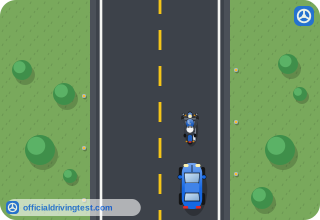
- On metal surfaces (bridge gratings, railroad tracks) and gravel
- Only when the motorcyclist is signaling a turn or lane change
- Never, since a motorcycle needs less following distance than a car
- Only on freeways where the speed limit is 65 mph or higher
Show answer
Correct answer: On metal surfaces (bridge gratings, railroad tracks) and gravel
The handbook says to create more space in front of your vehicle when following motorcyclists on metal surfaces (bridge gratings, railroad tracks, etc.) and gravel.
Source: California Driver Handbook (2025), page 57 · Open this page in the manual (Manual page 57)
-
To keep enough room to maneuver at your sides, you should:
- Stay level with the vehicle beside you so the driver can see you
- Drive close to parked cars to stay clear of moving traffic
- Avoid driving directly alongside other vehicles or in their blind spots
- Keep your vehicle centered between two lanes on wide roads
Show answer
Correct answer: Avoid driving directly alongside other vehicles or in their blind spots
Driving alongside another vehicle or sitting in its blind spot leaves you nowhere to go if that driver moves over.
Source: California Driver Handbook (2025), page 58 · Open this page in the manual (Manual page 58)
-
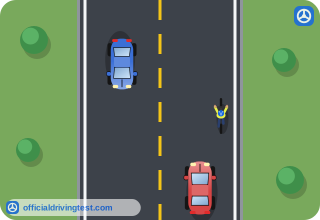
On a two-lane road you have an oncoming vehicle to your left and a bicyclist ahead on your right. What is the best action?
- Keep your speed and drive between the oncoming vehicle and the bicyclist
- Slow down, let the oncoming vehicle pass, then give the bicyclist at least three feet
- Sound your horn so the bicyclist moves onto the shoulder, then pass
- Stop completely in your lane until the vehicle and the bicyclist are gone
Show answer
Correct answer: Slow down, let the oncoming vehicle pass, then give the bicyclist at least three feet
Take one hazard at a time: give way to the greater danger first, then pass the bicyclist with at least three feet of space.
Source: California Driver Handbook (2025), page 68 · Open this page in the manual (Manual page 68)