Pavement markings in California
The California Driver Handbook shows or names everything on this page: 25 in all, on pages 13–18, 28, 38, 41.
Independent educational site · not affiliated with any government agency or DMV
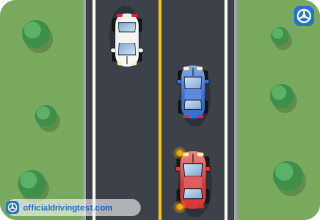
Single solid yellow line
A single solid yellow line marks the center of a road with two-way traffic. Do not pass a vehicle in front of you if there is only one lane of traffic going your direction and a solid yellow line on your side of the road.
Manual page 13 · Open this page in the manual (Manual page 13)
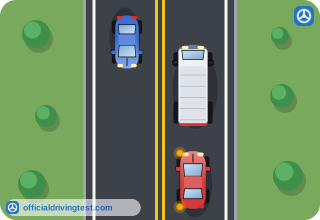
Double solid yellow lines
Do not pass over double solid yellow lines. Stay to the right of these lines unless you are: In a high-occupancy vehicle (HOV) carpool lane that has a designated entrance on the left. Instructed by construction or other signs to drive on the other side of the road because your side is closed or blocked. Turning left across a single set of double yellow lines to enter or exit a driveway or private road or make a U-turn.
Manual page 13 · Open this page in the manual (Manual page 13)
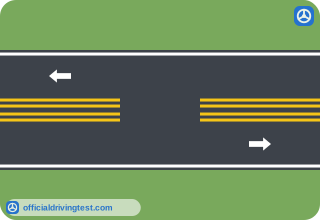
Double yellow barrier with opening
Two sets of solid double yellow lines spaced two or more feet apart are considered a barrier. Do not drive on or over this barrier, make a left turn, or make a U-turn across it, except at designated openings.
Manual page 13 · Open this page in the manual (Manual page 13)
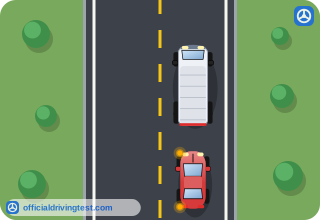
Broken yellow line
A broken yellow line indicates you may pass if the broken line is next to your driving lane. Only pass when it is safe.
Manual page 13 · Open this page in the manual (Manual page 13)
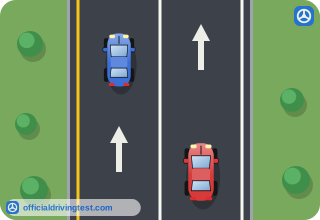
Single solid white line
A single solid white line marks traffic lanes going in the same direction. This includes one-way streets.
Manual page 13 · Open this page in the manual (Manual page 13)
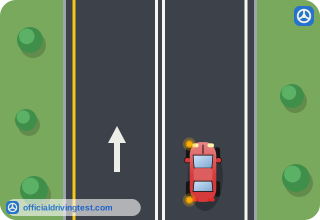
Double solid white lines
Double solid white lines indicate a lane barrier between a regular use and a preferential use lane, such as a carpool (HOV) lane. You may also see double solid white lines in or near freeway on and off ramps. Never change lanes over double solid white lines. Wait until you see a single broken white line.
Manual page 14 · Open this page in the manual (Manual page 14)
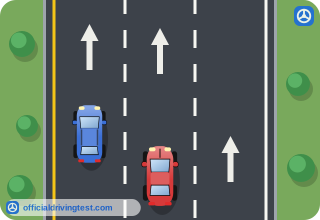
Broken white lines
Broken white lines separate traffic lanes on roads with two or more lanes in the same direction.
Manual page 14 · Open this page in the manual (Manual page 14)
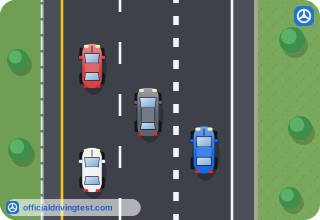
Lane-ending broken lines
Ending freeway and street lanes are usually marked with large broken lines. If you are driving in a lane marked with broken lines, be prepared to exit the freeway or for the lane to end. Look for a sign that tells you to exit or merge.
Manual page 14 · Open this page in the manual (Manual page 14)
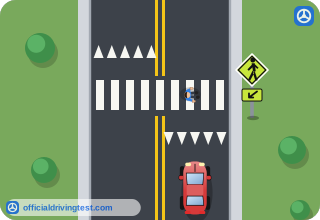
Yield line
A yield line is a line of solid white triangles that shows approaching vehicles where to yield or stop. The triangles point towards approaching vehicles.
Manual page 14 · Open this page in the manual (Manual page 14)
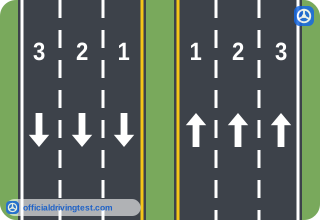
Numbered traffic lanes
Traffic lanes are often referred to by number. The left (or fast) lane is called the Number 1 Lane. The lane to the right of the Number 1 Lane is called the Number 2 Lane. Then the Number 3 Lane, etc.
Manual page 15 · Open this page in the manual (Manual page 15)
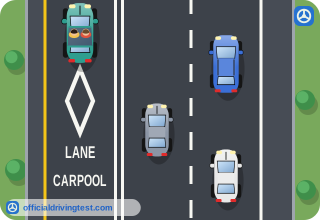
Carpool lane diamond
The road surface in an HOV lane is marked with a diamond symbol and the words Carpool Lane. Do not cross over double solid lines to enter or exit an HOV lane. Use designated entrances and exits.
Manual page 16 · Open this page in the manual (Manual page 16)
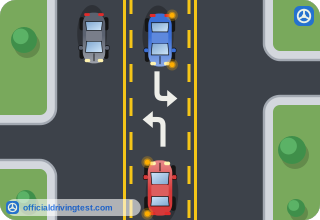
Center left turn lane
A center left turn lane is located in the middle of a two-way street. It is marked on both sides by two painted lines. The inner line is broken and the outer line is solid. Use the center left turn lane to prepare for and make a left turn or U-turn. It is not a regular traffic lane or passing lane. You may only drive for 200 feet in the center left turn lane.
Manual page 16 · Open this page in the manual (Manual page 16)
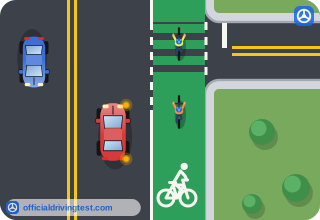
Bike lane
Bicycle lanes are for bicyclists only and run alongside vehicle traffic. They are typically marked by a single solid white line and signs. They are sometimes painted bright green to make them easier to see. Bike lane: Established along streets adjacent to vehicle traffic. Typically marked by a single solid white line that turns into a dash-line near an intersection.
Manual page 17 · Open this page in the manual (Manual page 17)
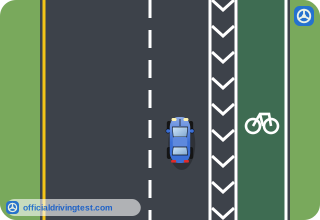
Buffered bike lane
Buffered bike lane: Uses chevrons or diagonal markings to provide greater separation from traffic and on-street parking.
Manual page 17 · Open this page in the manual (Manual page 17)
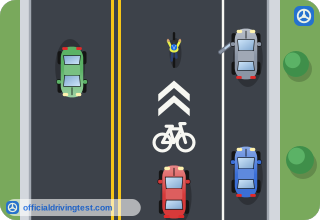
Shared roadway bicycle marking
Shared roadway bicycle markings: Alert drivers that bicyclists can occupy the lane and help bicyclists maintain a safe lane position in traffic.
Manual page 17 · Open this page in the manual (Manual page 17)
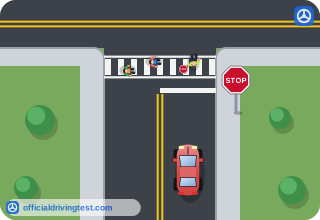
Limit line
Stop behind the limit line. A limit line is a wide white line that shows the drivers where to stop before an intersection or crosswalk. If there is no limit line, stop before you enter the crosswalk. If there is no crosswalk, stop before you enter the intersection.
Manual page 18 · Open this page in the manual (Manual page 18)
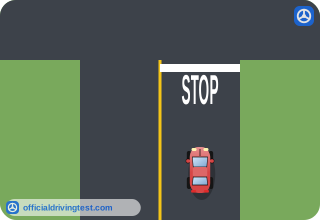
STOP pavement word
The manual does not state it
Manual page 18 · Open this page in the manual (Manual page 18)
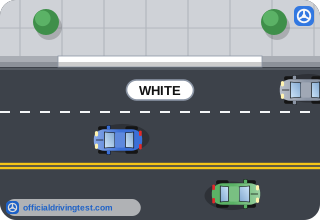
White curb
White: Stop only long enough to pick up or drop off passengers.
Manual page 28 · Open this page in the manual (Manual page 28)
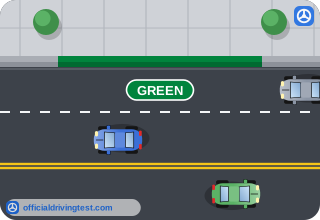
Green curb
Green: Park for a limited time. The time limit may be posted on signs or painted on the curb.
Manual page 28 · Open this page in the manual (Manual page 28)
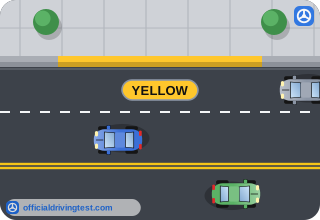
Yellow curb
Yellow: Load and unload passengers and freight. Do not stop longer than the time posted. If you drive a noncommercial vehicle, you are usually required to stay with your vehicle.
Manual page 28 · Open this page in the manual (Manual page 28)
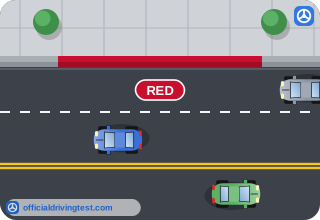
Red curb
Red: No stopping, standing, or parking. Buses may stop at a red zone marked for buses only.
Manual page 28 · Open this page in the manual (Manual page 28)
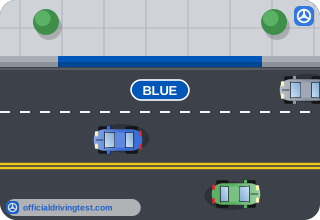
Blue curb
Blue: Parking for a disabled person or someone driving a disabled person with a special placard or special license plate.
Manual page 28 · Open this page in the manual (Manual page 28)
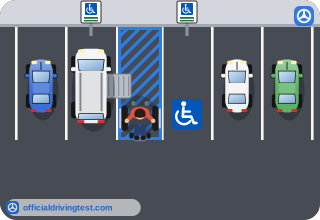
Crosshatched access aisle
Never park or leave your vehicle: In the crosshatched (diagonal lines) area next to a designated disabled parking space.
Manual page 28 · Open this page in the manual (Manual page 28)
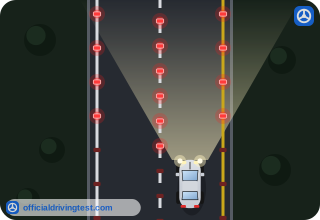
Red reflectors (wrong way)
If you are driving at night, you will know you are going the wrong way if the road reflectors shine red in your headlights.
Manual page 38 · Open this page in the manual (Manual page 38)
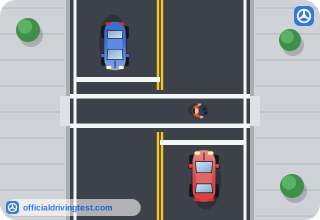
Crosswalk
A crosswalk is the part of the road set aside for pedestrians to safely cross the road. They are often marked with white lines. School crossings may have yellow crosswalk lines. Not all crosswalks are marked.
Manual page 41 · Open this page in the manual (Manual page 41)