California: Pavement markings Practice Test
Yellow and white lane lines, yield lines, and what each one allows.
Independent educational site · not affiliated with any government agency or DMV
Ready? Test yourself
- Instant feedback with an explanation
- Every answer cites its source in the manual
- Your best score is saved on this device
- Keyboard: press 1 to 4 to answer and Enter for the next question
Questions are original and based on the official manual "California Driver Handbook" (2025), California DMV.
All 13 questions in this practice test
Take the test above first, then use this list to study. Tap “Show answer” to see the correct answer and explanation.
Show the questions and answersHide the questions
-
What is a traffic lane?
- Any paved surface wide enough for a car.
- The shoulder alongside a highway.
- The space between two parked cars.
- A section of road for a single line of traffic.
Show answer
Correct answer: A section of road for a single line of traffic.
A traffic lane is a section of road set aside for a single line of traffic.
Source: California Driver Handbook (2025), page 13 · Open this page in the manual (Manual page 13)
-
A single solid yellow line runs down the middle of the road and there is one lane going your way. May you pass the car ahead?
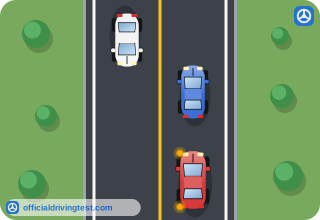
- No.
- Yes, if the road ahead looks clear.
- Yes, but only below 35 mph.
- Yes, as long as you signal first and return to your lane quickly afterwards.
Show answer
Correct answer: No.
A single solid yellow line marks the center of a two-way road. Do not pass when there is only one lane going your direction and a solid yellow line on your side.
Source: California Driver Handbook (2025), page 13 · Open this page in the manual (Manual page 13)
-
What do double solid yellow lines require of you?
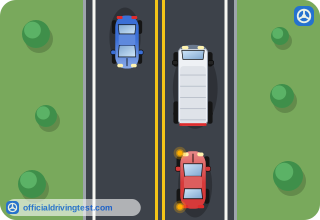
- Pass only when oncoming traffic is clear.
- Stay to the right of them and do not pass over them.
- Treat them as a broken line after dark.
- Come to a complete stop before crossing them at any point.
Show answer
Correct answer: Stay to the right of them and do not pass over them.
Do not pass over double solid yellow lines; stay to their right. One exception is an HOV carpool lane that has a designated entrance on the left.
Source: California Driver Handbook (2025), page 13 · Open this page in the manual (Manual page 13)
-
Construction signs direct you onto the other side of the road because your side is blocked. May you cross the double yellow lines?
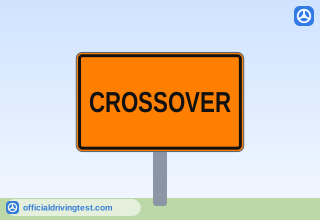
- Yes, the signs give you that permission.
- No, double yellow lines may never be crossed.
- Only if a flagger has physically stopped the oncoming traffic for you first.
- Only between sunrise and sunset.
Show answer
Correct answer: Yes, the signs give you that permission.
You may drive left of double solid yellow lines when construction or other signs instruct you to use the other side because your side is closed or blocked.
Source: California Driver Handbook (2025), page 13 · Open this page in the manual (Manual page 13)
-
You want to turn left into a private driveway across a single set of double yellow lines. Is that allowed?
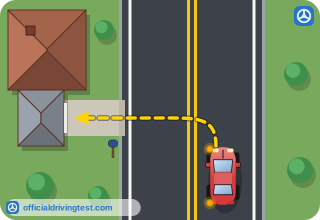
- No, you must drive on to an intersection.
- Only if the driveway serves a business.
- Only where a gap has been painted into the lines for that purpose.
- Yes, and a U-turn there is allowed too.
Show answer
Correct answer: Yes, and a U-turn there is allowed too.
You may turn left across a single set of double yellow lines to enter or leave a driveway or private road, or to make a U-turn.
Source: California Driver Handbook (2025), page 13 · Open this page in the manual (Manual page 13)
-
Two sets of solid double yellow lines are painted two or more feet apart. How are they treated?
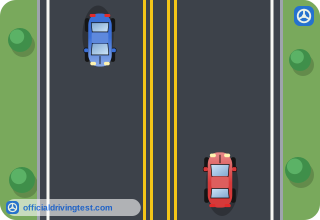
- As a wide lane you may use to pass whenever traffic is light and visibility is good.
- As a barrier: no driving over it, no left turn and no U-turn across it, except at marked openings.
- As an ordinary single center line.
- As the boundary of a bicycle lane.
Show answer
Correct answer: As a barrier: no driving over it, no left turn and no U-turn across it, except at marked openings.
Two sets of double yellow lines at least two feet apart form a barrier. Do not drive on or over it, or turn left or make a U-turn across it, except at designated openings.
Source: California Driver Handbook (2025), page 13 · Open this page in the manual (Manual page 13)
-
A broken yellow line runs next to your driving lane. What does it allow?
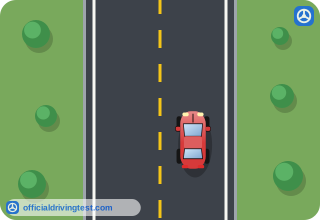
- You may pass when it is safe to do so.
- You may park along the center of the road.
- You must merge to the left.
- Passing is banned for traffic in both directions.
Show answer
Correct answer: You may pass when it is safe to do so.
A broken yellow line next to your lane means you may pass, but only when it is safe.
Source: California Driver Handbook (2025), page 13 · Open this page in the manual (Manual page 13)
-
What does a single solid white line between two lanes tell you?
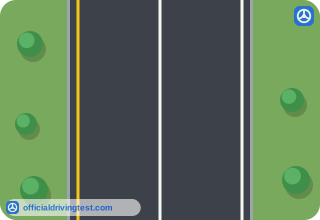
- They carry traffic going the same direction.
- One of them is a bus-only lane.
- They carry traffic in opposite directions.
- The roadway ends just ahead.
Show answer
Correct answer: They carry traffic going the same direction.
A single solid white line marks lanes of traffic going in the same direction, including on one-way streets.
Source: California Driver Handbook (2025), page 13 · Open this page in the manual (Manual page 13)
-
You are beside double solid white lines and want to change lanes. What should you do?
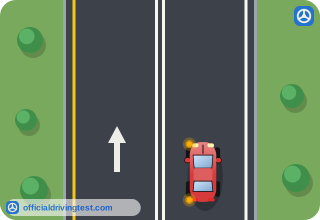
- Change lanes quickly while nobody is beside you.
- Signal for five seconds, then cross.
- Wait until you see a single broken white line.
- Stop and wait for a gap.
Show answer
Correct answer: Wait until you see a single broken white line.
Double solid white lines separate a regular lane from a preferential lane such as a carpool lane, and also appear near freeway ramps. Never change lanes across them; wait for a single broken white line.
Source: California Driver Handbook (2025), page 14 · Open this page in the manual (Manual page 14)
-
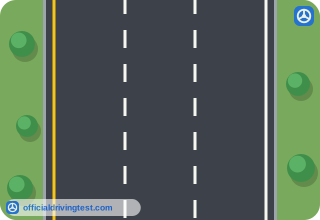
What do broken white lines separate?
- Opposing streams of traffic.
- Carpool lanes from toll lanes.
- The travelled part of the roadway from the paved shoulder running beside it.
- Lanes going the same direction on a road with two or more of them.
Show answer
Correct answer: Lanes going the same direction on a road with two or more of them.
Broken white lines separate traffic lanes on roads that have two or more lanes going the same direction.
Source: California Driver Handbook (2025), page 14 · Open this page in the manual (Manual page 14)
-
A row of solid white triangles is painted across your lane. What is it?
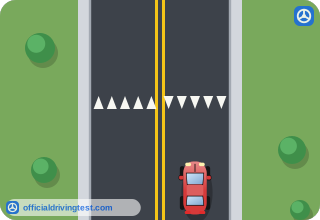
- A yield line showing where to yield or stop, with the triangles pointing at approaching vehicles.
- A crosswalk marking, telling you that pedestrians may step into the roadway at any point along it.
- A school bus loading zone marker.
- A warning that the lane is closed.
Show answer
Correct answer: A yield line showing where to yield or stop, with the triangles pointing at approaching vehicles.
A yield line is a row of solid white triangles that shows approaching drivers where to yield or stop. The triangle points face the approaching vehicles.
Source: California Driver Handbook (2025), page 14 · Open this page in the manual (Manual page 14)
-
How is a center left turn lane marked?
- By a single broken yellow line on each side.
- By solid white lines on both sides.
- By a diamond symbol painted at regular intervals along the middle of the road surface.
- By two lines on each side, the inner one broken and the outer one solid.
Show answer
Correct answer: By two lines on each side, the inner one broken and the outer one solid.
A center left turn lane sits in the middle of a two-way street and is marked on each side by two lines: a broken inner line and a solid outer line.
Source: California Driver Handbook (2025), page 16 · Open this page in the manual (Manual page 16)
-
What is a limit line, and where do you stop if there is not one?
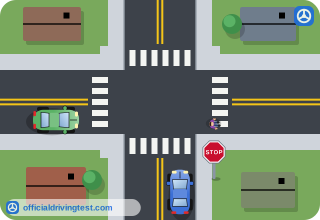
- A wide white line showing where to stop; with none, stop before the crosswalk or intersection.
- The yellow line down the centre of the road; where there is no such line, you may stop wherever you like.
- The painted edge of a parking space; without one, stop level with the corner.
- A line marking the end of a carpool lane; without one, no stop is needed.
Show answer
Correct answer: A wide white line showing where to stop; with none, stop before the crosswalk or intersection.
A limit line is a wide white line showing where to stop before an intersection or crosswalk. If there is no limit line, stop before the crosswalk; if there is no crosswalk, stop before entering the intersection.
Source: California Driver Handbook (2025), page 18 · Open this page in the manual (Manual page 18)