Arkansas: Speed and following distance
Speed for road conditions, following distance, the safety cushion, passing and stopping distances. Split into 6 shorter tests so you're not stuck in one long quiz.
Independent educational site · not affiliated with any government agency or DMV
Choose a part
Speed and following distance — Part 1
Questions in this part include: “A Work Zone has no reduced speed limit posted. What should drivers do?”
StartSpeed and following distance — Part 2
Questions in this part include: “What happens to the distance it takes to slow or stop as your vehicle goes faster?”
StartSpeed and following distance — Part 3
Questions in this part include: “What is the safest speed to drive in traffic?”
StartSpeed and following distance — Part 4
Questions in this part include: “When you use the "Four Second Sight Distance Rule", what do you pick out first?”
StartSpeed and following distance — Part 5
Questions in this part include: “How does towing affect your stopping distance?”
StartSpeed and following distance — Part 6
Questions in this part include: “Which of these places does the manual name as dangerous for passing because a vehicle may enter or cross the road?”
StartAll 113 Speed and following distance questions with answers
Choose a part above to take a practice test, or study every question and answer here.
Show the questions and answersHide the questions
-
A Work Zone has no reduced speed limit posted. What should drivers do?
- Slow down to a crawl until past the last worker
- Drive 10 miles per hour below the normal limit
- Obey the normally posted speed limit
- Follow the speed of the vehicle ahead
Show answer
Correct answer: Obey the normally posted speed limit
The manual says that if no reduced speed limits are posted, drivers should obey the normally posted speed limit.
Source: Arkansas Driver License Study Guide (Volume 1, Edition 10, October 2026), page 17 · Open this page in the manual (Manual page 17)
-
After you see Work Zone signs showing a reduced speed and begin to slow down, how long should you continue at the reduced speed?
- Until you no longer see any cones or barrels
- Until you see a posted speed limit sign
- Until you have driven one mile
- Until the car ahead of you speeds up
Show answer
Correct answer: Until you see a posted speed limit sign
The manual says to continue at a reduced speed until you see a posted speed limit sign.
Source: Arkansas Driver License Study Guide (Volume 1, Edition 10, October 2026), page 19 · Open this page in the manual (Manual page 19)
-
What does a speed limit sign indicate?
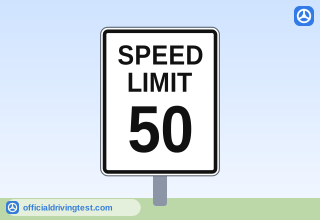
- The minimum and maximum speed allowed for a section of highway or street
- Only the maximum speed allowed for that section in any weather
- The recommended speed for the section when passing a curve
- The average speed of the traffic that is using the road each day
Show answer
Correct answer: The minimum and maximum speed allowed for a section of highway or street
The manual says a speed limit sign indicates the minimum and maximum speed allowed for a particular section of road.
Source: Arkansas Driver License Study Guide (Volume 1, Edition 10, October 2026), page 25 · Open this page in the manual (Manual page 25)
-
When should the maximum speed shown on a speed limit sign be used, according to the manual?
- In all conditions, regardless of the weather, the road surface, or how well you can see
- Only on dry roads during daylight hours when there is no other traffic
- In ideal conditions, reducing it as conditions such as slippery roads or poor visibility arise
- Only when the other traffic on the road is also traveling at that speed
Show answer
Correct answer: In ideal conditions, reducing it as conditions such as slippery roads or poor visibility arise
The maximum speed should be used in ideal conditions and reduced for slippery roads or poor visibility.
Source: Arkansas Driver License Study Guide (Volume 1, Edition 10, October 2026), page 25 · Open this page in the manual (Manual page 25)
-
In the Arkansas law quoted in the manual, what is a "county road"?
- Any road that is maintained by the county sheriff and used by county vehicles
- A public road that is not a state highway, interstate highway, or city street within the county
- Any public road that passes through a county seat or past a county courthouse square
- A road that connects two state highways and is maintained by the county
Show answer
Correct answer: A public road that is not a state highway, interstate highway, or city street within the county
The statute defines a county road as a public road that is not a state highway, interstate highway, or city street within the county.
Source: Arkansas Driver License Study Guide (Volume 1, Edition 10, October 2026), page 26 · Open this page in the manual (Manual page 26)
-
Who may establish speed limits on county roads within a county?
- The county sheriff
- The State Highway Commission
- The county judge
- The county road crew supervisor
Show answer
Correct answer: The county judge
The statute says each county judge may establish speed limits on county roads within his or her county.
Source: Arkansas Driver License Study Guide (Volume 1, Edition 10, October 2026), page 26 · Open this page in the manual (Manual page 26)
-
What is the speed limit on a county road if the county judge has not established one?
- 30 miles per hour
- 40 miles per hour
- 35 miles per hour
- 45 miles per hour
Show answer
Correct answer: 40 miles per hour
If no limit has been established, the statute sets the speed limit on the county road at forty miles per hour.
Source: Arkansas Driver License Study Guide (Volume 1, Edition 10, October 2026), page 26 · Open this page in the manual (Manual page 26)
-
Speeding more than how many miles per hour over the posted limit on a county road is a Class C misdemeanor?
- 5 miles per hour
- 10 miles per hour
- 20 miles per hour
- 15 miles per hour
Show answer
Correct answer: 15 miles per hour
The statute makes speeding in excess of 15 m.p.h. over the posted limit on a county road a Class C misdemeanor.
Source: Arkansas Driver License Study Guide (Volume 1, Edition 10, October 2026), page 26 · Open this page in the manual (Manual page 26)
-
How often does the manual say you should check your speedometer?
- Often, to stay within the speed limit
- Only when you enter a different road
- Only when you see a police vehicle
- Once, at the start of every long trip
Show answer
Correct answer: Often, to stay within the speed limit
The manual says to check your speedometer often to ensure you are within the speed limit.
Source: Arkansas Driver License Study Guide (Volume 1, Edition 10, October 2026), page 44 · Open this page in the manual (Manual page 44)
-
What does the manual say stopping suddenly indicates about a driver?
- The driver has excellent reflexes
- The driver is following too far behind
- The driver is not paying attention
- The driver is obeying the speed limit
Show answer
Correct answer: The driver is not paying attention
The manual says stopping suddenly is dangerous and indicates a driver who is not paying attention.
Source: Arkansas Driver License Study Guide (Volume 1, Edition 10, October 2026), page 44 · Open this page in the manual (Manual page 44)
-
What can braking quickly cause your vehicle to do?
- Stall, causing the engine to shut off
- Skid, causing you to lose control
- Speed up, causing the tires to heat
- Drift, causing the brakes to fade
Show answer
Correct answer: Skid, causing you to lose control
The manual says braking quickly can cause the vehicle to skid and cause you to lose control.
Source: Arkansas Driver License Study Guide (Volume 1, Edition 10, October 2026), page 44 · Open this page in the manual (Manual page 44)
-
What will help you avoid sudden stopping and allow more time to stop safely?
- Following the vehicle ahead more closely
- Looking only at the vehicle directly in front
- Keeping your speed up until the last moment
- Slowing down or changing lanes
Show answer
Correct answer: Slowing down or changing lanes
The manual says to avoid sudden stops, scan the road ahead, and slow down or change lanes.
Source: Arkansas Driver License Study Guide (Volume 1, Edition 10, October 2026), page 44 · Open this page in the manual (Manual page 44)
-
What does the manual give as the leading cause of car crashes?
- Speeding
- Bad weather
- Vehicle failure
- Inattention
Show answer
Correct answer: Inattention
The manual states that the leading cause of car crashes is inattention.
Source: Arkansas Driver License Study Guide (Volume 1, Edition 10, October 2026), page 48 · Open this page in the manual (Manual page 48)
-
How far ahead should you look down the road when driving on highways and interstates?
- At least one-quarter mile
- At least one city block
- At least one-half mile
- At least 100 feet
Show answer
Correct answer: At least one-quarter mile
The manual says to look one-quarter mile ahead on highways and interstates and at least one city block in the city.
Source: Arkansas Driver License Study Guide (Volume 1, Edition 10, October 2026), page 48 · Open this page in the manual (Manual page 48)
-
How far ahead should you look down the road when driving in the city?
- At least one-quarter mile
- At least two city blocks
- At least one city block
- At least 100 feet
Show answer
Correct answer: At least one city block
The manual says to look at least one city block ahead when driving in the city.
Source: Arkansas Driver License Study Guide (Volume 1, Edition 10, October 2026), page 48 · Open this page in the manual (Manual page 48)
-
How many seconds ahead should you be looking?
- At least 3 seconds
- At least 15 seconds
- At least 8 seconds
- At least 30 seconds
Show answer
Correct answer: At least 15 seconds
The manual says you should be looking at least fifteen (15) seconds ahead.
Source: Arkansas Driver License Study Guide (Volume 1, Edition 10, October 2026), page 48 · Open this page in the manual (Manual page 48)
-
How does the manual say to figure out whether you are looking fifteen seconds ahead?
- Count the seconds between the signs you pass
- Count the seconds the vehicle ahead takes to reach a point
- Count the seconds it takes to brake from your speed
- Choose a stationary object far ahead and count to it
Show answer
Correct answer: Choose a stationary object far ahead and count to it
The manual says to choose a stationary object as far ahead as you are seeing and count until you reach it.
Source: Arkansas Driver License Study Guide (Volume 1, Edition 10, October 2026), page 48 · Open this page in the manual (Manual page 48)
-
What should you do before slowing down?
- Sound your horn
- Turn on your hazard lights
- Shift into neutral
- Check behind you
Show answer
Correct answer: Check behind you
The manual says drivers should check behind them before slowing down.
Source: Arkansas Driver License Study Guide (Volume 1, Edition 10, October 2026), page 50 · Open this page in the manual (Manual page 50)
-
Why should you allow plenty of time to slow down?
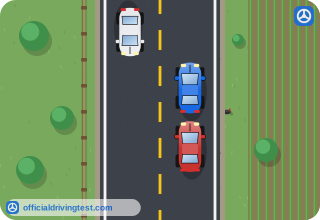
- To avoid stopping suddenly or at unexpected points
- To give the driver behind you room to pass you
- To save fuel when driving on level roads
- To give pedestrians time to cross the road
Show answer
Correct answer: To avoid stopping suddenly or at unexpected points
The manual says plenty of time to slow down keeps you from stopping suddenly or at unexpected points such as private driveways or parking lots.
Source: Arkansas Driver License Study Guide (Volume 1, Edition 10, October 2026), page 50 · Open this page in the manual (Manual page 50)
-
What happens to the distance it takes to slow or stop as your vehicle goes faster?
- It increases
- It stays about the same
- It decreases
- It changes only on wet roads
Show answer
Correct answer: It increases
The manual says the faster your vehicle is going, the more distance it takes to slow or stop.
Source: Arkansas Driver License Study Guide (Volume 1, Edition 10, October 2026), page 54 · Open this page in the manual (Manual page 54)
-
The average passenger car traveling at 55 miles per hour can stop within a total of how many feet?
- 125 feet
- 300 feet
- 225 feet
- 400 feet
Show answer
Correct answer: 225 feet
The manual says the average passenger car traveling at 55 mph can stop within a total of 225 feet.
Source: Arkansas Driver License Study Guide (Volume 1, Edition 10, October 2026), page 54 · Open this page in the manual (Manual page 54)
-
Which of these is listed as a way to reduce the time it takes to stop your vehicle?
- Follow other vehicles more closely
- Adjust your speed to road and traffic conditions
- Drive slightly above the posted speed limit
- Keep your high beams on at all times
Show answer
Correct answer: Adjust your speed to road and traffic conditions
The manual lists adjusting your speed to road and traffic conditions, being aware of your surroundings and obeying posted speed limits.
Source: Arkansas Driver License Study Guide (Volume 1, Edition 10, October 2026), page 54 · Open this page in the manual (Manual page 54)
-
You are traveling at the maximum speed allowed and road conditions become unsafe. What should you do?
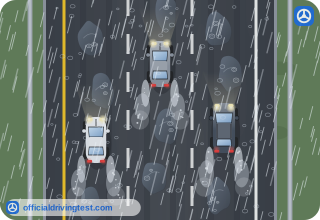
- Keep your speed because it is within the limit
- Keep your speed and use your horn
- Keep your speed and turn on your hazard lights
- Reduce your speed to the conditions
Show answer
Correct answer: Reduce your speed to the conditions
The manual says to reduce your speed to conditions when they become unsafe, even if you are at the maximum speed allowed.
Source: Arkansas Driver License Study Guide (Volume 1, Edition 10, October 2026), page 54 · Open this page in the manual (Manual page 54)
-
Through what part of your vehicle does it have its only contact with the road?
- The tires
- The brakes
- The axles
- The shock absorbers
Show answer
Correct answer: The tires
The manual says the only contact your vehicle has with the road is through the tires.
Source: Arkansas Driver License Study Guide (Volume 1, Edition 10, October 2026), page 54 · Open this page in the manual (Manual page 54)
-
Tires with a degree of wear on the tread could be dangerous in what conditions?
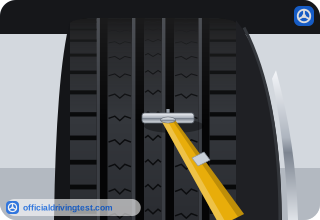
- Dry, hot pavement only
- Only at night
- Wet or icy road conditions
- Only on gravel roads
Show answer
Correct answer: Wet or icy road conditions
The manual says worn tread could be dangerous in wet or icy road conditions.
Source: Arkansas Driver License Study Guide (Volume 1, Edition 10, October 2026), page 54 · Open this page in the manual (Manual page 54)
-
What happens if you travel too fast around a curve?
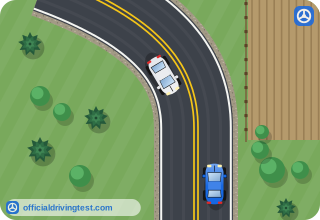
- Your headlights point away from the road
- Your tires cannot grip, so the vehicle skids
- Your brakes lock and hold the vehicle in place
- Your vehicle automatically slows down
Show answer
Correct answer: Your tires cannot grip, so the vehicle skids
Traveling too fast around a curve will not allow your tires to grip the road, causing your vehicle to skid.
Source: Arkansas Driver License Study Guide (Volume 1, Edition 10, October 2026), page 54 · Open this page in the manual (Manual page 54)
-
When should you slow down for a curve?
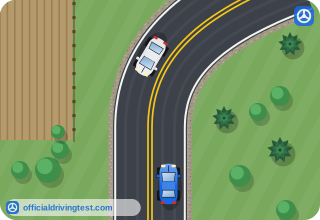
- In the middle of the curve, where it is sharpest
- As you leave the curve and begin to straighten
- Only if the curve is marked with a warning sign
- Before the curve, so you need not brake in it
Show answer
Correct answer: Before the curve, so you need not brake in it
The manual says to slow down before a curve so you do not have to brake in the curve, since braking in a curve can cause a skid.
Source: Arkansas Driver License Study Guide (Volume 1, Edition 10, October 2026), page 54 · Open this page in the manual (Manual page 54)
-
When should you decrease your speed for rain, snow or sleet?
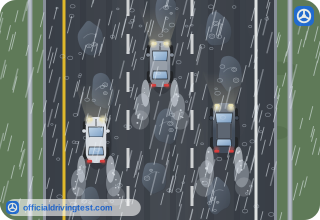
- At the first sign of it
- Only after the road becomes covered
- Only if the road is also curving
- Only after your tires begin to slip
Show answer
Correct answer: At the first sign of it
The manual says to decrease your speed at the first sign of rain, snow or sleet.
Source: Arkansas Driver License Study Guide (Volume 1, Edition 10, October 2026), page 55 · Open this page in the manual (Manual page 55)
-
On packed snow, by how much should you cut your speed?
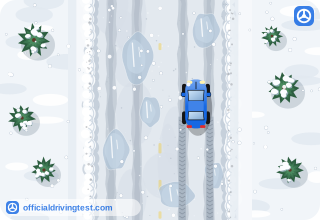
- By one-third
- By one-quarter
- In half
- By one-tenth
Show answer
Correct answer: In half
The manual says to cut your speed in half on packed snow.
Source: Arkansas Driver License Study Guide (Volume 1, Edition 10, October 2026), page 55 · Open this page in the manual (Manual page 55)
-
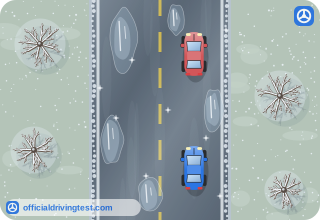
On ice, how far must you slow down?
- To half your speed
- To a coast
- To 25 mph
- To 15 mph
Show answer
Correct answer: To a coast
The manual says that on ice you must slow to a coast.
Source: Arkansas Driver License Study Guide (Volume 1, Edition 10, October 2026), page 55 · Open this page in the manual (Manual page 55)
-
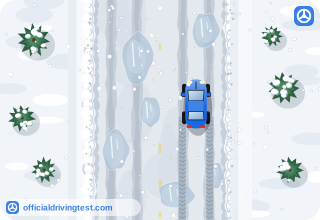
What should you do when the road becomes very slippery because of glare ice?
- Keep going at a very low speed until you reach your destination
- Speed up slightly to keep your tires from sliding
- Brake firmly to test how slippery the road is
- Stop driving as soon as you can safely do so
Show answer
Correct answer: Stop driving as soon as you can safely do so
The manual says to stop driving as soon as you can safely do so when the road is very slippery due to glare ice.
Source: Arkansas Driver License Study Guide (Volume 1, Edition 10, October 2026), page 55 · Open this page in the manual (Manual page 55)
-
On cold and wet days, where may ice linger along the roadway?
- In shady spots, the first to freeze and last to thaw
- In sunny spots, which are the first to freeze
- In the middle of the road, which is the last to freeze
- On hilltops, which are the last to thaw
Show answer
Correct answer: In shady spots, the first to freeze and last to thaw
The manual says ice may linger in shady spots, which are the first to freeze and the last to thaw.
Source: Arkansas Driver License Study Guide (Volume 1, Edition 10, October 2026), page 55 · Open this page in the manual (Manual page 55)
-
Which parts of a roadway can become some of the first to develop icy conditions?
- Straight stretches of highway
- Roads leading up to a bridge
- Overpasses and bridges
- Roads with a high speed limit
Show answer
Correct answer: Overpasses and bridges
The manual says overpasses and bridges can be among the first sections to develop icy conditions, even when the roadway leading to them is clear.
Source: Arkansas Driver License Study Guide (Volume 1, Edition 10, October 2026), page 55 · Open this page in the manual (Manual page 55)
-
When can ice be more slippery?
- When temperatures are well below freezing
- When it is near the freezing point
- When it has been on the road for several days
- When it is covered with snow
Show answer
Correct answer: When it is near the freezing point
Ice near the freezing point can be more slippery than ice at temperatures well below freezing.
Source: Arkansas Driver License Study Guide (Volume 1, Edition 10, October 2026), page 55 · Open this page in the manual (Manual page 55)
-
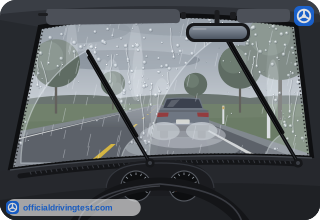
Why can pavement be particularly slippery for the first few minutes when it starts to rain on a hot day?
- The rain freezes as soon as it touches the hot pavement
- The heat makes the tires wear down faster
- The rain washes loose gravel onto the roadway
- Heat causes the oil in the asphalt to surface on the roadway
Show answer
Correct answer: Heat causes the oil in the asphalt to surface on the roadway
The oil that heat brings to the surface makes the road more slippery until the rain washes it away.
Source: Arkansas Driver License Study Guide (Volume 1, Edition 10, October 2026), page 55 · Open this page in the manual (Manual page 55)
-
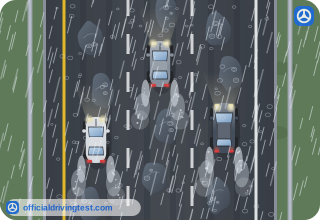
What is it called when your tires ride up on the water on a wet road, much like water skis?
- Hydroplaning
- Fishtailing
- Wheel lock
- Tread slip
Show answer
Correct answer: Hydroplaning
The manual calls this process hydroplaning.
Source: Arkansas Driver License Study Guide (Volume 1, Edition 10, October 2026), page 55 · Open this page in the manual (Manual page 55)
-
What is the best way to keep from hydroplaning?
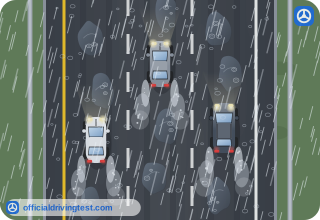
- Brake lightly and often
- Keep your tires fully inflated at all times
- Keep your speed down
- Drive in the center of the road
Show answer
Correct answer: Keep your speed down
The manual says the best way to keep from hydroplaning is to keep your speed down.
Source: Arkansas Driver License Study Guide (Volume 1, Edition 10, October 2026), page 55 · Open this page in the manual (Manual page 55)
-
What can cause your car to hydroplane?
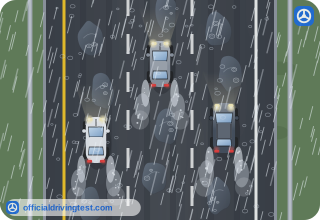
- A full tank of fuel
- Worn tires
- Low-beam headlights
- Dry pavement
Show answer
Correct answer: Worn tires
The manual says worn tires can cause your car to hydroplane.
Source: Arkansas Driver License Study Guide (Volume 1, Edition 10, October 2026), page 55 · Open this page in the manual (Manual page 55)
-
What should you do first if your vehicle begins to hydroplane?
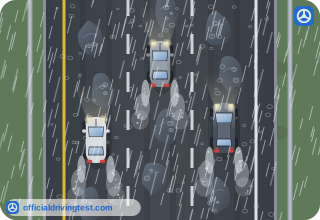
- Brake hard to slow the vehicle quickly
- Turn the steering wheel sharply to the side
- Press the gas pedal harder to regain grip
- Slowly take your foot off the gas pedal
Show answer
Correct answer: Slowly take your foot off the gas pedal
The manual says to slowly take your foot off the gas pedal if you begin to hydroplane.
Source: Arkansas Driver License Study Guide (Volume 1, Edition 10, October 2026), page 55 · Open this page in the manual (Manual page 55)
-
How should you handle the steering wheel if your vehicle begins to hydroplane?
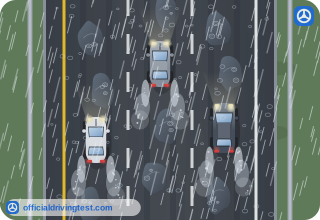
- Keep it straight, and if you must turn, do so slowly
- Turn it sharply in the direction of the skid
- Turn it back and forth to regain traction
- Let go of it until the tires grip again
Show answer
Correct answer: Keep it straight, and if you must turn, do so slowly
The manual says to keep the steering wheel straight and to turn it only in an emergency, and then slowly, or you will lose control or skid.
Source: Arkansas Driver License Study Guide (Volume 1, Edition 10, October 2026), page 55 · Open this page in the manual (Manual page 55)
-
If your vehicle is hydroplaning, when should you try to stop or turn?
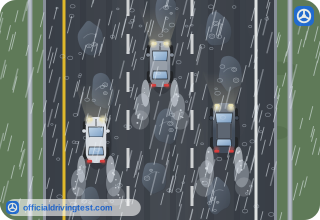
- As soon as you feel the tires lose traction
- Right after you take your foot off the gas
- Not until your tires are gripping the road again
- Only after you have braked hard
Show answer
Correct answer: Not until your tires are gripping the road again
The manual says not to try to stop or turn until your tires are gripping the road again.
Source: Arkansas Driver License Study Guide (Volume 1, Edition 10, October 2026), page 55 · Open this page in the manual (Manual page 55)
-
What is the safest speed to drive in traffic?
- Five mph below the speed of other vehicles
- The same speed as other vehicles
- Five mph above the speed of other vehicles
- The highest speed shown on the posted limit signs
Show answer
Correct answer: The same speed as other vehicles
The manual says the safest speed to drive in traffic is the same speed as other vehicles.
Source: Arkansas Driver License Study Guide (Volume 1, Edition 10, October 2026), page 56 · Open this page in the manual (Manual page 56)
-
When do crashes involving two or more vehicles often happen?
- When all vehicles travel in the same direction at the same speed
- When drivers keep a steady speed on a two-lane road
- When drivers use their turn signals for every lane change
- When drivers go faster or slower than other vehicles using the same roadway
Show answer
Correct answer: When drivers go faster or slower than other vehicles using the same roadway
The manual says such crashes often happen when drivers go faster or slower than other vehicles on the same roadway.
Source: Arkansas Driver License Study Guide (Volume 1, Edition 10, October 2026), page 56 · Open this page in the manual (Manual page 56)
-
Why is it risky to go faster than other traffic?
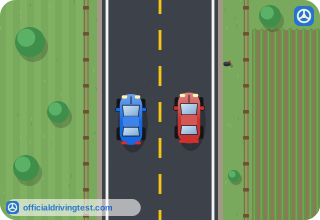
- You must keep passing, and each pass risks a collision
- Other drivers will slow down to match your speed
- Your vehicle will use less fuel with every pass you make
- Vehicles ahead cannot change lanes while you pass them
Show answer
Correct answer: You must keep passing, and each pass risks a collision
If you go faster than other traffic you must keep passing vehicles, and each time you pass there is a chance of a collision.
Source: Arkansas Driver License Study Guide (Volume 1, Edition 10, October 2026), page 56 · Open this page in the manual (Manual page 56)
-
How much time does speeding save, according to the manual?
- About 15 minutes an hour
- About half an hour on a long trip
- No more than a few minutes an hour
- More than an hour on a long trip
Show answer
Correct answer: No more than a few minutes an hour
The manual says speeding does not save more than a few minutes an hour.
Source: Arkansas Driver License Study Guide (Volume 1, Edition 10, October 2026), page 56 · Open this page in the manual (Manual page 56)
-
Vehicles are accumulating behind you because you are driving much slower than other traffic. What should you do?
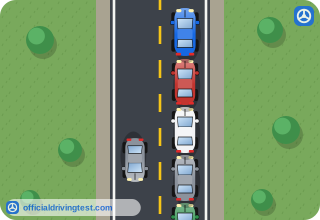
- Speed up to the posted limit at once
- Pull over and allow them to pass
- Turn on your hazard lights and keep your speed
- Move to the center of the road
Show answer
Correct answer: Pull over and allow them to pass
The manual says to pull over and allow vehicles to pass if they are accumulating behind you.
Source: Arkansas Driver License Study Guide (Volume 1, Edition 10, October 2026), page 56 · Open this page in the manual (Manual page 56)
-
You are about to leave a high-speed, two-lane roadway and traffic is following you. Instead of slowing down too soon, what should you do?
- Stop in your lane to let the traffic pass
- Move onto the shoulder and stop
- Tap your brakes and safely reduce your speed
- Hold your speed until you are past your exit
Show answer
Correct answer: Tap your brakes and safely reduce your speed
The manual says to try not to slow down too soon with traffic following and to tap your brakes and safely reduce speed.
Source: Arkansas Driver License Study Guide (Volume 1, Edition 10, October 2026), page 56 · Open this page in the manual (Manual page 56)
-
As you approach slow-moving traffic, what should you give yourself time to do?
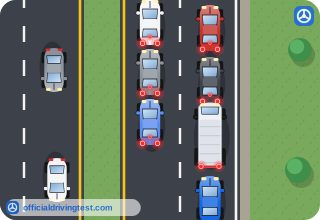
- Speed up and pass at once
- Change lanes or slow down
- Stop in the lane
- Sound your horn until traffic clears
Show answer
Correct answer: Change lanes or slow down
The manual says to give yourself time to change lanes or slow down, because slowing suddenly can cause a traffic accident.
Source: Arkansas Driver License Study Guide (Volume 1, Edition 10, October 2026), page 57 · Open this page in the manual (Manual page 57)
-
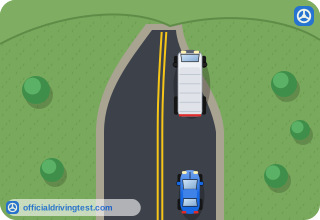
Why should you watch for trucks and underpowered cars on long or steep hills?
- They always travel faster than other vehicles uphill
- They are required to stop at the top of every steep hill
- They cannot use their brakes while going downhill
- They lose speed on hills and take longer to build speed
Show answer
Correct answer: They lose speed on hills and take longer to build speed
The manual says slower vehicles can lose speed on long or steep hills and take longer to build speed when entering traffic.
Source: Arkansas Driver License Study Guide (Volume 1, Edition 10, October 2026), page 57 · Open this page in the manual (Manual page 57)
-
At about what speed do farm tractors, animal-drawn vehicles and roadway maintenance vehicles usually travel?
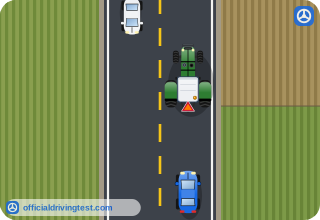
- 25 mph or less
- 35 to 45 mph
- 45 to 55 mph
- 55 mph or more
Show answer
Correct answer: 25 mph or less
The manual says these vehicles usually travel 25 mph or less.
Source: Arkansas Driver License Study Guide (Volume 1, Edition 10, October 2026), page 57 · Open this page in the manual (Manual page 57)
-
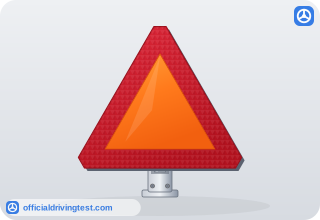
Which vehicles should have a slow-moving vehicle sign visible from the rear?
- Passenger cars and pickup trucks
- Motorcycles and mopeds
- Farm tractors and maintenance vehicles
- School buses and city buses
Show answer
Correct answer: Farm tractors and maintenance vehicles
The manual says these slow vehicles should have a slow-moving vehicle sign visible from the rear.
Source: Arkansas Driver License Study Guide (Volume 1, Edition 10, October 2026), page 57 · Open this page in the manual (Manual page 57)
-
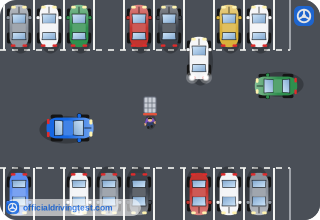
Where people and their vehicles are parked, you have limited space to maneuver. What should you do?
- Keep your speed and sound your horn often
- Reduce your speed to react in crowded spaces
- Move to the center of the roadway to pass
- Use your high beams to see farther
Show answer
Correct answer: Reduce your speed to react in crowded spaces
The manual says to reduce your speed to react in crowded spaces.
Source: Arkansas Driver License Study Guide (Volume 1, Edition 10, October 2026), page 57 · Open this page in the manual (Manual page 57)
-
Why should you slow down in shopping centers, parking lots and downtown areas?
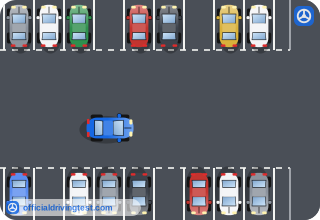
- Parking lots have a lower legal speed limit than other roads
- Drivers there are required to use their hazard lights
- Pedestrians there always have to yield to vehicles
- Vehicles stop, start and move in different directions
Show answer
Correct answer: Vehicles stop, start and move in different directions
The manual says these are busy areas with vehicles stopping and starting and moving in different directions.
Source: Arkansas Driver License Study Guide (Volume 1, Edition 10, October 2026), page 57 · Open this page in the manual (Manual page 57)
-
Why should you slow down at narrow bridges and tunnels?
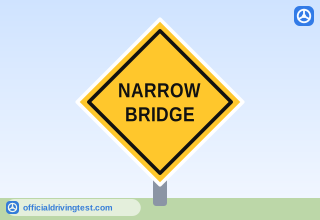
- Vehicles meet close together
- Passing is required there
- The road surface is always icy there
- Headlights are not allowed there
Show answer
Correct answer: Vehicles meet close together
The manual says vehicles meet close together on narrow bridges and in tunnels.
Source: Arkansas Driver License Study Guide (Volume 1, Edition 10, October 2026), page 57 · Open this page in the manual (Manual page 57)
-
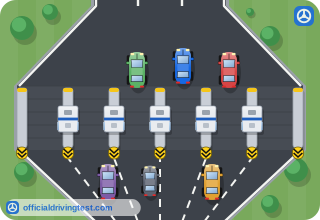
When should you slow down at toll booths?
- Only when the toll booth is closed to traffic
- Only when the road is wet or icy at the booth
- When changing lanes, stopping and speeding up
- Only when traffic is light near the toll plaza
Show answer
Correct answer: When changing lanes, stopping and speeding up
The manual says to slow down at toll booths when changing lanes, stopping and speeding up to exit.
Source: Arkansas Driver License Study Guide (Volume 1, Edition 10, October 2026), page 57 · Open this page in the manual (Manual page 57)
-
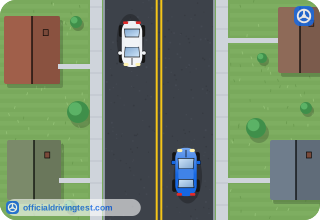
Why should you slow down near schools, playgrounds and residential streets?
- Drivers there must stop at every driveway they pass
- Children are present and may be crossing the street
- The speed limit there is always 15 miles per hour
- Parked cars there are not allowed near the curb
Show answer
Correct answer: Children are present and may be crossing the street
The manual says these areas have children present and you should be alert for children crossing the street.
Source: Arkansas Driver License Study Guide (Volume 1, Edition 10, October 2026), page 57 · Open this page in the manual (Manual page 57)
-
At night, how far ahead do your headlights let you see, according to the manual?
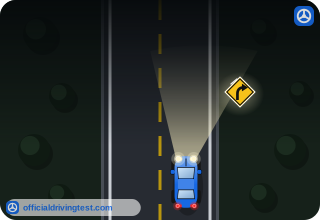
- About 400 feet
- About 200 feet
- About 300 feet
- About 600 feet
Show answer
Correct answer: About 400 feet
The manual says your headlights let you see about 400 feet ahead.
Source: Arkansas Driver License Study Guide (Volume 1, Edition 10, October 2026), page 58 · Open this page in the manual (Manual page 58)
-
At night you should drive at a speed that lets you stop within the distance your headlights show. About what speed is that?
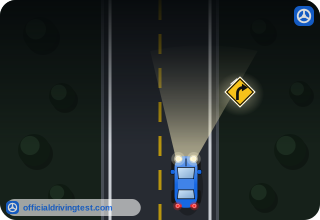
- Around 30 mph
- Around 40 mph
- Around 50 mph
- Around 65 mph
Show answer
Correct answer: Around 50 mph
Because headlights show about 400 feet ahead, the manual says the matching speed is around 50 mph.
Source: Arkansas Driver License Study Guide (Volume 1, Edition 10, October 2026), page 58 · Open this page in the manual (Manual page 58)
-
If you cannot see more than 200 feet ahead because of rain or fog, what is the fastest you should drive?
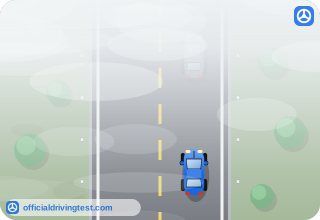
- 20 mph
- 30 mph
- 40 mph
- 45 mph
Show answer
Correct answer: 30 mph
The manual says that with less than 200 feet of visibility in rain or fog you should not drive faster than 30 mph.
Source: Arkansas Driver License Study Guide (Volume 1, Edition 10, October 2026), page 58 · Open this page in the manual (Manual page 58)
-
What should you do any time you cannot see the road ahead because of the weather?
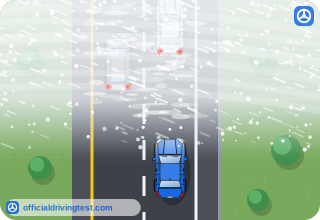
- Turn on your hazard lights and keep driving slowly
- Follow the taillights of the vehicle in front of you
- Drive in the middle of the road to stay away from the edges
- Pull over in a safe place and wait until the weather clears
Show answer
Correct answer: Pull over in a safe place and wait until the weather clears
The manual says to pull over in a safe place and wait until the weather clears whenever you cannot see the road ahead.
Source: Arkansas Driver License Study Guide (Volume 1, Edition 10, October 2026), page 58 · Open this page in the manual (Manual page 58)
-
Using the "Four Second Sight Distance Rule", what does it mean if you reach a stationary object ahead before you finish counting to four?
- You are going too fast and need to slow down
- You are driving at a safe speed for the conditions
- You should count again and speed up slightly
- You are following the vehicle ahead too closely
Show answer
Correct answer: You are going too fast and need to slow down
The manual says that reaching the object before finishing the count means you are going too fast and must slow down.
Source: Arkansas Driver License Study Guide (Volume 1, Edition 10, October 2026), page 58 · Open this page in the manual (Manual page 58)
-
When you use the "Four Second Sight Distance Rule", what do you pick out first?
- The vehicle directly in front of you
- The nearest sign on the opposite side of the road
- A stationary object as far ahead as you can clearly see
- The point where your headlights end on a wet road
Show answer
Correct answer: A stationary object as far ahead as you can clearly see
The rule starts by picking a stationary object, such as a sign or utility pole, as far ahead as you can clearly see.
Source: Arkansas Driver License Study Guide (Volume 1, Edition 10, October 2026), page 58 · Open this page in the manual (Manual page 58)
-
According to the manual, about how much total stopping distance can it take at 40 mph with good tires, brakes and dry pavement?
- About 54 feet
- About 124 feet
- About 85 feet
- About 225 feet
Show answer
Correct answer: About 124 feet
The manual gives about 124 feet of total stopping distance at 40 mph.
Source: Arkansas Driver License Study Guide (Volume 1, Edition 10, October 2026), page 58 · Open this page in the manual (Manual page 58)
-
What does the manual say about a driver who cannot see a safe length ahead at the speed being driven?
- The driver may not be driving at a safe speed
- The driver should switch to high beams and keep the same speed
- The driver is allowed to drive the posted speed limit
- The driver should follow closer to the vehicle ahead
Show answer
Correct answer: The driver may not be driving at a safe speed
The manual says that if you cannot see a safe length ahead at your speed, you may not be driving at a safe speed.
Source: Arkansas Driver License Study Guide (Volume 1, Edition 10, October 2026), page 58 · Open this page in the manual (Manual page 58)
-
What should you be ready for when vehicles are parked along the side of the road?
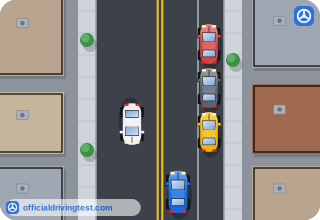
- Parked vehicles suddenly backing into your lane at high speed
- A driver who will always wait for you to pass
- A person getting out of a car or walking out from between parked cars
- Traffic signals that change color without warning
Show answer
Correct answer: A person getting out of a car or walking out from between parked cars
The manual warns that parked vehicles may block your view and people may get out or walk out from parked cars.
Source: Arkansas Driver License Study Guide (Volume 1, Edition 10, October 2026), page 58 · Open this page in the manual (Manual page 58)
-
What should you do as you approach a hill or a curve where you cannot see what is on the other side?
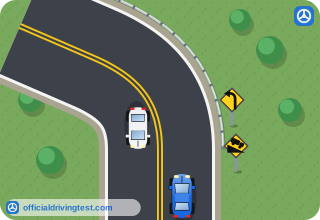
- Speed up to clear the hill quickly
- Be ready to stop and adjust your speed
- Move to the center line to see farther ahead
- Assume the road is clear and keep your speed
Show answer
Correct answer: Be ready to stop and adjust your speed
The manual says you may not know what is on the other side of a hill or curve, so be ready to stop and adjust your speed.
Source: Arkansas Driver License Study Guide (Volume 1, Edition 10, October 2026), page 58 · Open this page in the manual (Manual page 58)
-
On which of these is a road's speed limit based, according to the manual?
- Only the number of lanes and the width of the road
- Only the weather forecast and the time of day
- The average age of the drivers who use the road
- Road design, vehicle types and road location
Show answer
Correct answer: Road design, vehicle types and road location
The manual says speed limits are based on road design, the type of vehicles used on the road, and the road location.
Source: Arkansas Driver License Study Guide (Volume 1, Edition 10, October 2026), page 58 · Open this page in the manual (Manual page 58)
-
For which conditions are speed limits posted?
- Ideal conditions
- Wet conditions only
- Nighttime conditions only
- Heavy traffic conditions
Show answer
Correct answer: Ideal conditions
The manual says speed limits are posted for ideal conditions, so drivers must adjust to ice, rain and other conditions.
Source: Arkansas Driver License Study Guide (Volume 1, Edition 10, October 2026), page 58 · Open this page in the manual (Manual page 58)
-
Can you get a ticket for driving too fast for the conditions even if you are driving at the posted speed limit?
- No, driving at or under the limit can never be ticketed
- Only if you cause a crash
- Yes, you can be ticketed for traveling too fast for the conditions
- Only if you are driving at night
Show answer
Correct answer: Yes, you can be ticketed for traveling too fast for the conditions
The manual says that even at the speed limit you can get a ticket for traveling too fast for the conditions.
Source: Arkansas Driver License Study Guide (Volume 1, Edition 10, October 2026), page 58 · Open this page in the manual (Manual page 58)
-
Which rule does the manual give to help you tell whether you are following another vehicle too closely?
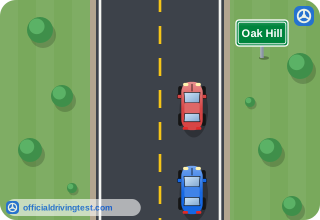
- The one-second rule
- The two-second rule
- The three-second rule
- The ten-second rule
Show answer
Correct answer: The two-second rule
The manual says to use the "two (2) second rule" to determine if you are following too close.
Source: Arkansas Driver License Study Guide (Volume 1, Edition 10, October 2026), page 59 · Open this page in the manual (Manual page 59)
-
By the two-second rule, when are you following too close?
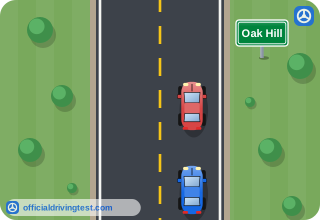
- When you reach the mark after you finish counting
- When you can still see the whole vehicle ahead
- When the vehicle ahead passes the mark first
- When you pass the mark before you finish counting
Show answer
Correct answer: When you pass the mark before you finish counting
The manual says you are following too close if you pass the mark before you finish counting.
Source: Arkansas Driver License Study Guide (Volume 1, Edition 10, October 2026), page 59 · Open this page in the manual (Manual page 59)
-
If you reach the mark before you finish counting for the two-second rule, what should you do?
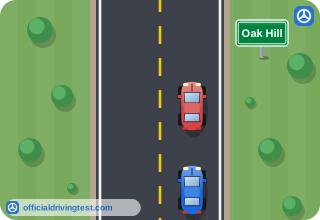
- Drop back and count again until you follow no closer than two seconds
- Speed up and pass the vehicle ahead as soon as you can
- Keep your distance, since you are already following safely
- Change lanes right away and then count a second time
Show answer
Correct answer: Drop back and count again until you follow no closer than two seconds
The manual says to drop back and count again, repeating until you are following no closer than two seconds.
Source: Arkansas Driver License Study Guide (Volume 1, Edition 10, October 2026), page 59 · Open this page in the manual (Manual page 59)
-
According to the manual, what causes rear-end crashes, which are very common?
- Drivers driving too far behind
- Drivers using their turn signals too early
- Drivers following too close
- Drivers staying in the right lane
Show answer
Correct answer: Drivers following too close
The manual says rear-end crashes are very common and caused by drivers following too close.
Source: Arkansas Driver License Study Guide (Volume 1, Edition 10, October 2026), page 59 · Open this page in the manual (Manual page 59)
-
Which rule may you need to use in some situations that require more space in front of your vehicle?
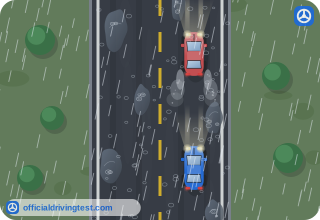
- A one-second rule
- A four-second rule
- A three-second rule
- A ten-second rule
Show answer
Correct answer: A four-second rule
The manual says that in some situations you may need to use a four second rule to be safe.
Source: Arkansas Driver License Study Guide (Volume 1, Edition 10, October 2026), page 59 · Open this page in the manual (Manual page 59)
-
Why do slippery roads require you to allow more space in front of your vehicle?
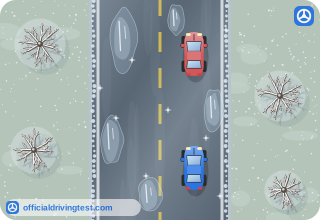
- They reduce the speed limit
- They make other drivers brake sooner
- They make your headlights dimmer
- They need more stopping distance
Show answer
Correct answer: They need more stopping distance
The manual says slippery roads require more stopping distance, so you need to allow space in front of you.
Source: Arkansas Driver License Study Guide (Volume 1, Edition 10, October 2026), page 59 · Open this page in the manual (Manual page 59)
-
When the driver behind you wants to pass, what should you do?
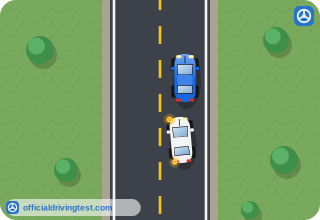
- Slow down to leave room in front of you so it can merge
- Speed up so the driver behind you cannot get past
- Move toward the left edge of your lane to block the pass
- Brake hard so the passing driver can go in front
Show answer
Correct answer: Slow down to leave room in front of you so it can merge
The manual says to slow down to allow room in front of your vehicle so the passing vehicle can merge safely.
Source: Arkansas Driver License Study Guide (Volume 1, Edition 10, October 2026), page 59 · Open this page in the manual (Manual page 59)
-
How does towing affect your stopping distance?
- The extra weight decreases it
- It stays the same
- The extra weight increases it
- It only changes on wet roads
Show answer
Correct answer: The extra weight increases it
The manual says the extra weight of towing increases your stopping distance.
Source: Arkansas Driver License Study Guide (Volume 1, Edition 10, October 2026), page 59 · Open this page in the manual (Manual page 59)
-
What should you do with your following distance when bad weather makes it hard for you to see?
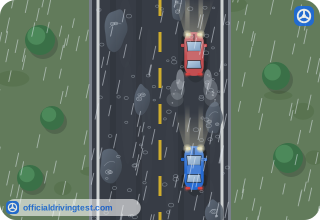
- Decrease it
- Increase it
- Keep it exactly the same
- Switch to following in the left lane
Show answer
Correct answer: Increase it
The manual says poor visibility from bad weather means you should increase your following distance.
Source: Arkansas Driver License Study Guide (Volume 1, Edition 10, October 2026), page 59 · Open this page in the manual (Manual page 59)
-
Why should you leave extra space when stopped on a hill?
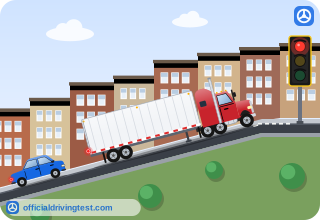
- Hills cause traffic signals to change much faster than usual
- Vehicles behind you are required to pass you on the right
- Vehicles ahead could roll back when starting off on an incline
- Brake lights do not work properly when stopped on a slope
Show answer
Correct answer: Vehicles ahead could roll back when starting off on an incline
The manual says vehicles in front of you could roll back when taking off from an incline.
Source: Arkansas Driver License Study Guide (Volume 1, Edition 10, October 2026), page 59 · Open this page in the manual (Manual page 59)
-
What two things can you do to help the driver behind you when you must stop or slow down?
- Brake suddenly and flash your headlights
- Keep a steady speed and signal in advance
- Move to the left lane and stay there
- Turn off your signals to avoid confusion
Show answer
Correct answer: Keep a steady speed and signal in advance
The manual says to help the driver behind by keeping a steady speed and signaling in advance when you must stop or slow down.
Source: Arkansas Driver License Study Guide (Volume 1, Edition 10, October 2026), page 60 · Open this page in the manual (Manual page 60)
-
If you drive slower than other vehicles, what should you do?
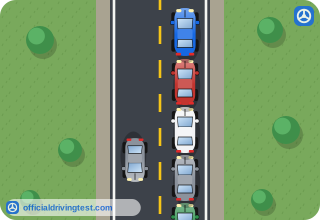
- Pull to the side of the road and let the vehicles pass
- Stay in your lane and keep your speed so traffic goes around
- Stop in the travel lane until the road ahead is clear
- Move into the left lane and stay there until traffic clears
Show answer
Correct answer: Pull to the side of the road and let the vehicles pass
The manual says to pull to the side of the road, using a turnout area where available, and let the vehicles pass.
Source: Arkansas Driver License Study Guide (Volume 1, Edition 10, October 2026), page 60 · Open this page in the manual (Manual page 60)
-
If you are being tailgated and there is no right lane, what does the manual say to do?
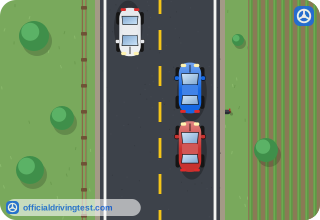
- Speed up as much as needed to leave the tailgater behind
- Wait for a clear path ahead and reduce speed so it can pass
- Stop quickly so the tailgater is forced to pass you
- Swerve onto the shoulder and stop at once to let it pass
Show answer
Correct answer: Wait for a clear path ahead and reduce speed so it can pass
The manual says if there is no right lane, wait until the path ahead is clear and reduce speed to allow the tailgater to drive around you.
Source: Arkansas Driver License Study Guide (Volume 1, Edition 10, October 2026), page 60 · Open this page in the manual (Manual page 60)
-
Why should you never slow down too quickly to discourage a tailgater?
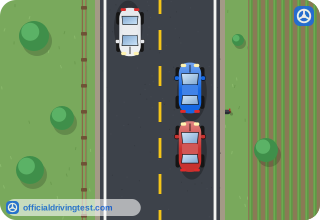
- It will damage your brakes and tires over time
- It will confuse other drivers about your lane
- It will cause your engine to stall in traffic
- It raises the risk of being hit from behind
Show answer
Correct answer: It raises the risk of being hit from behind
The manual says slowing down too quickly to discourage a tailgater increases the risk of being hit from behind.
Source: Arkansas Driver License Study Guide (Volume 1, Edition 10, October 2026), page 60 · Open this page in the manual (Manual page 60)
-
What does the manual advise about driving next to other vehicles on multi-lane roads?
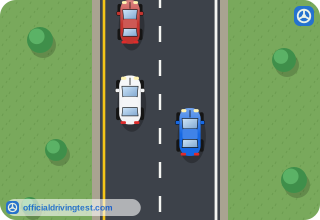
- Avoid it by moving ahead or dropping behind the other vehicle
- Stay beside other vehicles so they cannot change lanes
- Drive next to them so you can keep an eye on their speed
- Stay beside them as long as you use your turn signal
Show answer
Correct answer: Avoid it by moving ahead or dropping behind the other vehicle
The manual says other drivers may crowd your lane, so you should avoid driving next to them and move ahead or drop behind.
Source: Arkansas Driver License Study Guide (Volume 1, Edition 10, October 2026), page 60 · Open this page in the manual (Manual page 60)
-
On a two-lane road, where should you drive in relation to the center line?
- Close to the center line to keep away from the edge
- Straddling the center line when no one is coming
- In the center of your lane, without crowding the center line
- On the edge of the road away from oncoming vehicles
Show answer
Correct answer: In the center of your lane, without crowding the center line
The manual says not to crowd the center line on a two-lane road and always to drive in the center of your lane.
Source: Arkansas Driver License Study Guide (Volume 1, Edition 10, October 2026), page 60 · Open this page in the manual (Manual page 60)
-
What does the manual say to do for a vehicle entering a roadway that has two or more lanes?
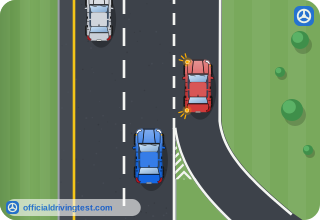
- Speed up to block it
- Make room for it
- Flash your headlights to stop it
- Move onto the shoulder
Show answer
Correct answer: Make room for it
The manual says to make room for a vehicle entering a roadway with two or more lanes.
Source: Arkansas Driver License Study Guide (Volume 1, Edition 10, October 2026), page 60 · Open this page in the manual (Manual page 60)
-
What is the "split difference rule" for steering between two hazards?
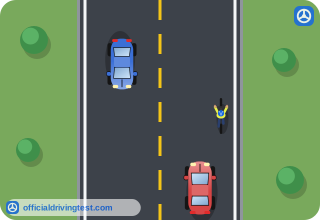
- Steer close to the hazard that looks less dangerous
- Stop between the two hazards and wait for them to move
- Steer a middle course between the two hazards
- Drive as close as possible to the hazard on your left
Show answer
Correct answer: Steer a middle course between the two hazards
The manual explains it as splitting the difference between two hazards, for example steering a middle course between oncoming and parked vehicles.
Source: Arkansas Driver License Study Guide (Volume 1, Edition 10, October 2026), page 60 · Open this page in the manual (Manual page 60)
-
If one of two hazards appears more dangerous than the other, how should you use the split difference rule?
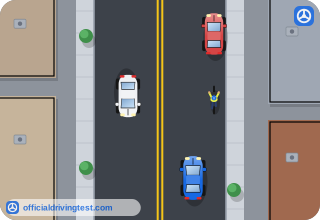
- Leave more room on the side of the less dangerous hazard
- Leave more room on the side of the more dangerous hazard
- Leave equal room on both sides regardless
- Stop and let both hazards pass first
Show answer
Correct answer: Leave more room on the side of the more dangerous hazard
The manual says to leave more room on the side of the vehicle that is more dangerous.
Source: Arkansas Driver License Study Guide (Volume 1, Edition 10, October 2026), page 60 · Open this page in the manual (Manual page 60)
-
When merging with other traffic, about how large a gap do you need?
- About four seconds
- About one second
- About two seconds
- About ten seconds
Show answer
Correct answer: About four seconds
The manual says that when merging you need a gap of about four seconds.
Source: Arkansas Driver License Study Guide (Volume 1, Edition 10, October 2026), page 61 · Open this page in the manual (Manual page 61)
-
If you move into the middle of a four-second gap while merging, what following distance will you and the vehicle behind you have?
- One second
- Three seconds
- Two seconds
- Four seconds
Show answer
Correct answer: Two seconds
The manual says that in the middle of a four-second gap, you and the vehicle behind you will have a two-second following distance.
Source: Arkansas Driver License Study Guide (Volume 1, Edition 10, October 2026), page 61 · Open this page in the manual (Manual page 61)
-
What should you do about small gaps when merging?
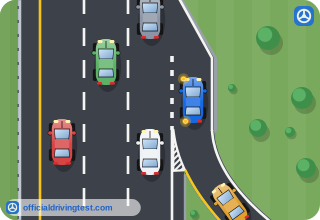
- Merge quickly before the small gap closes completely
- Do not merge in them, since small gaps can get smaller
- Merge only if you flash your headlights at the driver
- Merge if there is at least one car length of space
Show answer
Correct answer: Do not merge in them, since small gaps can get smaller
The manual says not to merge in a small gap, as it can quickly become smaller; enter a gap that gives a large cushion of space.
Source: Arkansas Driver License Study Guide (Volume 1, Edition 10, October 2026), page 61 · Open this page in the manual (Manual page 61)
-
If you are going to cross more than one lane of traffic, how should you do it?
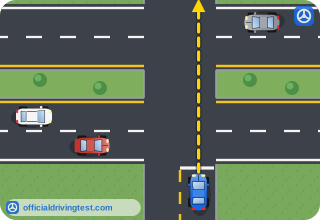
- Cross all the lanes in one move
- Stop and wait in the first lane
- Cross at a diagonal using the shoulder
- Take one lane at a time
Show answer
Correct answer: Take one lane at a time
The manual says to take one lane at a time when crossing more than one lane of traffic.
Source: Arkansas Driver License Study Guide (Volume 1, Edition 10, October 2026), page 61 · Open this page in the manual (Manual page 61)
-
As a rule, how many vehicles should you pass at one time?
- Two
- Three
- As many as are in the lane
- One
Show answer
Correct answer: One
The manual says not to count on having time to pass several cars at once; as a rule, only pass one vehicle at a time.
Source: Arkansas Driver License Study Guide (Volume 1, Edition 10, October 2026), page 61 · Open this page in the manual (Manual page 61)
-
At 55 mph, about how many seconds do you need to pass another vehicle?
- About ten seconds
- About three seconds
- About five seconds
- About twenty seconds
Show answer
Correct answer: About ten seconds
The manual says that at 55 mph you need about ten seconds to pass, so you need a ten second gap in oncoming traffic.
Source: Arkansas Driver License Study Guide (Volume 1, Edition 10, October 2026), page 62 · Open this page in the manual (Manual page 62)
-
At 55 mph, about how far do you and an oncoming vehicle travel in ten seconds?
- About 200 feet
- About 400 feet
- Over 800 feet
- Over 3000 feet
Show answer
Correct answer: Over 800 feet
The manual says at 55 mph you and the oncoming vehicle(s) travel over 800 feet in ten seconds.
Source: Arkansas Driver License Study Guide (Volume 1, Edition 10, October 2026), page 62 · Open this page in the manual (Manual page 62)
-
How does a vehicle that is very far away appear when you judge whether to pass?
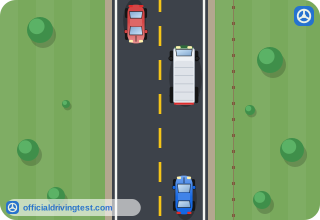
- It appears to be moving very fast
- It appears to be stationary (still)
- It appears closer than it really is
- It appears smaller but moving normally
Show answer
Correct answer: It appears to be stationary (still)
The manual says a vehicle too far away appears to be stationary (still), which makes its speed hard to judge.
Source: Arkansas Driver License Study Guide (Volume 1, Edition 10, October 2026), page 62 · Open this page in the manual (Manual page 62)
-
If you can see an oncoming vehicle coming closer, what may that mean for passing?
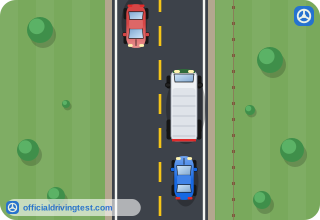
- You have plenty of time to pass safely
- It is slowing down to let you pass it
- The road ahead is clear enough to pass
- It may be traveling too fast for you to pass
Show answer
Correct answer: It may be traveling too fast for you to pass
The manual says that if you can see the vehicle coming closer, it may be traveling too fast to pass.
Source: Arkansas Driver License Study Guide (Volume 1, Edition 10, October 2026), page 62 · Open this page in the manual (Manual page 62)
-
If you are not sure whether there is enough time to pass safely, what should you do?
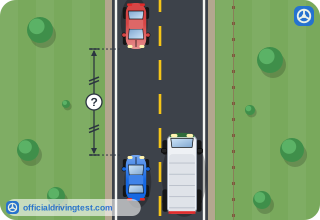
- Wait until there is more space before passing
- Pass quickly and then return to your lane
- Pass using the right shoulder if it is paved
- Flash your headlights and then start to pass
Show answer
Correct answer: Wait until there is more space before passing
The manual says to wait until there is more space before passing when you are not sure.
Source: Arkansas Driver License Study Guide (Volume 1, Edition 10, October 2026), page 62 · Open this page in the manual (Manual page 62)
-
Within what distance of a hill or curve should you not pass?
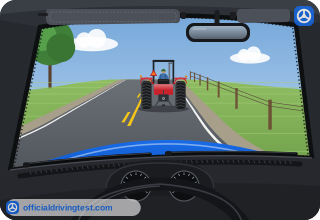
- 1/10 of a mile
- 1/2 of a mile
- 1/3 of a mile
- 1 full mile
Show answer
Correct answer: 1/3 of a mile
The manual says not to pass if you are within 1/3 of a mile of a hill or curve.
Source: Arkansas Driver License Study Guide (Volume 1, Edition 10, October 2026), page 62 · Open this page in the manual (Manual page 62)
-
When your view is blocked by a hill or a curve, what should you assume?
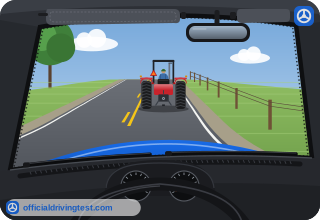
- That the road ahead is empty of other vehicles
- That an oncoming vehicle could be coming toward you
- That any oncoming drivers will move over for you
- That you may pass safely if you speed up a bit
Show answer
Correct answer: That an oncoming vehicle could be coming toward you
The manual says to always assume an oncoming vehicle could be coming whenever a hill or curve blocks your view.
Source: Arkansas Driver License Study Guide (Volume 1, Edition 10, October 2026), page 62 · Open this page in the manual (Manual page 62)
-
Which of these places does the manual name as dangerous for passing because a vehicle may enter or cross the road?
- Rest areas, scenic overlooks and picnic area entrances
- Wide shoulders, bus stops and other roadside stopping places
- Two-lane bridges, highway tunnels and toll plazas
- Intersections, railroad crossings and shopping center entrances
Show answer
Correct answer: Intersections, railroad crossings and shopping center entrances
The manual lists intersections, railroad crossings, and shopping center entrances as dangerous places to pass.
Source: Arkansas Driver License Study Guide (Volume 1, Edition 10, October 2026), page 62 · Open this page in the manual (Manual page 62)
-
Why is it dangerous to pass at an intersection?
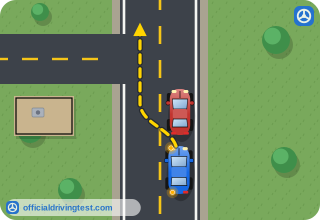
- Drivers turning right will not expect you in their lane
- Intersections never have any traffic signals to guide you
- Passing is always allowed there if you signal first
- Other drivers are required to stop for passing vehicles
Show answer
Correct answer: Drivers turning right will not expect you in their lane
The manual says drivers turning right into an approaching lane will not expect you within their lane and may not look before turning.
Source: Arkansas Driver License Study Guide (Volume 1, Edition 10, October 2026), page 62 · Open this page in the manual (Manual page 62)
-
When preparing to pass, how far behind the vehicle to be passed does the Passing Procedures diagram say to position your vehicle?
- Half a second
- Five to six seconds
- Two to three seconds
- Ten seconds
Show answer
Correct answer: Two to three seconds
The Passing Procedures diagram says to position the vehicle two to three seconds behind the vehicle to be passed.
Source: Arkansas Driver License Study Guide (Volume 1, Edition 10, October 2026), page 62 · Open this page in the manual (Manual page 62)
-
According to the Passing Procedures diagram, what do you do once you are in the passing lane to overtake the vehicle?
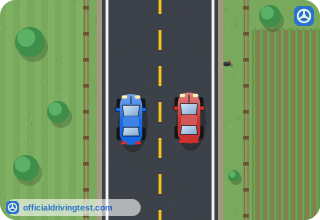
- Stay at the speed of the vehicle you are passing
- Accelerate quickly to a legal, appropriate speed
- Accelerate above the speed limit to finish fast
- Slow down and signal
Show answer
Correct answer: Accelerate quickly to a legal, appropriate speed
The diagram says to accelerate into the passing lane and then accelerate quickly to a legal appropriate speed.
Source: Arkansas Driver License Study Guide (Volume 1, Edition 10, October 2026), page 62 · Open this page in the manual (Manual page 62)
-
When does the manual say it is acceptable to pass another vehicle?
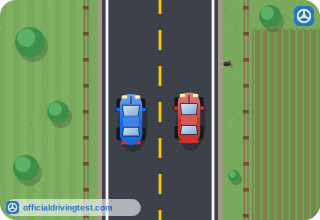
- When the other drivers have made room for you
- Whenever the vehicle ahead of you is driving slower
- After you have signaled for at least three seconds
- Only when you have enough space to return to the driving lane
Show answer
Correct answer: Only when you have enough space to return to the driving lane
The manual says never to pass unless you have enough space to return to the driving lane, and not to expect other drivers to make room.
Source: Arkansas Driver License Study Guide (Volume 1, Edition 10, October 2026), page 63 · Open this page in the manual (Manual page 63)
-
Which of these can make you lose your space for passing?
- A narrow bridge or other situation that reduces lane width
- A clear, wide shoulder beside the driving lane
- A freshly painted dashed line on the road ahead
- A vehicle that is stopped far behind you on the road
Show answer
Correct answer: A narrow bridge or other situation that reduces lane width
The manual lists people or bicyclists near the road, a narrow bridge, and ice, a pothole or an object on the road.
Source: Arkansas Driver License Study Guide (Volume 1, Edition 10, October 2026), page 63 · Open this page in the manual (Manual page 63)
-
At night, how can you tell it is safe to return to the driving lane after passing a vehicle?
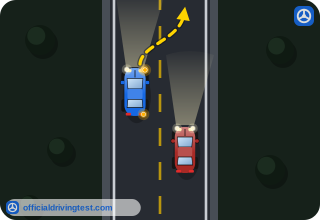
- You can see one headlight of that vehicle in your side mirror
- You have driven about ten seconds beyond that vehicle
- You see both headlights of that vehicle in your rear-view mirror
- The vehicle you passed has dimmed its lights
Show answer
Correct answer: You see both headlights of that vehicle in your rear-view mirror
The manual says that at night, seeing both headlights of the passed vehicle in your rear-view mirror means it is safe to return.
Source: Arkansas Driver License Study Guide (Volume 1, Edition 10, October 2026), page 63 · Open this page in the manual (Manual page 63)
-
How far may a fully loaded tractor-trailer traveling at 55 miles per hour need to come to a complete stop?
- About 250 feet
- About 150 feet
- More than 335 feet
- About 100 feet
Show answer
Correct answer: More than 335 feet
A fully loaded tractor-trailer at 55 miles per hour may take more than 335 feet to stop, about the length of a football field.
Source: Arkansas Driver License Study Guide (Volume 1, Edition 10, October 2026), page 64 · Open this page in the manual (Manual page 64)
-
Why is tailgating a truck or car dangerous?
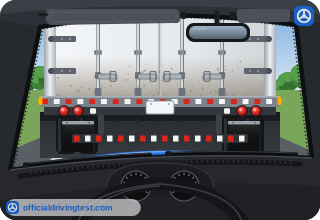
- Your headlights shine into the mirrors of the driver ahead of you
- You take away your own cushion of safety if the vehicle ahead stops
- Your horn becomes harder for the other driver to hear in traffic
- You lose sight of the traffic signs along the side of the roadway
Show answer
Correct answer: You take away your own cushion of safety if the vehicle ahead stops
Tailgating removes your own cushion of safety if the vehicle in front of you stops short.
Source: Arkansas Driver License Study Guide (Volume 1, Edition 10, October 2026), page 66 · Open this page in the manual (Manual page 66)
-
How much following distance does the manual advise when following a motorcycle?
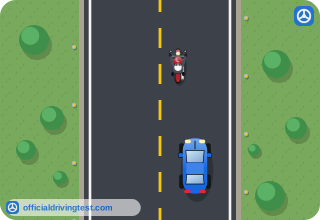
- At least one to two seconds
- At least two to three seconds
- At least eight to ten seconds
- At least four to six seconds
Show answer
Correct answer: At least four to six seconds
The manual says to allow at least four (4) to six (6) seconds when following a motorcycle so the rider has time to maneuver or stop.
Source: Arkansas Driver License Study Guide (Volume 1, Edition 10, October 2026), page 70 · Open this page in the manual (Manual page 70)
-
In dry conditions, how does a motorcycle's stopping ability compare with a car's?
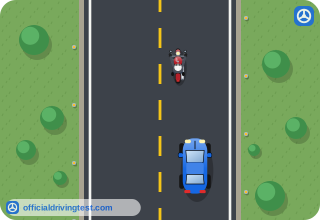
- Motorcycles can stop more quickly than a car
- Motorcycles need a longer distance to stop
- Motorcycles stop in exactly the same distance
- Motorcycles cannot stop in an emergency
Show answer
Correct answer: Motorcycles can stop more quickly than a car
The manual says that in dry conditions motorcycles can stop more quickly than a car.
Source: Arkansas Driver License Study Guide (Volume 1, Edition 10, October 2026), page 70 · Open this page in the manual (Manual page 70)
-
According to the manual, what causes the vast majority of skids?
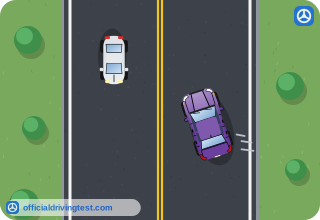
- Drivers going too fast for conditions
- Worn windshield wipers
- Drivers who follow too far behind
- Driving with the headlights on
Show answer
Correct answer: Drivers going too fast for conditions
The manual says most skids are caused by drivers traveling too fast for the conditions.
Source: Arkansas Driver License Study Guide (Volume 1, Edition 10, October 2026), page 79 · Open this page in the manual (Manual page 79)
-
What does driving at a high speed increase the possibility of if you turn or stop suddenly?
- A flat tire
- Engine failure
- A skid
- Headlight failure
Show answer
Correct answer: A skid
High speed makes a skid more likely when you turn or stop suddenly.
Source: Arkansas Driver License Study Guide (Volume 1, Edition 10, October 2026), page 79 · Open this page in the manual (Manual page 79)