Arkansas: Speed and following distance — Part 4 Practice Test
Questions in this part include: “When you use the "Four Second Sight Distance Rule", what do you pick out first?” · “For which conditions are speed limits posted?”
Independent educational site · not affiliated with any government agency or DMV
Ready? Test yourself
- Instant feedback with an explanation
- Every answer cites its source in the manual
- Your best score is saved on this device
Questions are original and based on the official manual "Arkansas Driver License Study Guide" (Volume 1, Edition 10, October 2026), Arkansas State Police (ASP).
All 19 questions in this practice test
Take the test above first, then use this list to study. Tap “Show answer” to see the correct answer and explanation.
Show the questions and answersHide the questions
-
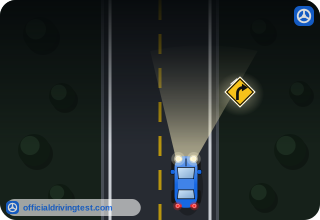
At night you should drive at a speed that lets you stop within the distance your headlights show. About what speed is that?
- Around 30 mph
- Around 40 mph
- Around 50 mph
- Around 65 mph
Show answer
Correct answer: Around 50 mph
Because headlights show about 400 feet ahead, the manual says the matching speed is around 50 mph.
Source: Arkansas Driver License Study Guide (Volume 1, Edition 10, October 2026), page 58 · Open this page in the manual (Manual page 58)
-
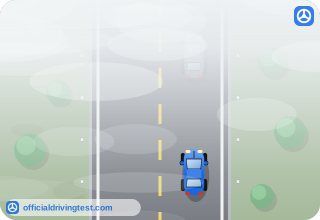
If you cannot see more than 200 feet ahead because of rain or fog, what is the fastest you should drive?
- 20 mph
- 30 mph
- 40 mph
- 45 mph
Show answer
Correct answer: 30 mph
The manual says that with less than 200 feet of visibility in rain or fog you should not drive faster than 30 mph.
Source: Arkansas Driver License Study Guide (Volume 1, Edition 10, October 2026), page 58 · Open this page in the manual (Manual page 58)
-
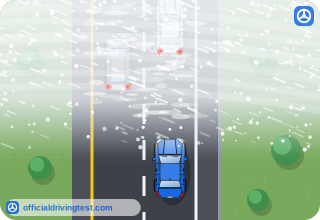
What should you do any time you cannot see the road ahead because of the weather?
- Turn on your hazard lights and keep driving slowly
- Follow the taillights of the vehicle in front of you
- Drive in the middle of the road to stay away from the edges
- Pull over in a safe place and wait until the weather clears
Show answer
Correct answer: Pull over in a safe place and wait until the weather clears
The manual says to pull over in a safe place and wait until the weather clears whenever you cannot see the road ahead.
Source: Arkansas Driver License Study Guide (Volume 1, Edition 10, October 2026), page 58 · Open this page in the manual (Manual page 58)
-
Using the "Four Second Sight Distance Rule", what does it mean if you reach a stationary object ahead before you finish counting to four?
- You are going too fast and need to slow down
- You are driving at a safe speed for the conditions
- You should count again and speed up slightly
- You are following the vehicle ahead too closely
Show answer
Correct answer: You are going too fast and need to slow down
The manual says that reaching the object before finishing the count means you are going too fast and must slow down.
Source: Arkansas Driver License Study Guide (Volume 1, Edition 10, October 2026), page 58 · Open this page in the manual (Manual page 58)
-
When you use the "Four Second Sight Distance Rule", what do you pick out first?
- The vehicle directly in front of you
- The nearest sign on the opposite side of the road
- A stationary object as far ahead as you can clearly see
- The point where your headlights end on a wet road
Show answer
Correct answer: A stationary object as far ahead as you can clearly see
The rule starts by picking a stationary object, such as a sign or utility pole, as far ahead as you can clearly see.
Source: Arkansas Driver License Study Guide (Volume 1, Edition 10, October 2026), page 58 · Open this page in the manual (Manual page 58)
-
According to the manual, about how much total stopping distance can it take at 40 mph with good tires, brakes and dry pavement?
- About 54 feet
- About 124 feet
- About 85 feet
- About 225 feet
Show answer
Correct answer: About 124 feet
The manual gives about 124 feet of total stopping distance at 40 mph.
Source: Arkansas Driver License Study Guide (Volume 1, Edition 10, October 2026), page 58 · Open this page in the manual (Manual page 58)
-
What does the manual say about a driver who cannot see a safe length ahead at the speed being driven?
- The driver may not be driving at a safe speed
- The driver should switch to high beams and keep the same speed
- The driver is allowed to drive the posted speed limit
- The driver should follow closer to the vehicle ahead
Show answer
Correct answer: The driver may not be driving at a safe speed
The manual says that if you cannot see a safe length ahead at your speed, you may not be driving at a safe speed.
Source: Arkansas Driver License Study Guide (Volume 1, Edition 10, October 2026), page 58 · Open this page in the manual (Manual page 58)
-
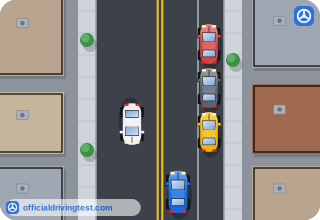
What should you be ready for when vehicles are parked along the side of the road?
- Parked vehicles suddenly backing into your lane at high speed
- A driver who will always wait for you to pass
- A person getting out of a car or walking out from between parked cars
- Traffic signals that change color without warning
Show answer
Correct answer: A person getting out of a car or walking out from between parked cars
The manual warns that parked vehicles may block your view and people may get out or walk out from parked cars.
Source: Arkansas Driver License Study Guide (Volume 1, Edition 10, October 2026), page 58 · Open this page in the manual (Manual page 58)
-
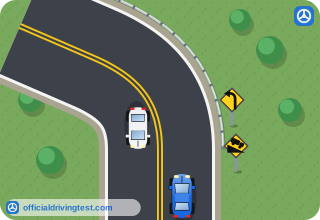
What should you do as you approach a hill or a curve where you cannot see what is on the other side?
- Speed up to clear the hill quickly
- Be ready to stop and adjust your speed
- Move to the center line to see farther ahead
- Assume the road is clear and keep your speed
Show answer
Correct answer: Be ready to stop and adjust your speed
The manual says you may not know what is on the other side of a hill or curve, so be ready to stop and adjust your speed.
Source: Arkansas Driver License Study Guide (Volume 1, Edition 10, October 2026), page 58 · Open this page in the manual (Manual page 58)
-
On which of these is a road's speed limit based, according to the manual?
- Only the number of lanes and the width of the road
- Only the weather forecast and the time of day
- The average age of the drivers who use the road
- Road design, vehicle types and road location
Show answer
Correct answer: Road design, vehicle types and road location
The manual says speed limits are based on road design, the type of vehicles used on the road, and the road location.
Source: Arkansas Driver License Study Guide (Volume 1, Edition 10, October 2026), page 58 · Open this page in the manual (Manual page 58)
-
For which conditions are speed limits posted?
- Ideal conditions
- Wet conditions only
- Nighttime conditions only
- Heavy traffic conditions
Show answer
Correct answer: Ideal conditions
The manual says speed limits are posted for ideal conditions, so drivers must adjust to ice, rain and other conditions.
Source: Arkansas Driver License Study Guide (Volume 1, Edition 10, October 2026), page 58 · Open this page in the manual (Manual page 58)
-
Can you get a ticket for driving too fast for the conditions even if you are driving at the posted speed limit?
- No, driving at or under the limit can never be ticketed
- Only if you cause a crash
- Yes, you can be ticketed for traveling too fast for the conditions
- Only if you are driving at night
Show answer
Correct answer: Yes, you can be ticketed for traveling too fast for the conditions
The manual says that even at the speed limit you can get a ticket for traveling too fast for the conditions.
Source: Arkansas Driver License Study Guide (Volume 1, Edition 10, October 2026), page 58 · Open this page in the manual (Manual page 58)
-
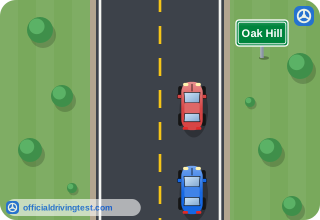
Which rule does the manual give to help you tell whether you are following another vehicle too closely?
- The one-second rule
- The two-second rule
- The three-second rule
- The ten-second rule
Show answer
Correct answer: The two-second rule
The manual says to use the "two (2) second rule" to determine if you are following too close.
Source: Arkansas Driver License Study Guide (Volume 1, Edition 10, October 2026), page 59 · Open this page in the manual (Manual page 59)
-
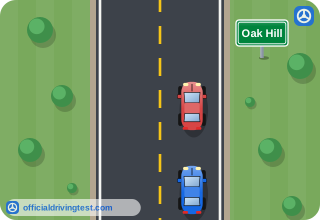
By the two-second rule, when are you following too close?
- When you reach the mark after you finish counting
- When you can still see the whole vehicle ahead
- When the vehicle ahead passes the mark first
- When you pass the mark before you finish counting
Show answer
Correct answer: When you pass the mark before you finish counting
The manual says you are following too close if you pass the mark before you finish counting.
Source: Arkansas Driver License Study Guide (Volume 1, Edition 10, October 2026), page 59 · Open this page in the manual (Manual page 59)
-
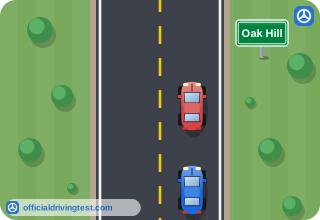
If you reach the mark before you finish counting for the two-second rule, what should you do?
- Drop back and count again until you follow no closer than two seconds
- Speed up and pass the vehicle ahead as soon as you can
- Keep your distance, since you are already following safely
- Change lanes right away and then count a second time
Show answer
Correct answer: Drop back and count again until you follow no closer than two seconds
The manual says to drop back and count again, repeating until you are following no closer than two seconds.
Source: Arkansas Driver License Study Guide (Volume 1, Edition 10, October 2026), page 59 · Open this page in the manual (Manual page 59)
-
According to the manual, what causes rear-end crashes, which are very common?
- Drivers driving too far behind
- Drivers using their turn signals too early
- Drivers following too close
- Drivers staying in the right lane
Show answer
Correct answer: Drivers following too close
The manual says rear-end crashes are very common and caused by drivers following too close.
Source: Arkansas Driver License Study Guide (Volume 1, Edition 10, October 2026), page 59 · Open this page in the manual (Manual page 59)
-
Which rule may you need to use in some situations that require more space in front of your vehicle?
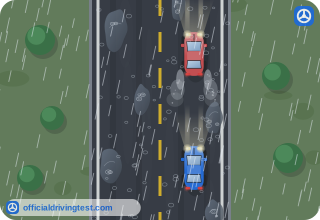
- A one-second rule
- A four-second rule
- A three-second rule
- A ten-second rule
Show answer
Correct answer: A four-second rule
The manual says that in some situations you may need to use a four second rule to be safe.
Source: Arkansas Driver License Study Guide (Volume 1, Edition 10, October 2026), page 59 · Open this page in the manual (Manual page 59)
-
Why do slippery roads require you to allow more space in front of your vehicle?
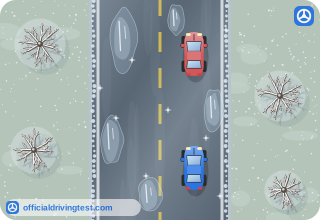
- They reduce the speed limit
- They make other drivers brake sooner
- They make your headlights dimmer
- They need more stopping distance
Show answer
Correct answer: They need more stopping distance
The manual says slippery roads require more stopping distance, so you need to allow space in front of you.
Source: Arkansas Driver License Study Guide (Volume 1, Edition 10, October 2026), page 59 · Open this page in the manual (Manual page 59)
-
When the driver behind you wants to pass, what should you do?
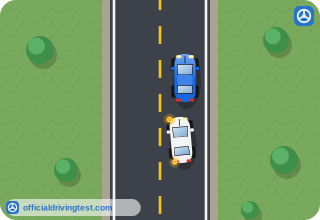
- Slow down to leave room in front of you so it can merge
- Speed up so the driver behind you cannot get past
- Move toward the left edge of your lane to block the pass
- Brake hard so the passing driver can go in front
Show answer
Correct answer: Slow down to leave room in front of you so it can merge
The manual says to slow down to allow room in front of your vehicle so the passing vehicle can merge safely.
Source: Arkansas Driver License Study Guide (Volume 1, Edition 10, October 2026), page 59 · Open this page in the manual (Manual page 59)