Arkansas: Speed and following distance — Part 2 Practice Test
Questions in this part include: “What happens to the distance it takes to slow or stop as your vehicle goes faster?” · “Through what part of your vehicle does it have its only contact with the road?”
Independent educational site · not affiliated with any government agency or DMV
Ready? Test yourself
- Instant feedback with an explanation
- Every answer cites its source in the manual
- Your best score is saved on this device
Questions are original and based on the official manual "Arkansas Driver License Study Guide" (Volume 1, Edition 10, October 2026), Arkansas State Police (ASP).
All 19 questions in this practice test
Take the test above first, then use this list to study. Tap “Show answer” to see the correct answer and explanation.
Show the questions and answersHide the questions
-
What happens to the distance it takes to slow or stop as your vehicle goes faster?
- It increases
- It stays about the same
- It decreases
- It changes only on wet roads
Show answer
Correct answer: It increases
The manual says the faster your vehicle is going, the more distance it takes to slow or stop.
Source: Arkansas Driver License Study Guide (Volume 1, Edition 10, October 2026), page 54 · Open this page in the manual (Manual page 54)
-
The average passenger car traveling at 55 miles per hour can stop within a total of how many feet?
- 125 feet
- 300 feet
- 225 feet
- 400 feet
Show answer
Correct answer: 225 feet
The manual says the average passenger car traveling at 55 mph can stop within a total of 225 feet.
Source: Arkansas Driver License Study Guide (Volume 1, Edition 10, October 2026), page 54 · Open this page in the manual (Manual page 54)
-
Which of these is listed as a way to reduce the time it takes to stop your vehicle?
- Follow other vehicles more closely
- Adjust your speed to road and traffic conditions
- Drive slightly above the posted speed limit
- Keep your high beams on at all times
Show answer
Correct answer: Adjust your speed to road and traffic conditions
The manual lists adjusting your speed to road and traffic conditions, being aware of your surroundings and obeying posted speed limits.
Source: Arkansas Driver License Study Guide (Volume 1, Edition 10, October 2026), page 54 · Open this page in the manual (Manual page 54)
-
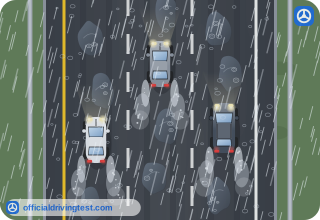
You are traveling at the maximum speed allowed and road conditions become unsafe. What should you do?
- Keep your speed because it is within the limit
- Keep your speed and use your horn
- Keep your speed and turn on your hazard lights
- Reduce your speed to the conditions
Show answer
Correct answer: Reduce your speed to the conditions
The manual says to reduce your speed to conditions when they become unsafe, even if you are at the maximum speed allowed.
Source: Arkansas Driver License Study Guide (Volume 1, Edition 10, October 2026), page 54 · Open this page in the manual (Manual page 54)
-
Through what part of your vehicle does it have its only contact with the road?
- The tires
- The brakes
- The axles
- The shock absorbers
Show answer
Correct answer: The tires
The manual says the only contact your vehicle has with the road is through the tires.
Source: Arkansas Driver License Study Guide (Volume 1, Edition 10, October 2026), page 54 · Open this page in the manual (Manual page 54)
-
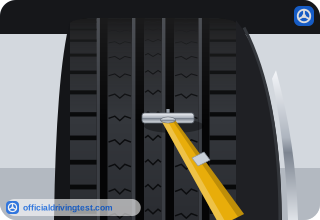
Tires with a degree of wear on the tread could be dangerous in what conditions?
- Dry, hot pavement only
- Only at night
- Wet or icy road conditions
- Only on gravel roads
Show answer
Correct answer: Wet or icy road conditions
The manual says worn tread could be dangerous in wet or icy road conditions.
Source: Arkansas Driver License Study Guide (Volume 1, Edition 10, October 2026), page 54 · Open this page in the manual (Manual page 54)
-
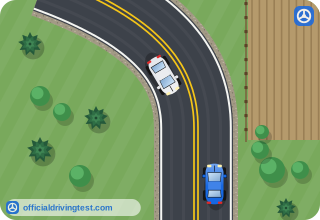
What happens if you travel too fast around a curve?
- Your headlights point away from the road
- Your tires cannot grip, so the vehicle skids
- Your brakes lock and hold the vehicle in place
- Your vehicle automatically slows down
Show answer
Correct answer: Your tires cannot grip, so the vehicle skids
Traveling too fast around a curve will not allow your tires to grip the road, causing your vehicle to skid.
Source: Arkansas Driver License Study Guide (Volume 1, Edition 10, October 2026), page 54 · Open this page in the manual (Manual page 54)
-
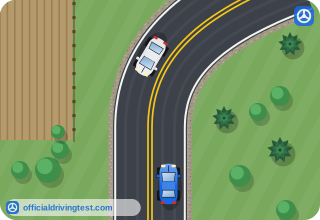
When should you slow down for a curve?
- In the middle of the curve, where it is sharpest
- As you leave the curve and begin to straighten
- Only if the curve is marked with a warning sign
- Before the curve, so you need not brake in it
Show answer
Correct answer: Before the curve, so you need not brake in it
The manual says to slow down before a curve so you do not have to brake in the curve, since braking in a curve can cause a skid.
Source: Arkansas Driver License Study Guide (Volume 1, Edition 10, October 2026), page 54 · Open this page in the manual (Manual page 54)
-
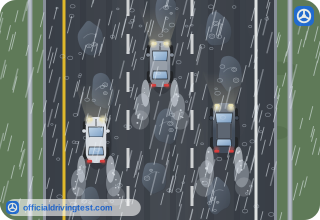
When should you decrease your speed for rain, snow or sleet?
- At the first sign of it
- Only after the road becomes covered
- Only if the road is also curving
- Only after your tires begin to slip
Show answer
Correct answer: At the first sign of it
The manual says to decrease your speed at the first sign of rain, snow or sleet.
Source: Arkansas Driver License Study Guide (Volume 1, Edition 10, October 2026), page 55 · Open this page in the manual (Manual page 55)
-
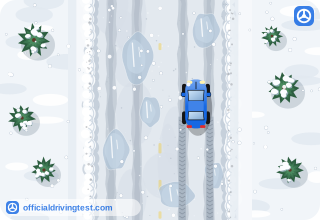
On packed snow, by how much should you cut your speed?
- By one-third
- By one-quarter
- In half
- By one-tenth
Show answer
Correct answer: In half
The manual says to cut your speed in half on packed snow.
Source: Arkansas Driver License Study Guide (Volume 1, Edition 10, October 2026), page 55 · Open this page in the manual (Manual page 55)
-
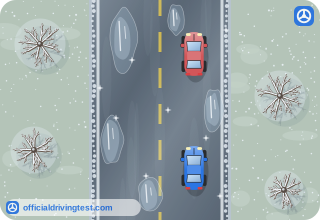
On ice, how far must you slow down?
- To half your speed
- To a coast
- To 25 mph
- To 15 mph
Show answer
Correct answer: To a coast
The manual says that on ice you must slow to a coast.
Source: Arkansas Driver License Study Guide (Volume 1, Edition 10, October 2026), page 55 · Open this page in the manual (Manual page 55)
-
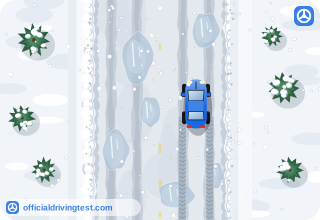
What should you do when the road becomes very slippery because of glare ice?
- Keep going at a very low speed until you reach your destination
- Speed up slightly to keep your tires from sliding
- Brake firmly to test how slippery the road is
- Stop driving as soon as you can safely do so
Show answer
Correct answer: Stop driving as soon as you can safely do so
The manual says to stop driving as soon as you can safely do so when the road is very slippery due to glare ice.
Source: Arkansas Driver License Study Guide (Volume 1, Edition 10, October 2026), page 55 · Open this page in the manual (Manual page 55)
-
On cold and wet days, where may ice linger along the roadway?
- In shady spots, the first to freeze and last to thaw
- In sunny spots, which are the first to freeze
- In the middle of the road, which is the last to freeze
- On hilltops, which are the last to thaw
Show answer
Correct answer: In shady spots, the first to freeze and last to thaw
The manual says ice may linger in shady spots, which are the first to freeze and the last to thaw.
Source: Arkansas Driver License Study Guide (Volume 1, Edition 10, October 2026), page 55 · Open this page in the manual (Manual page 55)
-
Which parts of a roadway can become some of the first to develop icy conditions?
- Straight stretches of highway
- Roads leading up to a bridge
- Overpasses and bridges
- Roads with a high speed limit
Show answer
Correct answer: Overpasses and bridges
The manual says overpasses and bridges can be among the first sections to develop icy conditions, even when the roadway leading to them is clear.
Source: Arkansas Driver License Study Guide (Volume 1, Edition 10, October 2026), page 55 · Open this page in the manual (Manual page 55)
-
When can ice be more slippery?
- When temperatures are well below freezing
- When it is near the freezing point
- When it has been on the road for several days
- When it is covered with snow
Show answer
Correct answer: When it is near the freezing point
Ice near the freezing point can be more slippery than ice at temperatures well below freezing.
Source: Arkansas Driver License Study Guide (Volume 1, Edition 10, October 2026), page 55 · Open this page in the manual (Manual page 55)
-
Why can pavement be particularly slippery for the first few minutes when it starts to rain on a hot day?
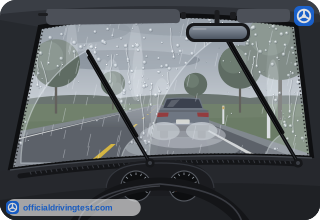
- The rain freezes as soon as it touches the hot pavement
- The heat makes the tires wear down faster
- The rain washes loose gravel onto the roadway
- Heat causes the oil in the asphalt to surface on the roadway
Show answer
Correct answer: Heat causes the oil in the asphalt to surface on the roadway
The oil that heat brings to the surface makes the road more slippery until the rain washes it away.
Source: Arkansas Driver License Study Guide (Volume 1, Edition 10, October 2026), page 55 · Open this page in the manual (Manual page 55)
-
What is it called when your tires ride up on the water on a wet road, much like water skis?
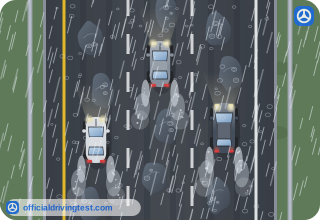
- Hydroplaning
- Fishtailing
- Wheel lock
- Tread slip
Show answer
Correct answer: Hydroplaning
The manual calls this process hydroplaning.
Source: Arkansas Driver License Study Guide (Volume 1, Edition 10, October 2026), page 55 · Open this page in the manual (Manual page 55)
-
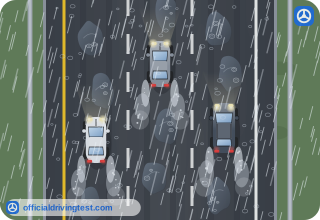
What is the best way to keep from hydroplaning?
- Brake lightly and often
- Keep your tires fully inflated at all times
- Keep your speed down
- Drive in the center of the road
Show answer
Correct answer: Keep your speed down
The manual says the best way to keep from hydroplaning is to keep your speed down.
Source: Arkansas Driver License Study Guide (Volume 1, Edition 10, October 2026), page 55 · Open this page in the manual (Manual page 55)
-
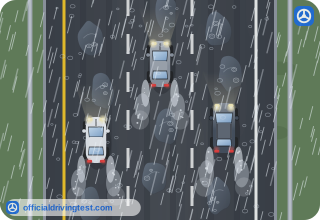
What can cause your car to hydroplane?
- A full tank of fuel
- Worn tires
- Low-beam headlights
- Dry pavement
Show answer
Correct answer: Worn tires
The manual says worn tires can cause your car to hydroplane.
Source: Arkansas Driver License Study Guide (Volume 1, Edition 10, October 2026), page 55 · Open this page in the manual (Manual page 55)