Arkansas: Speed and following distance — Part 6 Practice Test
Questions in this part include: “Which of these places does the manual name as dangerous for passing because a vehicle may enter or cross the road?” · “How far may a fully loaded tractor-trailer traveling at 55 miles per hour need to come to a complete stop?”
Independent educational site · not affiliated with any government agency or DMV
Ready? Test yourself
- Instant feedback with an explanation
- Every answer cites its source in the manual
- Your best score is saved on this device
Questions are original and based on the official manual "Arkansas Driver License Study Guide" (Volume 1, Edition 10, October 2026), Arkansas State Police (ASP).
All 18 questions in this practice test
Take the test above first, then use this list to study. Tap “Show answer” to see the correct answer and explanation.
Show the questions and answersHide the questions
-
How does a vehicle that is very far away appear when you judge whether to pass?
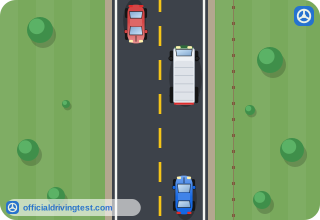
- It appears to be moving very fast
- It appears to be stationary (still)
- It appears closer than it really is
- It appears smaller but moving normally
Show answer
Correct answer: It appears to be stationary (still)
The manual says a vehicle too far away appears to be stationary (still), which makes its speed hard to judge.
Source: Arkansas Driver License Study Guide (Volume 1, Edition 10, October 2026), page 62 · Open this page in the manual (Manual page 62)
-
If you can see an oncoming vehicle coming closer, what may that mean for passing?
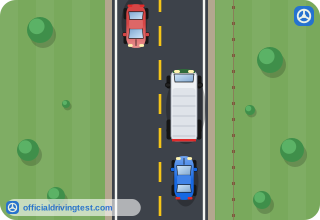
- You have plenty of time to pass safely
- It is slowing down to let you pass it
- The road ahead is clear enough to pass
- It may be traveling too fast for you to pass
Show answer
Correct answer: It may be traveling too fast for you to pass
The manual says that if you can see the vehicle coming closer, it may be traveling too fast to pass.
Source: Arkansas Driver License Study Guide (Volume 1, Edition 10, October 2026), page 62 · Open this page in the manual (Manual page 62)
-
If you are not sure whether there is enough time to pass safely, what should you do?
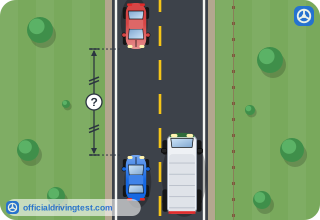
- Wait until there is more space before passing
- Pass quickly and then return to your lane
- Pass using the right shoulder if it is paved
- Flash your headlights and then start to pass
Show answer
Correct answer: Wait until there is more space before passing
The manual says to wait until there is more space before passing when you are not sure.
Source: Arkansas Driver License Study Guide (Volume 1, Edition 10, October 2026), page 62 · Open this page in the manual (Manual page 62)
-
Within what distance of a hill or curve should you not pass?
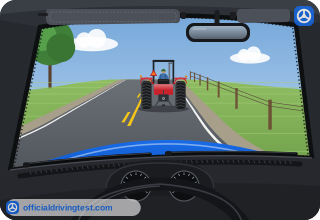
- 1/10 of a mile
- 1/2 of a mile
- 1/3 of a mile
- 1 full mile
Show answer
Correct answer: 1/3 of a mile
The manual says not to pass if you are within 1/3 of a mile of a hill or curve.
Source: Arkansas Driver License Study Guide (Volume 1, Edition 10, October 2026), page 62 · Open this page in the manual (Manual page 62)
-
When your view is blocked by a hill or a curve, what should you assume?
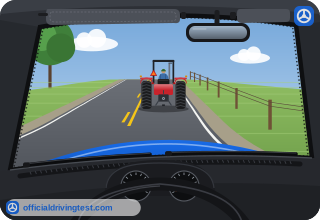
- That the road ahead is empty of other vehicles
- That an oncoming vehicle could be coming toward you
- That any oncoming drivers will move over for you
- That you may pass safely if you speed up a bit
Show answer
Correct answer: That an oncoming vehicle could be coming toward you
The manual says to always assume an oncoming vehicle could be coming whenever a hill or curve blocks your view.
Source: Arkansas Driver License Study Guide (Volume 1, Edition 10, October 2026), page 62 · Open this page in the manual (Manual page 62)
-
Which of these places does the manual name as dangerous for passing because a vehicle may enter or cross the road?
- Rest areas, scenic overlooks and picnic area entrances
- Wide shoulders, bus stops and other roadside stopping places
- Two-lane bridges, highway tunnels and toll plazas
- Intersections, railroad crossings and shopping center entrances
Show answer
Correct answer: Intersections, railroad crossings and shopping center entrances
The manual lists intersections, railroad crossings, and shopping center entrances as dangerous places to pass.
Source: Arkansas Driver License Study Guide (Volume 1, Edition 10, October 2026), page 62 · Open this page in the manual (Manual page 62)
-
Why is it dangerous to pass at an intersection?
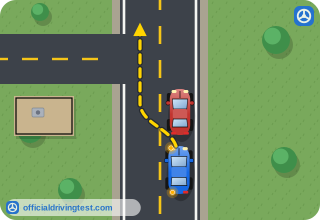
- Drivers turning right will not expect you in their lane
- Intersections never have any traffic signals to guide you
- Passing is always allowed there if you signal first
- Other drivers are required to stop for passing vehicles
Show answer
Correct answer: Drivers turning right will not expect you in their lane
The manual says drivers turning right into an approaching lane will not expect you within their lane and may not look before turning.
Source: Arkansas Driver License Study Guide (Volume 1, Edition 10, October 2026), page 62 · Open this page in the manual (Manual page 62)
-
When preparing to pass, how far behind the vehicle to be passed does the Passing Procedures diagram say to position your vehicle?
- Half a second
- Five to six seconds
- Two to three seconds
- Ten seconds
Show answer
Correct answer: Two to three seconds
The Passing Procedures diagram says to position the vehicle two to three seconds behind the vehicle to be passed.
Source: Arkansas Driver License Study Guide (Volume 1, Edition 10, October 2026), page 62 · Open this page in the manual (Manual page 62)
-
According to the Passing Procedures diagram, what do you do once you are in the passing lane to overtake the vehicle?
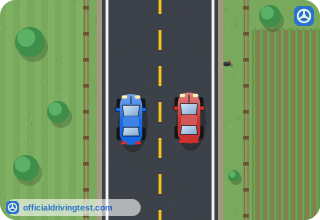
- Stay at the speed of the vehicle you are passing
- Accelerate quickly to a legal, appropriate speed
- Accelerate above the speed limit to finish fast
- Slow down and signal
Show answer
Correct answer: Accelerate quickly to a legal, appropriate speed
The diagram says to accelerate into the passing lane and then accelerate quickly to a legal appropriate speed.
Source: Arkansas Driver License Study Guide (Volume 1, Edition 10, October 2026), page 62 · Open this page in the manual (Manual page 62)
-
When does the manual say it is acceptable to pass another vehicle?
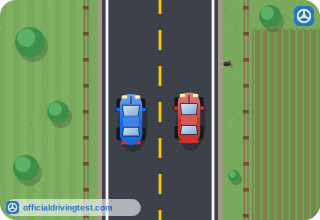
- When the other drivers have made room for you
- Whenever the vehicle ahead of you is driving slower
- After you have signaled for at least three seconds
- Only when you have enough space to return to the driving lane
Show answer
Correct answer: Only when you have enough space to return to the driving lane
The manual says never to pass unless you have enough space to return to the driving lane, and not to expect other drivers to make room.
Source: Arkansas Driver License Study Guide (Volume 1, Edition 10, October 2026), page 63 · Open this page in the manual (Manual page 63)
-
Which of these can make you lose your space for passing?
- A narrow bridge or other situation that reduces lane width
- A clear, wide shoulder beside the driving lane
- A freshly painted dashed line on the road ahead
- A vehicle that is stopped far behind you on the road
Show answer
Correct answer: A narrow bridge or other situation that reduces lane width
The manual lists people or bicyclists near the road, a narrow bridge, and ice, a pothole or an object on the road.
Source: Arkansas Driver License Study Guide (Volume 1, Edition 10, October 2026), page 63 · Open this page in the manual (Manual page 63)
-
At night, how can you tell it is safe to return to the driving lane after passing a vehicle?
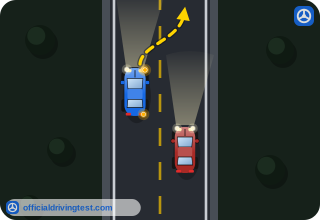
- You can see one headlight of that vehicle in your side mirror
- You have driven about ten seconds beyond that vehicle
- You see both headlights of that vehicle in your rear-view mirror
- The vehicle you passed has dimmed its lights
Show answer
Correct answer: You see both headlights of that vehicle in your rear-view mirror
The manual says that at night, seeing both headlights of the passed vehicle in your rear-view mirror means it is safe to return.
Source: Arkansas Driver License Study Guide (Volume 1, Edition 10, October 2026), page 63 · Open this page in the manual (Manual page 63)
-
How far may a fully loaded tractor-trailer traveling at 55 miles per hour need to come to a complete stop?
- About 250 feet
- About 150 feet
- More than 335 feet
- About 100 feet
Show answer
Correct answer: More than 335 feet
A fully loaded tractor-trailer at 55 miles per hour may take more than 335 feet to stop, about the length of a football field.
Source: Arkansas Driver License Study Guide (Volume 1, Edition 10, October 2026), page 64 · Open this page in the manual (Manual page 64)
-
Why is tailgating a truck or car dangerous?
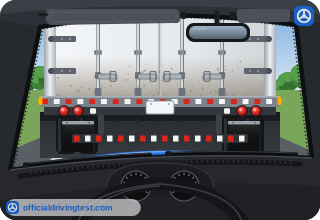
- Your headlights shine into the mirrors of the driver ahead of you
- You take away your own cushion of safety if the vehicle ahead stops
- Your horn becomes harder for the other driver to hear in traffic
- You lose sight of the traffic signs along the side of the roadway
Show answer
Correct answer: You take away your own cushion of safety if the vehicle ahead stops
Tailgating removes your own cushion of safety if the vehicle in front of you stops short.
Source: Arkansas Driver License Study Guide (Volume 1, Edition 10, October 2026), page 66 · Open this page in the manual (Manual page 66)
-
How much following distance does the manual advise when following a motorcycle?
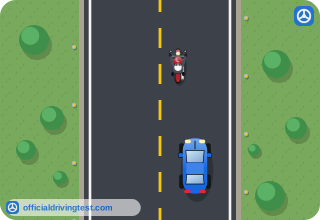
- At least one to two seconds
- At least two to three seconds
- At least eight to ten seconds
- At least four to six seconds
Show answer
Correct answer: At least four to six seconds
The manual says to allow at least four (4) to six (6) seconds when following a motorcycle so the rider has time to maneuver or stop.
Source: Arkansas Driver License Study Guide (Volume 1, Edition 10, October 2026), page 70 · Open this page in the manual (Manual page 70)
-
In dry conditions, how does a motorcycle's stopping ability compare with a car's?
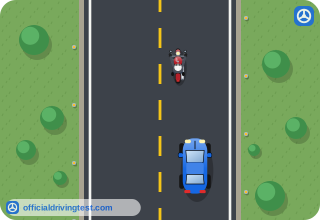
- Motorcycles can stop more quickly than a car
- Motorcycles need a longer distance to stop
- Motorcycles stop in exactly the same distance
- Motorcycles cannot stop in an emergency
Show answer
Correct answer: Motorcycles can stop more quickly than a car
The manual says that in dry conditions motorcycles can stop more quickly than a car.
Source: Arkansas Driver License Study Guide (Volume 1, Edition 10, October 2026), page 70 · Open this page in the manual (Manual page 70)
-
According to the manual, what causes the vast majority of skids?
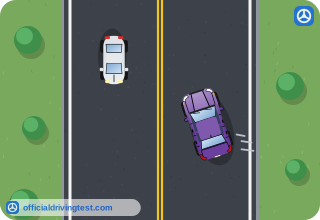
- Drivers going too fast for conditions
- Worn windshield wipers
- Drivers who follow too far behind
- Driving with the headlights on
Show answer
Correct answer: Drivers going too fast for conditions
The manual says most skids are caused by drivers traveling too fast for the conditions.
Source: Arkansas Driver License Study Guide (Volume 1, Edition 10, October 2026), page 79 · Open this page in the manual (Manual page 79)
-
What does driving at a high speed increase the possibility of if you turn or stop suddenly?
- A flat tire
- Engine failure
- A skid
- Headlight failure
Show answer
Correct answer: A skid
High speed makes a skid more likely when you turn or stop suddenly.
Source: Arkansas Driver License Study Guide (Volume 1, Edition 10, October 2026), page 79 · Open this page in the manual (Manual page 79)