Arizona: Sharing the road
Bicyclists, motorcyclists, trucks and their no-zones, buses and slow-moving vehicles. Split into 3 shorter tests so you're not stuck in one long quiz.
Independent educational site · not affiliated with any government agency or DMV
Choose a part
Sharing the road — Part 1
Questions in this part include: “What does a school bus display while passengers are entering or leaving it?”
StartSharing the road — Part 2
Questions in this part include: “What is the rule about carrying passengers on a bicycle?”
StartSharing the road — Part 3
Questions in this part include: “What do trucks do when making a right turn?”
StartAll 50 Sharing the road questions with answers
Choose a part above to take a practice test, or study every question and answer here.
Show the questions and answersHide the questions
-
When sharing a lane with a bicycle, how much clearance should you allow between you and the bicycle?
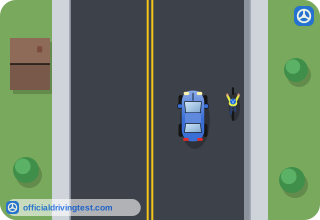
- At least 3 feet
- At least 1 foot
- At least 5 feet
- At least 10 feet
Show answer
Correct answer: At least 3 feet
The manual says to allow at least 3 feet of clearance when sharing a lane with a bicycle.
Source: Arizona Driver License Manual and Customer Service Guide (Revised March 2026), page 25
-
What should bicyclists do at a roundabout?
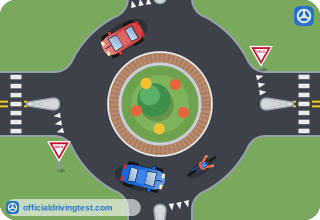
- Ride against the direction of traffic around the island
- Stop in the circle to let vehicles pass
- Be aware of traffic rules, or walk the bike and use the crosswalks
- Ride across the central island to save time
Show answer
Correct answer: Be aware of traffic rules, or walk the bike and use the crosswalks
Bicyclists should be aware of traffic rules, or walk their bike and use the crosswalks.
Source: Arizona Driver License Manual and Customer Service Guide (Revised March 2026), page 28
-
What must you do when approaching a school bus that is picking up or dropping off passengers?
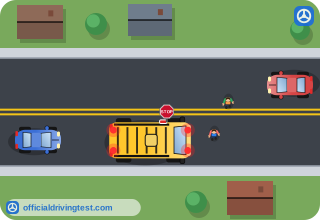
- Slow down and pass with caution
- Slow to 15 mph and pass on the left
- Come to a complete stop before reaching the bus
- Stop only if children are visible near the bus
Show answer
Correct answer: Come to a complete stop before reaching the bus
You must come to a complete stop before reaching the bus, except on a divided roadway when you are traveling in the opposite direction.
Source: Arizona Driver License Manual and Customer Service Guide (Revised March 2026), page 39
-
What does a school bus display while passengers are entering or leaving it?
- Steady amber lights and a small flag on the driver's side
- Alternating flashing lights and an extended mechanical stop-sign arm
- A single flashing white light on the roof of the bus
- Flashing hazard lights and a lowered side panel
Show answer
Correct answer: Alternating flashing lights and an extended mechanical stop-sign arm
A school bus has alternating flashing lights and a mechanical stop-sign arm extended while passengers are entering or leaving the bus.
Source: Arizona Driver License Manual and Customer Service Guide (Revised March 2026), page 39
-
How long must you remain stopped for a school bus that is loading or unloading passengers?
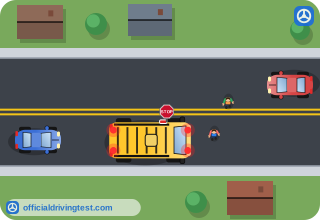
- Until the last child has crossed safely in front of your own vehicle
- For at least thirty seconds after the bus doors have closed
- Until the bus driver waves you forward past the stopped bus
- Until the bus moves ahead or the stop-sign arm and lights are no longer shown
Show answer
Correct answer: Until the bus moves ahead or the stop-sign arm and lights are no longer shown
You must remain stopped until the school bus moves ahead or until the stop-sign arm and flashing lights are no longer shown.
Source: Arizona Driver License Manual and Customer Service Guide (Revised March 2026), page 39
-
When are you NOT required to stop for a school bus on a divided roadway?
- When you are traveling in the opposite direction
- When the road has a painted center stripe
- When no children are visible near the bus
- When the bus is in the lane next to yours
Show answer
Correct answer: When you are traveling in the opposite direction
You are not required to stop for a school bus on a divided roadway when traveling in the opposite direction.
Source: Arizona Driver License Manual and Customer Service Guide (Revised March 2026), page 39
-
What makes a roadway divided when you meet a school bus?
- Double yellow lines or other striping painted down the center of the road
- A painted center turn lane between the two directions of traffic
- Physical barriers such as a fence, curbing or separation of the pavement
- Any road with two or more lanes in each direction
Show answer
Correct answer: Physical barriers such as a fence, curbing or separation of the pavement
A divided roadway is one separated by physical barriers such as a fence, curbing or separation of the pavement; roadway striping by itself does not count.
Source: Arizona Driver License Manual and Customer Service Guide (Revised March 2026), page 39
-
On a divided roadway, a school bus with flashing lights is stopped in your direction of traffic. What must you do?
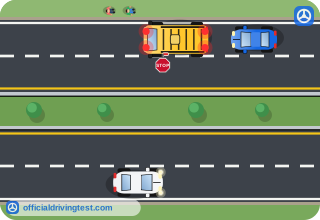
- Slow down and pass the bus with caution if the road is clear
- Stop; you may proceed only if the bus is in the approaching lanes
- Stop only if its stop-sign arm is not out
- Continue at the posted speed limit if the road has a median
Show answer
Correct answer: Stop; you may proceed only if the bus is in the approaching lanes
On a divided roadway you may proceed with caution if the school bus is in the approaching lanes, but not if it is stopped in your direction of traffic.
Source: Arizona Driver License Manual and Customer Service Guide (Revised March 2026), page 39
-
Why should you use extreme care near any stopped school bus?
- The bus may suddenly back up into traffic
- Other drivers often pass the bus on the right
- The bus driver cannot see vehicles behind it
- A child may dart from the front or the rear of the bus
Show answer
Correct answer: A child may dart from the front or the rear of the bus
Motorists should exercise extreme care near any stopped school bus because a child may dart from the front or the rear of the bus.
Source: Arizona Driver License Manual and Customer Service Guide (Revised March 2026), page 39
-
How do the traffic laws apply to bicyclists?
- Bicyclists follow special bicycle rules and are exempt from most traffic laws
- Bicyclists must obey traffic signals but not speed limits
- Bicyclists must obey the same traffic laws as drivers of vehicles
- Bicyclists must follow traffic laws only on roads without a bike lane
Show answer
Correct answer: Bicyclists must obey the same traffic laws as drivers of vehicles
Bicyclists must obey the same traffic laws as drivers, and they have the right-of-way under the same conditions as motorists.
Source: Arizona Driver License Manual and Customer Service Guide (Revised March 2026), page 50
-
When does a bicyclist have the right-of-way?
- Always, because bicycles are smaller than cars
- Under the same conditions as a motorist
- Only when riding in a marked bike lane
- Only at intersections with traffic signals
Show answer
Correct answer: Under the same conditions as a motorist
Bicyclists have the right-of-way under the same conditions as motorists.
Source: Arizona Driver License Manual and Customer Service Guide (Revised March 2026), page 50
-
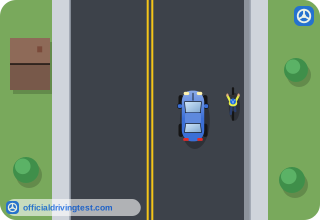
What minimum safe distance must motorists allow when passing a bicyclist traveling in the same direction?
- 1 foot
- 5 feet
- 10 feet
- 3 feet
Show answer
Correct answer: 3 feet
Motorists are required to allow a minimum safe distance of 3 feet when passing a bicyclist traveling in the same direction.
Source: Arizona Driver License Manual and Customer Service Guide (Revised March 2026), page 50
-
Why is it not safe to honk your horn at a bicyclist when passing?
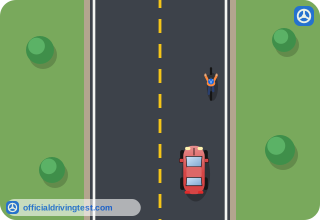
- It may startle the bicyclist and cause a crash
- It is not safe because it makes the bicyclist stop in the lane
- It is not safe because it may be mistaken for a train horn
- It is not safe because bicyclists cannot hear a horn
Show answer
Correct answer: It may startle the bicyclist and cause a crash
Honking when passing may startle the bicyclist and cause a crash.
Source: Arizona Driver License Manual and Customer Service Guide (Revised March 2026), page 50
-
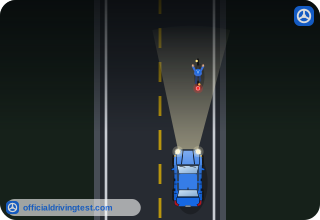
What should you do at night to be courteous to bicyclists?
- Turn on your high beams
- Turn on your hazard lights
- Dim your headlights
- Flash your headlights
Show answer
Correct answer: Dim your headlights
The manual says to dim your headlights at night to be courteous to bicyclists.
Source: Arizona Driver License Manual and Customer Service Guide (Revised March 2026), page 50
-
A bicyclist ahead of you in the lane moves left. Which of these is a legal reason a bicyclist may do so?
- The bicyclist is riding in a clearly marked bike lane on the road
- The lane is too narrow for a bike and a car side-by-side
- The bicyclist wants to ride facing oncoming traffic on a two-way road
- The driver behind the bicyclist is honking at the bicyclist
Show answer
Correct answer: The lane is too narrow for a bike and a car side-by-side
Bicyclists may legally move left for several reasons, including when the lane is too narrow for a bicycle and a motor vehicle to travel side-by-side.
Source: Arizona Driver License Manual and Customer Service Guide (Revised March 2026), page 50
-
Which of these is listed as a reason a bicyclist can legally move left?
- Riding faster than traffic
- Taking a shortcut through the intersection
- Racing with another bicyclist
- Avoiding hazards
Show answer
Correct answer: Avoiding hazards
The manual lists turning left, avoiding hazards and passing pedestrians or vehicles among the reasons a bicyclist can legally move left.
Source: Arizona Driver License Manual and Customer Service Guide (Revised March 2026), page 50
-
In which direction must bicyclists ride?
- In the same direction as traffic
- Against traffic so they can see oncoming vehicles
- In either direction on a road with a bike lane
- Against traffic on roads with no sidewalk
Show answer
Correct answer: In the same direction as traffic
The manual lists riding in the same direction as traffic among the important rules for bicyclists.
Source: Arizona Driver License Manual and Customer Service Guide (Revised March 2026), page 50
-
What is the rule about carrying passengers on a bicycle?
- Never carry any passenger on a bicycle on public roads
- Carry no more than one passenger on any kind of bicycle
- Do not carry more persons than the bicycle design permits
- Carry passengers only in the daytime on quiet streets
Show answer
Correct answer: Do not carry more persons than the bicycle design permits
A bicyclist must not carry more persons than the design of the bicycle permits.
Source: Arizona Driver License Manual and Customer Service Guide (Revised March 2026), page 50
-
How many bicyclists may ride side-by-side?
- No more than three
- No more than two
- Only one
- As many as the lane allows
Show answer
Correct answer: No more than two
The manual says not to ride more than two bicyclists side-by-side.
Source: Arizona Driver License Manual and Customer Service Guide (Revised March 2026), page 50
-
Where on the road should a bicyclist ride?
- In the center of the lane at all times
- As near to the left side of the road as practicable
- On the shoulder of the left side
- As near to the right side of the road as practicable
Show answer
Correct answer: As near to the right side of the road as practicable
Bicyclists should ride as near to the right side of the road as practicable.
Source: Arizona Driver License Manual and Customer Service Guide (Revised March 2026), page 50
-
What must a bicyclist use to show a turn?
- Proper hand signals
- A horn or bell only
- A hand wave to the car behind only
- Nothing, since bicycles have no signals
Show answer
Correct answer: Proper hand signals
The manual lists using proper hand signals among the important rules for bicyclists.
Source: Arizona Driver License Manual and Customer Service Guide (Revised March 2026), page 50
-
What must a bicycle have when ridden at night?
- A white head lamp visible from 200 feet and a rear flasher
- A white head lamp visible from 500 feet and a rear reflector
- A red head lamp and a white rear reflector
- A white head lamp visible from 1,000 feet only
Show answer
Correct answer: A white head lamp visible from 500 feet and a rear reflector
At night a bicyclist needs a white head lamp visible from 500 feet and a rear reflector.
Source: Arizona Driver License Manual and Customer Service Guide (Revised March 2026), page 50
-
What can a bicyclist add to improve visibility to drivers at night?
- A flashing white light on the front fork
- A steady green light on the handlebars
- A bright flag on the rear wheel
- A flashing red beacon on the rear of the bicycle
Show answer
Correct answer: A flashing red beacon on the rear of the bicycle
The manual says a flashing red beacon on the rear of the bicycle improves visibility to drivers.
Source: Arizona Driver License Manual and Customer Service Guide (Revised March 2026), page 50
-
How do motorcyclists compare with car drivers when a crash occurs?
- Motorcyclists are more vulnerable to injury
- Motorcyclists are less vulnerable because they can steer around the crash
- Motorcyclists are equally vulnerable to injury
- Motorcyclists are more vulnerable only at night
Show answer
Correct answer: Motorcyclists are more vulnerable to injury
Motorcyclists are more vulnerable to injury than a car driver if involved in a crash.
Source: Arizona Driver License Manual and Customer Service Guide (Revised March 2026), page 50
-
What is the usual cause of most car/motorcycle crashes?
- A motorcycle passing on the right
- A motorcycle following too closely
- A car turning in front of a motorcycle
- A car backing out of a parking space
Show answer
Correct answer: A car turning in front of a motorcycle
Most car/motorcycle crashes result from a car turning in front of a motorcycle, usually because the driver did not see it or misjudged its distance and speed.
Source: Arizona Driver License Manual and Customer Service Guide (Revised March 2026), page 51
-
How may the smaller size of a motorcycle make it appear to a driver?
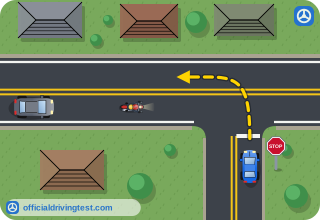
- Closer and faster than it actually is
- Farther away and slower than it actually is
- Closer but slower than it actually is
- Farther away but faster than it actually is
Show answer
Correct answer: Farther away and slower than it actually is
A motorcycle may appear to be farther away and traveling slower than it actually is.
Source: Arizona Driver License Manual and Customer Service Guide (Revised March 2026), page 51
-
Why is it harder to judge a motorcycle’s distance and speed?
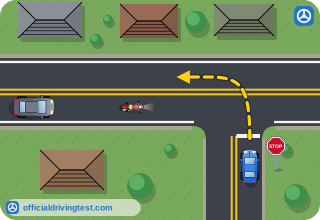
- It has no turn signals to show its movements
- Its headlight is always turned off in daylight
- It travels in the center of the lane only
- A single light provides fewer visual cues
Show answer
Correct answer: A single light provides fewer visual cues
A motorcycle’s single taillight or headlight provides fewer visual cues for judging distance.
Source: Arizona Driver License Manual and Customer Service Guide (Revised March 2026), page 51
-
How does weather affect motorcyclists?
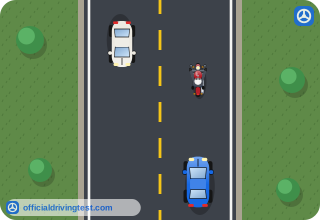
- They are less stable in rain and wind
- They are less stable only in snow
- They are more stable in wind than cars
- Weather has no effect on them
Show answer
Correct answer: They are less stable in rain and wind
The manual says motorcyclists are less stable in rain and wind.
Source: Arizona Driver License Manual and Customer Service Guide (Revised March 2026), page 51
-
What is lane filtering?
- A driver merging into the lane of a slower moving vehicle ahead
- A motorcyclist riding between two moving vehicles at highway speed
- A motorcyclist passing a stopped vehicle in the same direction and lane
- A driver changing lanes to avoid a motorcycle behind
Show answer
Correct answer: A motorcyclist passing a stopped vehicle in the same direction and lane
The manual calls a motorcyclist passing a stopped vehicle in the same direction and lane “lane filtering”.
Source: Arizona Driver License Manual and Customer Service Guide (Revised March 2026), page 51
-
Lane filtering by a motorcycle is allowed only if the street is divided into at least how many adjacent lanes traveling in the same direction?
- 1
- 2
- 3
- 4
Show answer
Correct answer: 2
Lane filtering requires at least 2 adjacent lanes traveling in the same direction.
Source: Arizona Driver License Manual and Customer Service Guide (Revised March 2026), page 51
-
Lane filtering by a motorcycle is allowed only if the posted speed limit does not exceed what?
- 25 miles per hour
- 35 miles per hour
- 55 miles per hour
- 45 miles per hour
Show answer
Correct answer: 45 miles per hour
Lane filtering is allowed only where the posted speed limit does not exceed 45 miles per hour.
Source: Arizona Driver License Manual and Customer Service Guide (Revised March 2026), page 51
-
During lane filtering, a motorcycle may not travel faster than what?
- 15 miles per hour
- 5 miles per hour
- 25 miles per hour
- 35 miles per hour
Show answer
Correct answer: 15 miles per hour
A motorcycle lane filtering may not travel faster than 15 miles per hour.
Source: Arizona Driver License Manual and Customer Service Guide (Revised March 2026), page 51
-
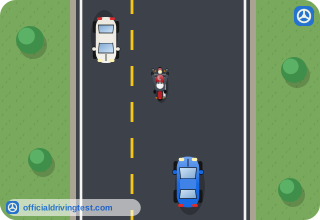
A motorcyclist moves to one side of the lane. What should you do?
- Assume the rider is about to turn
- Assume the rider will leave the lane
- Not assume the rider’s intentions
- Assume the rider wants you to pass
Show answer
Correct answer: Not assume the rider’s intentions
The manual says not to assume the rider’s intentions; a rider may move to one side to prepare for a turn, avoid a hazard or improve visibility.
Source: Arizona Driver License Manual and Customer Service Guide (Revised March 2026), page 51
-
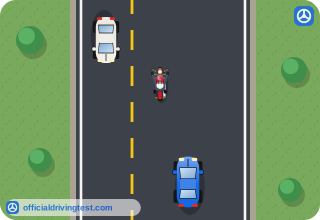
Why might a motorcyclist shift within the lane?
- To signal that the driver behind should pass
- To avoid oil, potholes or debris
- To warm up the tires
- Because the motorcycle must stay on the lane line
Show answer
Correct answer: To avoid oil, potholes or debris
Motorcyclists may shift within their lane to avoid oil, potholes or debris, so one may unexpectedly come into your lane.
Source: Arizona Driver License Manual and Customer Service Guide (Revised March 2026), page 51
-
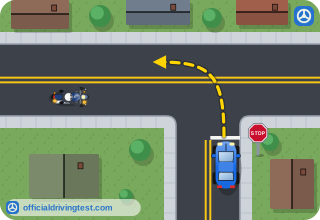
What should you know about motorcycle turn signals?
- They shut off automatically after the turn is completed
- They flash only when the brakes are applied by the rider
- They are not required to be on motorcycles by law
- They do not shut off automatically, so riders may forget
Show answer
Correct answer: They do not shut off automatically, so riders may forget
Motorcycle turn signals do not automatically shut off, so make sure you know what the rider is doing before you move into the motorcycle’s path.
Source: Arizona Driver License Manual and Customer Service Guide (Revised March 2026), page 51
-
How much of a lane are motorcycles allowed in which to maneuver?
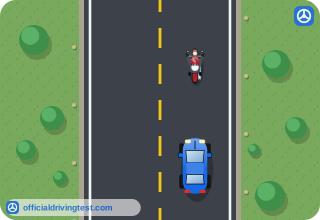
- The full width of the lane
- Half the width of the lane
- Only the left third of the lane
- Only the wheel track nearest the center line
Show answer
Correct answer: The full width of the lane
Motorcycles are allowed the full width of a lane, so never crowd into the same lane as a motorcycle.
Source: Arizona Driver License Manual and Customer Service Guide (Revised March 2026), page 51
-
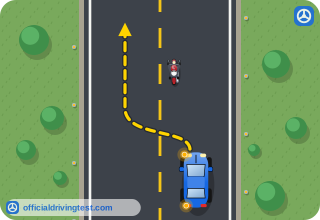
What can happen if you return to the original lane too soon after passing a motorcycle?
- It can make the rider lose the lane filtering right
- It can set off the rider’s turn signal
- It can force the rider to swerve into traffic or off the road
- It can cause the rider to stop in the lane
Show answer
Correct answer: It can force the rider to swerve into traffic or off the road
Returning to the original lane too soon can force the rider to swerve into traffic or off the road.
Source: Arizona Driver License Manual and Customer Service Guide (Revised March 2026), page 51
-
Why should you not cut in front of a truck?
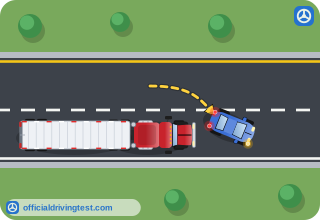
- Trucks cannot stop at all on a downgrade
- It takes trucks twice as long to stop
- Trucks always have the right-of-way
- Trucks stop in half the distance of a car
Show answer
Correct answer: It takes trucks twice as long to stop
It takes trucks twice as long to stop, so if you cut in and brake suddenly, you cut the truck's available stopping distance in half.
Source: Arizona Driver License Manual and Customer Service Guide (Revised March 2026), page 52
-
If you move in front of a truck and brake suddenly, what happens to the truck’s available stopping distance?
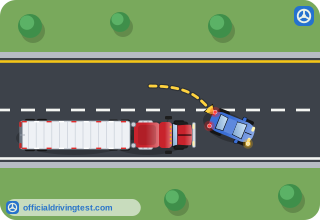
- It is cut by one quarter
- It is doubled
- It stays the same
- It is cut in half
Show answer
Correct answer: It is cut in half
Braking suddenly in front of a truck cuts its available stopping distance in half.
Source: Arizona Driver License Manual and Customer Service Guide (Revised March 2026), page 52
-
What is the “No-Zone” around large trucks and buses?
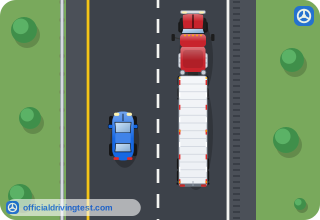
- The blind spots around the vehicle
- The area directly behind the vehicle where passing is banned
- The lane reserved for trucks
- The space where trucks may not park
Show answer
Correct answer: The blind spots around the vehicle
The “No-Zone” is the blind spots around large trucks and buses, and you should not hang out in it.
Source: Arizona Driver License Manual and Customer Service Guide (Revised March 2026), page 52
-
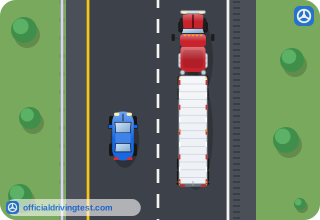
Where do trucks have large blind spots?
- Only directly behind the trailer of the vehicle
- Only on the left side of the cab and trailer
- Around the front and back sides of the vehicle
- Only directly in front of the cab of the truck
Show answer
Correct answer: Around the front and back sides of the vehicle
Trucks have large blind spots around the front and back sides of the vehicle.
Source: Arizona Driver License Manual and Customer Service Guide (Revised March 2026), page 52
-
What do trucks do when making a right turn?
- They make tight right turns from the far right edge of the lane
- They always turn right from the left lane of the road
- They stop completely before every right turn they make
- They make wide right turns and may leave an open space on the right
Show answer
Correct answer: They make wide right turns and may leave an open space on the right
Trucks make wide right turns and sometimes must leave an open space on the right just before turning.
Source: Arizona Driver License Manual and Customer Service Guide (Revised March 2026), page 52
-
When should you not pass a truck on the right?
- If it might possibly make a right turn
- If the truck is traveling below the speed limit
- If the truck has its hazard lights on
- If the truck is carrying a load
Show answer
Correct answer: If it might possibly make a right turn
To avoid a collision, do not pass a truck on the right if there is any possibility that it might make a right turn.
Source: Arizona Driver License Manual and Customer Service Guide (Revised March 2026), page 52
-
How many cars can a truck weigh as much as, according to the manual’s warning about parked vehicles on a highway shoulder?
- 5 cars
- 25 cars
- 10 cars
- 50 cars
Show answer
Correct answer: 25 cars
The manual says a truck can weigh as much as 25 cars, so a parked car struck by a truck could suffer tragic results.
Source: Arizona Driver License Manual and Customer Service Guide (Revised March 2026), page 52
-
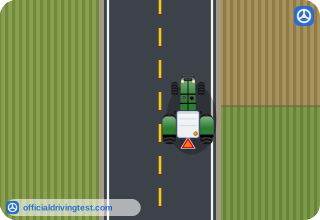
What should you do around farm machinery and other slow-moving vehicles?
- Follow as closely as possible to stay out of the oncoming lane
- Pass immediately on the right
- Stay beside them to keep them in view
- Keep a safe following distance with an adequate field of vision
Show answer
Correct answer: Keep a safe following distance with an adequate field of vision
The manual says to maintain a safe following distance that provides an adequate field of vision around farm machinery and other slow-moving vehicles.
Source: Arizona Driver License Manual and Customer Service Guide (Revised March 2026), page 52
-
Which of these is true of farm machinery?
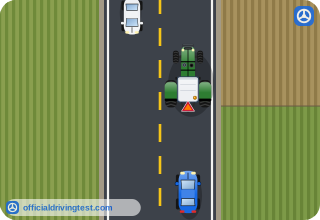
- It may take up more than one lane and may not have signals
- It always has signals and stays within a single lane
- It must travel faster than 25 mph on the road
- It may only travel on freeways and highways
Show answer
Correct answer: It may take up more than one lane and may not have signals
Farm machinery usually travels at 25 mph or less, may take up more than one lane, and may not have signals.
Source: Arizona Driver License Manual and Customer Service Guide (Revised March 2026), page 52
-
How may the operator of farm machinery make a wide turn?
- First pull to the right, then turn to the left
- Stop in the lane and signal
- First pull to the left, then turn to the right
- Turn from the center of the road
Show answer
Correct answer: First pull to the left, then turn to the right
To make a wide turn, operators of farm machinery may first pull to the left, then turn to the right.
Source: Arizona Driver License Manual and Customer Service Guide (Revised March 2026), page 52
-
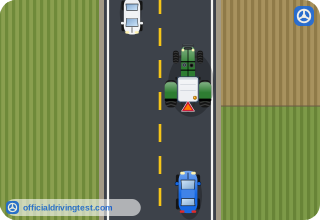
Why should you not become impatient behind a slow-moving vehicle?
- It has the legal right to be there
- It is exempt from traffic signals
- It will pull over after a short distance
- It may be passed only on the right
Show answer
Correct answer: It has the legal right to be there
The manual says a slow-moving vehicle has the legal right to be on the road, so do not become impatient.
Source: Arizona Driver License Manual and Customer Service Guide (Revised March 2026), page 52
-
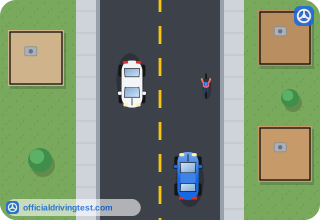
When you cannot separate risks and must deal with two or more at once, to which should you give the most room?
- The danger closest to your vehicle
- The danger that is moving the slowest
- The danger farthest ahead of you
- The greatest or most likely danger
Show answer
Correct answer: The greatest or most likely danger
The manual says to compromise by giving the most room to either the greatest or most likely danger.
Source: Arizona Driver License Manual and Customer Service Guide (Revised March 2026), page 70
-
You are on a two-lane street with oncoming cars to your left and a child riding a bike to your right. What is the correct compromise?
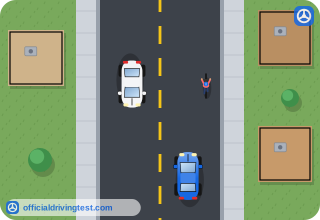
- Move closer to the center line
- Move closer to the child on the bicycle
- Stop in the middle of the road
- Speed up to pass the child quickly
Show answer
Correct answer: Move closer to the center line
The manual explains the child is the most likely to move suddenly, so moving closer to the center line is the correct compromise.
Source: Arizona Driver License Manual and Customer Service Guide (Revised March 2026), page 70