Arizona: Sharing the road — Part 1 Practice Test
Questions in this part include: “What does a school bus display while passengers are entering or leaving it?” · “How do the traffic laws apply to bicyclists?”
Independent educational site · not affiliated with any government agency or DMV
Ready? Test yourself
- Instant feedback with an explanation
- Every answer cites its source in the manual
- Your best score is saved on this device
Questions are original and based on the official manual "Arizona Driver License Manual and Customer Service Guide" (Revised March 2026), Arizona Department of Transportation Motor Vehicle Division (ADOT MVD).
All 17 questions in this practice test
Take the test above first, then use this list to study. Tap “Show answer” to see the correct answer and explanation.
Show the questions and answersHide the questions
-
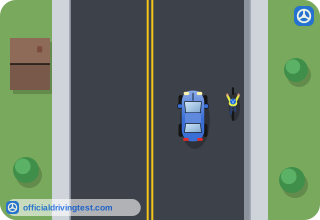
When sharing a lane with a bicycle, how much clearance should you allow between you and the bicycle?
- At least 3 feet
- At least 1 foot
- At least 5 feet
- At least 10 feet
Show answer
Correct answer: At least 3 feet
The manual says to allow at least 3 feet of clearance when sharing a lane with a bicycle.
Source: Arizona Driver License Manual and Customer Service Guide (Revised March 2026), page 25
-
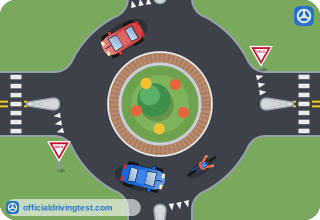
What should bicyclists do at a roundabout?
- Ride against the direction of traffic around the island
- Stop in the circle to let vehicles pass
- Be aware of traffic rules, or walk the bike and use the crosswalks
- Ride across the central island to save time
Show answer
Correct answer: Be aware of traffic rules, or walk the bike and use the crosswalks
Bicyclists should be aware of traffic rules, or walk their bike and use the crosswalks.
Source: Arizona Driver License Manual and Customer Service Guide (Revised March 2026), page 28
-
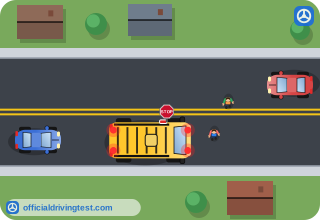
What must you do when approaching a school bus that is picking up or dropping off passengers?
- Slow down and pass with caution
- Slow to 15 mph and pass on the left
- Come to a complete stop before reaching the bus
- Stop only if children are visible near the bus
Show answer
Correct answer: Come to a complete stop before reaching the bus
You must come to a complete stop before reaching the bus, except on a divided roadway when you are traveling in the opposite direction.
Source: Arizona Driver License Manual and Customer Service Guide (Revised March 2026), page 39
-
What does a school bus display while passengers are entering or leaving it?
- Steady amber lights and a small flag on the driver's side
- Alternating flashing lights and an extended mechanical stop-sign arm
- A single flashing white light on the roof of the bus
- Flashing hazard lights and a lowered side panel
Show answer
Correct answer: Alternating flashing lights and an extended mechanical stop-sign arm
A school bus has alternating flashing lights and a mechanical stop-sign arm extended while passengers are entering or leaving the bus.
Source: Arizona Driver License Manual and Customer Service Guide (Revised March 2026), page 39
-
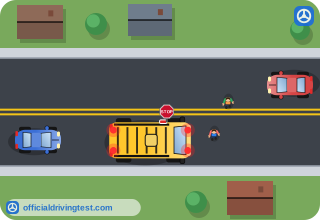
How long must you remain stopped for a school bus that is loading or unloading passengers?
- Until the last child has crossed safely in front of your own vehicle
- For at least thirty seconds after the bus doors have closed
- Until the bus driver waves you forward past the stopped bus
- Until the bus moves ahead or the stop-sign arm and lights are no longer shown
Show answer
Correct answer: Until the bus moves ahead or the stop-sign arm and lights are no longer shown
You must remain stopped until the school bus moves ahead or until the stop-sign arm and flashing lights are no longer shown.
Source: Arizona Driver License Manual and Customer Service Guide (Revised March 2026), page 39
-
When are you NOT required to stop for a school bus on a divided roadway?
- When you are traveling in the opposite direction
- When the road has a painted center stripe
- When no children are visible near the bus
- When the bus is in the lane next to yours
Show answer
Correct answer: When you are traveling in the opposite direction
You are not required to stop for a school bus on a divided roadway when traveling in the opposite direction.
Source: Arizona Driver License Manual and Customer Service Guide (Revised March 2026), page 39
-
What makes a roadway divided when you meet a school bus?
- Double yellow lines or other striping painted down the center of the road
- A painted center turn lane between the two directions of traffic
- Physical barriers such as a fence, curbing or separation of the pavement
- Any road with two or more lanes in each direction
Show answer
Correct answer: Physical barriers such as a fence, curbing or separation of the pavement
A divided roadway is one separated by physical barriers such as a fence, curbing or separation of the pavement; roadway striping by itself does not count.
Source: Arizona Driver License Manual and Customer Service Guide (Revised March 2026), page 39
-
On a divided roadway, a school bus with flashing lights is stopped in your direction of traffic. What must you do?
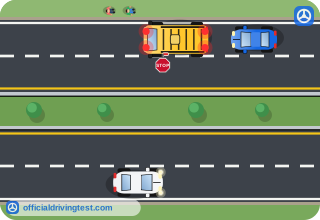
- Slow down and pass the bus with caution if the road is clear
- Stop; you may proceed only if the bus is in the approaching lanes
- Stop only if its stop-sign arm is not out
- Continue at the posted speed limit if the road has a median
Show answer
Correct answer: Stop; you may proceed only if the bus is in the approaching lanes
On a divided roadway you may proceed with caution if the school bus is in the approaching lanes, but not if it is stopped in your direction of traffic.
Source: Arizona Driver License Manual and Customer Service Guide (Revised March 2026), page 39
-
Why should you use extreme care near any stopped school bus?
- The bus may suddenly back up into traffic
- Other drivers often pass the bus on the right
- The bus driver cannot see vehicles behind it
- A child may dart from the front or the rear of the bus
Show answer
Correct answer: A child may dart from the front or the rear of the bus
Motorists should exercise extreme care near any stopped school bus because a child may dart from the front or the rear of the bus.
Source: Arizona Driver License Manual and Customer Service Guide (Revised March 2026), page 39
-
How do the traffic laws apply to bicyclists?
- Bicyclists follow special bicycle rules and are exempt from most traffic laws
- Bicyclists must obey traffic signals but not speed limits
- Bicyclists must obey the same traffic laws as drivers of vehicles
- Bicyclists must follow traffic laws only on roads without a bike lane
Show answer
Correct answer: Bicyclists must obey the same traffic laws as drivers of vehicles
Bicyclists must obey the same traffic laws as drivers, and they have the right-of-way under the same conditions as motorists.
Source: Arizona Driver License Manual and Customer Service Guide (Revised March 2026), page 50
-
When does a bicyclist have the right-of-way?
- Always, because bicycles are smaller than cars
- Under the same conditions as a motorist
- Only when riding in a marked bike lane
- Only at intersections with traffic signals
Show answer
Correct answer: Under the same conditions as a motorist
Bicyclists have the right-of-way under the same conditions as motorists.
Source: Arizona Driver License Manual and Customer Service Guide (Revised March 2026), page 50
-
What minimum safe distance must motorists allow when passing a bicyclist traveling in the same direction?
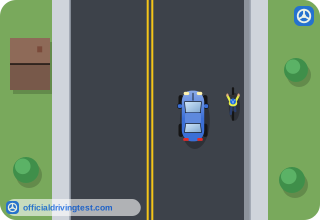
- 1 foot
- 5 feet
- 10 feet
- 3 feet
Show answer
Correct answer: 3 feet
Motorists are required to allow a minimum safe distance of 3 feet when passing a bicyclist traveling in the same direction.
Source: Arizona Driver License Manual and Customer Service Guide (Revised March 2026), page 50
-
Why is it not safe to honk your horn at a bicyclist when passing?
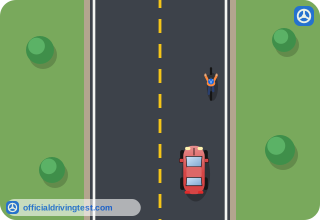
- It may startle the bicyclist and cause a crash
- It is not safe because it makes the bicyclist stop in the lane
- It is not safe because it may be mistaken for a train horn
- It is not safe because bicyclists cannot hear a horn
Show answer
Correct answer: It may startle the bicyclist and cause a crash
Honking when passing may startle the bicyclist and cause a crash.
Source: Arizona Driver License Manual and Customer Service Guide (Revised March 2026), page 50
-
What should you do at night to be courteous to bicyclists?
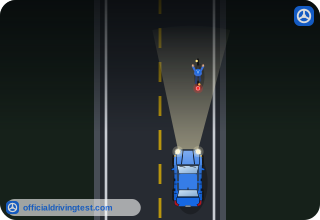
- Turn on your high beams
- Turn on your hazard lights
- Dim your headlights
- Flash your headlights
Show answer
Correct answer: Dim your headlights
The manual says to dim your headlights at night to be courteous to bicyclists.
Source: Arizona Driver License Manual and Customer Service Guide (Revised March 2026), page 50
-
A bicyclist ahead of you in the lane moves left. Which of these is a legal reason a bicyclist may do so?
- The bicyclist is riding in a clearly marked bike lane on the road
- The lane is too narrow for a bike and a car side-by-side
- The bicyclist wants to ride facing oncoming traffic on a two-way road
- The driver behind the bicyclist is honking at the bicyclist
Show answer
Correct answer: The lane is too narrow for a bike and a car side-by-side
Bicyclists may legally move left for several reasons, including when the lane is too narrow for a bicycle and a motor vehicle to travel side-by-side.
Source: Arizona Driver License Manual and Customer Service Guide (Revised March 2026), page 50
-
Which of these is listed as a reason a bicyclist can legally move left?
- Riding faster than traffic
- Taking a shortcut through the intersection
- Racing with another bicyclist
- Avoiding hazards
Show answer
Correct answer: Avoiding hazards
The manual lists turning left, avoiding hazards and passing pedestrians or vehicles among the reasons a bicyclist can legally move left.
Source: Arizona Driver License Manual and Customer Service Guide (Revised March 2026), page 50
-
In which direction must bicyclists ride?
- In the same direction as traffic
- Against traffic so they can see oncoming vehicles
- In either direction on a road with a bike lane
- Against traffic on roads with no sidewalk
Show answer
Correct answer: In the same direction as traffic
The manual lists riding in the same direction as traffic among the important rules for bicyclists.
Source: Arizona Driver License Manual and Customer Service Guide (Revised March 2026), page 50