Arizona: Sharing the road — Part 3 Practice Test
Questions in this part include: “What do trucks do when making a right turn?” · “When should you not pass a truck on the right?”
Independent educational site · not affiliated with any government agency or DMV
Ready? Test yourself
- Instant feedback with an explanation
- Every answer cites its source in the manual
- Your best score is saved on this device
Questions are original and based on the official manual "Arizona Driver License Manual and Customer Service Guide" (Revised March 2026), Arizona Department of Transportation Motor Vehicle Division (ADOT MVD).
All 16 questions in this practice test
Take the test above first, then use this list to study. Tap “Show answer” to see the correct answer and explanation.
Show the questions and answersHide the questions
-
What should you know about motorcycle turn signals?
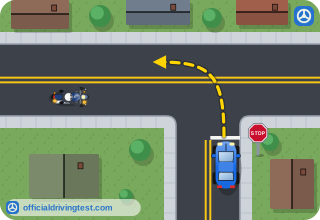
- They shut off automatically after the turn is completed
- They flash only when the brakes are applied by the rider
- They are not required to be on motorcycles by law
- They do not shut off automatically, so riders may forget
Show answer
Correct answer: They do not shut off automatically, so riders may forget
Motorcycle turn signals do not automatically shut off, so make sure you know what the rider is doing before you move into the motorcycle’s path.
Source: Arizona Driver License Manual and Customer Service Guide (Revised March 2026), page 51
-
How much of a lane are motorcycles allowed in which to maneuver?
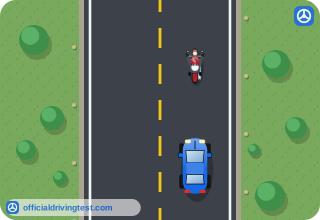
- The full width of the lane
- Half the width of the lane
- Only the left third of the lane
- Only the wheel track nearest the center line
Show answer
Correct answer: The full width of the lane
Motorcycles are allowed the full width of a lane, so never crowd into the same lane as a motorcycle.
Source: Arizona Driver License Manual and Customer Service Guide (Revised March 2026), page 51
-
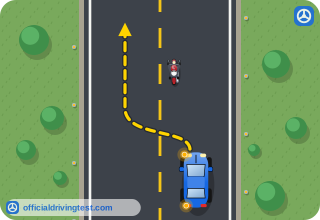
What can happen if you return to the original lane too soon after passing a motorcycle?
- It can make the rider lose the lane filtering right
- It can set off the rider’s turn signal
- It can force the rider to swerve into traffic or off the road
- It can cause the rider to stop in the lane
Show answer
Correct answer: It can force the rider to swerve into traffic or off the road
Returning to the original lane too soon can force the rider to swerve into traffic or off the road.
Source: Arizona Driver License Manual and Customer Service Guide (Revised March 2026), page 51
-
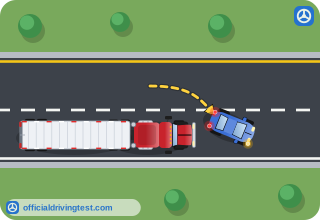
Why should you not cut in front of a truck?
- Trucks cannot stop at all on a downgrade
- It takes trucks twice as long to stop
- Trucks always have the right-of-way
- Trucks stop in half the distance of a car
Show answer
Correct answer: It takes trucks twice as long to stop
It takes trucks twice as long to stop, so if you cut in and brake suddenly, you cut the truck's available stopping distance in half.
Source: Arizona Driver License Manual and Customer Service Guide (Revised March 2026), page 52
-
If you move in front of a truck and brake suddenly, what happens to the truck’s available stopping distance?
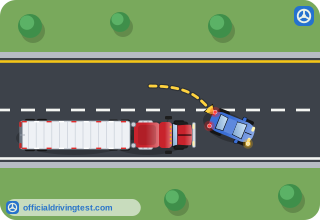
- It is cut by one quarter
- It is doubled
- It stays the same
- It is cut in half
Show answer
Correct answer: It is cut in half
Braking suddenly in front of a truck cuts its available stopping distance in half.
Source: Arizona Driver License Manual and Customer Service Guide (Revised March 2026), page 52
-
What is the “No-Zone” around large trucks and buses?
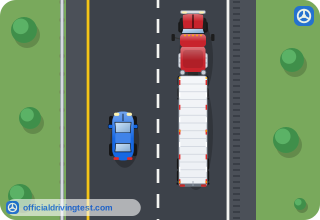
- The blind spots around the vehicle
- The area directly behind the vehicle where passing is banned
- The lane reserved for trucks
- The space where trucks may not park
Show answer
Correct answer: The blind spots around the vehicle
The “No-Zone” is the blind spots around large trucks and buses, and you should not hang out in it.
Source: Arizona Driver License Manual and Customer Service Guide (Revised March 2026), page 52
-
Where do trucks have large blind spots?
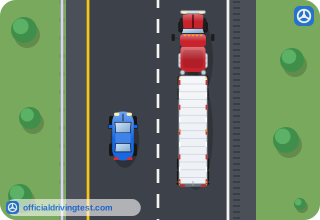
- Only directly behind the trailer of the vehicle
- Only on the left side of the cab and trailer
- Around the front and back sides of the vehicle
- Only directly in front of the cab of the truck
Show answer
Correct answer: Around the front and back sides of the vehicle
Trucks have large blind spots around the front and back sides of the vehicle.
Source: Arizona Driver License Manual and Customer Service Guide (Revised March 2026), page 52
-
What do trucks do when making a right turn?
- They make tight right turns from the far right edge of the lane
- They always turn right from the left lane of the road
- They stop completely before every right turn they make
- They make wide right turns and may leave an open space on the right
Show answer
Correct answer: They make wide right turns and may leave an open space on the right
Trucks make wide right turns and sometimes must leave an open space on the right just before turning.
Source: Arizona Driver License Manual and Customer Service Guide (Revised March 2026), page 52
-
When should you not pass a truck on the right?
- If it might possibly make a right turn
- If the truck is traveling below the speed limit
- If the truck has its hazard lights on
- If the truck is carrying a load
Show answer
Correct answer: If it might possibly make a right turn
To avoid a collision, do not pass a truck on the right if there is any possibility that it might make a right turn.
Source: Arizona Driver License Manual and Customer Service Guide (Revised March 2026), page 52
-
How many cars can a truck weigh as much as, according to the manual’s warning about parked vehicles on a highway shoulder?
- 5 cars
- 25 cars
- 10 cars
- 50 cars
Show answer
Correct answer: 25 cars
The manual says a truck can weigh as much as 25 cars, so a parked car struck by a truck could suffer tragic results.
Source: Arizona Driver License Manual and Customer Service Guide (Revised March 2026), page 52
-
What should you do around farm machinery and other slow-moving vehicles?
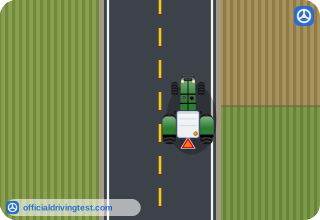
- Follow as closely as possible to stay out of the oncoming lane
- Pass immediately on the right
- Stay beside them to keep them in view
- Keep a safe following distance with an adequate field of vision
Show answer
Correct answer: Keep a safe following distance with an adequate field of vision
The manual says to maintain a safe following distance that provides an adequate field of vision around farm machinery and other slow-moving vehicles.
Source: Arizona Driver License Manual and Customer Service Guide (Revised March 2026), page 52
-
Which of these is true of farm machinery?
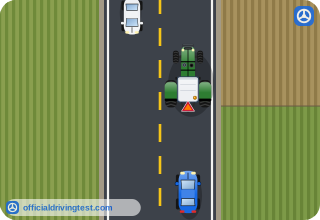
- It may take up more than one lane and may not have signals
- It always has signals and stays within a single lane
- It must travel faster than 25 mph on the road
- It may only travel on freeways and highways
Show answer
Correct answer: It may take up more than one lane and may not have signals
Farm machinery usually travels at 25 mph or less, may take up more than one lane, and may not have signals.
Source: Arizona Driver License Manual and Customer Service Guide (Revised March 2026), page 52
-
How may the operator of farm machinery make a wide turn?
- First pull to the right, then turn to the left
- Stop in the lane and signal
- First pull to the left, then turn to the right
- Turn from the center of the road
Show answer
Correct answer: First pull to the left, then turn to the right
To make a wide turn, operators of farm machinery may first pull to the left, then turn to the right.
Source: Arizona Driver License Manual and Customer Service Guide (Revised March 2026), page 52
-
Why should you not become impatient behind a slow-moving vehicle?
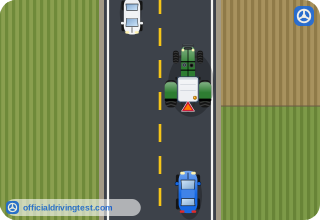
- It has the legal right to be there
- It is exempt from traffic signals
- It will pull over after a short distance
- It may be passed only on the right
Show answer
Correct answer: It has the legal right to be there
The manual says a slow-moving vehicle has the legal right to be on the road, so do not become impatient.
Source: Arizona Driver License Manual and Customer Service Guide (Revised March 2026), page 52
-
When you cannot separate risks and must deal with two or more at once, to which should you give the most room?
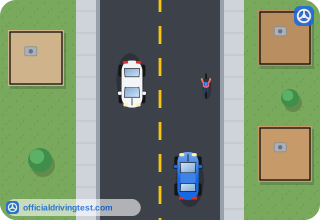
- The danger closest to your vehicle
- The danger that is moving the slowest
- The danger farthest ahead of you
- The greatest or most likely danger
Show answer
Correct answer: The greatest or most likely danger
The manual says to compromise by giving the most room to either the greatest or most likely danger.
Source: Arizona Driver License Manual and Customer Service Guide (Revised March 2026), page 70
-
You are on a two-lane street with oncoming cars to your left and a child riding a bike to your right. What is the correct compromise?
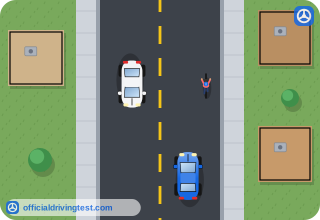
- Move closer to the center line
- Move closer to the child on the bicycle
- Stop in the middle of the road
- Speed up to pass the child quickly
Show answer
Correct answer: Move closer to the center line
The manual explains the child is the most likely to move suddenly, so moving closer to the center line is the correct compromise.
Source: Arizona Driver License Manual and Customer Service Guide (Revised March 2026), page 70