Arizona: Sharing the road — Part 2 Practice Test
Questions in this part include: “What is the rule about carrying passengers on a bicycle?” · “What can a bicyclist add to improve visibility to drivers at night?”
Independent educational site · not affiliated with any government agency or DMV
Ready? Test yourself
- Instant feedback with an explanation
- Every answer cites its source in the manual
- Your best score is saved on this device
Questions are original and based on the official manual "Arizona Driver License Manual and Customer Service Guide" (Revised March 2026), Arizona Department of Transportation Motor Vehicle Division (ADOT MVD).
All 17 questions in this practice test
Take the test above first, then use this list to study. Tap “Show answer” to see the correct answer and explanation.
Show the questions and answersHide the questions
-
What is the rule about carrying passengers on a bicycle?
- Never carry any passenger on a bicycle on public roads
- Carry no more than one passenger on any kind of bicycle
- Do not carry more persons than the bicycle design permits
- Carry passengers only in the daytime on quiet streets
Show answer
Correct answer: Do not carry more persons than the bicycle design permits
A bicyclist must not carry more persons than the design of the bicycle permits.
Source: Arizona Driver License Manual and Customer Service Guide (Revised March 2026), page 50
-
How many bicyclists may ride side-by-side?
- No more than three
- No more than two
- Only one
- As many as the lane allows
Show answer
Correct answer: No more than two
The manual says not to ride more than two bicyclists side-by-side.
Source: Arizona Driver License Manual and Customer Service Guide (Revised March 2026), page 50
-
Where on the road should a bicyclist ride?
- In the center of the lane at all times
- As near to the left side of the road as practicable
- On the shoulder of the left side
- As near to the right side of the road as practicable
Show answer
Correct answer: As near to the right side of the road as practicable
Bicyclists should ride as near to the right side of the road as practicable.
Source: Arizona Driver License Manual and Customer Service Guide (Revised March 2026), page 50
-
What must a bicyclist use to show a turn?
- Proper hand signals
- A horn or bell only
- A hand wave to the car behind only
- Nothing, since bicycles have no signals
Show answer
Correct answer: Proper hand signals
The manual lists using proper hand signals among the important rules for bicyclists.
Source: Arizona Driver License Manual and Customer Service Guide (Revised March 2026), page 50
-
What must a bicycle have when ridden at night?
- A white head lamp visible from 200 feet and a rear flasher
- A white head lamp visible from 500 feet and a rear reflector
- A red head lamp and a white rear reflector
- A white head lamp visible from 1,000 feet only
Show answer
Correct answer: A white head lamp visible from 500 feet and a rear reflector
At night a bicyclist needs a white head lamp visible from 500 feet and a rear reflector.
Source: Arizona Driver License Manual and Customer Service Guide (Revised March 2026), page 50
-
What can a bicyclist add to improve visibility to drivers at night?
- A flashing white light on the front fork
- A steady green light on the handlebars
- A bright flag on the rear wheel
- A flashing red beacon on the rear of the bicycle
Show answer
Correct answer: A flashing red beacon on the rear of the bicycle
The manual says a flashing red beacon on the rear of the bicycle improves visibility to drivers.
Source: Arizona Driver License Manual and Customer Service Guide (Revised March 2026), page 50
-
How do motorcyclists compare with car drivers when a crash occurs?
- Motorcyclists are more vulnerable to injury
- Motorcyclists are less vulnerable because they can steer around the crash
- Motorcyclists are equally vulnerable to injury
- Motorcyclists are more vulnerable only at night
Show answer
Correct answer: Motorcyclists are more vulnerable to injury
Motorcyclists are more vulnerable to injury than a car driver if involved in a crash.
Source: Arizona Driver License Manual and Customer Service Guide (Revised March 2026), page 50
-
What is the usual cause of most car/motorcycle crashes?
- A motorcycle passing on the right
- A motorcycle following too closely
- A car turning in front of a motorcycle
- A car backing out of a parking space
Show answer
Correct answer: A car turning in front of a motorcycle
Most car/motorcycle crashes result from a car turning in front of a motorcycle, usually because the driver did not see it or misjudged its distance and speed.
Source: Arizona Driver License Manual and Customer Service Guide (Revised March 2026), page 51
-
How may the smaller size of a motorcycle make it appear to a driver?
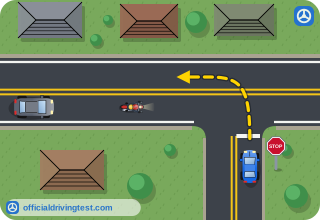
- Closer and faster than it actually is
- Farther away and slower than it actually is
- Closer but slower than it actually is
- Farther away but faster than it actually is
Show answer
Correct answer: Farther away and slower than it actually is
A motorcycle may appear to be farther away and traveling slower than it actually is.
Source: Arizona Driver License Manual and Customer Service Guide (Revised March 2026), page 51
-
Why is it harder to judge a motorcycle’s distance and speed?
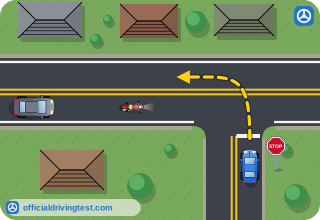
- It has no turn signals to show its movements
- Its headlight is always turned off in daylight
- It travels in the center of the lane only
- A single light provides fewer visual cues
Show answer
Correct answer: A single light provides fewer visual cues
A motorcycle’s single taillight or headlight provides fewer visual cues for judging distance.
Source: Arizona Driver License Manual and Customer Service Guide (Revised March 2026), page 51
-
How does weather affect motorcyclists?
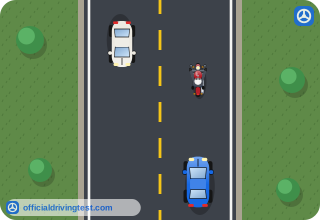
- They are less stable in rain and wind
- They are less stable only in snow
- They are more stable in wind than cars
- Weather has no effect on them
Show answer
Correct answer: They are less stable in rain and wind
The manual says motorcyclists are less stable in rain and wind.
Source: Arizona Driver License Manual and Customer Service Guide (Revised March 2026), page 51
-
What is lane filtering?
- A driver merging into the lane of a slower moving vehicle ahead
- A motorcyclist riding between two moving vehicles at highway speed
- A motorcyclist passing a stopped vehicle in the same direction and lane
- A driver changing lanes to avoid a motorcycle behind
Show answer
Correct answer: A motorcyclist passing a stopped vehicle in the same direction and lane
The manual calls a motorcyclist passing a stopped vehicle in the same direction and lane “lane filtering”.
Source: Arizona Driver License Manual and Customer Service Guide (Revised March 2026), page 51
-
Lane filtering by a motorcycle is allowed only if the street is divided into at least how many adjacent lanes traveling in the same direction?
- 1
- 2
- 3
- 4
Show answer
Correct answer: 2
Lane filtering requires at least 2 adjacent lanes traveling in the same direction.
Source: Arizona Driver License Manual and Customer Service Guide (Revised March 2026), page 51
-
Lane filtering by a motorcycle is allowed only if the posted speed limit does not exceed what?
- 25 miles per hour
- 35 miles per hour
- 55 miles per hour
- 45 miles per hour
Show answer
Correct answer: 45 miles per hour
Lane filtering is allowed only where the posted speed limit does not exceed 45 miles per hour.
Source: Arizona Driver License Manual and Customer Service Guide (Revised March 2026), page 51
-
During lane filtering, a motorcycle may not travel faster than what?
- 15 miles per hour
- 5 miles per hour
- 25 miles per hour
- 35 miles per hour
Show answer
Correct answer: 15 miles per hour
A motorcycle lane filtering may not travel faster than 15 miles per hour.
Source: Arizona Driver License Manual and Customer Service Guide (Revised March 2026), page 51
-
A motorcyclist moves to one side of the lane. What should you do?
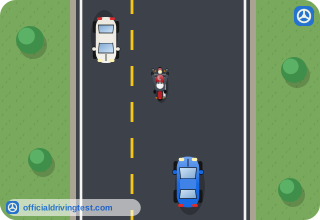
- Assume the rider is about to turn
- Assume the rider will leave the lane
- Not assume the rider’s intentions
- Assume the rider wants you to pass
Show answer
Correct answer: Not assume the rider’s intentions
The manual says not to assume the rider’s intentions; a rider may move to one side to prepare for a turn, avoid a hazard or improve visibility.
Source: Arizona Driver License Manual and Customer Service Guide (Revised March 2026), page 51
-
Why might a motorcyclist shift within the lane?
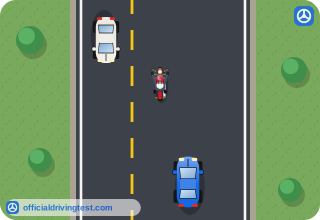
- To signal that the driver behind should pass
- To avoid oil, potholes or debris
- To warm up the tires
- Because the motorcycle must stay on the lane line
Show answer
Correct answer: To avoid oil, potholes or debris
Motorcyclists may shift within their lane to avoid oil, potholes or debris, so one may unexpectedly come into your lane.
Source: Arizona Driver License Manual and Customer Service Guide (Revised March 2026), page 51