Wisconsin: Speed and space — Part 2 Practice Test
Questions in this part include: “How often should you check your rearview mirror to see if someone is following too closely?” · “In severe weather, what freezes before the rest of the roadway?”
Independent educational site · not affiliated with any government agency or DMV
Ready? Test yourself
Answer to start, or tap Start below:
How often should you check your rearview mirror to see if someone is following too closely?
- Instant feedback with an explanation
- Every answer cites its source in the manual
- Your best score is saved on this device
- Keyboard: press 1 to 4 to answer and Enter for the next question
Questions are original and based on the official manual "Wisconsin Motorists' Handbook" (2026 (BDS126)), Wisconsin Department of Transportation, Division of Motor Vehicles (DMV).
All 20 questions in this practice test
Take the test above first, then use this list to study. Tap “Show answer” to see the correct answer and explanation.
Show the questions and answersHide the questions
-
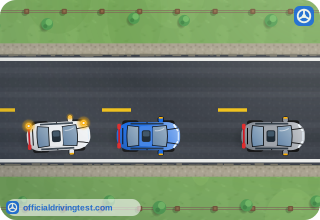
The driver behind you wants to pass. What might you need to do?
- Speed up so that the driver cannot pass you
- Brake suddenly to warn the driver behind you
- Move closer to the vehicle ahead of you
- Give additional seconds of space in front of you
Show answer
Correct answer: Give additional seconds of space in front of you
You might need to give additional seconds of space in front of you when the driver behind you wants to pass.
Source: Wisconsin Motorists' Handbook (2026 (BDS126)), page 13 · Open this page in the manual (Manual page 13)
-
How often should you check your rearview mirror to see if someone is following too closely?
- Every 1 to 2 seconds
- Every 3 to 4 seconds
- Every 12 to 15 seconds
- Every 6 to 8 seconds
Show answer
Correct answer: Every 6 to 8 seconds
You should check your rearview mirror every 6 to 8 seconds to see if someone is tailgating.
Source: Wisconsin Motorists' Handbook (2026 (BDS126)), page 13 · Open this page in the manual (Manual page 13)
-
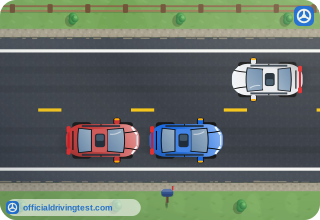
Someone is tailgating you. What should you do?
- Speed up to put distance between you
- Brake hard to warn the driver
- Move to the left lane
- Slowly reduce your speed
Show answer
Correct answer: Slowly reduce your speed
Slowly reducing your speed should encourage a tailgater to drive around you.
Source: Wisconsin Motorists' Handbook (2026 (BDS126)), page 13 · Open this page in the manual (Manual page 13)
-
How can you help a driver behind you?
- By changing speed often and signaling only at the last second before you slow or turn
- By staying close to the vehicle ahead and signaling only when you start to turn
- By keeping a steady speed and signaling in advance when you need to slow down or turn
- By driving slightly faster than traffic and braking firmly whenever you need to slow
Show answer
Correct answer: By keeping a steady speed and signaling in advance when you need to slow down or turn
You help the driver behind you by keeping a steady speed and signaling in advance before you slow down or turn.
Source: Wisconsin Motorists' Handbook (2026 (BDS126)), page 13 · Open this page in the manual (Manual page 13)
-
If you pull over to the side of the road because you are driving slower than most traffic, on which side can others pass you?
- On the right
- On the left
- On either side
- They cannot pass until you stop
Show answer
Correct answer: On the left
You pull over so that others can pass on the left.
Source: Wisconsin Motorists' Handbook (2026 (BDS126)), page 13 · Open this page in the manual (Manual page 13)
-
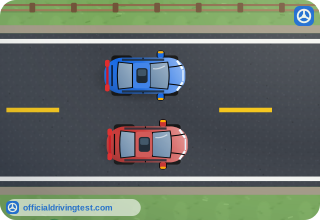
May you go over the speed limit to pass another vehicle on the road?
- Yes, but only on a multi-lane road with a passing lane
- Yes, if the other driver speeds up while you pass
- No, you cannot go over the speed limit to pass
- Yes, but only for a few seconds while passing
Show answer
Correct answer: No, you cannot go over the speed limit to pass
The handbook says you cannot go over the speed limit to pass another vehicle.
Source: Wisconsin Motorists' Handbook (2026 (BDS126)), page 18 · Open this page in the manual (Manual page 18)
-
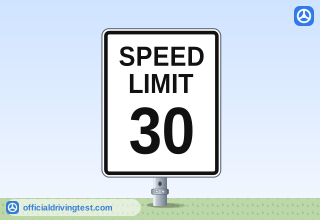
A rectangular sign reads SPEED LIMIT above a number. What does the number show?
- The lowest speed allowed on the road at all times
- The maximum speed you can drive in good driving conditions
- The speed you must keep in every kind of weather
- A suggested speed for trucks and buses only
Show answer
Correct answer: The maximum speed you can drive in good driving conditions
A Speed Limit sign shows the maximum speed you can drive in good driving conditions.
Source: Wisconsin Motorists' Handbook (2026 (BDS126)), page 24 · Open this page in the manual (Manual page 24)
-
A diamond-shaped sign shows an upward arrow above a small SPEED LIMIT sign. What does it mean?
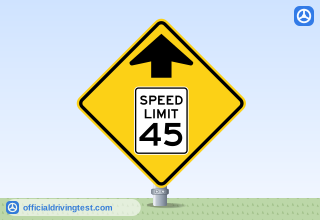
- You may speed up to the new limit
- Speed limits no longer apply ahead
- A minimum speed rule starts ahead
- You should slow down
Show answer
Correct answer: You should slow down
The Reduced Speed Ahead sign means you should slow down.
Source: Wisconsin Motorists' Handbook (2026 (BDS126)), page 24 · Open this page in the manual (Manual page 24)
-
A sign reads SCHOOL SPEED LIMIT 15 WHEN CHILDREN ARE PRESENT, and children are visible. What does the sign require?
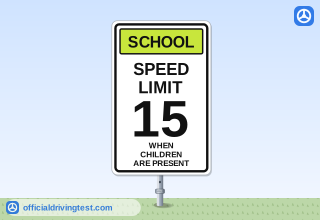
- You cannot go over 15 mph
- You may drive up to 25 mph
- You may drive up to 35 mph
- You must stop until they leave
Show answer
Correct answer: You cannot go over 15 mph
When children are visible, you cannot go over the speed listed on a school zone speed limit sign, such as 15 mph.
Source: Wisconsin Motorists' Handbook (2026 (BDS126)), page 24 · Open this page in the manual (Manual page 24)
-
According to the handbook, what do bald tires do?
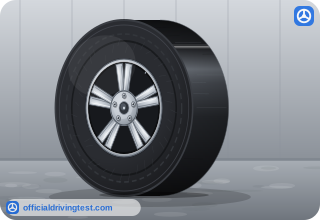
- They reduce traction and increase stopping distance
- They improve grip but lower fuel mileage
- They increase traction but make steering harder
- They shorten stopping distance on wet roads
Show answer
Correct answer: They reduce traction and increase stopping distance
Tires with a lot of wear lose traction and need more distance to stop, which is dangerous in bad weather.
Source: Wisconsin Motorists' Handbook (2026 (BDS126)), page 44 · Open this page in the manual (Manual page 44)
-
In the handbook, what are "bald tires"?
- Tires that are filled with too little air
- Tires made only for winter driving
- Tires that have a lot of wear on them
- Tires that were put on the car recently
Show answer
Correct answer: Tires that have a lot of wear on them
The handbook uses "bald tires" for tires that are heavily worn.
Source: Wisconsin Motorists' Handbook (2026 (BDS126)), page 44 · Open this page in the manual (Manual page 44)
-
When visibility is reduced, how may other vehicles appear to you?
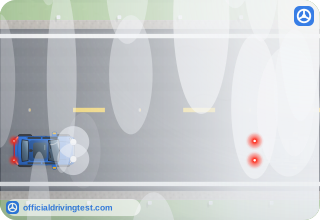
- To be moving faster than they actually are
- To be stopped in the road
- To be farther away than they actually are
- To be moving slower than they actually are
Show answer
Correct answer: To be moving slower than they actually are
With reduced visibility, vehicles can look slower than their real speed, so judge speed with care.
Source: Wisconsin Motorists' Handbook (2026 (BDS126)), page 44 · Open this page in the manual (Manual page 44)
-
What is harder to judge at night?
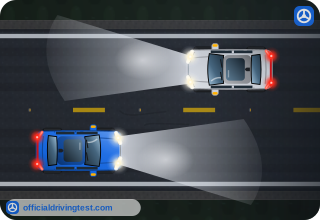
- The distance and speed of oncoming traffic
- The color of traffic signals ahead of you
- The width of your own lane on the road
- The shape of road signs along the road
Show answer
Correct answer: The distance and speed of oncoming traffic
At night it is harder to judge how far away oncoming traffic is and how fast it is going.
Source: Wisconsin Motorists' Handbook (2026 (BDS126)), page 44 · Open this page in the manual (Manual page 44)
-
What should you do when driving in fog, rain or other conditions with low visibility?
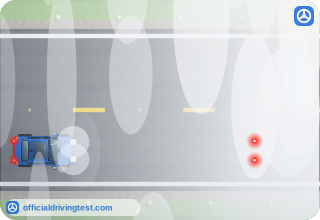
- Keep your normal speed and follow closely behind another vehicle
- Speed up to leave the low-visibility area sooner
- Drive at a lower speed, be ready to stop and use your headlights
- Turn off your headlights so they do not reflect
Show answer
Correct answer: Drive at a lower speed, be ready to stop and use your headlights
The handbook says to reduce speed, be ready to stop and use your headlights so you can see better.
Source: Wisconsin Motorists' Handbook (2026 (BDS126)), page 44 · Open this page in the manual (Manual page 44)
-
In severe weather, what freezes before the rest of the roadway?
- Tunnels and underpasses
- Bridges and overpasses
- Roundabouts
- Roads with curves
Show answer
Correct answer: Bridges and overpasses
The handbook warns that bridges and overpasses freeze before the rest of the road in severe weather.
Source: Wisconsin Motorists' Handbook (2026 (BDS126)), page 44 · Open this page in the manual (Manual page 44)
-
To keep control of your vehicle in severe weather, what should you avoid?
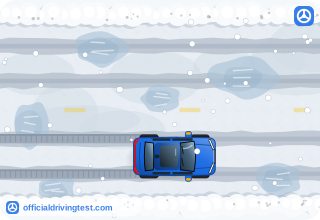
- Using your headlights and windshield wipers
- Driving below the speed limit
- Using your turn signals
- Rapid braking and sudden sharp turns
Show answer
Correct answer: Rapid braking and sudden sharp turns
Rapid braking and sudden sharp turns can make a vehicle lose control on slippery roads.
Source: Wisconsin Motorists' Handbook (2026 (BDS126)), page 44 · Open this page in the manual (Manual page 44)
-
At what temperature should you watch for slippery or icy roads?
- Only well below zero
- Only when snow is falling
- Around the freezing point
- Only after the sun goes down
Show answer
Correct answer: Around the freezing point
The handbook lists a temperature around the freezing point as a sign that roads may be slippery or icy.
Source: Wisconsin Motorists' Handbook (2026 (BDS126)), page 44 · Open this page in the manual (Manual page 44)
-
Which moment can make the pavement slippery?
- When the road has been dry for several days
- When it starts to rain
- When the sun comes out after a rain
- When the road is covered with fresh gravel
Show answer
Correct answer: When it starts to rain
The handbook lists pavement when it starts to rain as a place to expect slippery roads.
Source: Wisconsin Motorists' Handbook (2026 (BDS126)), page 44 · Open this page in the manual (Manual page 44)
-
Why does the handbook tell drivers to be alert and extra cautious on the first day of snowfall?
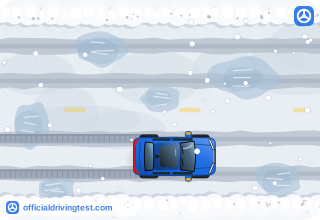
- People are not used to driving in snow on that day
- Snowplows are not yet working on that day
- Roads are closed to heavy vehicles on that day
- Headlights are not allowed on that day
Show answer
Correct answer: People are not used to driving in snow on that day
The handbook explains that people are not used to driving on the first day of snowfall.
Source: Wisconsin Motorists' Handbook (2026 (BDS126)), page 45 · Open this page in the manual (Manual page 45)
-
What does the handbook say about speed and room in front of your vehicle in winter?
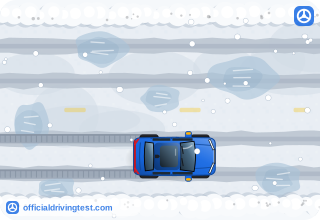
- Drive at the speed limit and keep your usual room
- Drive slowly and give extra room in front of your vehicle
- Drive slowly and stay close to the vehicle ahead
- Drive at the speed of traffic and give less room
Show answer
Correct answer: Drive slowly and give extra room in front of your vehicle
Winter driving needs a lower speed and extra room ahead.
Source: Wisconsin Motorists' Handbook (2026 (BDS126)), page 45 · Open this page in the manual (Manual page 45)