Wisconsin: Vehicle controls and signals — Part 2 Practice Test
Questions in this part include: “Which is a time when you can use your high beams?” · “Which hand signal shows that you want to turn right?”
Independent educational site · not affiliated with any government agency or DMV
Ready? Test yourself
Answer to start, or tap Start below:
Which is a time when you can use your high beams?
- Instant feedback with an explanation
- Every answer cites its source in the manual
- Your best score is saved on this device
- Keyboard: press 1 to 4 to answer and Enter for the next question
Questions are original and based on the official manual "Wisconsin Motorists' Handbook" (2026 (BDS126)), Wisconsin Department of Transportation, Division of Motor Vehicles (DMV).
All 22 questions in this practice test
Take the test above first, then use this list to study. Tap “Show answer” to see the correct answer and explanation.
Show the questions and answersHide the questions
-
Someone drives toward you and forgets to turn off their high beams. Where should you look?
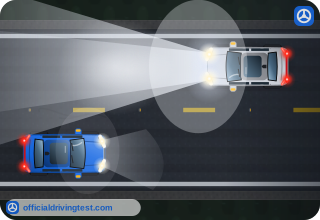
- Toward the right side of the road
- Directly at the oncoming headlights
- Toward the center line
- Toward your rearview mirror
Show answer
Correct answer: Toward the right side of the road
If an oncoming driver forgets to dim the brights, you look toward the right side of the road.
Source: Wisconsin Motorists' Handbook (2026 (BDS126)), page 21 · Open this page in the manual (Manual page 21)
-
Which is a time when you can use your high beams?
- You are following closely behind another vehicle
- A vehicle is approaching from the opposite direction
- You are driving through fog
- There are no vehicles coming toward you
Show answer
Correct answer: There are no vehicles coming toward you
You can use your high beams when no vehicles are coming toward you.
Source: Wisconsin Motorists' Handbook (2026 (BDS126)), page 21 · Open this page in the manual (Manual page 21)
-
Besides when no vehicles come toward you, when can you use your high beams?
- You are driving through fog
- You are in an unfamiliar place or construction area
- You are following closely behind another vehicle
- You are stopped at a red light
Show answer
Correct answer: You are in an unfamiliar place or construction area
You can use your high beams in an unfamiliar place or a construction area.
Source: Wisconsin Motorists' Handbook (2026 (BDS126)), page 21 · Open this page in the manual (Manual page 21)
-
What does the handbook say about parking lights?
- They should be used together with your high beams
- They should only be used when you are parked and idling
- They should be turned on at every intersection you cross
- They should be used whenever you drive in a construction area
Show answer
Correct answer: They should only be used when you are parked and idling
Parking lights should only be used when you are parked and idling.
Source: Wisconsin Motorists' Handbook (2026 (BDS126)), page 21 · Open this page in the manual (Manual page 21)
-
What does a turn signal do?
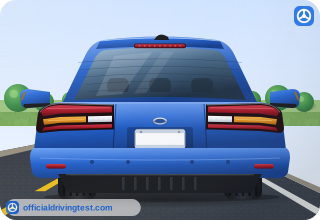
- Warns other drivers that your vehicle is legally parked at the curb
- Makes your vehicle easier to see for other drivers in fog or rain
- Tells other drivers behind you that they must slow down at once
- Tells others where you plan to go and gives them time to respond
Show answer
Correct answer: Tells others where you plan to go and gives them time to respond
A turn signal tells others where you plan to go and gives them time to respond.
Source: Wisconsin Motorists' Handbook (2026 (BDS126)), page 21 · Open this page in the manual (Manual page 21)
-
About how far before an intersection turn should you start signaling?
- About three seconds (about 100 feet)
- About one second (about 30 feet)
- About five seconds (about 250 feet)
- About ten seconds (about 500 feet)
Show answer
Correct answer: About three seconds (about 100 feet)
At an intersection you should start signaling about three seconds, or about 100 feet, before the turn.
Source: Wisconsin Motorists' Handbook (2026 (BDS126)), page 21 · Open this page in the manual (Manual page 21)
-
You are turning after an intersection. When do you start signaling?
- About three seconds before you reach the intersection
- As you enter the intersection
- Once you cross the intersection
- Only after you have completed the turn
Show answer
Correct answer: Once you cross the intersection
If you are turning after an intersection, you start signaling once you cross the intersection.
Source: Wisconsin Motorists' Handbook (2026 (BDS126)), page 21 · Open this page in the manual (Manual page 21)
-
When can you use hand signals?
- When you are driving a vehicle with a manual transmission
- When your horn does not work and you need to warn others
- On roads with a speed limit of 25 mph or less in town
- When your car has no turn signals or they are hard for others to see
Show answer
Correct answer: When your car has no turn signals or they are hard for others to see
Hand signals can be used if your car has no turn signals or other drivers have trouble seeing them.
Source: Wisconsin Motorists' Handbook (2026 (BDS126)), page 21 · Open this page in the manual (Manual page 21)
-
Which hand signal shows that you want to turn left?
- Your elbow bent with your hand pointed up toward the sky
- Your hand pointed straight out of the driver side window
- Your hand pointed down toward the ground beside the door
- Your hand waving up and down out of the window repeatedly
Show answer
Correct answer: Your hand pointed straight out of the driver side window
To signal a left turn you point your hand out the driver side window, straight.
Source: Wisconsin Motorists' Handbook (2026 (BDS126)), page 21 · Open this page in the manual (Manual page 21)
-
Which hand signal shows that you want to turn right?
- Your hand pointed straight out of the driver side window
- Your hand pointed down toward the ground
- Your elbow bent and your hand pointed up
- Your arm held straight out with the palm facing back
Show answer
Correct answer: Your elbow bent and your hand pointed up
To signal a right turn you bend your elbow and point your hand up.
Source: Wisconsin Motorists' Handbook (2026 (BDS126)), page 21 · Open this page in the manual (Manual page 21)
-
Which hand signal shows that you are stopping or slowing down?
- Your hand pointed down toward the ground
- Your elbow bent and your hand pointed up
- Your hand pointed straight out of the driver side window
- Your arm bent with the palm pushed forward
Show answer
Correct answer: Your hand pointed down toward the ground
To signal that you are stopping or slowing down you point your hand to the ground.
Source: Wisconsin Motorists' Handbook (2026 (BDS126)), page 21 · Open this page in the manual (Manual page 21)
-
If your car does not have an Anti-Lock Braking System (ABS), what should you do on slippery roads?
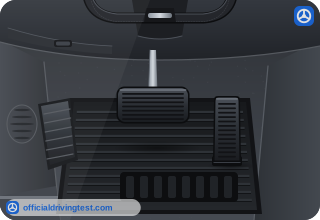
- Gently pump the brakes
- Apply firm, continuous pressure to the brakes
- Brake once as hard as you can and hold it
- Turn off the engine and coast
Show answer
Correct answer: Gently pump the brakes
Without ABS, gentle pumping helps keep the car from skidding or sliding on slippery roads.
Source: Wisconsin Motorists' Handbook (2026 (BDS126)), page 44 · Open this page in the manual (Manual page 44)
-
Before driving in winter, from which parts of your vehicle should you clear snow and ice?
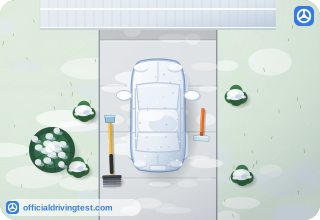
- Only the windshield, the rear window and the headlights
- Only the front and rear windows and the side mirrors
- All windows, vehicle lamps, side mirrors and license plates
- Only the windows, the roof and the hood of the vehicle
Show answer
Correct answer: All windows, vehicle lamps, side mirrors and license plates
The handbook says to clear snow and ice from all parts of the vehicle, including all windows, lamps, side mirrors and license plates.
Source: Wisconsin Motorists' Handbook (2026 (BDS126)), page 45 · Open this page in the manual (Manual page 45)
-
What does the handbook say about cruise control on slippery roads?
- Use cruise control to keep a steady speed
- Use cruise control only on bridges
- Use cruise control only at night
- Do not use cruise control
Show answer
Correct answer: Do not use cruise control
Cruise control should not be used on slippery roads.
Source: Wisconsin Motorists' Handbook (2026 (BDS126)), page 45 · Open this page in the manual (Manual page 45)
-
When driving in winter, what should you do about your lights?
- Turn on your headlights and do not use your high beams
- Use only your parking lights
- Turn on your headlights and use your high beams
- Use your high beams only
Show answer
Correct answer: Turn on your headlights and do not use your high beams
Winter driving tips call for headlights on and no high beams (brights).
Source: Wisconsin Motorists' Handbook (2026 (BDS126)), page 45 · Open this page in the manual (Manual page 45)
-
A bicyclist holds the left arm straight out to the side. What does this hand signal mean?
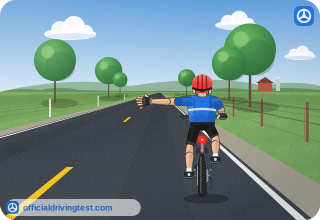
- Right turn
- Stop
- Slowing down
- Left turn
Show answer
Correct answer: Left turn
A bicycle hand signal with the left arm straight out means a left turn.
Source: Wisconsin Motorists' Handbook (2026 (BDS126)), page 52 · Open this page in the manual (Manual page 52)
-
A bicyclist holds the left arm bent downward. What does this hand signal mean?
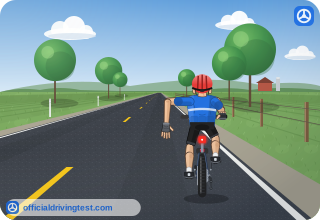
- Left turn
- Stop
- Right turn
- Passing
Show answer
Correct answer: Stop
A bicycle hand signal with the left arm bent downward means stop.
Source: Wisconsin Motorists' Handbook (2026 (BDS126)), page 52 · Open this page in the manual (Manual page 52)
-
A bicyclist holds the right arm straight out to the side. What does this hand signal mean?
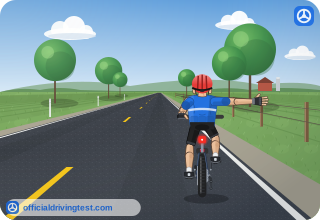
- Right turn
- Stop
- Left turn
- Passing
Show answer
Correct answer: Right turn
A bicyclist may signal a right turn by holding the right arm straight out to the side; the other way is the left arm bent upward.
Source: Wisconsin Motorists' Handbook (2026 (BDS126)), page 52 · Open this page in the manual (Manual page 52)
-
Which of these helps save fuel and your brakes?
- Braking hard at the last moment
- Stop-and-go driving
- Slowing down little by little
- Driving during heavy traffic periods
Show answer
Correct answer: Slowing down little by little
Slowing down little by little helps save fuel and your brakes.
Source: Wisconsin Motorists' Handbook (2026 (BDS126)), page 55 · Open this page in the manual (Manual page 55)
-
What does stop-and-go driving cause?
- Lower fuel use and longer brake life
- Less wear on the engine and tires
- Better tire pressure and less wear
- Extra wear and tear on the vehicle
Show answer
Correct answer: Extra wear and tear on the vehicle
Stop-and-go driving causes extra wear and tear on the vehicle.
Source: Wisconsin Motorists' Handbook (2026 (BDS126)), page 55 · Open this page in the manual (Manual page 55)
-
What does low air pressure in tires do?
- It decreases fuel mileage
- It increases fuel mileage
- It shortens braking distance
- It reduces the wear on the tires
Show answer
Correct answer: It decreases fuel mileage
Low air pressure in tires decreases fuel mileage.
Source: Wisconsin Motorists' Handbook (2026 (BDS126)), page 55 · Open this page in the manual (Manual page 55)
-
What can happen when a vehicle is not in good working condition?
- It costs less to run but wears out faster
- It must be reported to the DMV before use
- It costs more to run and could break down and crash
- It is allowed on the road only in daylight hours
Show answer
Correct answer: It costs more to run and could break down and crash
A vehicle in poor condition costs more to run and could break down and crash.
Source: Wisconsin Motorists' Handbook (2026 (BDS126)), page 55 · Open this page in the manual (Manual page 55)