Wisconsin: Pavement markings and special lanes Practice Test
White and yellow lines, crosswalks, shared center lanes, reversible lanes, reserved lanes and flex lanes.
Independent educational site · not affiliated with any government agency or DMV
Ready? Test yourself
Answer to start, or tap Start below:
Besides telling you when you can pass, what do lines on the road tell you?
- Instant feedback with an explanation
- Every answer cites its source in the manual
- Your best score is saved on this device
- Keyboard: press 1 to 4 to answer and Enter for the next question
Questions are original and based on the official manual "Wisconsin Motorists' Handbook" (2026 (BDS126)), Wisconsin Department of Transportation, Division of Motor Vehicles (DMV).
All 24 questions in this practice test
Take the test above first, then use this list to study. Tap “Show answer” to see the correct answer and explanation.
Show the questions and answersHide the questions
-
Besides telling you when you can pass, what do lines on the road tell you?
- Where the next intersection with a traffic light is
- Which lane currently has the least amount of traffic
- When there are curves and if you are close to a curb
- How fast the vehicle in front of you is traveling
Show answer
Correct answer: When there are curves and if you are close to a curb
Road lines show when you can pass, when there are curves on the road and if you are close to a curb.
Source: Wisconsin Motorists' Handbook (2026 (BDS126)), page 32 · Open this page in the manual (Manual page 32)
-
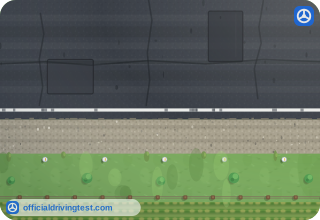
What does a solid white line at the side of the road indicate?
- The left edge of the traffic lanes in your direction
- The right edge of the traffic lane
- A lane for turning only
- The center of a two-way road
Show answer
Correct answer: The right edge of the traffic lane
A solid white line marks the right edge of the traffic lane.
Source: Wisconsin Motorists' Handbook (2026 (BDS126)), page 34 · Open this page in the manual (Manual page 34)
-
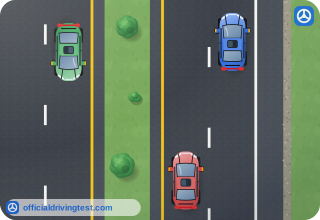
A solid or dashed yellow line at the left side of your lane indicates what?
- The right edge of the traffic lanes going in your direction
- The end of a lane reserved for turning vehicles
- The boundary between a bike lane and the shoulder
- The left edge of the traffic lanes going in your direction
Show answer
Correct answer: The left edge of the traffic lanes going in your direction
A solid or dashed yellow line marks the left edge of the lanes going in your direction.
Source: Wisconsin Motorists' Handbook (2026 (BDS126)), page 34 · Open this page in the manual (Manual page 34)
-
What do white dashed lines divide?
- Lanes of traffic going in the same direction
- Lanes of traffic going in opposite directions
- A traffic lane from the shoulder
- A roadway from a crosswalk
Show answer
Correct answer: Lanes of traffic going in the same direction
White dashed lines separate lanes whose traffic moves the same way.
Source: Wisconsin Motorists' Handbook (2026 (BDS126)), page 34 · Open this page in the manual (Manual page 34)
-
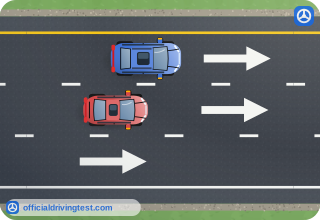
Under what condition can you cross a white dashed line?
- Never
- Only to turn
- When it is safe
- Only to pass a stopped vehicle
Show answer
Correct answer: When it is safe
A white dashed line can be crossed when it is safe to do so.
Source: Wisconsin Motorists' Handbook (2026 (BDS126)), page 34 · Open this page in the manual (Manual page 34)
-
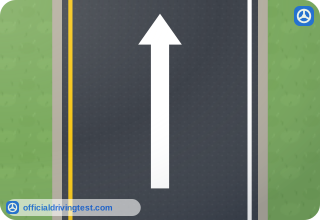
What does a white arrow painted in a lane show?
- The lane's maximum speed
- The direction you need to go
- That the lane is for one vehicle type
- That the lane is ending ahead
Show answer
Correct answer: The direction you need to go
A white arrow on the pavement shows which direction you need to go.
Source: Wisconsin Motorists' Handbook (2026 (BDS126)), page 34 · Open this page in the manual (Manual page 34)
-
When may you cross a solid white line between lanes?
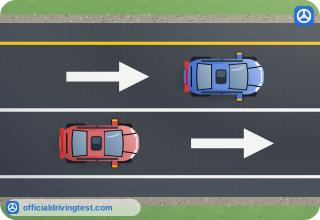
- Whenever it is safe, as with a white dashed line
- Only when passing a slower vehicle ahead of you
- Only when a police officer waves you across
- Only for a hazard or to turn just ahead
Show answer
Correct answer: Only for a hazard or to turn just ahead
A solid white line between lanes may be crossed only if there is a hazard or you are turning just ahead.
Source: Wisconsin Motorists' Handbook (2026 (BDS126)), page 34 · Open this page in the manual (Manual page 34)
-
Where should your front wheels stop at a crosswalk?
- Just before the solid white line
- On the crosswalk itself
- Just past the solid white line
- In the middle of the crosswalk markings
Show answer
Correct answer: Just before the solid white line
Your front wheels stop just before the solid white line, never on the crosswalk.
Source: Wisconsin Motorists' Handbook (2026 (BDS126)), page 34 · Open this page in the manual (Manual page 34)
-
What is a crosswalk for?
- Bicyclists to ride through without stopping at a signal
- Drivers to stop and wait for a signal to change
- Pedestrians to walk safely across the intersection
- Vehicles to turn across traffic without yielding
Show answer
Correct answer: Pedestrians to walk safely across the intersection
A crosswalk is where pedestrians walk safely across.
Source: Wisconsin Motorists' Handbook (2026 (BDS126)), page 34 · Open this page in the manual (Manual page 34)
-
Besides at intersections, where can crosswalks sometimes be?
- Only on freeway on-ramps
- In the middle of a street or block
- Only on one-way streets
- On the left edge of the roadway
Show answer
Correct answer: In the middle of a street or block
Crosswalks are normally at intersections but can also be in the middle of a street or block.
Source: Wisconsin Motorists' Handbook (2026 (BDS126)), page 34 · Open this page in the manual (Manual page 34)
-
What do line colors tell you?
- The maximum speed allowed on the roadway
- Which types of vehicles may use the lane
- Whether a roadway is owned by the state or county
- Whether you are on a one-way or two-way roadway
Show answer
Correct answer: Whether you are on a one-way or two-way roadway
The color of the lines shows whether the road is one-way or two-way.
Source: Wisconsin Motorists' Handbook (2026 (BDS126)), page 34 · Open this page in the manual (Manual page 34)
-
What do solid yellow lines separate?
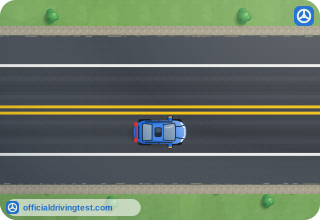
- Traffic going in opposite directions
- Traffic going in the same direction
- A crosswalk from the roadway
- A bike lane from a travel lane
Show answer
Correct answer: Traffic going in opposite directions
Solid yellow lines separate traffic going in opposite directions.
Source: Wisconsin Motorists' Handbook (2026 (BDS126)), page 35 · Open this page in the manual (Manual page 35)
-
What do two solid yellow lines mean?
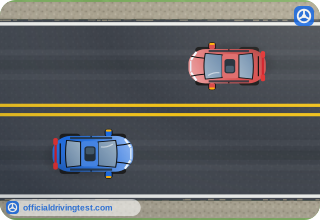
- Vehicles may pass when it is safe to do so
- Only vehicles in the right lane may pass
- No lane of travel can pass
- The road ahead is a one-way roadway
Show answer
Correct answer: No lane of travel can pass
Two solid yellow lines mean that no lane of travel can pass.
Source: Wisconsin Motorists' Handbook (2026 (BDS126)), page 35 · Open this page in the manual (Manual page 35)
-
Which of these is a time you may cross two solid yellow lines?
- Whenever you can see a long, straight road ahead
- When you turn into a driveway and it is safe to do so
- Whenever you are changing lanes on a two-lane road
- Whenever you are at least 100 feet from an intersection
Show answer
Correct answer: When you turn into a driveway and it is safe to do so
Turning into a driveway, when safe, is an exception that lets you cross two solid yellow lines.
Source: Wisconsin Motorists' Handbook (2026 (BDS126)), page 35 · Open this page in the manual (Manual page 35)
-
What does a dashed yellow line mean?
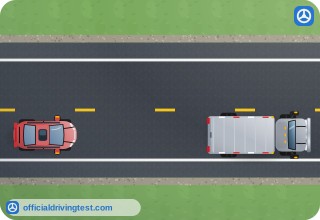
- You may never pass other vehicles
- You may pass only on the right side of the road
- You may pass other vehicles when it is safe to do so
- You must pass any slower vehicle ahead
Show answer
Correct answer: You may pass other vehicles when it is safe to do so
A dashed yellow line allows passing when it is safe.
Source: Wisconsin Motorists' Handbook (2026 (BDS126)), page 35 · Open this page in the manual (Manual page 35)
-
If you choose to pass where there is a dashed yellow line, what should you do?
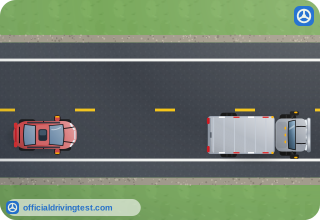
- Sound your horn continuously
- Watch for other traffic
- Increase your speed above the limit
- Pass only on the right side
Show answer
Correct answer: Watch for other traffic
Passing at a dashed yellow line requires watching for other traffic.
Source: Wisconsin Motorists' Handbook (2026 (BDS126)), page 35 · Open this page in the manual (Manual page 35)
-
A dashed yellow line and a solid yellow line run side by side. When may you pass?
- Only if you are on the solid side of the line
- From either side, when it is safe to do so
- Only if oncoming traffic is more than a block away
- Only if you are on the dashed side of the line
Show answer
Correct answer: Only if you are on the dashed side of the line
You may pass only from the dashed side; from the solid side you may not pass.
Source: Wisconsin Motorists' Handbook (2026 (BDS126)), page 35 · Open this page in the manual (Manual page 35)
-
Some passing zones have what that tells you where you can and cannot pass?
- Signs
- Flashing beacons
- Rumble strips
- Speed bumps
Show answer
Correct answer: Signs
Some passing zones use signs to show where passing is and is not allowed.
Source: Wisconsin Motorists' Handbook (2026 (BDS126)), page 35 · Open this page in the manual (Manual page 35)
-
What vehicles may use a shared center lane?
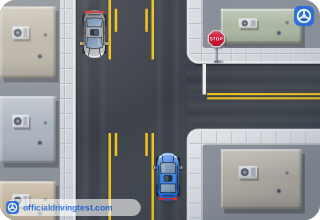
- Vehicles passing slower traffic
- Vehicles turning right or going straight
- Vehicles turning left or making a U-turn
- Vehicles stopping to park briefly
Show answer
Correct answer: Vehicles turning left or making a U-turn
A shared center lane is only for vehicles turning left or making a U-turn.
Source: Wisconsin Motorists' Handbook (2026 (BDS126)), page 36 · Open this page in the manual (Manual page 36)
-
In which directions can vehicles use a shared center lane?
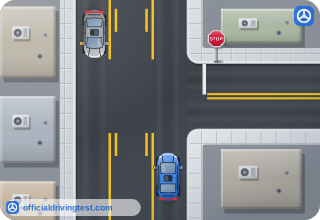
- Only one direction at a time
- Either direction
- Only the direction with the most traffic
- Only traffic heading toward the intersection
Show answer
Correct answer: Either direction
Vehicles going in either direction can use a shared center lane.
Source: Wisconsin Motorists' Handbook (2026 (BDS126)), page 36 · Open this page in the manual (Manual page 36)
-
What marks which direction you can turn in a shared center lane?
- Yellow arrows on the lane lines
- Green arrows on overhead signals
- Red X signals over each lane
- White left turn symbols
Show answer
Correct answer: White left turn symbols
White left turn symbols on the pavement mark the turn direction.
Source: Wisconsin Motorists' Handbook (2026 (BDS126)), page 36 · Open this page in the manual (Manual page 36)
-
In a shared center lane, when may you cross the solid yellow line?
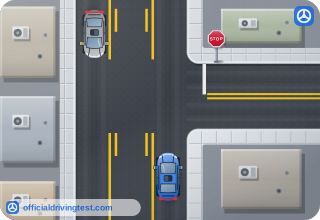
- When you want to make a left turn or a U-turn
- When you want to pass a slower vehicle
- When you want to turn right at the next intersection
- Never, because solid lines may not be crossed
Show answer
Correct answer: When you want to make a left turn or a U-turn
You may cross the solid line to make a left turn or U-turn, entering only when it is safe.
Source: Wisconsin Motorists' Handbook (2026 (BDS126)), page 36 · Open this page in the manual (Manual page 36)
-
What kind of lines does each reversible lane have?
- A single solid white line
- Double solid yellow lines
- Double dashed yellow lines
- Dashed white lines on both sides
Show answer
Correct answer: Double dashed yellow lines
Each reversible lane has double dashed yellow lines.
Source: Wisconsin Motorists' Handbook (2026 (BDS126)), page 36 · Open this page in the manual (Manual page 36)
-
What kind of line separates a flex lane?
- A solid white line
- A solid yellow line
- A dashed white line
- Double dashed yellow lines
Show answer
Correct answer: A solid yellow line
A solid yellow line separates the flex lane.
Source: Wisconsin Motorists' Handbook (2026 (BDS126)), page 38 · Open this page in the manual (Manual page 38)