Pavement markings in Wisconsin
The Wisconsin Motorists' Handbook shows or names everything on this page: 12 in all, on pages 18, 34–38, 41.
Independent educational site · not affiliated with any government agency or DMV
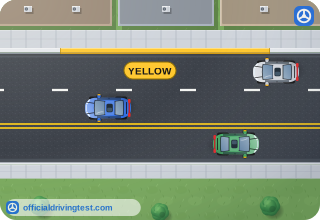
Yellow curb marking
Parking is not allowed where there are yellow markings on the curb or areas in front of fire hydrants.
Manual page 18 · Open this page in the manual (Manual page 18)
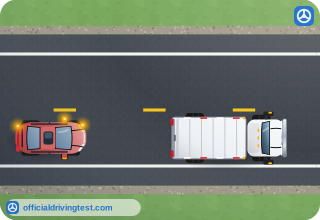
Edge and Lane Lines
A solid white line indicates the right edge of the traffic lane. A solid or dashed yellow line indicates the left edge of the traffic lanes going in your direction.
Manual page 34 · Open this page in the manual (Manual page 34)
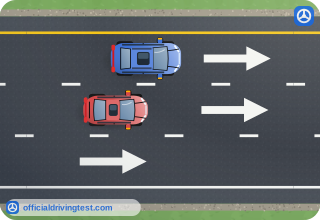
White Dashed Line
These divide lanes of traffic going in the same direction. You can cross this line when it is safe. A white arrow shows what direction you need to go.
Manual page 34 · Open this page in the manual (Manual page 34)
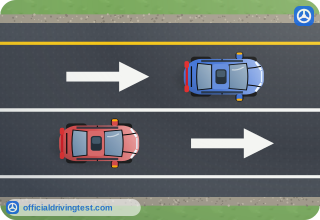
Solid White Line
A solid white line between lanes means you cannot cross. You can only cross if there is a hazard or you are turning within the next block.
Manual page 34 · Open this page in the manual (Manual page 34)
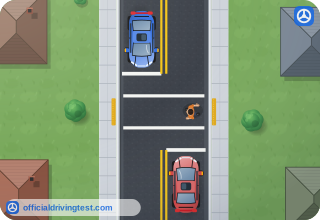
Crosswalk
A crosswalk is for pedestrians to walk safely across the intersection. Pedestrians may be given signals for when they can safely cross. Your front wheels should stop just before the solid white line. Do not stop on the crosswalk. Crosswalks are normally at intersections but can sometimes be in the middle of a street or block.
Manual page 34 · Open this page in the manual (Manual page 34)
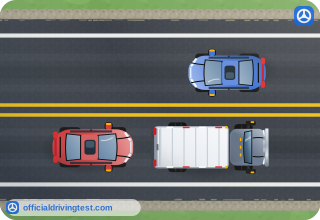
Solid Yellow Lines
These lines separate traffic going in opposite directions. Two solid yellow lines means that no lane of travel can pass. Exceptions: You can cross the line if you turn into a driveway and it is safe to do so. You can pass a vehicle going less than half the speed limit if it is safe, except if it is farm equipment.
Manual page 35 · Open this page in the manual (Manual page 35)
Dashed Yellow Line
This means you may pass other vehicles when it is safe to do so. Watch for other traffic if you choose to pass.
Manual page 35 · Open this page in the manual (Manual page 35)
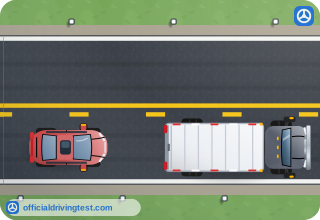
Dashed and Solid Yellow Lines
This means you may pass if you are on the dashed side of the line. If you are on the solid side of the line, you may not pass.
Manual page 35 · Open this page in the manual (Manual page 35)
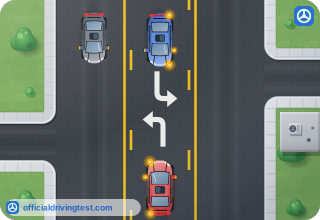
Center Left-Turn Lane
This lane is only for vehicles turning left or making a U-turn. Vehicles can use this lane going in either direction. There are white left turn symbols marking which direction you can turn. Solid yellow and dashed lines are in each lane. You can cross the solid line when you want to make the left turn or make a U-turn. Be sure you enter the lane only if it is safe to do so.
Manual page 36 · Open this page in the manual (Manual page 36)
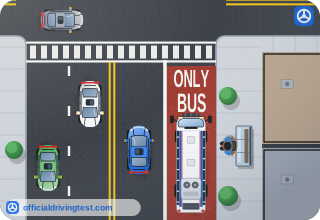
Bus Lane Only / Bike Lane Only
Only buses or bikes can drive in this lane. Bus or bike lanes might be painted in different colors (ex. Red, green, gray). Follow the markings on street lettering and posted signage.
Manual page 37 · Open this page in the manual (Manual page 37)
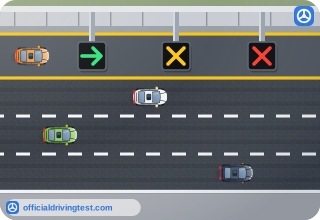
Flex lane on the roadway
Some highways allow you to use the paved shoulder as a travel lane. Signage will tell you when you can use this lane as a “flex lane.” A solid yellow line separates this special lane. Traffic volumes and special events dictate when this lane is open. If there is an incident along the flex lane route, the yellow and red X’s will tell drivers to merge into the next lane. No large trucks can drive in the flex lane.
Manual page 38 · Open this page in the manual (Manual page 38)
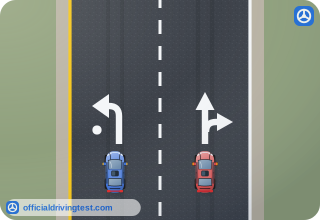
Lane-use pavement arrows
Going straight: follow the pavement markings, arrows or signs
Manual page 41 · Open this page in the manual (Manual page 41)