Wisconsin: Highways and ramps Practice Test
Acceleration and deceleration lanes, merging, metered ramps and the diverging diamond interchange.
Independent educational site · not affiliated with any government agency or DMV
Ready? Test yourself
Answer to start, or tap Start below:
How are the traffic signals arranged on a metered ramp that has more than one lane?
- Instant feedback with an explanation
- Every answer cites its source in the manual
- Your best score is saved on this device
- Keyboard: press 1 to 4 to answer and Enter for the next question
Questions are original and based on the official manual "Wisconsin Motorists' Handbook" (2026 (BDS126)), Wisconsin Department of Transportation, Division of Motor Vehicles (DMV).
All 14 questions in this practice test
Take the test above first, then use this list to study. Tap “Show answer” to see the correct answer and explanation.
Show the questions and answersHide the questions
-
When you merge with traffic, what speed should you try to enter at?
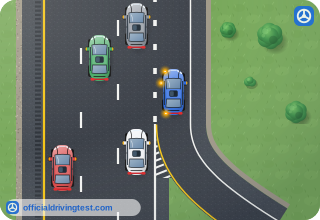
- A little slower than traffic so that others can pass you
- The same speed that the traffic is currently moving
- A little faster than traffic so that you get ahead
- The speed of the vehicle that is behind you
Show answer
Correct answer: The same speed that the traffic is currently moving
When merging, you should try to enter at the same speed that the traffic is currently moving.
Source: Wisconsin Motorists' Handbook (2026 (BDS126)), page 10 · Open this page in the manual (Manual page 10)
-
What should you avoid when you merge with traffic?
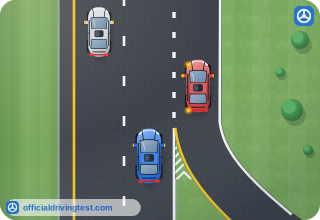
- Forcing another driver to change speed or direction
- Using the acceleration lane to match the speed of traffic
- Looking for a safe gap in traffic before you move over
- Entering at the same speed that the traffic is moving
Show answer
Correct answer: Forcing another driver to change speed or direction
The handbook says to avoid forcing another driver to change speed or direction because of your merging.
Source: Wisconsin Motorists' Handbook (2026 (BDS126)), page 10 · Open this page in the manual (Manual page 10)
-
What do you do in an acceleration lane (on-ramp)?
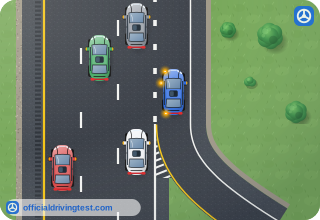
- Slow down gradually to leave the roadway
- Stop and wait for a gap in the traffic flow
- Speed up as you merge with the traffic flow
- Drive slower than the traffic flow
Show answer
Correct answer: Speed up as you merge with the traffic flow
In the acceleration lane you speed up as you merge with the traffic flow.
Source: Wisconsin Motorists' Handbook (2026 (BDS126)), page 10 · Open this page in the manual (Manual page 10)
-
What do you do in a deceleration lane (off-ramp)?
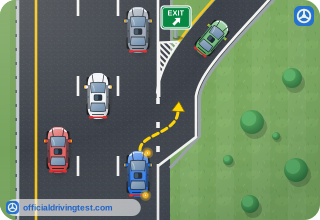
- Speed up to match traffic
- Gradually slow down
- Stop before entering
- Merge into the flow of traffic
Show answer
Correct answer: Gradually slow down
The deceleration lane (off-ramp) is where traffic slows down and you gradually slow down as well.
Source: Wisconsin Motorists' Handbook (2026 (BDS126)), page 10 · Open this page in the manual (Manual page 10)
-
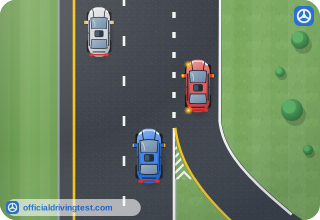
Whose responsibility is it to find a safe gap in traffic to merge?
- The drivers already in the flow of traffic
- The driver closest to the ramp
- The police
- The merging driver
Show answer
Correct answer: The merging driver
It is the merging driver's own responsibility to find a safe gap in traffic to legally merge.
Source: Wisconsin Motorists' Handbook (2026 (BDS126)), page 10 · Open this page in the manual (Manual page 10)
-
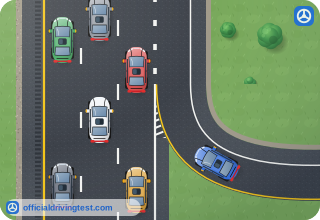
What should you do when you enter or leave traffic?
- Turn on your hazard lights
- Sound your horn
- Switch to high beams
- Check your surroundings
Show answer
Correct answer: Check your surroundings
The handbook says to check your surroundings when you enter or leave traffic.
Source: Wisconsin Motorists' Handbook (2026 (BDS126)), page 10 · Open this page in the manual (Manual page 10)
-
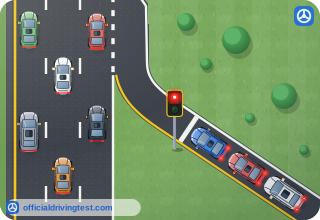
Why do some freeway entrance ramps have traffic signals?
- To collect a toll from entering vehicles
- To keep entering vehicles under the ramp speed limit
- To evenly space the vehicles merging onto the freeway
- To give semitrucks priority over cars
Show answer
Correct answer: To evenly space the vehicles merging onto the freeway
Ramp signals help evenly space the vehicles merging onto the freeway, which reduces congestion.
Source: Wisconsin Motorists' Handbook (2026 (BDS126)), page 41 · Open this page in the manual (Manual page 41)
-
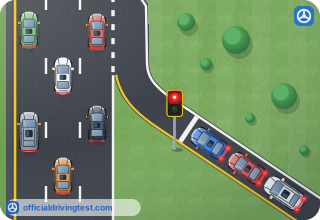
When is a freeway entrance ramp metered?
- Only during the hours of darkness each night
- When the sign "Ramp Metered When Flashing" is on
- Only when a police officer is at the ramp
- At all times, with or without the sign on
Show answer
Correct answer: When the sign "Ramp Metered When Flashing" is on
A ramp is metered when the sign "Ramp Metered When Flashing" is on.
Source: Wisconsin Motorists' Handbook (2026 (BDS126)), page 41 · Open this page in the manual (Manual page 41)
-
Where should you stop at a metered ramp signal so the sensors in the pavement detect your vehicle?
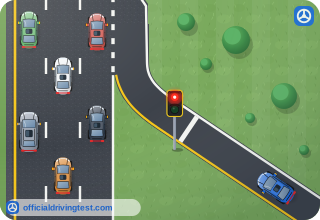
- One car length behind the white stop line
- Just past the white stop line
- Off to the side of the lane at the signal
- Pulled completely up to the white stop line
Show answer
Correct answer: Pulled completely up to the white stop line
You should pull completely up to the white stop line so your tires trigger the pavement sensors.
Source: Wisconsin Motorists' Handbook (2026 (BDS126)), page 41 · Open this page in the manual (Manual page 41)
-
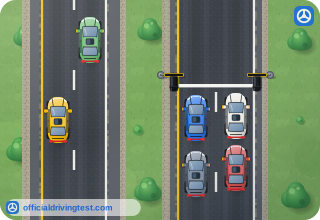
How are the traffic signals arranged on a metered ramp that has more than one lane?
- Each lane has its own traffic signal
- One signal controls all the lanes
- Only the left lane has a signal
- The signals are only on the freeway itself
Show answer
Correct answer: Each lane has its own traffic signal
Each lane of a metered ramp has its own traffic signal.
Source: Wisconsin Motorists' Handbook (2026 (BDS126)), page 41 · Open this page in the manual (Manual page 41)
-
At a metered ramp, when may you go and merge with traffic?
- After you count to five at the stop line
- When the car in the next lane starts to move
- When your signal turns green
- As soon as freeway traffic beside the ramp clears
Show answer
Correct answer: When your signal turns green
On a metered ramp you may go and merge with traffic when your signal turns green.
Source: Wisconsin Motorists' Handbook (2026 (BDS126)), page 41 · Open this page in the manual (Manual page 41)
-
What can happen if you disobey a ramp signal on a metered ramp?
- Nothing, because ramp signals are only a suggestion
- You can be ticketed
- You must retake the knowledge test
- Your vehicle is towed from the ramp
Show answer
Correct answer: You can be ticketed
Disobeying a ramp signal can get you a ticket.
Source: Wisconsin Motorists' Handbook (2026 (BDS126)), page 41 · Open this page in the manual (Manual page 41)
-
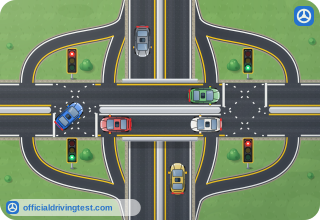
What does the handbook say to follow when you drive through a Diverging Diamond Interchange (DDI)?
- Only the traffic signals
- Only the signs posted before the ramps
- The path of the vehicle ahead of you
- The signs, signals and road markings
Show answer
Correct answer: The signs, signals and road markings
For a DDI you follow the signs, signals and road markings.
Source: Wisconsin Motorists' Handbook (2026 (BDS126)), page 42 · Open this page in the manual (Manual page 42)
-
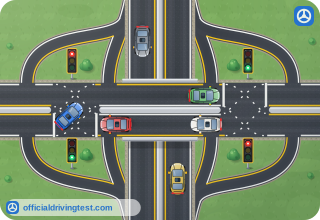
Which benefit does the handbook give for a Diverging Diamond Interchange (DDI)?
- It helps with safety and gets rid of crowding
- It removes the need for traffic signals
- It lets drivers ignore road markings
- It raises the speed limit on the freeway
Show answer
Correct answer: It helps with safety and gets rid of crowding
A DDI is described as helping with safety, getting rid of crowding and lowering the cost for new roads.
Source: Wisconsin Motorists' Handbook (2026 (BDS126)), page 42 · Open this page in the manual (Manual page 42)