Wisconsin: Parking rules Practice Test
Where you may not park, parking on hills, parallel parking and reserved parking.
Independent educational site · not affiliated with any government agency or DMV
Ready? Test yourself
Answer to start, or tap Start below:
Where is a vehicle normally parked on the road?
- Instant feedback with an explanation
- Every answer cites its source in the manual
- Your best score is saved on this device
- Keyboard: press 1 to 4 to answer and Enter for the next question
Questions are original and based on the official manual "Wisconsin Motorists' Handbook" (2026 (BDS126)), Wisconsin Department of Transportation, Division of Motor Vehicles (DMV).
All 22 questions in this practice test
Take the test above first, then use this list to study. Tap “Show answer” to see the correct answer and explanation.
Show the questions and answersHide the questions
-
Where is a vehicle normally parked on the road?
- In the middle of the road beside the center line
- On the far-left side of the road
- On the side with the least traffic
- On the far-right side of the road
Show answer
Correct answer: On the far-right side of the road
You must park far enough from travel lanes not to interfere with traffic, which is normally on the far-right side.
Source: Wisconsin Motorists' Handbook (2026 (BDS126)), page 18 · Open this page in the manual (Manual page 18)
-
What are you responsible for when you park your vehicle?
- Moving it every few hours
- Making sure that it is not a hazard
- Leaving the hazard lights on while it is parked
- Leaving the engine idling
Show answer
Correct answer: Making sure that it is not a hazard
You are responsible for making sure your vehicle is not a hazard when it is parked.
Source: Wisconsin Motorists' Handbook (2026 (BDS126)), page 18 · Open this page in the manual (Manual page 18)
-
What do yellow markings on the curb mean for parking?
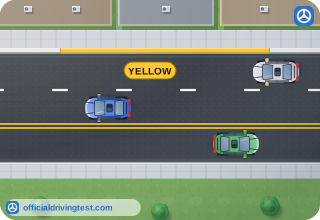
- Parking is allowed for a short time
- Parking is allowed only for loading
- Parking is not allowed there
- Parking is allowed if the hazard lights are on
Show answer
Correct answer: Parking is not allowed there
Parking is not allowed where there are yellow markings on the curb.
Source: Wisconsin Motorists' Handbook (2026 (BDS126)), page 18 · Open this page in the manual (Manual page 18)
-
In which place is parking not allowed?
- In front of a fire hydrant
- Between two parked vehicles
- On a level surface with the parking brake set
- On the far-right side of the road
Show answer
Correct answer: In front of a fire hydrant
Parking is not allowed in areas in front of fire hydrants.
Source: Wisconsin Motorists' Handbook (2026 (BDS126)), page 18 · Open this page in the manual (Manual page 18)
-
How fast should you drive when you park?
- At the same speed as traffic
- At the speed limit posted for that street
- At a very low speed
- At a moderate speed so that you do not block traffic
Show answer
Correct answer: At a very low speed
Parking should be done at a very low speed to avoid crashes.
Source: Wisconsin Motorists' Handbook (2026 (BDS126)), page 18 · Open this page in the manual (Manual page 18)
-
What should you do when you park on a level surface?
- Put your vehicle in neutral and turn the wheels toward the curb
- Leave the vehicle in drive with your foot on the brake pedal
- Turn off the engine and leave the parking brake off for the night
- Put it in Park, or in gear if it is a manual, and set the parking brake
Show answer
Correct answer: Put it in Park, or in gear if it is a manual, and set the parking brake
On a level surface you put the vehicle in Park (or in gear with a manual transmission) and set the parking brake.
Source: Wisconsin Motorists' Handbook (2026 (BDS126)), page 18 · Open this page in the manual (Manual page 18)
-
You park facing uphill next to a curb. Which way do you turn your wheels before putting your car in park?
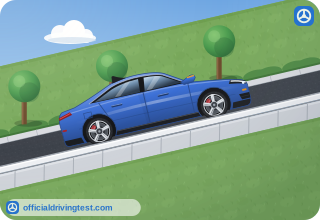
- All the way to the left
- All the way to the right
- Straight ahead
- Slightly to the right
Show answer
Correct answer: All the way to the left
Parked uphill with a curb, you turn your wheels all the way to the left before putting the car in park.
Source: Wisconsin Motorists' Handbook (2026 (BDS126)), page 19 · Open this page in the manual (Manual page 19)
-
You park facing uphill with no curb. Which way do you turn your wheels before putting your car in park?
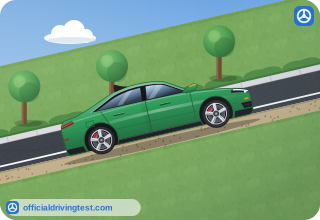
- All the way to the left
- All the way to the right
- Straight ahead
- Slightly to the left
Show answer
Correct answer: All the way to the right
Parked uphill without a curb, you turn your wheels all the way to the right before putting the car in park.
Source: Wisconsin Motorists' Handbook (2026 (BDS126)), page 19 · Open this page in the manual (Manual page 19)
-
You park facing downhill. Which way do you move your wheels?
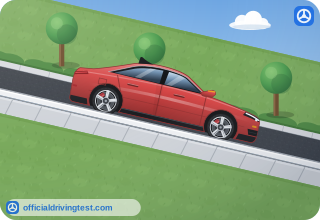
- All the way to the right
- All the way to the left
- Straight ahead
- Halfway to the left
Show answer
Correct answer: All the way to the right
If you are parked downhill, you move your wheels all the way to the right.
Source: Wisconsin Motorists' Handbook (2026 (BDS126)), page 19 · Open this page in the manual (Manual page 19)
-
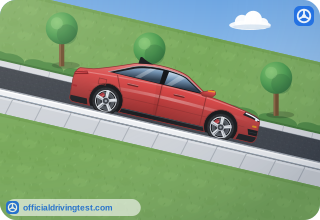
What else should you do when you park on a hill?
- Shift into neutral
- Turn on your hazard lights
- Set your emergency brake
- Turn off your headlights
Show answer
Correct answer: Set your emergency brake
After turning the wheels on a hill you also set your emergency brake.
Source: Wisconsin Motorists' Handbook (2026 (BDS126)), page 19 · Open this page in the manual (Manual page 19)
-
What is parallel parking used for?
- To park at an angle to the curb
- To park in-between vehicles
- To turn around on a narrow street
- To park on a hill
Show answer
Correct answer: To park in-between vehicles
Parallel parking is used to park in-between vehicles.
Source: Wisconsin Motorists' Handbook (2026 (BDS126)), page 19 · Open this page in the manual (Manual page 19)
-
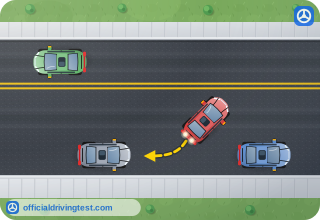
While you parallel park, what must you watch out for?
- Only the vehicles parked in front of and behind your space
- Only traffic coming from behind you
- Only pedestrians crossing the street
- Traffic, pedestrians and fixed objects
Show answer
Correct answer: Traffic, pedestrians and fixed objects
While parking you watch out for traffic, pedestrians and fixed objects.
Source: Wisconsin Motorists' Handbook (2026 (BDS126)), page 19 · Open this page in the manual (Manual page 19)
-
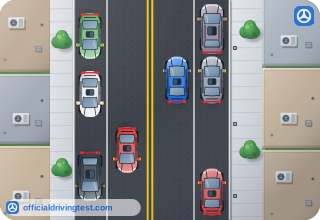
How much longer than your vehicle should a parallel parking space be?
- About 1-2 feet longer
- About 10-12 feet longer
- About 3-6 feet longer
- Exactly as long as your vehicle
Show answer
Correct answer: About 3-6 feet longer
Look for a parking space that is about 3-6 feet longer than your vehicle.
Source: Wisconsin Motorists' Handbook (2026 (BDS126)), page 19 · Open this page in the manual (Manual page 19)
-
What is the first step of parallel parking?
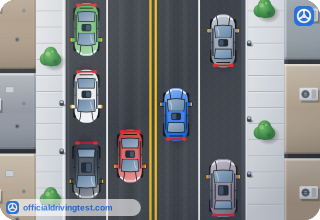
- Put your turn signal on and stop evenly with the vehicle ahead of your space
- Back into the space and then turn on your turn signal as you finish
- Pull up behind the space with your wheels turned all the way to the left
- Stop beside the vehicle behind the space and turn your wheel sharply
Show answer
Correct answer: Put your turn signal on and stop evenly with the vehicle ahead of your space
You start by turning on your turn signal and stopping evenly with the vehicle ahead of your space.
Source: Wisconsin Motorists' Handbook (2026 (BDS126)), page 19 · Open this page in the manual (Manual page 19)
-
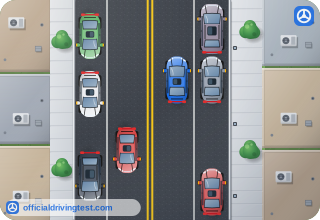
How far from the vehicle ahead of your space do you stop at the start of parallel parking?
- About 5 feet
- About 8 feet
- About 10 feet
- About 2 feet
Show answer
Correct answer: About 2 feet
You stop evenly with the vehicle ahead and about 2 feet away from it.
Source: Wisconsin Motorists' Handbook (2026 (BDS126)), page 19 · Open this page in the manual (Manual page 19)
-
You are parallel parking on the right side of the road. Which way do you turn your wheel as you begin to back up slowly?
- All the way to the left
- All the way to the right
- Halfway to the left
- Straight ahead
Show answer
Correct answer: All the way to the right
When parking on the right side of the road, turn your wheel all the way to the right and move backward slowly.
Source: Wisconsin Motorists' Handbook (2026 (BDS126)), page 19 · Open this page in the manual (Manual page 19)
-
You are parallel parking on the left side of the road. Which way do you turn your wheel as you begin to back up slowly?
- All the way to the right
- All the way to the left
- Halfway to the right
- Straight ahead
Show answer
Correct answer: All the way to the left
When parking on the left side of the road, turn your wheel all the way to the left and move backward slowly.
Source: Wisconsin Motorists' Handbook (2026 (BDS126)), page 19 · Open this page in the manual (Manual page 19)
-
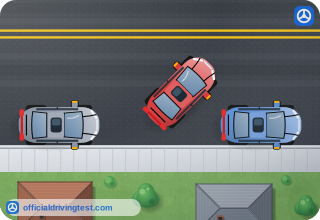
When do you straighten your wheel while parallel parking?
- As soon as your rear wheels touch the curb beside the space you chose
- Once your front bumper is even with the vehicle ahead of the space you chose
- As soon as you start to back up from your first position
- Once your front door passes the back bumper of the vehicle you are parking behind
Show answer
Correct answer: Once your front door passes the back bumper of the vehicle you are parking behind
You straighten the wheel once your front door passes the back bumper of the vehicle you are parking behind, then keep backing straight and slowly.
Source: Wisconsin Motorists' Handbook (2026 (BDS126)), page 20 · Open this page in the manual (Manual page 20)
-
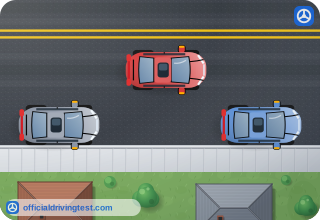
In parallel parking, what do you do when your bumper is clear of the vehicle in front?
- Turn your wheel sharply the other way and back up until parallel with the curb
- Straighten your wheels and drive forward slowly into the space ahead
- Turn your wheel gently in the same direction and stop completely
- Stop, signal left again and check for traffic coming from behind you
Show answer
Correct answer: Turn your wheel sharply the other way and back up until parallel with the curb
Once your bumper clears the vehicle in front, you turn the wheel sharply the other way and back up slowly until you are parallel with the curb.
Source: Wisconsin Motorists' Handbook (2026 (BDS126)), page 20 · Open this page in the manual (Manual page 20)
-
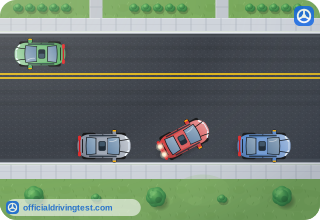
How far from the curb should you be when you finish parallel parking?
- About 4 feet
- About 6 inches
- About a foot
- About 3 feet
Show answer
Correct answer: About a foot
After straightening your wheels you should be about a foot from the curb.
Source: Wisconsin Motorists' Handbook (2026 (BDS126)), page 20 · Open this page in the manual (Manual page 20)
-
When you finish parallel parking, how far should you be from the vehicles in front of you and behind you?
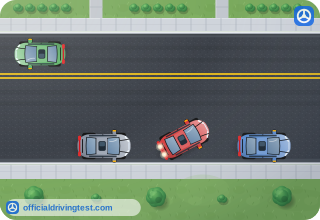
- At least 6 feet
- Exactly 1 foot
- At least 10 feet
- At least 2 feet
Show answer
Correct answer: At least 2 feet
You should be at least 2 feet away from the vehicle in front of you and behind you.
Source: Wisconsin Motorists' Handbook (2026 (BDS126)), page 20 · Open this page in the manual (Manual page 20)
-
A sign reads RESERVED PARKING above a wheelchair symbol. Who may park in that space?
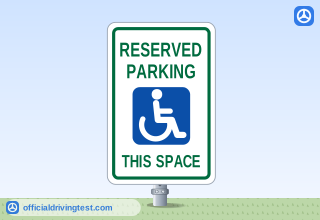
- Only drivers who park there for less than fifteen minutes
- Only drivers who have a passenger age 65 or older
- Only drivers with a valid disabled parking permit or disabled plate
- Only drivers who turn on their emergency flashers while parked
Show answer
Correct answer: Only drivers with a valid disabled parking permit or disabled plate
You may park in a reserved parking space only if you hold a valid disabled parking identification permit or a valid disabled license plate.
Source: Wisconsin Motorists' Handbook (2026 (BDS126)), page 25 · Open this page in the manual (Manual page 25)