West Virginia: Parking rules
Parallel and angle parking, parking on hills, metered parking, and the places and distances where you may not stop or park. Split into 2 shorter tests so you're not stuck in one long quiz.
Independent educational site · not affiliated with any government agency or DMV
Choose a part
Parking rules — Part 1
Questions in this part include: “In which direction must vehicles always be parked on a street?”
Parking rules — Part 2
Questions in this part include: “When you park or stop on a grade, what must you be sure to set?”
Questions are original and based on the official manual "West Virginia Driver's Licensing Handbook" (Revised July 2026), West Virginia Division of Motor Vehicles (DMV).
All 43 Parking rules questions with answers
Choose a part above to take a practice test, or study every question and answer here.
Show the questions and answersHide the questions
1Part 122 questions
-
Which exercise does the handbook describe as one of the best indicators that you have the basic skills necessary to safely operate a motor vehicle?
- Parallel parking
- Three-point turnabout
- Forward two-point turnabout
- Reverse two-point turnabout
Show answer
Correct answer: Parallel parking
Parallel parking is described as one of the best indicators of the basic skills needed to operate a vehicle safely.
Source: West Virginia Driver's Licensing Handbook (Revised July 2026), page 27 · Open this page in the manual (Manual page 27)
-
In which direction must vehicles always be parked on a street?
- Facing the opposite direction of traffic on that side of the street
- Facing whichever direction lets you leave the space most easily
- Facing the curb at a slight angle on that side of the street
- In the same direction as the movement of traffic on that side of the street
Show answer
Correct answer: In the same direction as the movement of traffic on that side of the street
A parked vehicle must face the same direction as the traffic moving on that side of the street.
Source: West Virginia Driver's Licensing Handbook (Revised July 2026), page 45 · Open this page in the manual (Manual page 45)
-
How does the handbook describe double parking?
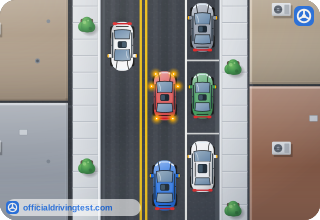
- Illegal and discourteous
- Legal if you stay with the vehicle
- Allowed for a few minutes with hazard lights on
- Allowed on streets with light traffic
Show answer
Correct answer: Illegal and discourteous
The handbook says double parking is illegal and discourteous.
Source: West Virginia Driver's Licensing Handbook (Revised July 2026), page 45 · Open this page in the manual (Manual page 45)
-
When you park, where should your vehicle be in relation to the traveled portion of the road?
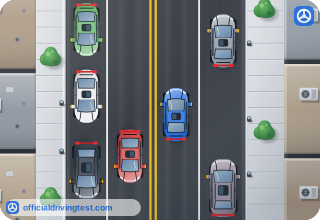
- Partly on the traveled portion if the road is wide
- On the traveled portion if your hazard lights are on
- Completely off the traveled portion of the road
- On the traveled portion if the space is short
Show answer
Correct answer: Completely off the traveled portion of the road
A parked vehicle should be completely off the traveled portion of the road.
Source: West Virginia Driver's Licensing Handbook (Revised July 2026), page 45 · Open this page in the manual (Manual page 45)
-
What must you do whenever you park and leave your vehicle?
- Turn off the engine and leave the vehicle in neutral
- Turn off the engine and set the parking (emergency) brake
- Leave the engine running and lock the doors
- Set the parking brake and leave the lights on
Show answer
Correct answer: Turn off the engine and set the parking (emergency) brake
The handbook says you must turn off the engine and set the parking (emergency) brake when you park and leave.
Source: West Virginia Driver's Licensing Handbook (Revised July 2026), page 45 · Open this page in the manual (Manual page 45)
-
What does the handbook say to do about the keys and doors when you park and leave your vehicle?
- Lock the doors and hide the keys under the seat
- Leave the keys in the ignition so the vehicle can be moved
- Take your keys but leave the doors unlocked
- Lock your vehicle and take your keys
Show answer
Correct answer: Lock your vehicle and take your keys
The handbook says to lock your vehicle and take your keys.
Source: West Virginia Driver's Licensing Handbook (Revised July 2026), page 45 · Open this page in the manual (Manual page 45)
-
Why can getting out of your vehicle on the street side be dangerous?
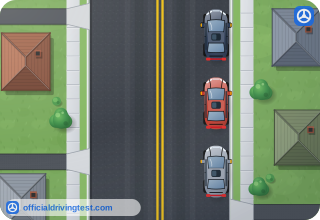
- Passing drivers may not see you in time to avoid hitting your open door, or you
- The door may be blocked by the curb and trap you inside the vehicle
- Other drivers cannot tell that your vehicle is actually parked
- Street side doors cannot be locked when the engine is turned off
Show answer
Correct answer: Passing drivers may not see you in time to avoid hitting your open door, or you
Bicycles, motorcycles or larger vehicles passing may not see you in time to avoid the open door or you.
Source: West Virginia Driver's Licensing Handbook (Revised July 2026), page 45 · Open this page in the manual (Manual page 45)
-
Which reason is an exception to the rule against stopping, standing or parking in a prohibited location?
- Waiting briefly for a passenger to come out
- Making a quick delivery to a nearby building
- Obeying a police officer or a traffic signal
- Reading a map or taking a short phone call
Show answer
Correct answer: Obeying a police officer or a traffic signal
The rule has exceptions only to avoid a conflict with other traffic or to obey a law, a police officer or a traffic signal.
Source: West Virginia Driver's Licensing Handbook (Revised July 2026), page 45 · Open this page in the manual (Manual page 45)
-
Stopping, standing or parking is not allowed within how many feet of a fire hydrant?
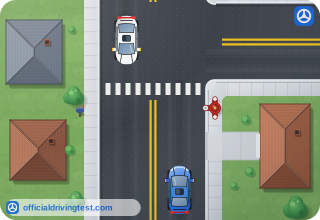
- 5 feet
- 15 feet
- 10 feet
- 25 feet
Show answer
Correct answer: 15 feet
The prohibited-parking list includes anywhere within 15 feet of a fire hydrant.
Source: West Virginia Driver's Licensing Handbook (Revised July 2026), page 45 · Open this page in the manual (Manual page 45)
-
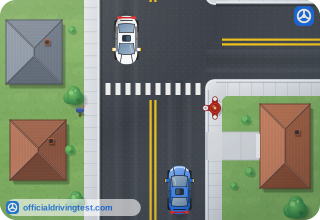
Stopping, standing or parking is not allowed within how many feet of a crosswalk at an intersection?
- 10 feet
- 25 feet
- 40 feet
- 20 feet
Show answer
Correct answer: 20 feet
You may not stop, stand or park within 20 feet of a crosswalk at an intersection.
Source: West Virginia Driver's Licensing Handbook (Revised July 2026), page 45 · Open this page in the manual (Manual page 45)
-
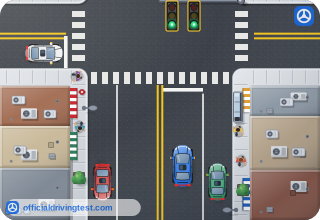
Stopping, standing or parking is not allowed within how many feet of any stop sign or traffic control signal?
- 30 feet
- 10 feet
- 25 feet
- 40 feet
Show answer
Correct answer: 30 feet
The list of prohibited places includes within 30 feet of any stop sign or traffic control signal.
Source: West Virginia Driver's Licensing Handbook (Revised July 2026), page 45 · Open this page in the manual (Manual page 45)
-
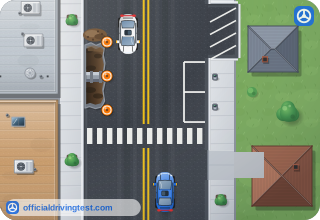
Which of these is a place where you must not stop, stand or park?
- In a parallel parking space within 18 inches of the right curb
- In front of a public or private driveway
- In an angle parking space on your right
- In a metered parking spot beside the road
Show answer
Correct answer: In front of a public or private driveway
Stopping, standing or parking in front of a public or private driveway is not allowed.
Source: West Virginia Driver's Licensing Handbook (Revised July 2026), page 45 · Open this page in the manual (Manual page 45)
-
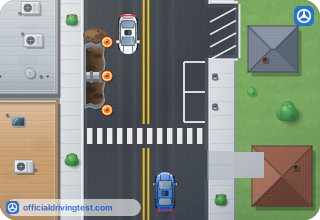
Where is stopping, standing or parking not allowed?
- In an angle parking space on your right
- In a metered parking spot beside the road
- Within 18 inches of the right curb on a two-way street
- On a crosswalk
Show answer
Correct answer: On a crosswalk
A crosswalk is on the list of places where stopping, standing or parking is not allowed.
Source: West Virginia Driver's Licensing Handbook (Revised July 2026), page 45 · Open this page in the manual (Manual page 45)
-
Stopping, standing or parking is not allowed within how many feet of a mailbox served by a carrier using a motor vehicle for daily deliveries?
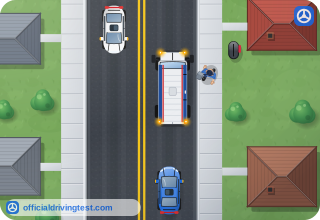
- 20 feet
- 5 feet
- 10 feet
- 40 feet
Show answer
Correct answer: 20 feet
The prohibited-parking list includes within 20 feet of any mailbox served by a carrier using a motor vehicle for daily deliveries.
Source: West Virginia Driver's Licensing Handbook (Revised July 2026), page 46 · Open this page in the manual (Manual page 46)
-
Which of these locations is on the handbook's list of no stopping, standing or parking places?
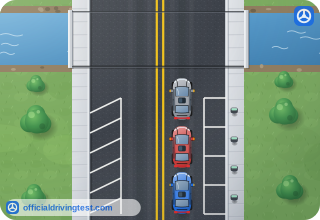
- In an angle parking space on your right
- In a metered parking spot beside the road
- Upon any bridge or other elevated structure
- In a parallel parking space on a two-way street, right wheels near the curb
Show answer
Correct answer: Upon any bridge or other elevated structure
Stopping, standing or parking is not allowed upon a bridge or other elevated structure, or in a highway tunnel.
Source: West Virginia Driver's Licensing Handbook (Revised July 2026), page 46 · Open this page in the manual (Manual page 46)
-
At which of these places is stopping, standing or parking prohibited?
- In an angle parking space on your right
- In front of a wheelchair ramp or curb cut
- In a metered parking spot beside the road
- In a parallel parking space with the right wheels near the curb
Show answer
Correct answer: In front of a wheelchair ramp or curb cut
The handbook lists the area in front of a wheelchair ramp or curb cut as a place where stopping, standing or parking is not allowed.
Source: West Virginia Driver's Licensing Handbook (Revised July 2026), page 45 · Open this page in the manual (Manual page 45)
-
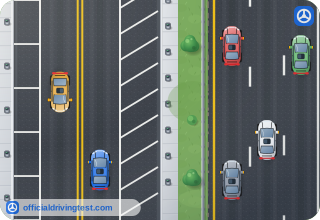
Which of these is a prohibited place to stop, stand or park?
- In an angle parking space on your right
- In a metered parking spot beside the road
- In a parallel parking space with the right wheels near the curb
- Upon any controlled-access highway
Show answer
Correct answer: Upon any controlled-access highway
Stopping, standing or parking is not allowed upon any controlled-access highway.
Source: West Virginia Driver's Licensing Handbook (Revised July 2026), page 46 · Open this page in the manual (Manual page 46)
-
Stopping, standing or parking is not allowed in which of these places?
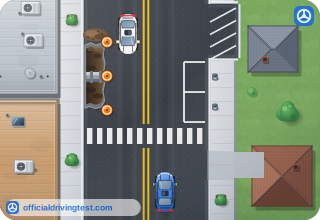
- Beside or opposite a street excavation where parking would obstruct traffic
- In an angle parking space on your right, entered with a signal
- In a metered parking spot beside the road with change in the meter
- In a parallel parking space with the right wheels near the curb
Show answer
Correct answer: Beside or opposite a street excavation where parking would obstruct traffic
Stopping, standing or parking is not allowed beside or opposite any street excavation or obstruction where it would obstruct traffic.
Source: West Virginia Driver's Licensing Handbook (Revised July 2026), page 46 · Open this page in the manual (Manual page 46)
-
What color may a curb in a no-parking zone be painted?
- Red
- White
- Yellow
- Blue
Show answer
Correct answer: Yellow
The handbook says a curb in a no-parking zone may be painted yellow.
Source: West Virginia Driver's Licensing Handbook (Revised July 2026), page 46 · Open this page in the manual (Manual page 46)
-
When entering an angle parking space on your right, what should you do first?
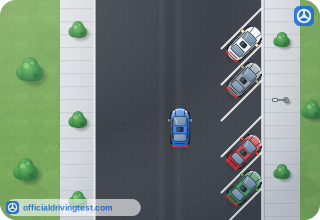
- Stop in the lane and then back toward the space
- Signal your intention to park and slow down
- Move to the left side of the lane for a wide turn
- Turn on your hazard lights and drive past the space
Show answer
Correct answer: Signal your intention to park and slow down
The handbook says to signal your intention to park and slow down when entering a space on your right.
Source: West Virginia Driver's Licensing Handbook (Revised July 2026), page 46 · Open this page in the manual (Manual page 46)
-
When approaching an angle parking space on your right, how far out from the parked vehicles should you remain, parallel to the curb?
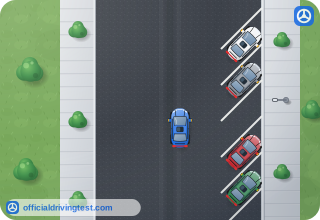
- At least one foot
- At least three feet
- At least ten feet
- At least five feet
Show answer
Correct answer: At least five feet
You should stay parallel to the curb, at least five feet out from the parked vehicles.
Source: West Virginia Driver's Licensing Handbook (Revised July 2026), page 46 · Open this page in the manual (Manual page 46)
-
When should you steer sharply to the right into an angle parking space?
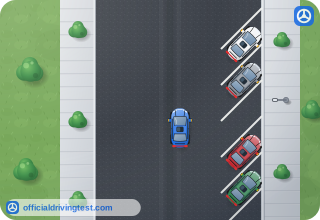
- When your vehicle's front end is even with the rear of the space
- When your vehicle's front end is even with the front of the space
- When your vehicle's front end is even with the middle of the space
- When your rear bumper passes the rear of the space
Show answer
Correct answer: When your vehicle's front end is even with the rear of the space
You steer sharply right when the front end of your vehicle is even with the rear of the parking space.
Source: West Virginia Driver's Licensing Handbook (Revised July 2026), page 46 · Open this page in the manual (Manual page 46)
2Part 221 questions
-
In angle parking, how far should you continue forward after straightening the steering wheel?
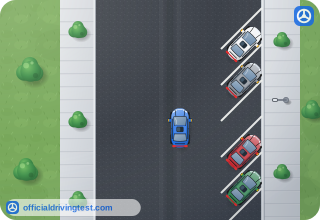
- Until the front bumper touches the curb
- Until the vehicle is about one foot from the curb
- Until the front wheel barely touches the curb
- Until the rear wheels reach the curb
Show answer
Correct answer: Until the front wheel barely touches the curb
After straightening the wheel, you continue forward until the front wheel barely touches the curb.
Source: West Virginia Driver's Licensing Handbook (Revised July 2026), page 46 · Open this page in the manual (Manual page 46)
-
If your vision is blocked when you back out of an angle parking space, what should you do?
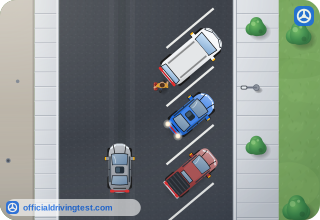
- Sound your horn and back out quickly before traffic arrives
- Move back cautiously, watching for pedestrians or other vehicles
- Back out at a normal speed and rely on your rear view mirror alone
- Wait until all traffic has passed and then back out in one move
Show answer
Correct answer: Move back cautiously, watching for pedestrians or other vehicles
Back out slowly and cautiously, and watch for a pedestrian or vehicle that might suddenly appear.
Source: West Virginia Driver's Licensing Handbook (Revised July 2026), page 46 · Open this page in the manual (Manual page 46)
-
When backing out of an angle parking space, which must you not do?
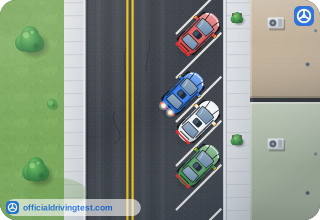
- Move back slowly and cautiously
- Watch for a pedestrian or vehicle
- Look to the rear as you move
- Back across the center line
Show answer
Correct answer: Back across the center line
The handbook reminds you not to back across the center line when backing out of an angle parking space.
Source: West Virginia Driver's Licensing Handbook (Revised July 2026), page 46 · Open this page in the manual (Manual page 46)
-
When you park or stop on a grade, what must you be sure to set?
- The emergency or parking brake
- The hazard flashers and headlights
- The cruise control
- The turn signals
Show answer
Correct answer: The emergency or parking brake
On a grade you must be sure to set the emergency or parking brake.
Source: West Virginia Driver's Licensing Handbook (Revised July 2026), page 46 · Open this page in the manual (Manual page 46)
-
To reinforce the parking brake in an automatic shift vehicle, where should you put the selector shift?
- Neutral
- Reverse
- Park
- Drive
Show answer
Correct answer: Park
In an automatic shift vehicle, the selector shift goes in park to reinforce the parking brake.
Source: West Virginia Driver's Licensing Handbook (Revised July 2026), page 46 · Open this page in the manual (Manual page 46)
-
To reinforce the parking brake in a manual shift vehicle parked on a downgrade, which gear should you use?
- 1st gear
- Reverse
- Neutral
- 2nd gear
Show answer
Correct answer: Reverse
In a manual shift vehicle, use reverse on a downgrade to reinforce the parking brake.
Source: West Virginia Driver's Licensing Handbook (Revised July 2026), page 46 · Open this page in the manual (Manual page 46)
-
To reinforce the parking brake in a manual shift vehicle parked on an upgrade, which gear should you use?
- Reverse
- Neutral
- 3rd gear
- 1st gear
Show answer
Correct answer: 1st gear
In a manual shift vehicle, use 1st gear on an upgrade to reinforce the parking brake.
Source: West Virginia Driver's Licensing Handbook (Revised July 2026), page 46 · Open this page in the manual (Manual page 46)
-
What does the handbook say it is best to keep in your vehicle in case you need to park in a metered parking spot?
- Change
- A flashlight
- A tire gauge
- A parking permit
Show answer
Correct answer: Change
The handbook says to keep change easily accessible for metered parking, for convenience and safety.
Source: West Virginia Driver's Licensing Handbook (Revised July 2026), page 46 · Open this page in the manual (Manual page 46)
-
If you must remain in your vehicle while parked in a busy area, what does the handbook say to do?
- Leave the doors unlocked so you can get out quickly
- Keep the windows fully down to hear your surroundings
- Keep your doors locked until you are ready to exit
- Keep the engine running with the doors unlocked
Show answer
Correct answer: Keep your doors locked until you are ready to exit
You should keep your doors locked until you are ready to exit and always be alert to your surroundings.
Source: West Virginia Driver's Licensing Handbook (Revised July 2026), page 46 · Open this page in the manual (Manual page 46)
-
When you parallel park on a two-way street, how close should the right-hand wheels be to the right curb?
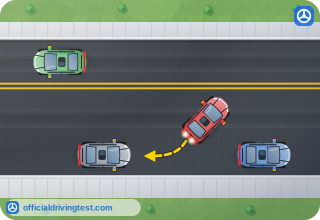
- Within 12 inches
- Within 18 inches
- Within 24 inches
- Within 30 inches
Show answer
Correct answer: Within 18 inches
For parallel parking on a two-way street, the right-hand wheels are parallel to and within 18 inches of the right curb.
Source: West Virginia Driver's Licensing Handbook (Revised July 2026), page 47 · Open this page in the manual (Manual page 47)
-
When you begin to parallel park, how far out from the front vehicle should you stop, even with it?
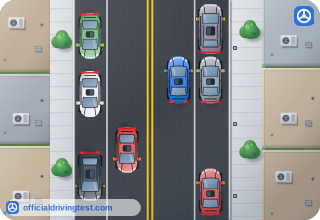
- About 10 inches
- About four feet
- About six feet
- About two feet
Show answer
Correct answer: About two feet
You signal and stop even with the front vehicle, about two feet out from it.
Source: West Virginia Driver's Licensing Handbook (Revised July 2026), page 47 · Open this page in the manual (Manual page 47)
-
In parallel parking, after stopping even with the front vehicle, how should you turn your front wheels before backing slowly toward the curb?
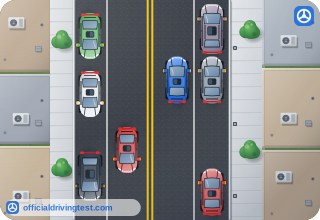
- All the way to the right
- All the way to the left
- Halfway to the left
- Halfway to the right
Show answer
Correct answer: All the way to the right
You turn the front wheels all the way to the right and back slowly toward the curb.
Source: West Virginia Driver's Licensing Handbook (Revised July 2026), page 47 · Open this page in the manual (Manual page 47)
-
In parallel parking, what should you do when your front bumper is opposite the rear bumper of the vehicle ahead?
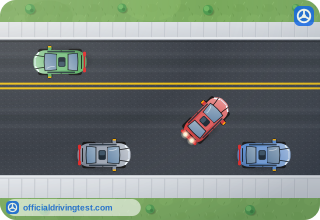
- Straighten your front wheels and pull forward
- Stop and turn your wheels all the way to the right
- Quickly turn your steering wheel all the way to the left
- Keep the wheel turned right until you touch the curb
Show answer
Correct answer: Quickly turn your steering wheel all the way to the left
At that point you quickly turn the steering wheel all the way to the left and back slowly toward the vehicle behind.
Source: West Virginia Driver's Licensing Handbook (Revised July 2026), page 47 · Open this page in the manual (Manual page 47)
-
When you finish parallel parking, about how far from the curb should you be?
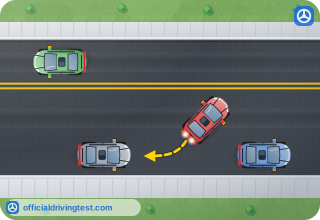
- About 12 inches
- About 6 inches
- About 2 feet
- About 3 feet
Show answer
Correct answer: About 6 inches
The handbook says you should be about 6 inches from the curb.
Source: West Virginia Driver's Licensing Handbook (Revised July 2026), page 47 · Open this page in the manual (Manual page 47)
-
What should you do when exiting a parallel parking space?
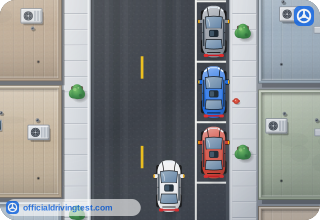
- Sound your horn and pull out slowly into the traffic lane
- Flash your headlights and pull out at once if the lane is open
- Pull out right away since parked cars are not part of traffic
- Signal and make sure traffic is clear before pulling out
Show answer
Correct answer: Signal and make sure traffic is clear before pulling out
You always signal your intentions and make sure traffic is clear before pulling back onto the roadway.
Source: West Virginia Driver's Licensing Handbook (Revised July 2026), page 47 · Open this page in the manual (Manual page 47)
-
What does the handbook say you should do for a driver in front of you who is parallel parking?
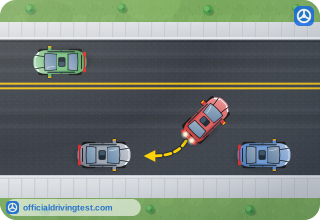
- Give the driver ample space
- Stay very close so no one cuts in
- Honk once to warn the driver
- Move alongside to help judge the space
Show answer
Correct answer: Give the driver ample space
Drivers should provide ample space to the driver in front who is parallel parking.
Source: West Virginia Driver's Licensing Handbook (Revised July 2026), page 49 · Open this page in the manual (Manual page 49)
-
Designated mobility impaired parking spaces are reserved for people with a condition that limits what?
- Their ability to see road signs at a distance
- Their ability to drive long distances
- Their ability to walk reasonable distances
- Their ability to carry heavy items
Show answer
Correct answer: Their ability to walk reasonable distances
These parking areas are reserved for those having a condition that limits their ability to walk reasonable distances.
Source: West Virginia Driver's Licensing Handbook (Revised July 2026), page 55 · Open this page in the manual (Manual page 55)
-
Besides persons with a mobility impairment, who else may use a designated parking space?
- Those who routinely transport mobility impaired persons
- Anyone who stays in the vehicle with the engine running
- Anyone making a short stop of fifteen minutes or less
- Delivery drivers who are loading or unloading goods
Show answer
Correct answer: Those who routinely transport mobility impaired persons
Citizens or those who routinely transport mobility impaired persons may also use a designated parking space.
Source: West Virginia Driver's Licensing Handbook (Revised July 2026), page 55 · Open this page in the manual (Manual page 55)
-
To get a mobility impaired parking placard or license plate, who must certify your condition?
- A county clerk, on a form from the courthouse
- A driver's license examiner at a DMV office
- Any licensed driver who knows your condition
- A doctor, on a form provided by the DMV
Show answer
Correct answer: A doctor, on a form provided by the DMV
You must have a doctor certify your condition on a form provided by the DMV.
Source: West Virginia Driver's Licensing Handbook (Revised July 2026), page 55 · Open this page in the manual (Manual page 55)
-
What is illegal in a designated mobility impaired parking area?
- Leaving the vehicle unattended for more than two hours at a time
- Parking a vehicle that displays no mobility impaired placard or plate
- Parking without turning on your hazard lights while you are away
- Parking without paying at the meter nearest to the space
Show answer
Correct answer: Parking a vehicle that displays no mobility impaired placard or plate
It is illegal to park a vehicle that does not display a mobility impaired parking placard or license plate in a designated area.
Source: West Virginia Driver's Licensing Handbook (Revised July 2026), page 55 · Open this page in the manual (Manual page 55)
-
What may happen to a vehicle parked on the shoulder of an interstate?
- Nothing, if the flashers are on
- It may be towed
- Nothing, if it is off the through lane
- It will be given a warning only
Show answer
Correct answer: It may be towed
No parking is permitted on the shoulders of interstates, and parked vehicles may be towed.
Source: West Virginia Driver's Licensing Handbook (Revised July 2026), page 59 · Open this page in the manual (Manual page 59)