Washington: Emergency vehicles and work zones — Part 2 Practice Test
Questions in this part include: “Which of these is listed as a roadside response vehicle?” · “When an officer approaches your vehicle, when should you reach for your driver license or vehicle documents?”
Independent educational site · not affiliated with any government agency or DMV
Ready? Test yourself
Answer to start, or tap Start below:
Which of these is listed as a roadside response vehicle?
- Instant feedback with an explanation
- Every answer cites its source in the manual
- Your best score is saved on this device
- Keyboard: press 1 to 4 to answer and Enter for the next question
Questions are original and based on the official manual "Washington Driver Guide" (© 2025), Washington State Department of Licensing (DOL).
All 18 questions in this practice test
Take the test above first, then use this list to study. Tap “Show answer” to see the correct answer and explanation.
Show the questions and answersHide the questions
-
Which of these is listed as a roadside response vehicle?
- A school bus
- A taxi
- A mail truck
- A solid waste truck
Show answer
Correct answer: A solid waste truck
Roadside response vehicles include tow trucks, solid waste trucks, highway maintenance and utility vehicles, law enforcement, fire trucks and ambulances.
Source: Washington Driver Guide (© 2025), page 143 · Open this page in the manual (Manual page 143)
-
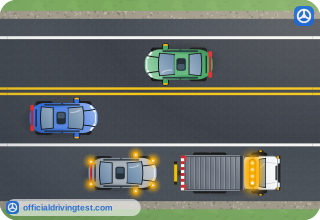
What should you create for roadside workers as soon as possible?
- A passing lane
- A safe space
- A detour
- A parking space
Show answer
Correct answer: A safe space
Drivers can help roadside workers by creating a safe space for them as soon as possible.
Source: Washington Driver Guide (© 2025), page 143 · Open this page in the manual (Manual page 143)
-
How do police vehicles try to stop a driver?
- By blocking the road with another vehicle
- By flashing the headlights only
- By turning on flashing lights and/or a siren
- By sounding a horn
Show answer
Correct answer: By turning on flashing lights and/or a siren
The guide says police use flashing lights and/or a siren to stop drivers.
Source: Washington Driver Guide (© 2025), page 180 · Open this page in the manual (Manual page 180)
-
If a law enforcement officer pulls you over, what should you do first?
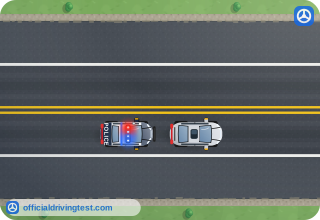
- Signal and pull to the right side of the road when it is safe
- Stop immediately in the lane that you are driving in
- Pull to the left shoulder as quickly as you can
- Keep driving slowly until you reach a well-lit parking lot
Show answer
Correct answer: Signal and pull to the right side of the road when it is safe
The guide starts with signaling and pulling to the right as soon as it is safe.
Source: Washington Driver Guide (© 2025), page 180 · Open this page in the manual (Manual page 180)
-
What should you do with the engine and audio devices when you are pulled over?
- Leave the engine on and turn the radio up
- Turn off the engine and any audio devices
- Turn off the engine but keep the radio on
- Turn off only the radio
Show answer
Correct answer: Turn off the engine and any audio devices
The guide lists turning off the engine and audio devices as the second step.
Source: Washington Driver Guide (© 2025), page 180 · Open this page in the manual (Manual page 180)
-
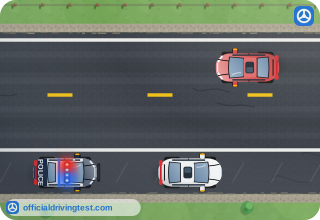
When you are pulled over, should you stay in your vehicle?
- No, you should walk back to the officer
- No, you should stand beside the vehicle
- Yes, but only if it is raining
- Yes, unless the officer directs you to get out
Show answer
Correct answer: Yes, unless the officer directs you to get out
The guide tells you to stay in your vehicle unless directed to get out.
Source: Washington Driver Guide (© 2025), page 180 · Open this page in the manual (Manual page 180)
-
What should you turn on if you are pulled over at night?
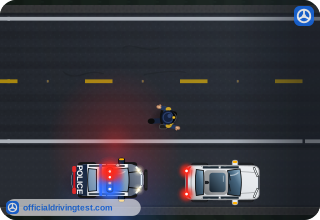
- Your interior lights
- Your high beams
- Your fog lights only
- Nothing, to avoid distraction
Show answer
Correct answer: Your interior lights
Turn on your interior lights if you are pulled over at night; officers might also use a spotlight for more visibility.
Source: Washington Driver Guide (© 2025), page 181 · Open this page in the manual (Manual page 181)
-
Where should your hands be when you are pulled over?
- On the dashboard in plain view
- Resting in your lap or on your knees
- On the steering wheel
- Held out of the window
Show answer
Correct answer: On the steering wheel
The guide says to keep your hands on the steering wheel.
Source: Washington Driver Guide (© 2025), page 181 · Open this page in the manual (Manual page 181)
-
What should you do with the officer's instructions when you are pulled over?
- Follow only the instructions given directly to you
- Ask the officer to repeat them in writing
- Follow all instructions the officer gives you or your passengers
- Follow them only if you agree with the reason for the stop
Show answer
Correct answer: Follow all instructions the officer gives you or your passengers
The guide says to follow all instructions for you and your passengers.
Source: Washington Driver Guide (© 2025), page 181 · Open this page in the manual (Manual page 181)
-
When an officer approaches your vehicle, what should you do about the window?
- Lower the window on the side the officer is on
- Keep the window closed and speak through the glass
- Lower all the windows in the vehicle
- Open the door instead of the window
Show answer
Correct answer: Lower the window on the side the officer is on
The officer could approach either side, so lower the window on that side.
Source: Washington Driver Guide (© 2025), page 181 · Open this page in the manual (Manual page 181)
-
If you have a weapon in the vehicle when an officer approaches, what should you do?
- Hide it before the officer reaches the window
- Say nothing unless asked
- Hand it to the officer
- Let the officer know right away
Show answer
Correct answer: Let the officer know right away
The guide says to tell the officer right away about a weapon.
Source: Washington Driver Guide (© 2025), page 181 · Open this page in the manual (Manual page 181)
-
When an officer approaches your vehicle, when should you reach for your driver license or vehicle documents?
- As soon as you stop
- After the officer gives you instructions
- Before the officer reaches the window
- While the officer walks to the vehicle
Show answer
Correct answer: After the officer gives you instructions
You wait for the officer's instructions and tell the officer where the documents are before reaching.
Source: Washington Driver Guide (© 2025), page 181 · Open this page in the manual (Manual page 181)
-
Which of these will an officer typically ask for when you are pulled over?
- Proof of insurance
- Your vehicle title
- Your birth certificate
- Your Social Security card
Show answer
Correct answer: Proof of insurance
The guide lists driver license, proof of insurance, and vehicle registration.
Source: Washington Driver Guide (© 2025), page 181 · Open this page in the manual (Manual page 181)
-
Before reaching for your driver license, proof of insurance, or vehicle registration, what should you do?
- Hand over everything in your glove box
- Step out of the vehicle to get them
- Tell the officer where the documents are
- Turn on your hazard lights and wait
Show answer
Correct answer: Tell the officer where the documents are
The guide says to tell the officer where the documents are before reaching for them.
Source: Washington Driver Guide (© 2025), page 181 · Open this page in the manual (Manual page 181)
-
What can you do if an officer does not explain the action being taken, such as a warning, ticket, or arrest?
- Leave the scene
- Ask the officer to explain
- Drive to the nearest police station
- Call 911 right away
Show answer
Correct answer: Ask the officer to explain
The guide says you can ask the officer to explain the action being taken.
Source: Washington Driver Guide (© 2025), page 181 · Open this page in the manual (Manual page 181)
-
If you disagree with an officer's decision, what should you not do?
- Respectfully ask the officer questions
- Contest the decision in court
- Contact the agency and request a supervisor
- Prolong the contact by arguing with the officer
Show answer
Correct answer: Prolong the contact by arguing with the officer
The guide says you may contest the decision in court but should not argue at the scene.
Source: Washington Driver Guide (© 2025), page 182 · Open this page in the manual (Manual page 182)
-
If you disagree with an officer's decision, what may you do?
- Refuse to sign the ticket
- Argue until the officer changes the decision
- Follow the officer's decision but ignore the ticket
- Seek to contest the decision in court
Show answer
Correct answer: Seek to contest the decision in court
The guide says you may contest the decision in court.
Source: Washington Driver Guide (© 2025), page 182 · Open this page in the manual (Manual page 182)
-
If you believe an officer acted inappropriately, what can you do?
- Call the Department of Licensing the same day
- Contact the officer's agency and request a supervisor
- Follow the officer back to the police station
- File a collision report form within 4 days
Show answer
Correct answer: Contact the officer's agency and request a supervisor
The guide says to contact the officer's agency and ask for a supervisor, ideally as soon as possible.
Source: Washington Driver Guide (© 2025), page 182 · Open this page in the manual (Manual page 182)