Washington: Emergency vehicles and work zones
Yielding to emergency vehicles, roadside response vehicles, work zones and flaggers, and being pulled over. Split into 2 shorter tests so you're not stuck in one long quiz.
Independent educational site · not affiliated with any government agency or DMV
Choose a part
Emergency vehicles and work zones — Part 1
Questions in this part include: “Which vehicles using lights and/or sirens always have the right-of-way?”
Emergency vehicles and work zones — Part 2
Questions in this part include: “Which of these is listed as a roadside response vehicle?”
Questions are original and based on the official manual "Washington Driver Guide" (© 2025), Washington State Department of Licensing (DOL).
All 36 Emergency vehicles and work zones questions with answers
Choose a part above to take a practice test, or study every question and answer here.
Show the questions and answersHide the questions
1Part 118 questions
-
Which vehicles using lights and/or sirens always have the right-of-way?
- Fire trucks, ambulances, and police cars
- Only fire trucks and ambulances, not police cars
- Farm vehicles, rental trucks, and motorcycles
- Transit buses, delivery vans, and taxis
Show answer
Correct answer: Fire trucks, ambulances, and police cars
Fire trucks, ambulances and police cars using lights and/or sirens always have the right-of-way.
Source: Washington Driver Guide (© 2025), page 107 · Open this page in the manual (Manual page 107)
-
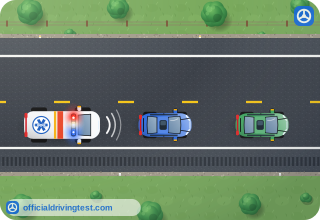
As soon as you see or hear the signals of an approaching emergency vehicle, what should you immediately do?
- Speed up to clear the lane
- Pull to the left side of the road and stop
- Pull to the right side of the road and stop
- Stop where you are in your lane
Show answer
Correct answer: Pull to the right side of the road and stop
Immediately pull your vehicle to the right side of the road and stop.
Source: Washington Driver Guide (© 2025), page 107 · Open this page in the manual (Manual page 107)
-
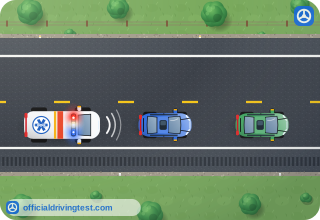
When should you signal and reenter traffic after pulling over for an emergency vehicle?
- As soon as the siren sounds quieter
- After the emergency vehicle has passed
- As soon as the emergency vehicle is beside you
- After the emergency vehicle's lights are turned off
Show answer
Correct answer: After the emergency vehicle has passed
Wait until the emergency vehicle has passed before signaling and reentering traffic.
Source: Washington Driver Guide (© 2025), page 107 · Open this page in the manual (Manual page 107)
-
In what order should you reenter traffic after an emergency vehicle has passed?
- Fastest vehicles first
- Largest vehicles first
- Vehicles closest to the road first
- In the order you were traveling before
Show answer
Correct answer: In the order you were traveling before
You should reenter traffic in the order you were traveling before.
Source: Washington Driver Guide (© 2025), page 107 · Open this page in the manual (Manual page 107)
-
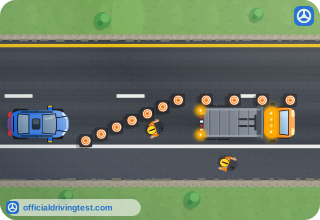
Inside a highway construction or maintenance work zone, who must yield to construction personnel, vehicles with flashing yellow lights, and equipment?
- Motorists only
- Motorists and bicyclists, but not pedestrians
- Motorists, pedestrians, and bicyclists
- Only vehicles that are larger than the equipment
Show answer
Correct answer: Motorists, pedestrians, and bicyclists
Everyone, whether driving, walking, or cycling, must yield to workers, flashing-yellow vehicles, and equipment inside a work zone.
Source: Washington Driver Guide (© 2025), page 117 · Open this page in the manual (Manual page 117)
-
What happens to fines for offenses committed in construction areas when workers are present?
- They double
- They are reduced if you slow down
- They stay the same as elsewhere
- They apply only to speeding
Show answer
Correct answer: They double
Fines are doubled for offenses in construction areas when workers are present.
Source: Washington Driver Guide (© 2025), page 117 · Open this page in the manual (Manual page 117)
-
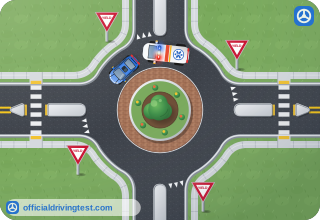
What should you do if an emergency vehicle approaches while you are in a roundabout?
- Stop immediately where you are in the circle
- Speed up and exit before it reaches you
- Pull onto the truck apron and wait
- Drive through the roundabout and pull over
Show answer
Correct answer: Drive through the roundabout and pull over
Handle it as at any other intersection: get through the roundabout and then pull over.
Source: Washington Driver Guide (© 2025), page 127 · Open this page in the manual (Manual page 127)
-
What is a work zone?
- An area where a tow truck has stopped at the roadside
- A road closed to all traffic until repairs end
- An area where roadwork or construction takes place
- A lane set aside for road crew vehicles to park
Show answer
Correct answer: An area where roadwork or construction takes place
A work zone is an area where roadwork or construction takes place; it can involve lane closures, detours and moving equipment.
Source: Washington Driver Guide (© 2025), page 141 · Open this page in the manual (Manual page 141)
-
How should you adjust your speed in a work zone?
- Reduce it only when workers are visible
- Always reduce it, even if there are no workers
- Keep it the same unless a sign says otherwise
- Reduce it only at night
Show answer
Correct answer: Always reduce it, even if there are no workers
Always slow down in a work zone, even with no workers present, because narrower lanes and rough pavement can be hazardous.
Source: Washington Driver Guide (© 2025), page 141 · Open this page in the manual (Manual page 141)
-
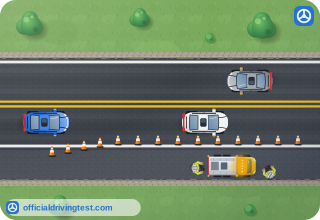
What should you do with your following distance in a work zone?
- Decrease it so traffic keeps moving
- Keep it the same as outside the zone
- Shorten it so no one cuts in front of you
- Increase it and be prepared to stop
Show answer
Correct answer: Increase it and be prepared to stop
In a work zone you should leave more space, watch the traffic around you and be ready to stop.
Source: Washington Driver Guide (© 2025), page 141 · Open this page in the manual (Manual page 141)
-
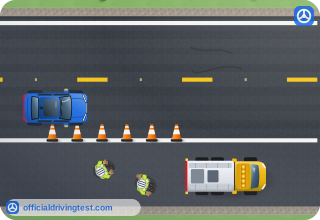
How can you reduce distractions as you approach a work zone?
- Turn up the radio to stay alert
- Talk with passengers to stay awake
- Turn down music and pause conversations
- Look only at the vehicle ahead and ignore signs
Show answer
Correct answer: Turn down music and pause conversations
Eliminating distractions such as loud music and conversation helps you focus near a work zone.
Source: Washington Driver Guide (© 2025), page 141 · Open this page in the manual (Manual page 141)
-
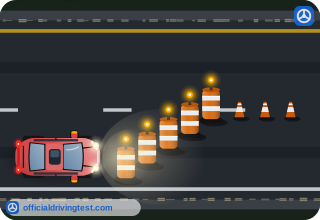
How should you drive through a work zone at night?
- With normal caution if no workers are visible
- With caution only when workers are in sight
- Faster, since there is less traffic
- With extreme caution, whether you see workers or not
Show answer
Correct answer: With extreme caution, whether you see workers or not
Night driving in a work zone calls for extreme caution even when no workers are visible.
Source: Washington Driver Guide (© 2025), page 142 · Open this page in the manual (Manual page 142)
-
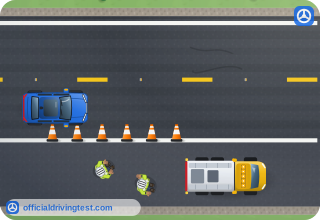
What should you do, when possible, to give workers and construction vehicles space?
- Sound your horn to warn them
- Move over
- Flash your high beams at them
- Drive as close to them as you can
Show answer
Correct answer: Move over
You should move over when possible to allow space for workers and construction vehicles.
Source: Washington Driver Guide (© 2025), page 142 · Open this page in the manual (Manual page 142)
-
Until you see which sign should you keep observing the posted work zone signs?
- End Road Work
- Road Narrows
- Detour Ahead
- Resume Speed
Show answer
Correct answer: End Road Work
The posted work zone signs apply until you reach the End Road Work sign.
Source: Washington Driver Guide (© 2025), page 142 · Open this page in the manual (Manual page 142)
-
What should you do about delays you expect in a work zone?
- Drive faster before and after the zone
- Leave at your usual time and speed up later
- Plan for them and leave early
- Follow the vehicle ahead closely to save time
Show answer
Correct answer: Plan for them and leave early
You should expect delays, plan for them and leave early so you still arrive on time.
Source: Washington Driver Guide (© 2025), page 142 · Open this page in the manual (Manual page 142)
-
What is advised if you want to avoid a work zone?
- Wait at the edge until workers wave you in
- Use a different route when possible
- Drive on the shoulder to bypass it
- Ask the workers to open a lane
Show answer
Correct answer: Use a different route when possible
Using a different route when possible helps you avoid work zones.
Source: Washington Driver Guide (© 2025), page 142 · Open this page in the manual (Manual page 142)
-
What is an emergency zone?
- A stretch of road that police close off for a public event
- An area around a hospital where a lower speed limit applies
- A lane kept free at all times for ambulances and fire trucks
- A zone created for a roadside situation needing immediate attention
Show answer
Correct answer: A zone created for a roadside situation needing immediate attention
An emergency zone arises from a roadside situation such as a crash, a broken vehicle or a person in distress.
Source: Washington Driver Guide (© 2025), page 142 · Open this page in the manual (Manual page 142)
-
What must you do as soon as you see a roadside response vehicle with flashing lights?
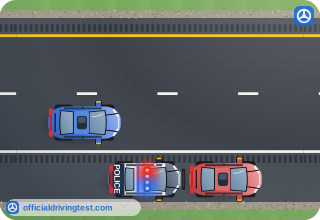
- Stay in your lane and keep your speed if the shoulder is clear
- Slow to 5 mph below the limit and stay in the same lane
- Move to a farther lane or slow to 10 mph below the limit
- Speed up to clear the area before reaching the vehicle
Show answer
Correct answer: Move to a farther lane or slow to 10 mph below the limit
You must either move over into a farther lane or slow down to 10 mph below the posted speed limit.
Source: Washington Driver Guide (© 2025), page 143 · Open this page in the manual (Manual page 143)
2Part 218 questions
-
Which of these is listed as a roadside response vehicle?
- A school bus
- A taxi
- A mail truck
- A solid waste truck
Show answer
Correct answer: A solid waste truck
Roadside response vehicles include tow trucks, solid waste trucks, highway maintenance and utility vehicles, law enforcement, fire trucks and ambulances.
Source: Washington Driver Guide (© 2025), page 143 · Open this page in the manual (Manual page 143)
-
What should you create for roadside workers as soon as possible?
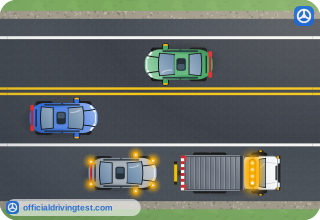
- A passing lane
- A safe space
- A detour
- A parking space
Show answer
Correct answer: A safe space
Drivers can help roadside workers by creating a safe space for them as soon as possible.
Source: Washington Driver Guide (© 2025), page 143 · Open this page in the manual (Manual page 143)
-
How do police vehicles try to stop a driver?
- By blocking the road with another vehicle
- By flashing the headlights only
- By turning on flashing lights and/or a siren
- By sounding a horn
Show answer
Correct answer: By turning on flashing lights and/or a siren
The guide says police use flashing lights and/or a siren to stop drivers.
Source: Washington Driver Guide (© 2025), page 180 · Open this page in the manual (Manual page 180)
-
If a law enforcement officer pulls you over, what should you do first?
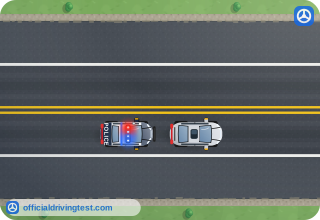
- Signal and pull to the right side of the road when it is safe
- Stop immediately in the lane that you are driving in
- Pull to the left shoulder as quickly as you can
- Keep driving slowly until you reach a well-lit parking lot
Show answer
Correct answer: Signal and pull to the right side of the road when it is safe
The guide starts with signaling and pulling to the right as soon as it is safe.
Source: Washington Driver Guide (© 2025), page 180 · Open this page in the manual (Manual page 180)
-
What should you do with the engine and audio devices when you are pulled over?
- Leave the engine on and turn the radio up
- Turn off the engine and any audio devices
- Turn off the engine but keep the radio on
- Turn off only the radio
Show answer
Correct answer: Turn off the engine and any audio devices
The guide lists turning off the engine and audio devices as the second step.
Source: Washington Driver Guide (© 2025), page 180 · Open this page in the manual (Manual page 180)
-
When you are pulled over, should you stay in your vehicle?
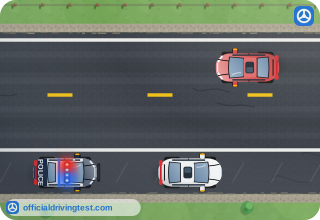
- No, you should walk back to the officer
- No, you should stand beside the vehicle
- Yes, but only if it is raining
- Yes, unless the officer directs you to get out
Show answer
Correct answer: Yes, unless the officer directs you to get out
The guide tells you to stay in your vehicle unless directed to get out.
Source: Washington Driver Guide (© 2025), page 180 · Open this page in the manual (Manual page 180)
-
What should you turn on if you are pulled over at night?
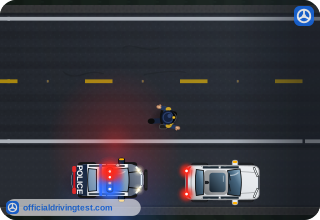
- Your interior lights
- Your high beams
- Your fog lights only
- Nothing, to avoid distraction
Show answer
Correct answer: Your interior lights
Turn on your interior lights if you are pulled over at night; officers might also use a spotlight for more visibility.
Source: Washington Driver Guide (© 2025), page 181 · Open this page in the manual (Manual page 181)
-
Where should your hands be when you are pulled over?
- On the dashboard in plain view
- Resting in your lap or on your knees
- On the steering wheel
- Held out of the window
Show answer
Correct answer: On the steering wheel
The guide says to keep your hands on the steering wheel.
Source: Washington Driver Guide (© 2025), page 181 · Open this page in the manual (Manual page 181)
-
What should you do with the officer's instructions when you are pulled over?
- Follow only the instructions given directly to you
- Ask the officer to repeat them in writing
- Follow all instructions the officer gives you or your passengers
- Follow them only if you agree with the reason for the stop
Show answer
Correct answer: Follow all instructions the officer gives you or your passengers
The guide says to follow all instructions for you and your passengers.
Source: Washington Driver Guide (© 2025), page 181 · Open this page in the manual (Manual page 181)
-
When an officer approaches your vehicle, what should you do about the window?
- Lower the window on the side the officer is on
- Keep the window closed and speak through the glass
- Lower all the windows in the vehicle
- Open the door instead of the window
Show answer
Correct answer: Lower the window on the side the officer is on
The officer could approach either side, so lower the window on that side.
Source: Washington Driver Guide (© 2025), page 181 · Open this page in the manual (Manual page 181)
-
If you have a weapon in the vehicle when an officer approaches, what should you do?
- Hide it before the officer reaches the window
- Say nothing unless asked
- Hand it to the officer
- Let the officer know right away
Show answer
Correct answer: Let the officer know right away
The guide says to tell the officer right away about a weapon.
Source: Washington Driver Guide (© 2025), page 181 · Open this page in the manual (Manual page 181)
-
When an officer approaches your vehicle, when should you reach for your driver license or vehicle documents?
- As soon as you stop
- After the officer gives you instructions
- Before the officer reaches the window
- While the officer walks to the vehicle
Show answer
Correct answer: After the officer gives you instructions
You wait for the officer's instructions and tell the officer where the documents are before reaching.
Source: Washington Driver Guide (© 2025), page 181 · Open this page in the manual (Manual page 181)
-
Which of these will an officer typically ask for when you are pulled over?
- Proof of insurance
- Your vehicle title
- Your birth certificate
- Your Social Security card
Show answer
Correct answer: Proof of insurance
The guide lists driver license, proof of insurance, and vehicle registration.
Source: Washington Driver Guide (© 2025), page 181 · Open this page in the manual (Manual page 181)
-
Before reaching for your driver license, proof of insurance, or vehicle registration, what should you do?
- Hand over everything in your glove box
- Step out of the vehicle to get them
- Tell the officer where the documents are
- Turn on your hazard lights and wait
Show answer
Correct answer: Tell the officer where the documents are
The guide says to tell the officer where the documents are before reaching for them.
Source: Washington Driver Guide (© 2025), page 181 · Open this page in the manual (Manual page 181)
-
What can you do if an officer does not explain the action being taken, such as a warning, ticket, or arrest?
- Leave the scene
- Ask the officer to explain
- Drive to the nearest police station
- Call 911 right away
Show answer
Correct answer: Ask the officer to explain
The guide says you can ask the officer to explain the action being taken.
Source: Washington Driver Guide (© 2025), page 181 · Open this page in the manual (Manual page 181)
-
If you disagree with an officer's decision, what should you not do?
- Respectfully ask the officer questions
- Contest the decision in court
- Contact the agency and request a supervisor
- Prolong the contact by arguing with the officer
Show answer
Correct answer: Prolong the contact by arguing with the officer
The guide says you may contest the decision in court but should not argue at the scene.
Source: Washington Driver Guide (© 2025), page 182 · Open this page in the manual (Manual page 182)
-
If you disagree with an officer's decision, what may you do?
- Refuse to sign the ticket
- Argue until the officer changes the decision
- Follow the officer's decision but ignore the ticket
- Seek to contest the decision in court
Show answer
Correct answer: Seek to contest the decision in court
The guide says you may contest the decision in court.
Source: Washington Driver Guide (© 2025), page 182 · Open this page in the manual (Manual page 182)
-
If you believe an officer acted inappropriately, what can you do?
- Call the Department of Licensing the same day
- Contact the officer's agency and request a supervisor
- Follow the officer back to the police station
- File a collision report form within 4 days
Show answer
Correct answer: Contact the officer's agency and request a supervisor
The guide says to contact the officer's agency and ask for a supervisor, ideally as soon as possible.
Source: Washington Driver Guide (© 2025), page 182 · Open this page in the manual (Manual page 182)